Friday, 15 August 2025

What to Do if Someone Drives and Crashes Your Car

Before you hand your keys to anyone in Florida, stop and think: Are they licensed? Are they insured? Are they on your policy? Because once the crash happens, you can’t take that back, and you may be the one left paying for it.

?” That’s a question a lot of people don’t think about until it’s already happened.

In Florida, the insurance is not per se driver but car-based. This implies that your insurance gets hit, more often than not, the first time, even without your being in the driver’s seat. And say your car gets wrecked courtesy of your friend, and chances are that your insurance will cover it and not the friend. However, this brings up many questions to be answered, and all of them will be answered below.

Step 1: What to Do Right After the Crash

Step 1 What to Do Right After the Crash

When someone causes an accident in your automobile, the first actions he or she takes are very significant. According to the Florida law (Section 316.065), any accident that resulted in any injury, death, or even a mere 500 dollars in property damages should be reported by the person involved in the accident to law enforcement at once.

When it has not been reported, and the police have not arrived, the driver is supposed to fill out a form known as a Driver Report of Traffic Crash (Self Report) or an exchange of information and submit it to the Florida Department of Highway Safety and Motor Vehicles (FLHSMV). They can do it online or mail it in.

Missing a qualifying crash will have its way with you or the driver both legally and monetarily.

Step 2: Dealing with Insurance (Yours and Theirs)

Step 2 Dealing with Insurance (Yours and Theirs)

In Florida, when someone drives your car and crashes it, your insurance usually covers it because your policy follows the vehicle. That means:

  • Your Personal Injury Protection (PIP) will cover injuries (up to $10,000 per person), even if you weren’t in the car.
  • Your Property Damage Liability (PDL) will cover damage to other people’s property, like their vehicle or a fence.

In case of having Collision Coverage, it may assist in repairing your own vehicle damages; however, with the condition that you are going to pay your deductible first.

In case the driver is a party with his or her own insurance, then his or her policy may also come into play, but still after they exhaust the liability limits on your policy. This is referred to as secondary coverage, and it only comes into action in circumstances where your coverage is not sufficient to compensate for all the damages.

An exception here: when an unauthorized driver was at the wheel, or no one listed on your policy was at the wheel, your insurance company may deny them the crash completely.

When the Accident Involves Injuries

When the Accident Involves Injuries

In case a person has been hurt in the crash, and fault has been determined to be on the side of the driver, everything is more complex. Here Florida Financial Responsibility Law comes into play. In case the driver lacked full liability insurance when the crash occurred, the state might force him or her to:

  • Purchase and carry no less than 10k/$20k bodily injury liability and 10k property damage.
  • Submit an (a special insurance certificate) to the state, which lasts up to three years.
  • Pay a reinstatement fee (usually $15).
  • Or, they’ll have to settle financially with the injured party or deposit a specific amount of money with the state as security.

In short, if your friend wasn’t properly insured and seriously hurt someone, it can turn into a legal mess. And you, as the car owner, could still be pulled into it depending on the situation.

When There Are No Injuries, Just Property Damage

When There Are No Injuries, Just Property Damage

This might sound less serious, but don’t be fooled. If someone hits another car, or a fence, or a pole, and there’s damage over $500, and they’re at fault, they’re still legally required to have at least $10,000 in PDL coverage and $10,000 in PIP coverage. If they don’t, the state could:

  • Require them to settle damages with the other party or post a financial deposit.
  • Force them to buy proper insurance or surrender your car’s plates and registration.
  • Charge a reinstatement fee that ranges from $150 to $500.

So even if no one was hurt, this can turn into a financial burden if the person driving wasn’t adequately insured.

Conclusion

It is very serious when it comes to owning a vehicle under Florida law. When a person using your car hurts somebody, the law may sue you even in your absence.

You can even be charged with a second-degree misdemeanor and be asked to leave your car with someone who is not a licensed and insured driver. That is imprisonment, probation, and fines of up to 500 dollars.

Incidentally, should the driver be a member of your household and drive your car at least a dozen or so times a year, you should insure him or her as a named driver on your policy.

Failing to do so can be considered insurance fraud.

On the flip side, if you don’t want someone covered, you can officially exclude them, but you’d better make sure they never get behind the wheel.


from Auto Blog | Latest Car News and Reviews, Trucks, Bikes, and Motorcycles https://ift.tt/652ZNcr

Thursday, 14 August 2025

Trackday Special: A Custom Aprilia RS 660 by 46Works

Custom Aprilia RS 660 sportbike by 46Works
When Shiro Nakajima isn’t tinkering away in his workshop or storming the B-roads around the foothills of the Yatsugatake Mountains, you’ll find him at the track. He’s a regular face on Japan’s classic racing scene, and is just as happy piloting race bikes as he is building them. Even when he’s working on a classic café racer or restomod for a client, the man behind 46Works can’t help but imbue it with a sense of track-ready performance.

Nakajima-san typically uses older donor bikes for his projects, but he’s not opposed to spinning spanners on newer machines. So when the Japanese leather racing suit manufacturer Kushitani asked him to customize a 2023-model Aprilia RS 660, he jumped right in.

Custom Aprilia RS 660 sportbike by 46Works
Picking an Aprilia for the project wasn’t random. Kushitani is a sponsor of the Japanese MotoGP racing star Ai Ogura, who competes aboard a Trackhouse Racing Aprilia RS-GP. The idea was for Ogura to ride the bike at a Kushitani-sponsored event at the iconic Motegi circuit.

Aside from that stipulation, Kushitani had no notes for Shiro—leaving him free to do whatever he wanted with the RS 660. “I rarely customize supersport bikes,” he says. “I built a custom bike based on a KTM RC8 before, but that was a completely different approach.”

Custom Aprilia RS 660 sportbike by 46Works
With 100 hp and 67 Nm from its 659 cc parallel-twin motor, and weighing just 183 kilos [403 pounds] wet, the Aprilia RS 660 is no slouch. It also boasts an aluminum twin-spar frame, alloy wheels, adjustable suspension, Brembo brakes, and a smorgasbord of electronic rider aids.

Shiro typically upgrades the running gear on his builds to eke modern levels of performance from them, but that wasn’t necessary here. Instead, he focused on the Aprilia’s aesthetics, without losing any of the characteristics that make it such a good sportbike.

Custom Aprilia RS 660 sportbike by 46Works
“The design of a supersport bike suits race tracks and winding roads, but feels a little out of place when riding to a café in the city,” Shiro explains. “It’s like how ski apparel looks great at a ski resort, but feels out of place in the city. The concept was to build a supersport bike that would suit the rider whether they ride on the circuit, on a winding road, or to a café in the city.”

Shiro’s first task was to test the RS 660 extensively on his local twisties. Once he had his head around the bike’s handling and ergonomics, a clear path forward began to form. “The shape of the tank is good for sporty riding, so I decided to use it as is—but the original fairing has a complex shape with sharp edges,” he says.


With everything but the tank stripped off the Aprilia’s frame, Shiro focused on the fairing first. He sourced an aftermarket unit with smoother lines and then proceeded to massage it even further. The RS 660’s broad array of headlights was traded for a single round projector—no easy feat, since the bike’s lighting is managed by its CAN bus system.

One notable change is the absence of the RS 660’s fairing-mounted mirrors. “I don’t like how the mirrors stick out from the fairing like an insect’s antennae,” Shiro quips. “I made mirror mounts to attach to the handlebars, and mounted a pair of Tanax 46Works mirrors on them.”

Custom Aprilia RS 660 sportbike by 46Works
Moving to the rear end of the bike, Shiro fabricated a new tailpiece out of aluminum, while maintaining the original ergonomics. “The design is my interpretation of a fusion between 1980s sportbikes and modern MotoGP bikes,” he explains. “The finish was left as bare aluminum, giving it a prototype look.”

The seat pan was made out of fiber-reinforced polymer, and the Alcantara upholstery was executed by Razzle Dazzle. The back pad can be removed to reveal a small storage compartment inside the rear hump. Shiro echoed the front end’s design by embedding a round taillight in the back of the tail cowl, and installed tiny LED turn signals at both ends.

Custom Aprilia RS 660 sportbike by 46Works
Another part worth keeping was the RS 660’s carbon fiber SC-Project muffler, but the OEM mounting position was at odds with the redesign. Shiro repositioned the end can, fabricated a titanium section to connect it to the headers, and made an aluminum hanger to support it.

Drops Design Work handled the livery, which is as simple as it is impactful. The blue sections mimic the color of Ogura’s Aprilia RS-GP, complemented by blue pinstripes on the upper fairing and fuel tank. Subtle 46Works x Kushitani logos, done in silver leaf, add extra panache.

Ai Ogura aboard an Aprilia RS 660 sportbike by 46Works
Shiro got the bike buttoned up in time for Kushitani’s event, with Ai Ogura tearing up Motegi with it as planned. Since then, it’s been relegated to display duty at the brand’s various locations across Japan.

With any luck, it’ll return to the track soon.

46Works | Facebook | Instagram

Custom Aprilia RS 660 sportbike by 46Works


from Bike EXIF https://ift.tt/AwFhseL

Wednesday, 13 August 2025

Classic Lines, Modern Builds: Vintage Forks for Custom Motorcycles

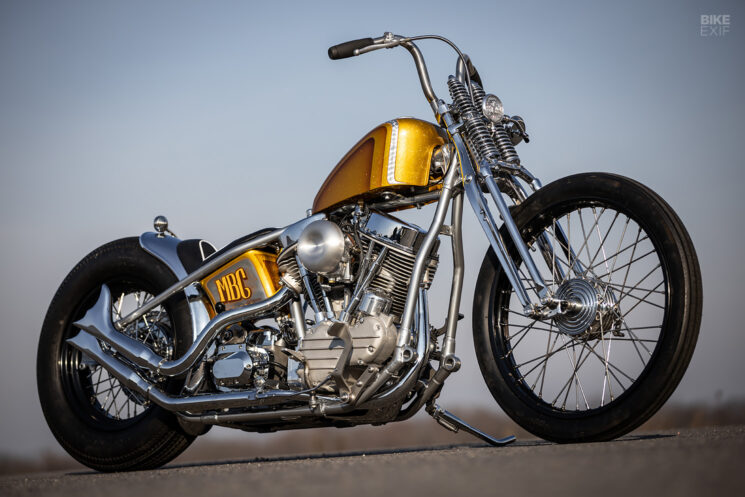
Custom S&S panhead by MB Cycles

It’s undeniable that gas tanks, forks, and frames have the biggest aesthetic impact on a custom motorcycle. Take the Captain America bike from the movie Easy Rider, for instance. Its long raked front end, American flag gas tank and chrome-clad frame made it more than an iconic custom motorcycle; it’s become the symbol of a generation and an unmistakable piece of American cinema history—albeit one lost to the clutches of time.

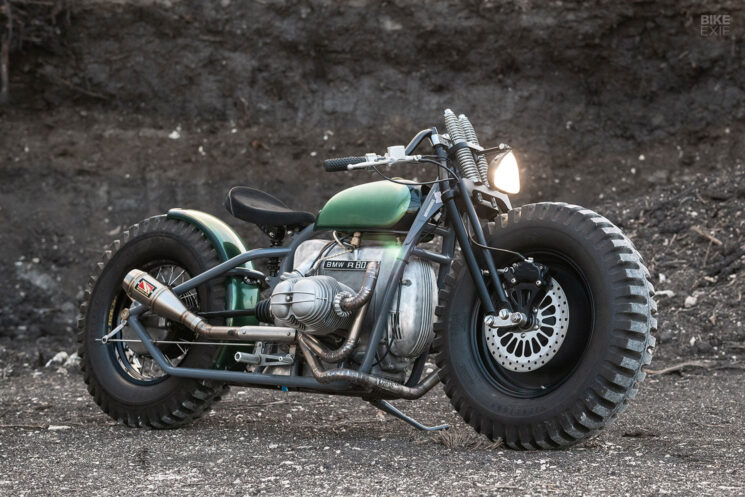
BMW R80 bobber by Upcycle Garage

Requiring specialized tools, frame modifications are out of reach for many home builders. Gas tanks can be affordable, but you often run into compatibility issues with certain frame configurations. While painting a motorcycle gas tank can be a lot of fun, it can be a lengthy process if you want to do it correctly.

Changing out a fork is something that most home mechanics can complete in a single day with basic tools. Whether you are trying to create a raked-out chopper, a low-slung bobber, or simply reviving a restomod project, there are great options for replacing that stock front end with something a bit more exciting. Here are five forks that can have major impacts on your motorcycle’s appearance.

The Offset Springer from Northern Springer is an excellent option for custom motorcycles embracing the skinny chopper look.

1. Northern Motorcycle Supply Offset Springer Inspired by legendary builders like Sugar Bear and Denver Mullins, the Northern Motorcycle Supply Offset Springer delivers the long flowing lines, narrow feel, and smooth ride of classic choppers, much like the iconic Captain America bike. This handcrafted front end is built by Canadian craftsman Eric Marshall, known for his attention to detail and dedication to old-school chopper tradition.

Each unit is built one at a time using high-quality materials, including 1.125 x .188 DOM tubing, laser-cut and CNC-machined components, and 1045 steel that’s precisely milled for strength and reliability. Custom-built to your preferred length, from stock all the way up to 30” over, the Northern Springer comes standard with a 1-inch Harley neck size, 3.5-inch riser gap, and a 3/4-inch axle.

The Offset Springer from Northern Springer is an excellent option for custom motorcycles embracing the skinny chopper look.

The fork features a 5.5-inch rear leg spacing and 5-inch front leg spacing on center, offering a balanced stance. It includes standard fork stop holes tapped to 10-32 and is available in either a raw or show chrome finish. Designed without front brake mounts, it’s perfect for minimalist chopper builds that favor clean lines and a traditional aesthetic. [Northern Motorcycle Supply]

The VooDoo Relic fork offers a unique fabricated look and adjustable suspension setups for custom motorcycles.

2. Voodoo Vintage Relic For builders seeking a highly customizable and rugged front-end solution, the Voodoo Vintage Relic may be the answer for their custom motorcycle project. Handcrafted in Austin, Texas, from U.S. steel, the Relic Girder is one of the most adjustable forks on the market.

It’s available in Narrow, Mid, and (the wide) Relic-X widths, offering versatility to fit a wide range of frame and wheel setups. Additionally, it also offers up to 2 inches of length and rake adjustment, providing fine-tuned control over the bike’s stance and handling. Finally, the fork’s bare steel finish invites builders to finish it their way, whether through chrome, powder coat, or paint.

The VooDoo Relic fork offers a unique fabricated look and adjustable suspension setups for custom motorcycles.

One of the fork’s most unique features is its use of performance mountain bike shocks as its main form of suspension, lending itself to extensive tuning of ride characteristics. Builders can choose between air or coil shocks, including options with steel or titanium springs, making it ideal for riders who demand a personalized suspension feel. [Voodoo Vintage Fabrication]

The Mid USA Antique Springer fork is an excellent choice for custom motorcycle builders who prefer the look of vintage Harley springers with modern enhancements.

3. Mid-USA Hardbody Antique-Style Springer While we all lust over the dream of a custom front end built specifically for us, it is not always in the budget. For those looking for the traditional lines of a vintage springer without the hefty price tag, the Mid-USA Hardbody Antique-Style Springer is an excellent option. This production springer front end is designed to deliver the vintage aesthetic of an original HD front end with modern reliability and a user-friendly price.

It’s available in a wide range of lengths from -2” under stock to 6” over, allowing you to fine-tune your bike’s finished stance. Built with a 1-inch OD steering stem compatible with Timken-type bearings and measuring 8-3/4 inches between the cast axle rockers, it offers solid construction and dependable handling.

The Mid USA Antique Springer fork is an excellent choice for custom motorcycle builders who prefer the look of vintage Harley springers with modern enhancements.

This front end includes a 3/4-inch OD axle and features riser mounts on 4-3/4-inch centers, which may require springer-specific handlebars. A universal brake stay mount is positioned on the right rear leg with a 5/8-inch hole, making it compatible with disc brake setups. Offered in both chrome and black finishes, the Hardbody Springer also includes upper and lower zerk fittings for easy maintenance, making it a practical yet stylish option for builders who favor classic HD springer styling. [Mid-USA]

The Cyclery Classic Springer Forks evokes the classic styling of Harley-Davidson Knucklehead-era rigid frame motorcycles.

4. The Cyclery Classic Springer Forks The Cyclery brand of Germany specializes in authentic parts and accessories for early Harley-Davidsons. Their Classic Springer Forks are modern replicas of the early Knucklehead-era springers, ideal for builders seeking to capture the look and feel of pre-war Harley-Davidson motorcycles without sourcing pricey original parts.

These forks bring classic aesthetics to modern builds without compromising on quality or craftsmanship. Made in Europe with precision, these springers feature completely brazed construction like the originals, along with factory-style fender brackets, brake anchors, and grease zerks. Available in a wide range of lengths from -2” under to an impressive 16” over stock, the Cyclery Classic Springer caters to both restoration projects and radical custom choppers.

The Cyclery Classic Springer Forks evokes the classic styling of Harley-Davidson Knucklehead-era rigid frame motorcycles.

Each fork comes either unpainted for custom finishing or in a durable black powder coat for a ready-to-install option. Featuring a neck post with internal threading at 3/4”-14 UNS and external threading at 1”-24 UNS, these forks are engineered to match vintage specs while maintaining compatibility with various setups. For those chasing true old-school style, this springer is a standout choice. [The Cyclery]

The Velocity leaf-spring motorcycle fork from VooDoo Vintage is an excellent option for adding unique antique flavor to your motorcycle build.

5. Voodoo Vintage Velocity Leaf Spring A modern interpretation of the classic of forks found on vintage flathead motorcycles, Voodoo Vintage Velocity Leaf Spring, combines old-world aesthetics with thoughtful engineering upgrades. Handcrafted and 100% TIG welded, the Velocity maintains a traditional look while incorporating practical features for today’s custom builders.

It’s sized for a standard 3/4-inch Mid-Glide axle and includes low-profile brake stays on each leg, making it ready for functional performance and varying setups. The top clamp is standard Harley spec with 1/2-inch mounting holes on 3-1/2-inch centers and includes a 1″-24 TPI steering stem.

The Velocity leaf-spring motorcycle fork from VooDoo Vintage is an excellent option for adding unique antique flavor to your motorcycle build.

Where the Velocity shines is in its innovative double-rocker system, which can be oriented vertically or horizontally based on your setup, and easily modified to fit various axle sizes beyond 3/4-inch. Another unique feature is the anti-cam system integrated into the forward legs to prevent suspension hang-up—a common issue with traditional leaf spring designs.

Available in three lengths (Stock, 2″ under, and 4″ under), the Velocity comes in an unpainted finish and can be ordered with or without a chrome axle kit. It’s a well-crafted blend of old-school style and modern functionality, perfect for builders looking to stand out with a vintage-inspired ride. [Voodoo Vintage Fabrication]

Antique Harley-Davidson springer front end

Swapping out the front end is one of the most impactful—and accessible—ways to transform the look and feel of a custom motorcycle. Whether you’re aiming for the nostalgic lines of a Knucklehead springer, the radical look of a girder, or the mechanical charm of a leaf spring setup, there’s a vintage-style fork to match your vision.

The front end becomes more than just a structural component—it becomes a defining piece of your bike’s identity. With so many options now available to builders at every skill level, achieving that timeless custom look has never been more within reach.

Harley-Davidson Softail beach racer by Gasoline Motor Co.

This article contains affiliate links, which means Bike EXIF may receive a commission if you click a link and purchase something we referenced.


from Bike EXIF https://ift.tt/NZKtQ5U

Tuesday, 12 August 2025

No Days Off: Fatech’s Hot-Rodded 1968 Harley Shovelhead

1968 Harley Shovelhead by Fatech, Japan
Not too long ago, our good friend and ace photographer Kazuo Matsumoto introduced us to the work of Minoru Watanabe at Fatech in Tokyo, Japan. Watanabe-san clearly never takes a day off, because he’s already blessed us with another glamorous vintage Harley Shovelhead. This one’s dripping with just as much nostalgic Americana as the last—but it’s way more sparkly.

The lines, details, and finishes on Fatech’s custom bikes reflect Minoru’s personal interests. He’s equally passionate about vintage choppers and hot rods, and is the proud owner of a 1930 Ford Model A Roadster. “The owner of this machine and I both love old American motor culture,” he explains, “so we decided to customize it based on the style of 1960s gasser drag racers.”

1968 Harley Shovelhead by Fatech, Japan
The goal was to build the two-wheeled equivalent of a muscle car, with a shimmering paint job that would evoke images of 1960s Californian summers. The bike needed a whole lot of shiny bits, an appropriate name, and an accompanying logo in a period-correct style. With a 1936 Harley-Davidson FLH Electra Glide on the bench, Minoru had his work cut out for him.

As per Fatech’s usual operating procedure, the Shovelhead motor was the top priority. Minoru rebuilt the stock 74 cubic-inch engine into a stonking 93 cubic-inch powerhouse, with a balanced Truett & Osborn bottom end, coated pistons, and modified S&S Cycle heads. Other hop-up parts include an Andrews camshaft, Jims USA tappets, and a Dyna S ignition from Dynatek.

1968 Harley Shovelhead by Fatech, Japan
On the outside, you’ll find a Sputhe cam cover and a 2” open belt primary from Rivera Primo. The carb is an S&S Cycle Super E, fitted with a custom-made scooped intake that adds a little hot rod flair. Woven between the drivetrain’s components are elegant copper-nickel oil lines, hand-bent by Minoru.

Everything is housed in a bespoke chassis that uses the OEM lugs, but nothing else. “After talking with the owner, I decided to build a frame that, although it looks like a four-speed frame, is different upon closer inspection,” says Minoru. “I wanted to create a frame that no one had ever seen before.”

1968 Harley Shovelhead by Fatech, Japan
The Fatech design places the steering neck an inch lower and the rake at 34 degrees, and the rear end is now an inch shorter. Wrapped tightly around the Shovelhead motor, the whole thing looks squat and purposeful. The absence of a traditional rear rigid triangle is also worth a closer look, as are the myriad pinstriped details that adorn the polished frame tubes.

Shortened Harley Wide Glide forks sit up front, gripping a 21” front wheel with Firestone rubber. The rear wheel is a 16” item, wrapped in a Coker whitewall. Minoru kept the OEM brakes—a standard drum brake up front, with a Wagner Lockheed hydraulic drum brake at the back that’s integrated with the sprocket assembly.

1968 Harley Shovelhead by Fatech, Japan
As we’ve come to expect from Fatech by now, this Shovelhead’s bodywork is extremely well judged. Minoru fabricated the slim fuel tank and flared rear fender from scratch, adding twin filler caps and an aluminum strip to the tank to make it appear like a split setup. The center console, which houses a Motogadget speedo, is lined with rivets that reference old aircraft—a nod to the owner’s grandfather, who was a naval pilot.

A vintage Elctroline headlight is mounted up front, followed by a narrow set of mini ape hangers. The bike employs a foot clutch and hand-shifter, so the bars wear little more than trimmed Beck grips, an internal throttle, and a front brake lever. A pair of micro-switches adorns the left-hand side of the bars, with the bike’s ignition barrel and remaining switches hidden elsewhere.

1968 Harley Shovelhead by Fatech, Japan
Atelier Cherry handled the seat upholstery, while Minoru finished the tail end off with a vintage Ford taillight. The bike’s tight proportions are what Minoru calls “Tokyo style,” built for darting between cars on Tokyo’s bustling streets.

That philosophy is echoed in the stunning drag exhausts, which are notched to tuck them inside the frame rails. A custom tank is wedged in between the pipes and seat with Tetris-like precision, holding oil in one section and the bike’s battery and electronics in another. Minoru also fabricated the stunning finned aluminum oil filter housing.

1968 Harley Shovelhead by Fatech, Japan
There are countless more details to take in, but none loud enough to detract from the Shovelhead’s hot rod-worthy ice blue flake paint job. That was the work of the immensely talented Shakin’ Speed Graphix, who also handled all the pinstriping and graphics.

To finish things off, Minoru dubbed the bike Mighty Roar, before conceiving a tank graphic that depicts a winged cam and tappet roller. “This is the logo of a fictitious cam grind manufacturer that I came up with, called Fatech Company,” he adds, cheekily.

1968 Harley Shovelhead by Fatech, Japan
Fatech’s Shovelhead is a rolling tribute to an era when muscle and style ruled the streets, blending hot rod heart with vintage Harley soul. Honoring the past while pushing boundaries, it brings a touch of Californian cool to the streets of downtown Tokyo.

Fatech | Instagram | Images by, and with thanks to, Kazuo Matsumoto

1968 Harley Shovelhead by Fatech, Japan


from Bike EXIF https://ift.tt/D6hWczf

Monday, 11 August 2025

The Bolt: A Retro Yamaha Scrambler that Harkens Back to Simpler Times

Hageman MC transforms the 2014 Yamaha Bolt into a clean retro scrambler.

Ten Bolts. Ten Custom Builders. One Winner. You Decide. Such was the headline traversing around the web when Star Motorcycles gave calls to some of the top builders in the country to compete in a “customize it as you see fit” build contest based on a freshly minted, stock 2014 Yamaha Bolt.

Hageman MC transforms the 2014 Yamaha Bolt into a clean retro scrambler.

Big OEMs continue to help grow motorcycling by realizing that the DIY movement is here to stay, and that the only way to play in the same sandbox as the rapidly growing vintage custom market is to show their support through projects like these. Triumph, Kawasaki, BMW, Moto Guzzi—they all get it. And now Yamaha America is declaring they get it, too.

Hageman MC transforms the 2014 Yamaha Bolt into a clean retro scrambler.

The future is bright for those of us not content with what rolls off the assembly line. This means a new possible leap in custom motorcycling—meaning new customers for these smart brands—who realize that customers are based on the motorcycling lifecycle, and not just current purchasing power or habits.

Hageman MC transforms the 2014 Yamaha Bolt into a clean retro scrambler.

One of our favorite builders was on the list when the calls went out: Greg Hageman, of Hageman Motorcycles. Greg has built a quiet but undeniable reputation for building ultra-clean performance customs based on vintage machines. His penchant is for the old, combined with upgrades in spots that count—suspension, rubber, braking.

This time, Greg had a chance to put a modern machine under the knife.

Hageman MC transforms the 2014 Yamaha Bolt into a clean retro scrambler.

“My goal was to build a bike that would bring back that feeling of awe I had when walking into a dealership as a ten-year-old. I’d walk up and down the aisles looking at bikes, just dreaming and staring at the beauty of these things, especially the dirt bikes and enduros—the go-anywhere bikes that seemed perfect living in the country like we did. So when given the chance to build a modern, go-anywhere, do-anything interpretation, I jumped at it.

Hageman MC transforms the 2014 Yamaha Bolt into a clean retro scrambler.

“I did as much research as possible before receiving the bike, but there just wasn’t much out there. There were a few builders posting pics, but really nothing available aftermarket yet, and very little info about the bike. Once I received the bike, I sat and studied it for a few hours, and rode it around a little to get a feel for the power and balance it had. After that, I tore it down. Once I had a “clean slate” and had removed all the clutter blocking my view of the skeleton, I then envisioned what I wanted to do.

Hageman MC transforms the 2014 Yamaha Bolt into a clean retro scrambler.

“I built the bike in a way as not to molest or harm the stock frame or components—something that was all bolt-on, so I can later create a kit to supply so others can reproduce it. The end result is a retro-looking, tough machine. With the knobbies, you can hit the gravel, unmaintained roads, or ride down to Starbucks for a coffee.

Or if you prefer, throw on some less aggressive tires and you’ve got a retro supermotard. They just don’t build anything like these bikes anymore. You walk into a dealership now, and your choice is to buy a cruiser, a plastic sport bike, or a plastic dirt bike. Nothing with soul or beauty like the bikes had in the ‘60s and ‘70s.”

Hageman MC transforms the 2014 Yamaha Bolt into a clean retro scrambler.

This article first appeared in issue 11 of Iron & Air Magazine, and is reproduced here under license.

Hageman Cycles | Website | Instagram

Story by Brett Houle | Images by Erick Runyon


from Bike EXIF https://ift.tt/6VwezKl