Friday, 23 December 2022

Long Touring on Cruiser Bikes: Essential Tips & Knowledge

There’s no better feeling in the world than the exhilaration that comes from riding down an open road. Chances are if you own a cruiser bike, you’ve been dreaming about going on an epic journey. Long motorcycle trips are difficult and challenging, but that’s a part of what makes them so satisfying. Here are the essential tips and tricks you need to know to plan the ultimate long-touring adventure on a cruiser bike. 

Why Cruisers Make Great Long Touring Bikes

Nowadays, there is a type of bike for every kind of journey, so why choose a cruiser over a touring or adventure bike for a long road trip? The answer is comfort. Above all else, long rides, especially multi-day rides, are endurance marathons. Comfort is the most important factor when you’re riding 6-7 hours a day. Here are some of the reasons why you want a cruiser as your trusty steed.

The laidback riding position on a cruiser bike is the most comfortable angle for long-distance rides. Cruisers also sit lower to the ground than most bikes which makes frequent stops less tiring because you can put both feet down while resting and easily swing your leg over. 

Riders can adjust their bikes with aftermarket like mustache bars which allow for more leg room, and rubber pegs that cut down on the vibration to make a long trip even more comfortable. 

Bigger gas tanks equal longer distances between refueling. This is a critical thing to consider if you’re traveling somewhere remote, where it might be a hundred miles before the next gas station. 
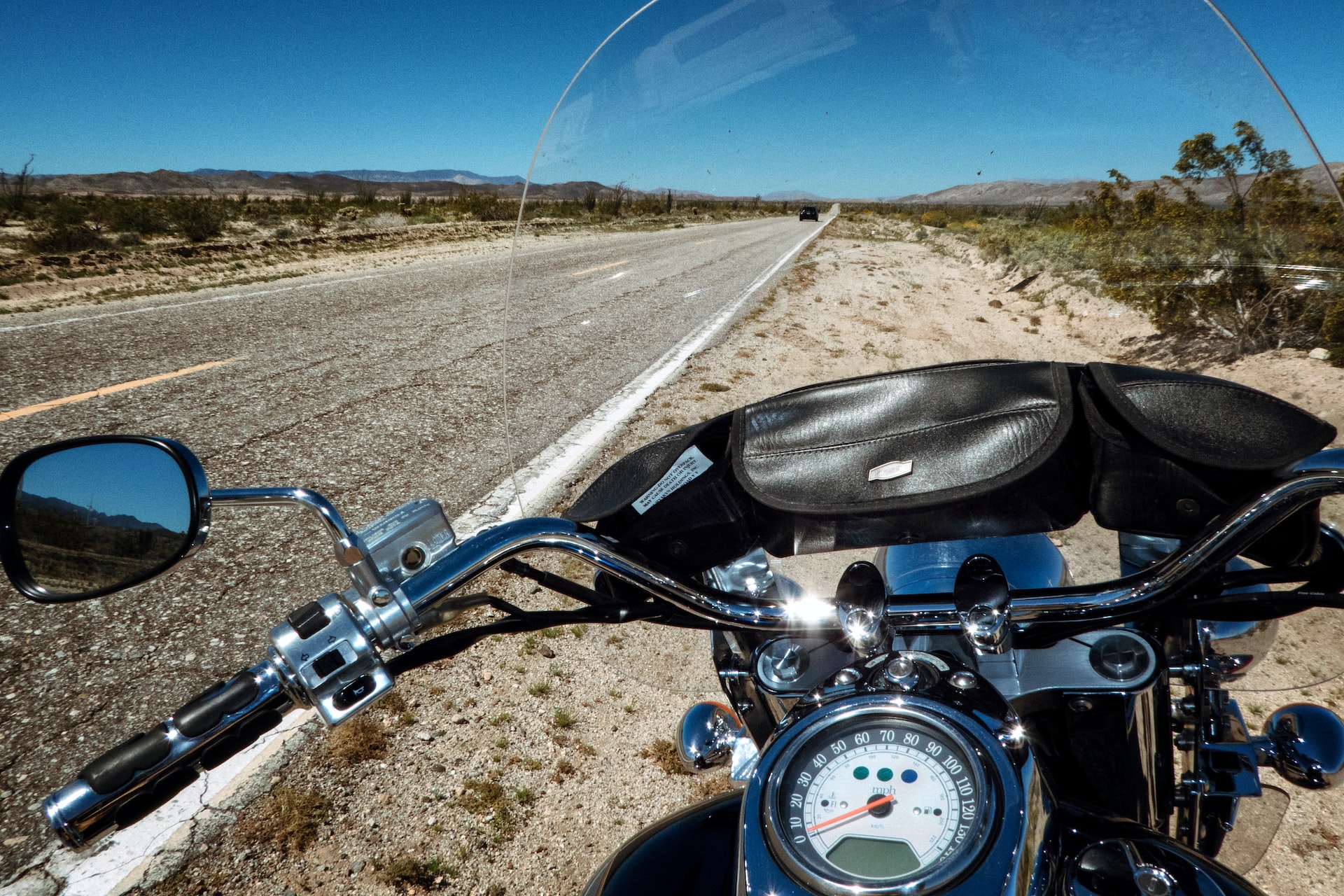
Touring Motorcycle

A windshield is an absolute must for long journeys. Even a small windscreen helps reduce the amount of resistance your body has to fight while riding. They also keep the rain and other elements at bay. Riding without a windshield will wear you out much faster. You won’t be able to cover as many miles or appreciate the scenery around you if you’re exhausted. 

Moreover, cruiser bikes were made to hold saddle bags and extra gear. Due to their low clearance and heavy wide tires, your balance and center of gravity won’t get thrown off by strapping on extra bags, allowing you to carry more. 

Time to Start Planning

The first thing you need to consider is: your dream destination vs. how much time you have to get there and back. It’s easy to look at a map and say, sure, 400 miles a day is doable. But the truth is, riding is not always that simple. You need to think about the weather, terrain, and type of roads you’ll be traveling on. 

What do you want to see along the way? Will there be scenic stops, roadside attractions, or the world’s best-barbecued ribs? Are you going to stay in hotels, motels or a camp? If you’re camping, make sure to give yourself an extra hour of daylight to set up the camp before the sun goes down.

Clearly map out your route and refueling options. You should plan to stop every hour and a half to two hours even if it’s just to get off your bike, stretch, hydrate, and eat something. Leaving early in the mornings allows you to cover more ground while it’s still light out and you can avoid riding at night if possible. 

Assume the Worst

Even the best-laid plans are bound to fail once in a while. Have backup plans and routes for emergency situations, inclement weather, or repair needs. Check what your motorcycle insurance will cover and what towing options you’ll have if necessary. Avoid booking accommodations too far in advance in case of last-minute changes. 

You’ll want to bring:

  • A travel tool kit for easy roadside repairs
  • Backup spark plugs and bulbs
  • Flat tire repair kit and tire gauge
  • A
  • Flashlight
  • Spare Keys
  • Extra bungee cords and zip ties
  • GPS locator or emergency beacon
  • Bike cover and a lock

If you’re traveling alone, consider checking in daily with a friend or family member, so someone knows where you are and where you’re heading. Check your tire pressure and condition frequently to spot a problem before it blows out or goes flat. 

Get Packing

Depending on where you’re going and whether you’re camping, you’ll want to consider what type of luggage is best for you and your cruiser. Some people love the look of saddlebags and the ease with which you can take them on and off the bike. But if you plan to leave your bike unattended for long periods or need more space, you might consider hard plastic or metal panniers that are more secure and durable. Whichever you choose, make sure they can withstand the wind and weather of a long ride.

Things to pack:

  • Protective riding gear
  • Clothing for all types of weather that can be layered easily
  • Sturdy, waterproof footwear
  • Earplugs to help reduce the noise while riding
  • Power banks
  • Water
  • Snacks
  • Bluetooth headphones and headset for handless talking on the phone and listening to music or podcasts.
  • Sunscreen
  • Allergy medication/ointment for bug bites/stings
  • Camping equipment if camping
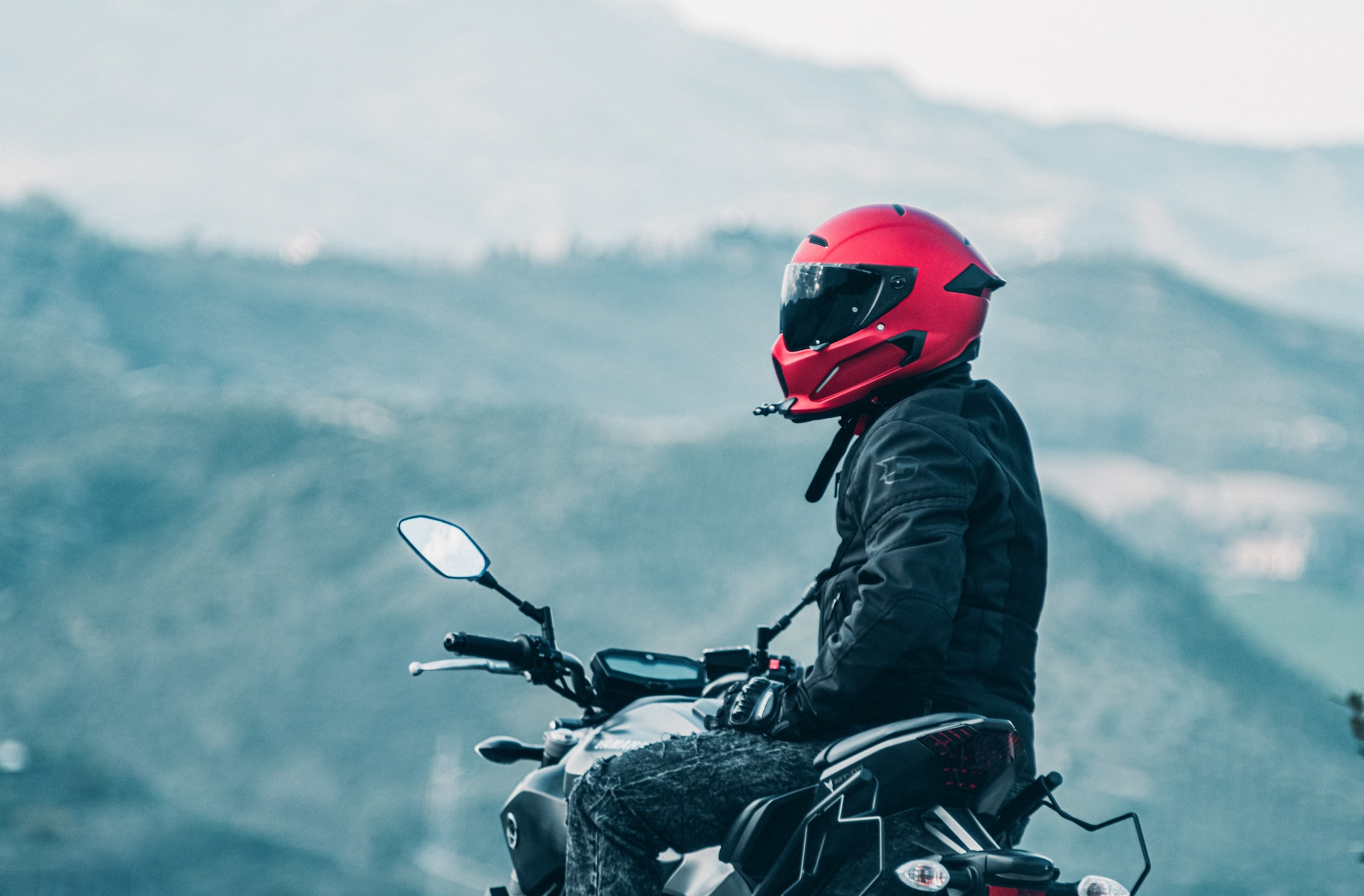
  • Full-face helmet
Motorcycle Accessories Touring

One of the most common mistakes made on long-distance rides is not wearing a full-face helmet. Half helmets are great for quick trips around town, but during a long ride, you want to protect your face and neck as much as possible from the sun, wind, rain, and bugs. A light sprinkling or a few flies might not seem like such a big deal, but it’s painful and potentially dangerous when you’re speeding down the highway at 60 miles an hour. 

Start Preparing Early

One of the most important things to do before heading off on a long tour is to build up your endurance. 

  • Start by going on longer rides or weekend trips to see how you handle hours in the saddle. 
  • Gather all of your gear and bags, pack everything onto your cruiser, and head out for a test ride. 
  • See how your bike maneuvers with all the extra weight.
  • Check if everything is secured properly and make sure it stays that way during the ride. 
  • Adjust your suspension if necessary. 
  • Download all maps, music, or podcasts ahead of time for moments when there’s no reception.
  • Pack the things you’ll need to use frequently in easy-to-reach spots. There’s nothing worse than stopping for gas and realizing your wallet’s at the bottom of a bag within a bag.
  • Get your bike professionally serviced before leaving and plan ahead if you’ll need to get new tires along the way. 
  • Ride out in bad weather and see if your boots really are waterproof or if those new gloves actually grip while wet. 
  • Practice riding on different types of surfaces in case you find yourself on a gravel detour later on.
  • Does your phone actually stay in its mount at high speeds or in the rain?  
  • Ensure all the tools and components in your tool kit are the correct size and fit for your bike.

These little trips will help you iron out the kinks and make mistakes you can learn from before it’s too late. Building up your endurance will help your body prepare for the amount of physical exertion long trips require. And practicing ahead of time with all of your gear will bring you peace of mind so that you can focus on enjoying the journey. 
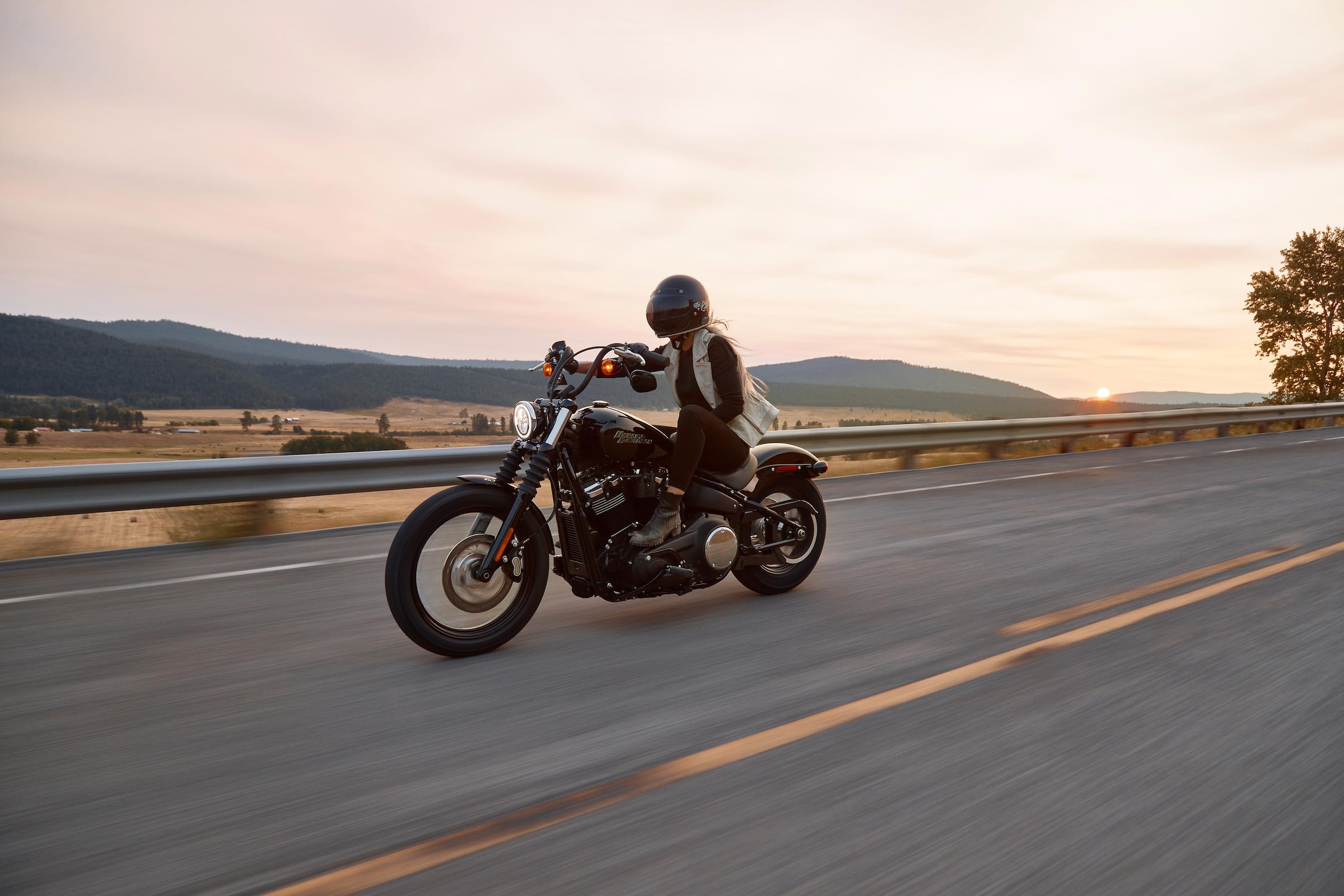
Girl Riding Motorcycle

Riders are explorers who thrive on discovering new destinations, experiences, and vistas. With proper planning and preparation, you and your cruiser can take on the world. Go forth, explore, discover and experience the magic of the open road today!

The post Long Touring on Cruiser Bikes: Essential Tips & Knowledge appeared first on Automotorblog: Daily news on cars and motorcycles.


from Automotorblog: Daily news on cars and motorcycles https://ift.tt/rdz168b

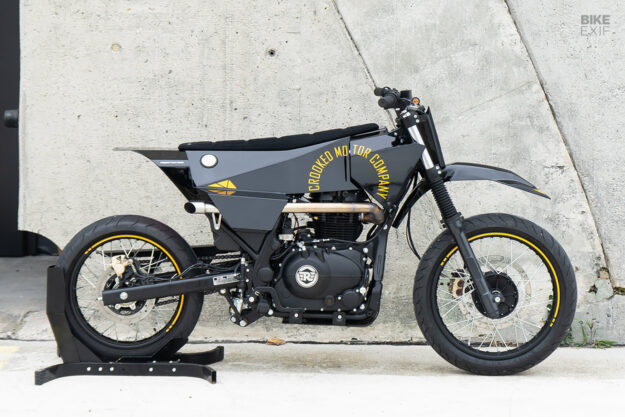
SuperScram: Crooked’s Royal Enfield Scram supermoto

Royal Enfield Scram 411 supermoto by Crooked Motorcycles
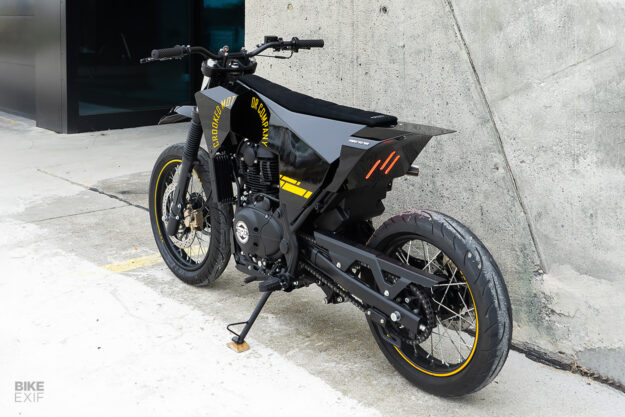
While many motorcycle brands are still struggling to meet manufacturing demands, Royal Enfield is flourishing. Not only have they been consistently releasing new models, but they’ve been commissioning some amazing custom builds as well. The latest is brought to us by Crooked Motorcycles in Germany; a Royal Enfield Scram 411 turned supermoto, with some impressive details.

Since the build was commissioned by Royal Enfield, the the project essentially had two goals. It had to express the creative drive of the builders behind Crooked, and it had to highlight the Scram 411 as a platform. This meant getting the most visual impact out of the design without really altering the stock bike’s geometry; a challenging feat.

Royal Enfield Scram 411 supermoto by Crooked Motorcycles
Royal Enfield’s 2022 Scram 411 is a variation of the brand’s popular light adventure bike, the Himalayan. The Scram essentially uses the same chassis, with some pieces like the crash bar removed, and a smaller 19” front wheel compared to the Himalayan’s 21”. So it’s lighter, more nimble, and less cluttered than its stablemate, straight out the box.

The Scram 411 was delivered to Crooked Moto’s shop only three weeks before the bike was to break cover at the popular Glemseck 101 race meet. With this incredibly short timeline, the team immediately got to work on the largest and most impactful part of the project—the monocoque body.

Royal Enfield Scram 411 supermoto by Crooked Motorcycles
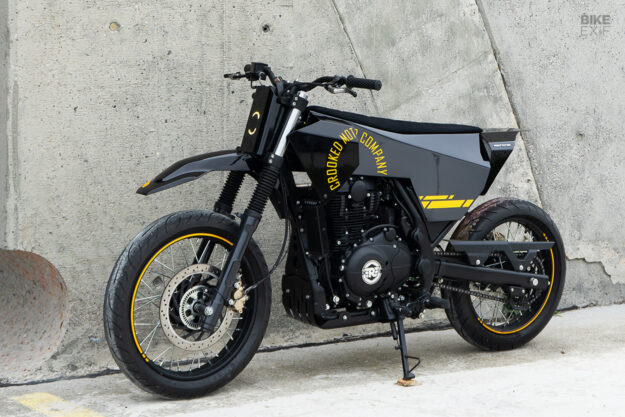
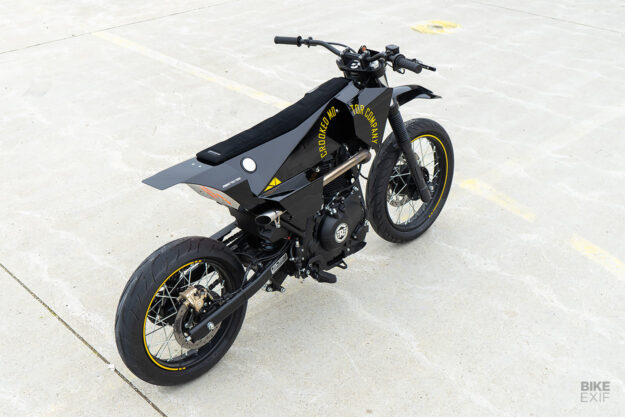
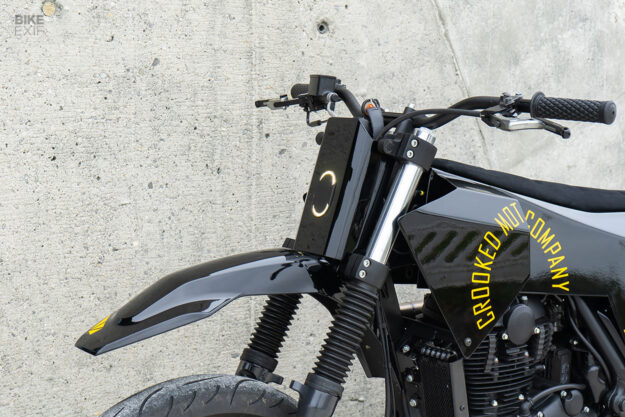
The supermoto aesthetic is largely defined by dirt bike-style bodywork, which Crooked sought to recreate in aluminum, but with a few stylish twists. To achieve this new style, the subframe was removed and replaced with a custom piece that the new bodywork could mount to.

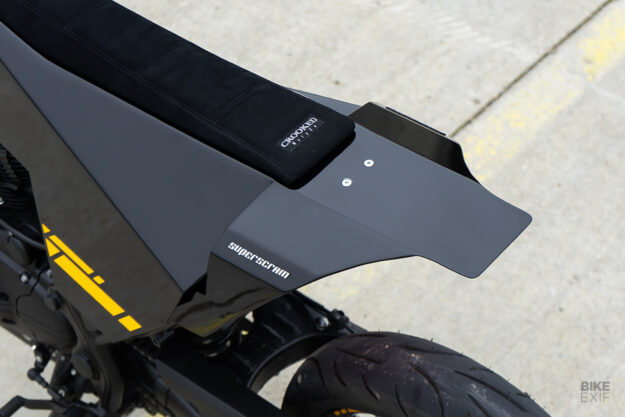
The lines of the newly-fabricated aluminum bodywork left little room for a fuel tank, so Crooked built a new reservoir to sit under the seat. Fitted with a pop-up filler cap, it both lower’s the Scram’s center of gravity—and helps the build better fit the supermoto vibe. A set of aluminum ‘wings’ sit up front, adding some bulk back to where the tank used to be.

Royal Enfield Scram 411 supermoto by Crooked Motorcycles
Out front, an aluminum number plate was fabricated around a bright Supernova LED headlight. In the tail section, LED strips were built into the lower part of the rear fender, visible above the wheel. As this machine was made to be displayed more than used on public roads, there is no accommodation for a license plate—nor a speedo or turn signals.

A supermoto will traditionally have 17” wheels front and rear, but the team at Crooked wanted to retain some of the fun and adventurous look of the Scram. So the original 17” rear wheel and 19” front were fitted with Metzeler Sportec M9 tires. A Husqvarna enduro bike fender replaced the Scram’s low-mounted original.

Royal Enfield Scram 411 supermoto by Crooked Motorcycles
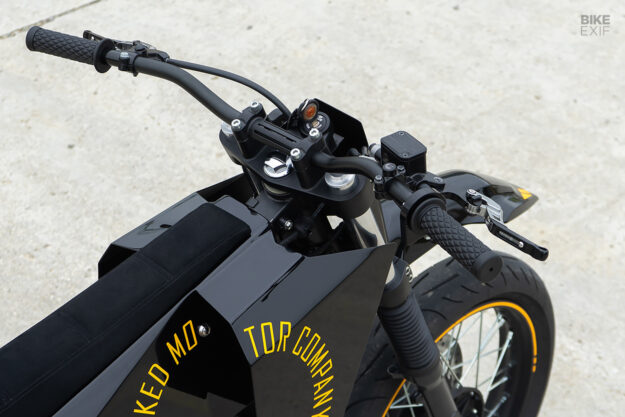
Braking and suspension components remain unchanged, though new Probrake levers and LSL handlebars add a sportier feel to the rider’s view. A short-stroke throttle was installed to increase sensitivity, and the bars were wrapped in Biltwell Inc. grips. The wiring was made to work without switches, with a CNC-machined start button crafted into the bodywork—leaving the whole deal radically uncluttered.

Royal Enfield Scram 411 supermoto by Crooked Motorcycles
Supermoto is more than a style of bike—it’s a riding style too, marked by tracks that are partly paved and part dirt, requiring the rider to move all over the bike to shift their weight. So a custom Alcantara seat was made, extending all the way from the rear fender to just behind the Scram’s steering head.

A custom exhaust system was made, integrating the lambda sensor and tucked beneath a protective grid, which also hides a heat shield. Finally, Crooked wrapped the ‘SuperScram’ in black, with yellow highlights and subtle branding.

Royal Enfield Scram 411 supermoto by Crooked Motorcycles
While the operational geometry and engine remain essentially unchanged, Crooked has completely altered the way a rider will interact with this machine. From the hidden start button and ultra-clean handlebar assembly, to the new seating position and lighting, the modifications certainly highlight what you can do with the Scram.

Mission accomplished.

Crooked Motorcycles | Facebook | Instagram


from Bike EXIF https://ift.tt/FU5cpPy

Thursday, 22 December 2022

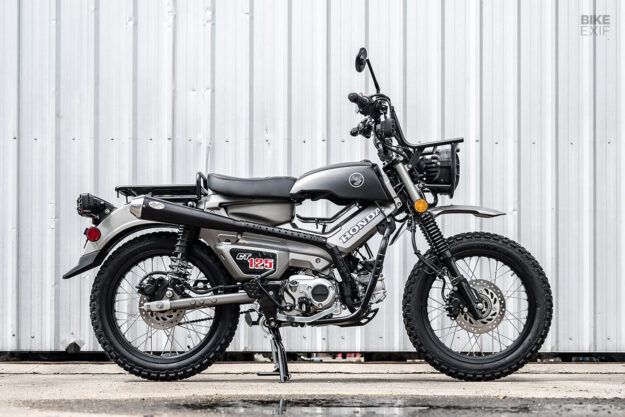
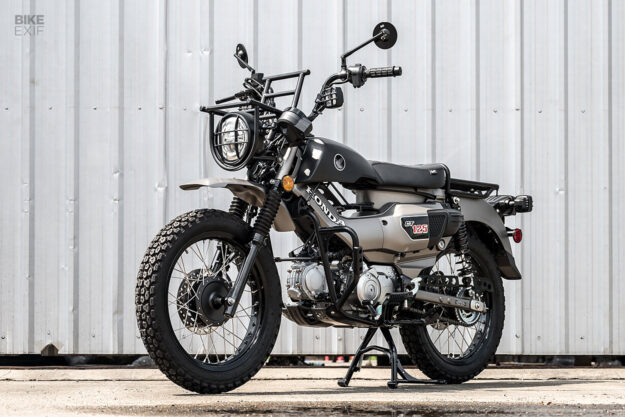
Country Cub: A DIY Honda CT125 kit from K-Speed

Custom Honda CT125 kit by K-Speed
It’s just a couple of days to Christmas—and if you still don’t know what to get yourself, maybe a kit to transform your Honda CT125 is the answer. After all, it’s been a long 365 days, and to be honest, you deserve it.

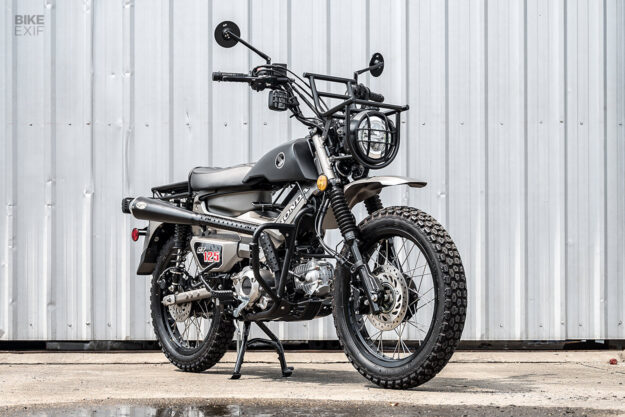
The Honda CT125 Hunter Cub is cute AF out the box, but if anyone knows how to mod the absolute daylights out of it, it’s K-Speed. This time around, they’ve used the CT125 as a test bed to develop a set of bolt-on parts, so that you can do it yourself. The only thing K-Speed doesn’t supply, are a few festive bevande to consume while you assemble your steezy steed.
Custom Honda CT125 kit by K-Speed
The transformation starts up front, with a K-Speed-designed fender and fender lift kit. This provides the necessary clearance for all the mud-slinging you’re definitely going to be doing with this thing. The fenders are available in different colors to match the CT125’s OEM colorways, and the lift kit can work with the stock fender too.

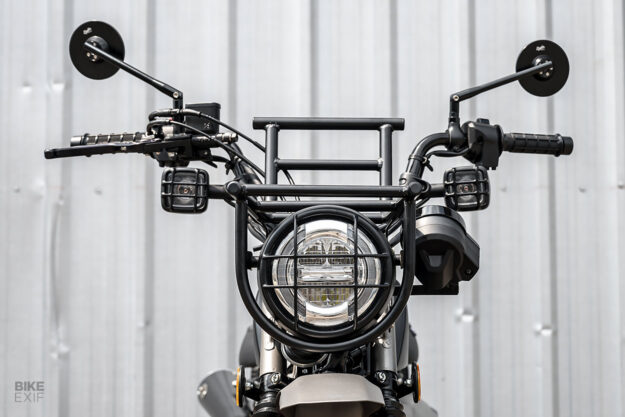
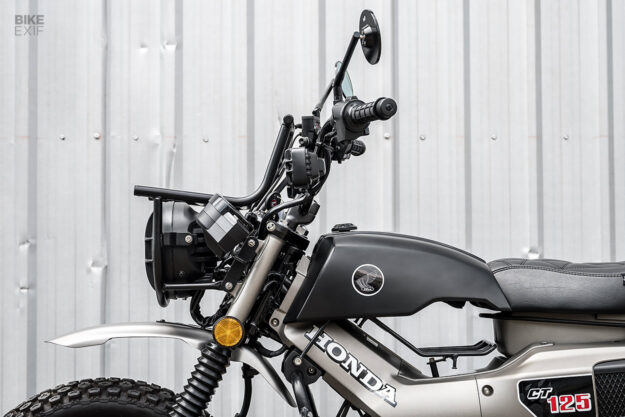
The headlight cover is included in the kit, as is the metal luggage carrier that sits above it. It’s the perfect place to stack firewood or a bag of ice for overnight camping trips. The original speedo has been relocated to the side to make room for the rack.

Custom Honda CT125 kit by K-Speed
The turn signals wear grills too, disguising them as auxiliary lights. The bars now sport a new master cylinder, grips and aluminum mirrors, all from Diablo (K-Speed’s in-house parts brand).

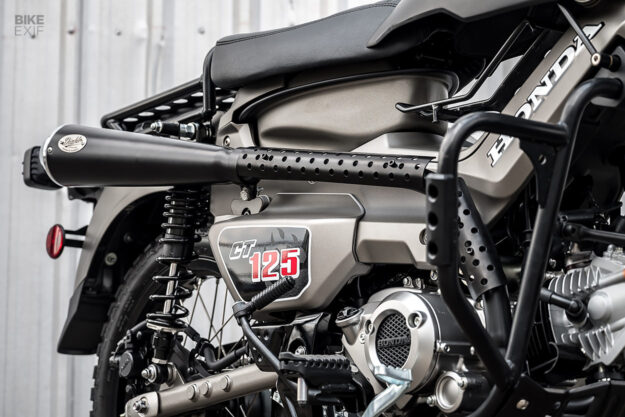
To keep things simple, the engine remains stock—but K-Speed provides a full high-mount exhaust system. Finished in matte black, it looks great and should be super easy to keep clean. It likely also sounds much better than the stock pipe.

Custom Honda CT125 kit by K-Speed
The literal centerpiece of the bike is the new ‘tank,’ which is actually just a fiberglass cover that sits where a traditional fuel tank would. In the Cub’s case, it’s all empty space—so K-Speed decided to take advantage of this. Hiding underneath it is a small luggage rack, adding to the CT125’s utilitarian vibe.

K-Speed admits that the cover is mostly there to change the look of the bike—and that the storage is just a bonus feature. But the design has been popular with customers so far, and we love it.

Custom Honda CT125 kit by K-Speed
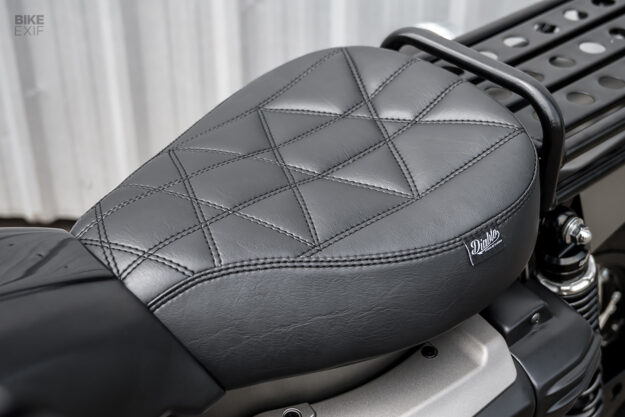
Behind the ‘tank’ is a new Diablo seat that’s slimmer than stock, with upholstery that puts a fresh spin on classic diamond stitching patterns. The side cover and air filter cover are also new, as is the alloy chain guard.

To help the bike stay upright on soft surfaces, the kickstand foot has a CNC extension bolted on. It’s one of the easiest and cheapest mods to make to any adventure bike, so it’s great that the team at K-Speed has an eye for little details like this.

Custom Honda CT125 kit by K-Speed
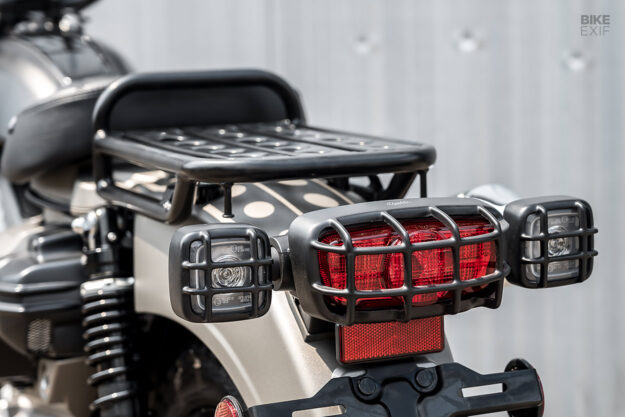
Finally, a new luggage rack sits out back. Painted black and made of tubular steel, it not only looks better than the pressed-steel original, but would likely be more sturdy too. So it’s perfect for hauling all kinds of inappropriately large items from Home Depot.

The tail light and rear turn signals also get their own covers to match the front lighting. And a new pair of rear shock absorbers, complete with preload, length and rebound adjustment, offer a substantial upgrade over the original suspension.

Custom Honda CT125 kit by K-Speed
The crash bars, skid plate and engine side cases are also included, painted black to match the other Diablo parts. And if you’re a bit shy on the tools, K-Speed have you covered here as well. This kit is completely plug-and-play, with no cutting, welding or frame modifications required.

K-Speed lists the 18-piece kit for 47,379 Thai Baht, which converts to $1,362, excluding shipping. That’s a lot of boom for your moose. And if you don’t want to go all-in, you can buy the individual parts separately too.

Custom Honda CT125 kit by K-Speed
With the Country Cub you’re not going to go fast, and you can’t really go that far. But wherever you do go, you know you’ll look damn good.

Go ahead… treat yourself.

K-Speed | Instagram | Images by Hipmotography

Custom Honda CT125 kit by K-Speed


from Bike EXIF https://ift.tt/7wMOZYA

Wednesday, 21 December 2022

Here comes trouble: A Triumph TR6 with a Matchless frame


Kids are impressionable, especially when motorcycles are involved. That magical combination of sound, smell and danger has a way of imprinting itself on young minds. But Kyle Harvey didn’t just dream of bikes as a child—he practically grew up with them.

Kyle’s trade is tool and die making, but his passion is building bikes. His father, Garth Harvey, got Kyle and his brother into bikes at a young age; as soon as they could start their old man’s vintage motorcycles, they were riding them. Living in Edenvale in South Africa’s Gauteng province, the boys also had direct access to the local Classic Motorcycle Club.

Custom Triumph TR6 with Matchless frame
The folks at the CMC made quite an impression on young Kyle—and taught him everything he knows about vintage bikes. After helping numerous friends work on their bikes, he went on to open his own shop, named simply ‘The Workshop.’ Kyle has been building and restoring classic motorcycles for over a decade now.

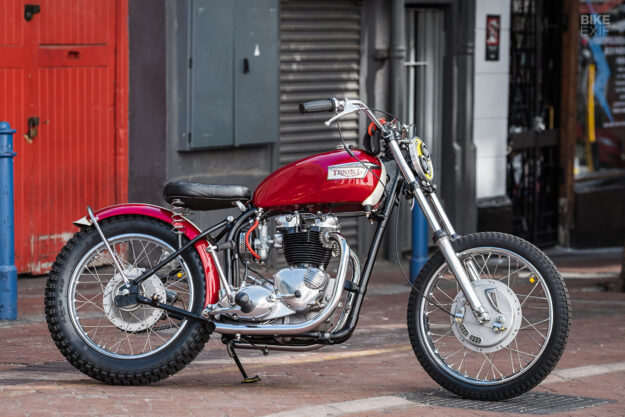
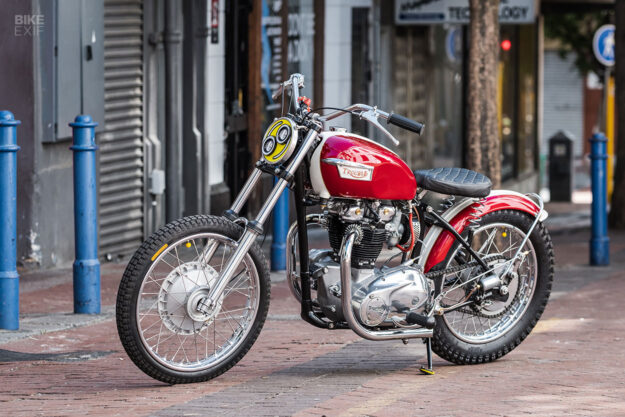
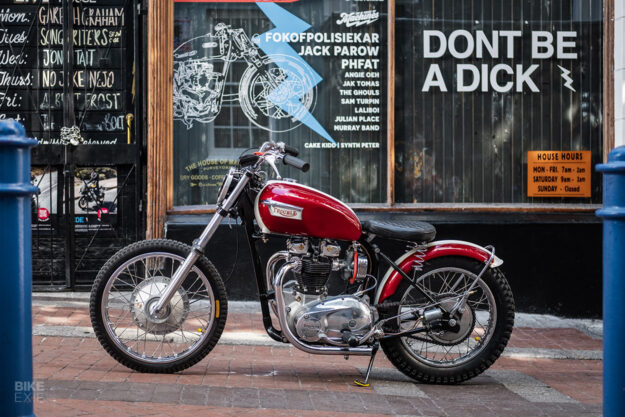
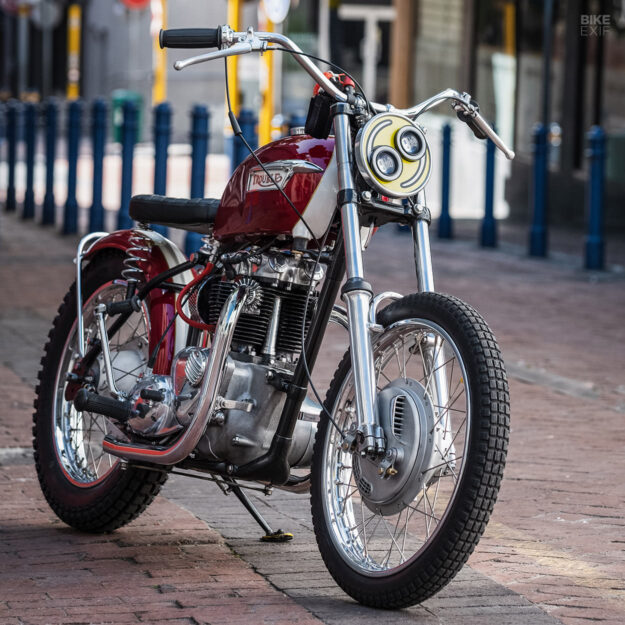
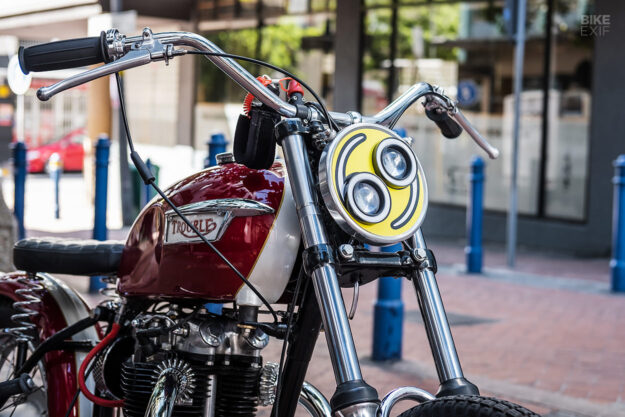
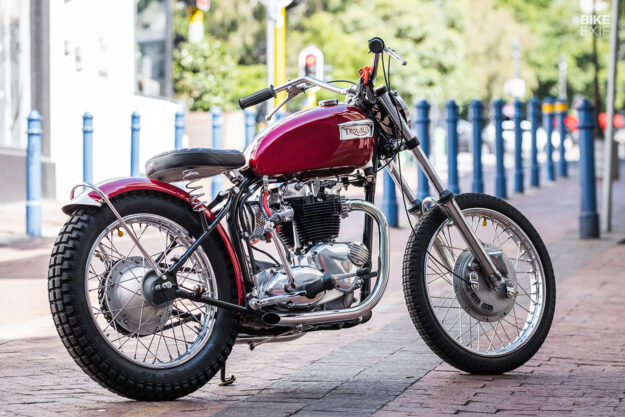
This cheeky bobber is his latest build, and it’s immensely fascinating. The engine’s from a Triumph TR6 Trophy, the frame is from a Matchless, and the quirky handmade details on it are endless.

Custom Triumph TR6 with Matchless frame
Kyle’s imagination was sparked when he stumbled across a 1946 Matchless G80 frame around five years ago. He wanted to build a bobber that shied away from the stretched-out hardtail look, and the short Matchless frame was exactly what he needed.

To prep the frame for the 1971 Triumph TR6 Trophy engine chosen for the build, the backbone was cut out and replaced with an oil-bearing one. After that, the engine went in smoothly, with the bottom part of the frame matching up perfectly.

Custom Triumph TR6 with Matchless frame
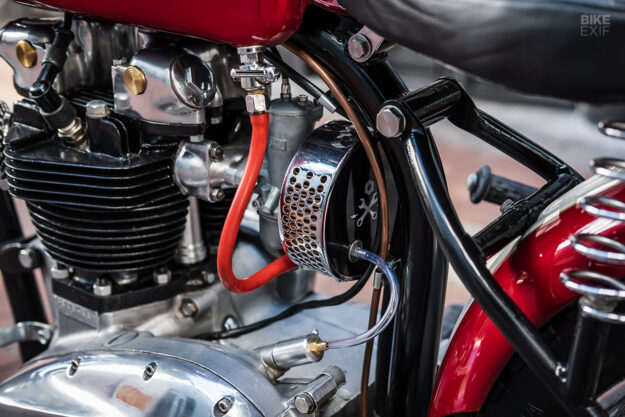
The motor itself needed a full rebuild. Earlier model rocker covers were modified to fit it, then polished, while the head and barrel were painted black as a nod to older Triumphs. The ignition was replaced with a self-generating unit, fitted where the alternator used to be.

The engine sucks fuel and air through a new 32 mm Amal carb with a pancake filter, and makes noise through a pair of slash-cut pipes. For an ultra-clean look, it runs without a battery.

Custom Triumph TR6 with Matchless frame
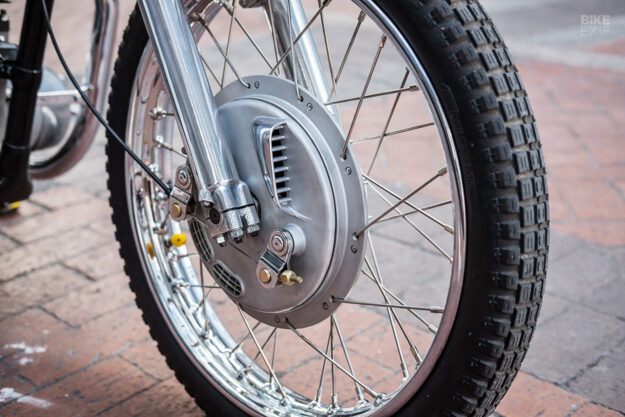
The wheels feature Triumph and BSA conical hubs, which were blasted to get another 50 years of use out of them. Kyle cut down the scoop on the front drum and polished what was left. The brass details are a particularly nice touch—as are the smiley face valve caps.

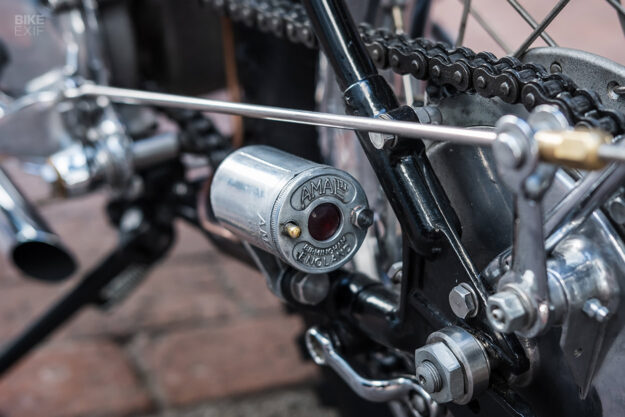
“I tried to use as much as I could from my shed full of spares and old scrap,” says Kyle. “The head steady and brake stay are made from old spanners. The brake rod I made from stainless steel rod, and then welded a shackle from my sailing toolbox on the other end.”

Custom Triumph TR6 with Matchless frame
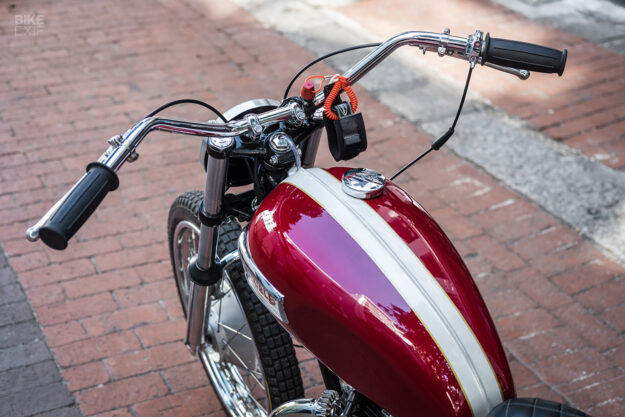
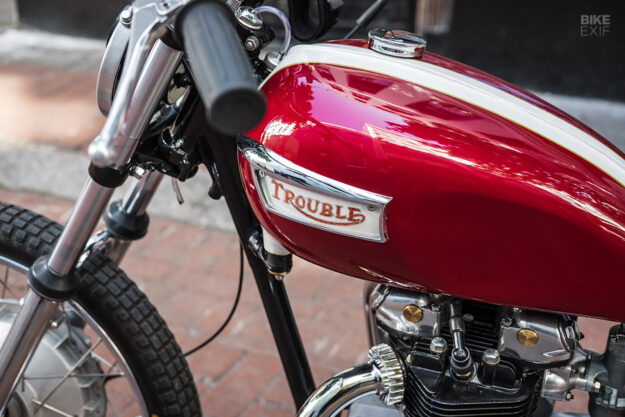
Covering the frame’s backbone is an American-spec 1969 Triumph Bonneville tank. The American Bonnie had a skinnier tank than its British counterparts, and it looks perfect on the stripped-back bobber.

To soften the ride out the back, Kyle made a saddle that pivots at the front and is sprung at the back. Expertly diamond-stitched in leather by Wynberg Auto Trimmers, it looks like a nice enough place to sit—especially behind those wide, relaxed bars.

Custom Triumph TR6 with Matchless frame
The dashboard is painfully simple; there’s barely anything there. The bars wear Lowbrow Customs grips, replica Amal levers and little else, save for a basic kill switch.

“The kill switch is fitted with a surf leash,” Kyle points out. “This way, I can take the bike down to the beach, go for a swim and not lose the key! It also reminds me of a speedway bike my brother once owned.”

Custom Triumph TR6 with Matchless frame
Mounted to a set of Triumph forks is a unique headlight nacelle, fabricated by Kyle. The lights are LEDs, and the ’69’ decal was made by a local shop, Print Design Studio. There are no turn signals, but there is a taillight—it was made from an old Amal carb housing, and bolted to the rear foot peg mount.

The bike was an all-hands-on-deck kind of build. All the mudguard stays and brackets were made in-house, and Kyle’s dad laid down the pearl white and candy red paint himself. The rear mudguard was lifted from a BSA and painted to match, giving the bike an old-school hot rod vibe.

Custom Triumph TR6 with Matchless frame
Finally, Kyle’s sister-in-law drew the “Trouble” logos on the fuel tank, by hand.

“The name comes from helping my brother build his first bike—a 1962 Triumph Tiger 110,” explains Kyle. “It was built from scratch and we really battled with it. Fortunately, my dad taught us to never give up, and we finally got it right. Since then, all Triumphs are considered trouble.”

Custom Triumph TR6 with Matchless frame
Incredibly, even though Kyle had been collecting parts for years, this bike was built in only four months. If having a child and moving house weren’t enough pressure, Kyle learnt that Africa’s premier custom motorcycle show, The Lightning Bolt, was returning to Cape Town. So he pushed on and debuted the bike at the show.

“I would like to thank everyone who helped me with the bike,” he adds. “Special thanks to my friend Tristan for all the help with little bits in the workshop, and Greg and Jimmy from the Edenvale Classic Motorcycle Club for the chroming.”

Custom Triumph TR6 with Matchless frame
If Kyle’s Triumph and Matchless hybrid proves one thing, it’s that the next generation of bike builders is in good hands.

The Workshop Instagram | Images by Wes Reyneke [above] and Andy Lund [below]

Custom Triumph TR6 with Matchless frame


from Bike EXIF https://ift.tt/6e2XKsN

Monday, 19 December 2022

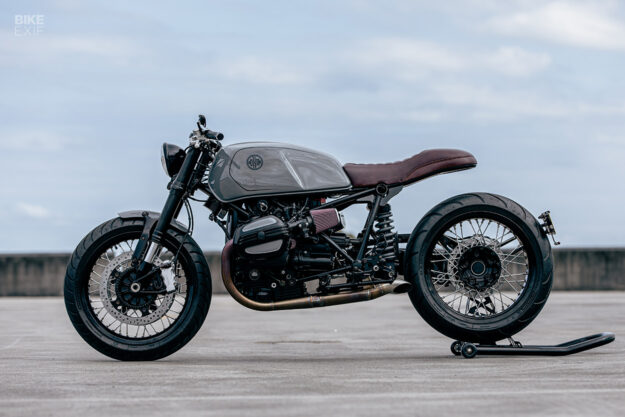
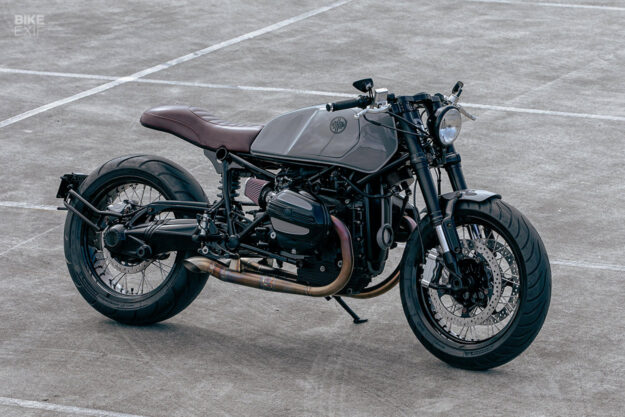
Distilled boxer: A BMW R nineT café racer by Deus

BMW R nineT café racer by Deus Ex Machina
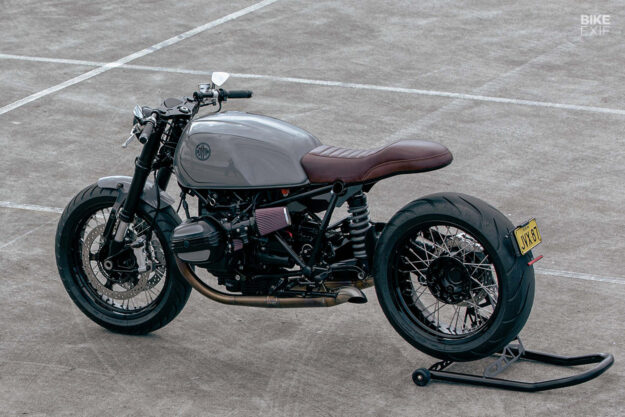
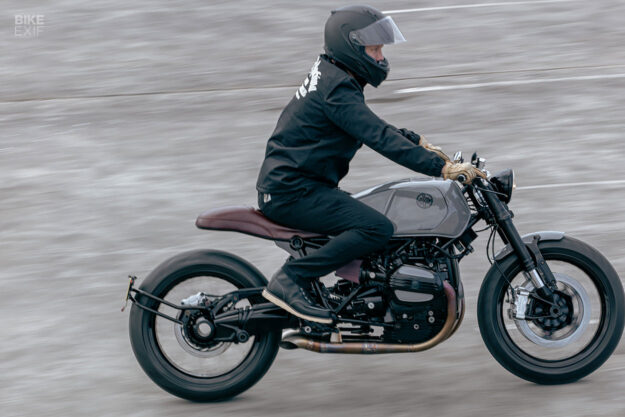
Dieter Rams said that good design “involves as little design as possible.” Colin Chapman said “simplify, then add lightness.” Both principles are at work in this ultra-crisp BMW R nineT café racer, brought to you by Deus Ex Machina Australia.

It’s certainly not the first café racer that Deus’ head wrench, Jeremy Tagand, has built. But the brief—to turn a stock 2014-model R nineT into a trimmed-down custom with classic style and modern tech—felt like a fresh challenge. The job called for a radical reworking of the BMW’s silhouette, plus a smattering of upgraded parts.

BMW R nineT café racer by Deus Ex Machina
A tank swap was on the cards—but that’s no mean feat with the BMW R nineT. It’s a modern motorcycle with a fuel pump and a number of electronic components in play, plus the OEM tank fits its trellis frame like a glove. Jeremy had to find a donor that would nail the look, while striking a visual balance with the nineT’s wide boxer motor.

In the end, Jeremy chose a 1980s Suzuki GS1100 reservoir for its muscular, angled style. Deus handed it over to fabricator Jonathan Okada at Kansai Giant Design Factory, to modify it accordingly. Jonathan massaged it to sit lower on the BMW frame, and made space for the stock fuel pump, ABS module and ECU.

BMW R nineT café racer by Deus Ex Machina
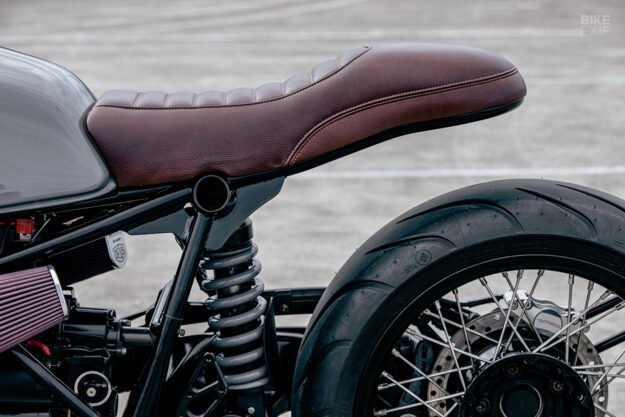
Next up, Deus fabricated a new subframe to create a clean line from the bottom of the tank through to the seat. Terminating in line with the rear axle, it’s neatly integrated with a custom seat pan that also hides the nineT’s remaining electronic bits. Dave at Bad Arse Trim Co. handled the tidy upholstery on the generously padded seat.

To keep the tail end clean, Deus relocated the license plate to a swingarm-mounted bracket from Wünderlich. A pair of Kellermann LEDs act as turn signals and taillights.

BMW R nineT café racer by Deus Ex Machina
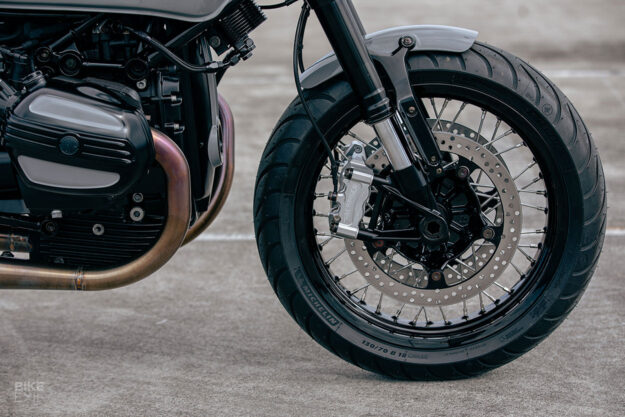
Moving to the nineT’s running gear, Deus disassembled the stock suspension, anodized the parts, and sent everything to Shock Treatment for a service. The 17” rims were swapped out for a set of 18” hoops, laced to the stock hubs by Ash’s Spoked Wheelz. A full Beringer brake set was installed for extra stopping power.

BMW R nineT café racer by Deus Ex Machina
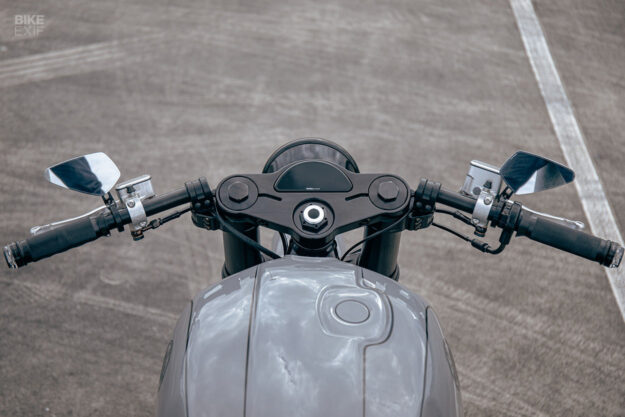
Jeremy’s relentless pursuit of minimalism is most evident from the rider’s point of view. The BMW’s new cockpit is as purist as it gets, built around a CNC-machined top clamp from Ricci Engineering that also houses a digital Motogadget speedo. Adjustable ABM clip-ons wear the Beringer controls, a KTM RC8 throttle, and Motogadget mirrors and bar-end turn signals.

If you’re looking for the switchgear, you’ll have to hunker down to find it. Integrated into the bottom of the CNC-machined grip on the clutch side, is a set of small push buttons from Grip Ace. The bike’s key ignition now lives just below the fuel tank on the left hand side.

BMW R nineT café racer by Deus Ex Machina
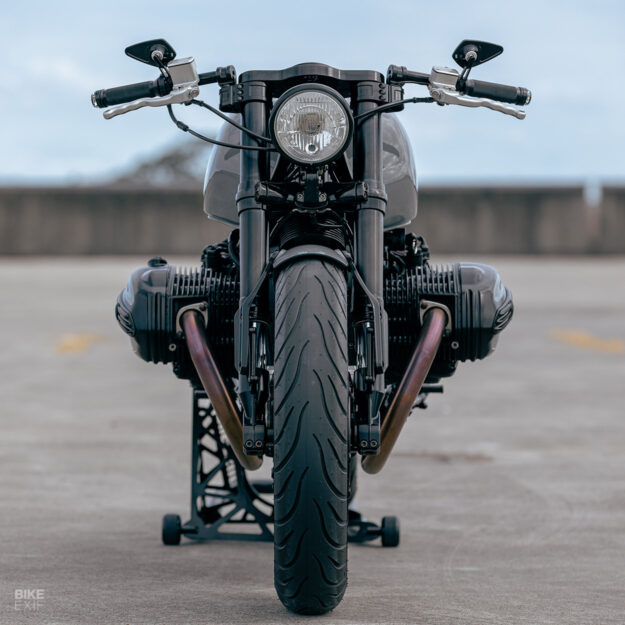
Other changes include a classic 5.75” Bates-style headlight and a gorgeous flush-mounted gas cap. Deus also installed Sato Racing rear-sets, and a small Honda oil cooler, tucked up behind the bottom yoke on a custom-made bracket. It’s hooked up via custom-braided oil lines.

The engine’s dressed up with valve covers from Roland Sands Design, and a front belt cover from Rizoma. Both were modified with sand cast Deus badges.

BMW R nineT café racer by Deus Ex Machina
With 109 hp on tap in stock form, the BMW R nineT’s boxer motor has more than enough grunt for most riders. So Deus left it alone on the inside, choosing to fettle the intake and exhaust instead.

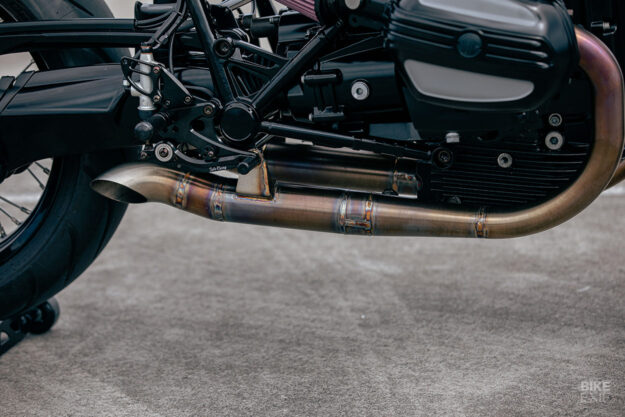
The air box was swapped out for a stage three filter kit from DNA, then RB Racing tuned the bike via a Dynojet Power Commander unit. The twin drag pipes are full custom items, and even include hidden baffles to keep the neighbors happy.

BMW R nineT café racer by Deus Ex Machina
Finally, Deus dressed the distilled boxer’s tank and front fender in a coat of Nardo Grey paint. Subtle pinstripes, powder coated parts and color-matched panels on the new engine covers tie everything together. With some subtle discoloration already coming through on the exhaust headers, the overall vibe is as stylish as it gets.

BMW R nineT café racer by Deus Ex Machina
In a sea of BMW café racers, this one stands out for its raw simplicity. Deus describes it as “a wink to the past, a nod to the present and a helmet full of smiles per hour.”

We’ll buy that.

Deus Customs | Facebook | Instagram | Images by Kenyon Batterson

BMW R nineT café racer by Deus Ex Machina


from Bike EXIF https://ift.tt/J4rLy7N

Sunday, 18 December 2022

Speed Read, December 18, 2022

Custom Triumph Scrambler 900, Super73 e-bike, Royal Enfield Himalayan and Triumph Rocket 3
A couple of fraternal Triumph twins from Istanbul kick off this week’s batch of customs, followed by an e-bike built for the vertical thrills of the Wall of Death. Moto Exotica brings us their maximalist Royal Enfield Himalayan, and our old friend CW Zon is back with his unique take on Triumph’s massive Rocket 3R. And finally, Malle London debuts their latest short film.

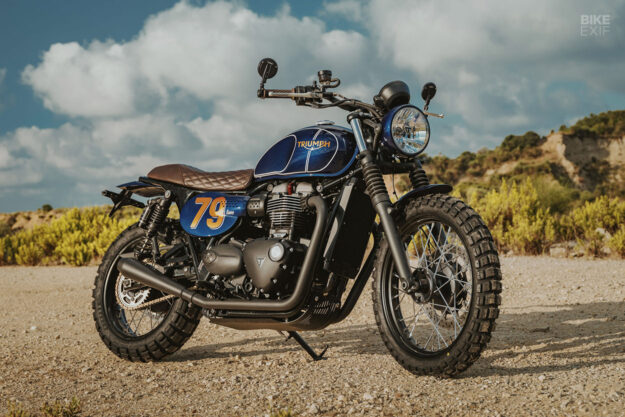
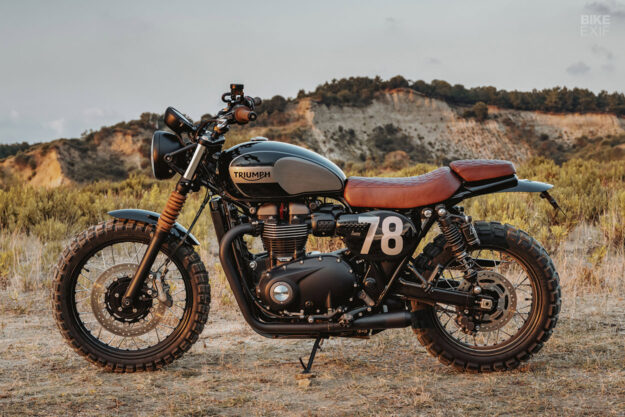
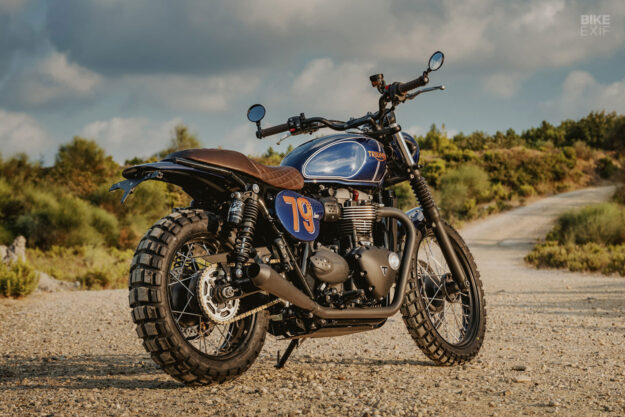
Triumph Scrambler 900 by Bunker Custom Cycles
Triumph Scrambler 900 twins by Bunker Custom Cycles Motorcycling is a sport we so often enjoy alone, but sharing the experience with a close friend brings it to a new level. Lifelong friends Pekin and Mert had been riding together since they learned how to keep a couple of bikes upright. Now in their 40s, they wanted to a pair of matching custom machines to enjoy together.

Considering the use of these motorcycles—riding around the city, commuting, but also conquering off-road challenges on the weekends—the two quickly decided on Triumph Scrambler 900s as base models for their builds.

Triumph Scrambler 900 by Bunker Custom Cycles
The bikes were delivered to Bunker Custom Cycles for their makeovers—and to serve as test mules for a new line of bolt-on parts.

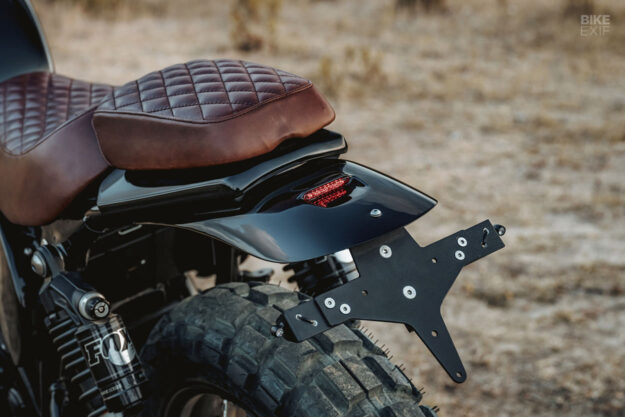
Each bike was built up with custom suspension, featuring upgraded fork internals and new Fox rear shocks. Each got a new handmade exhaust system too, redirecting the headers away from their original high-mounted position for a more comfortable ride. They also now wear Bunker’s signature skid plate and radiator guard.

Triumph Scrambler 900 by Bunker Custom Cycles
That’s where the similarities end, since the two owners chose to differentiate the bikes with paint and seating styles.

The two scramblers were named ’78,’ and ’79,’ after the birth years of their owners. 79 was equipped with a slimmed-down but traditional seat, while 78 got a two-piece seat, allowing for the passenger pad to be removed for use of a cargo rack. One is wrapped in a blue livery, while the other uses a black and grey combo.

Triumph Scrambler 900 by Bunker Custom Cycles
Parts like the side panels, fenders and license plate mounts were all developed in-house, mostly using 3D design and printing techniques. They’re now available on Bunker Cycles’ website—so if you’d like to pursue a similar look for your Scrambler, it’s only a few clicks away.

[Bunker Custom Cycles | Images by Mustafa Arikan]

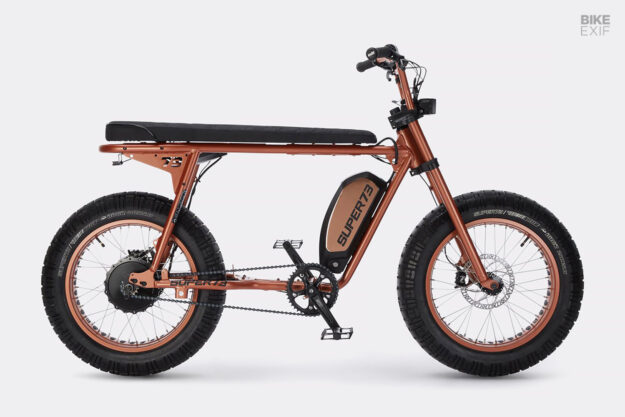
Super73 Wall of Death electric bike
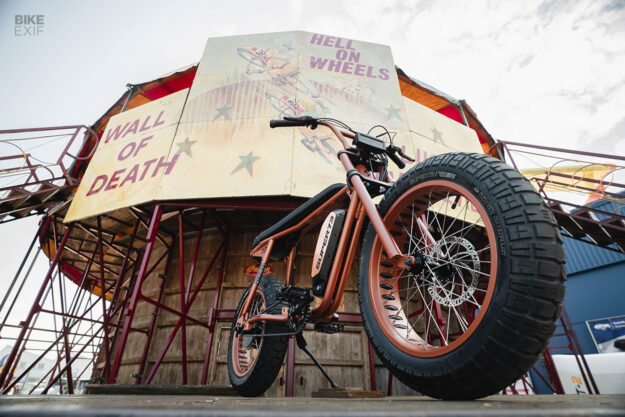
Custom Wall of Death Super73 The Wall of Death is a high speed thrill show that’s been around for over 100 years. Riders start on the flat center of a wooden cylinder, gaining speed as they climb onto the vertical walls, using centrifugal force to stay glued to the sides. While gas-powered vehicles have been the long-standing choice of vehicle, the instant torque offered by electric power is an obvious choice… so Super73 got an idea.

Super73 Wall of Death electric bike
Lovingly called Marvelous Marv, Marvin Prinssen is a Dutch Wall of Death rider and a member of the Lucky Daredevils. After seeing Marv and the crew do their thing at Wheels and Waves in Biarritz, the team at Super73 knew this would be a natural partnership.

They started a conversation, and in what seemed like minutes, Marv was up on the wall riding an e-bike. Shortly after, a one-off commission began.

Super73 Wall of Death electric bike
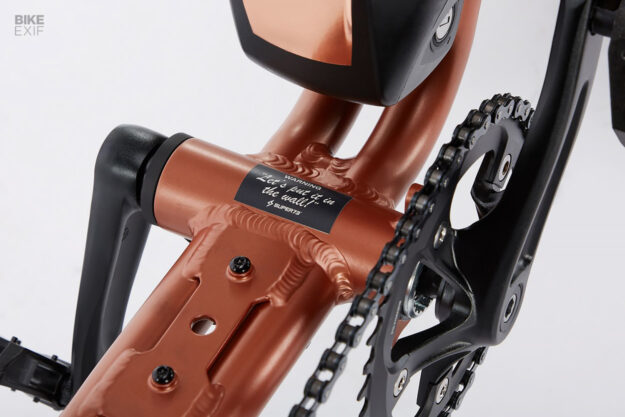
Starting with what looks to be Super73’s S2 chassis, the spokes were reinforced and strengthened, and the front end was equipped with a rigid fork to keep the bike sturdy and reliable with the incredible g-forces at play. An extended seat was upholstered with high-grip material, to help the rider stay on while the vehicle is parallel with the floor. A throttle was added to help Marv get up to speed as quickly as possible, without having to pedal.

The bike’s battery was relocated lower inside the frame, both to help with mass centralization and to protect the power source if things go sideways—or more sideways than intended. Lastly, a bit of copper paint sets off the build and helps further distinguish this one-off custom.

Marv’s Super73 will be touring with the Lucky Daredevils, so look out for them around Europe if you would like to see this unique creation in person. [Super73]

Custom Royal Enfield Himalayan by Moto Exotica
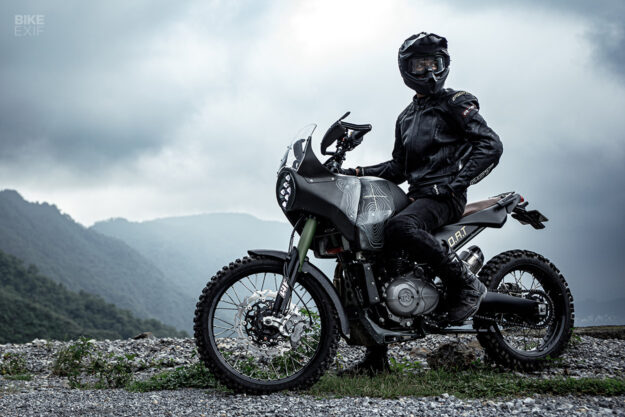
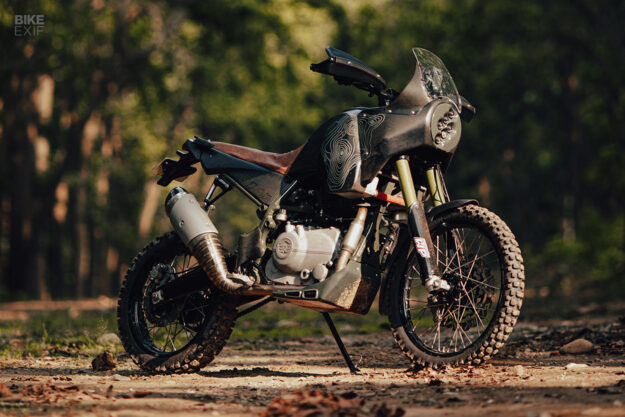
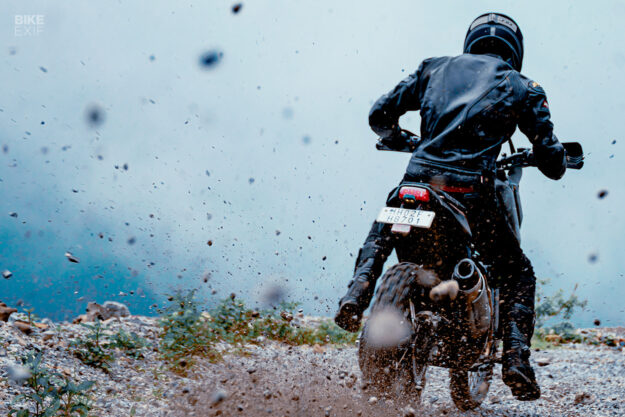
Royal Enfield Himalayan by Moto Exotica Based in Dehradun, India, Moto Exotica is tucked into the beautiful Himalayan countryside. Since 2013, the shop has made a name for itself by building custom scramblers and café racers around vintage Yamaha RDs. But recently, they were presented with a new challenge: to take the already capable Royal Enfield Himalayan, and build it out to the maximum level.

Custom Royal Enfield Himalayan by Moto Exotica
With a brand new Himalayan on hand, the team at Moto Exotica sought to retain Royal Enfield’s design language, keeping the round headlight and general shape of the gas tank. Design sketches and ideation led to over 50 pieces, designed in CAD and then milled. This shop does not outsource any of its work, so the full set of carbon fiber bodywork that you see here was formed in-house.

To get some more punch out of the engine, a custom 500 cc big bore kit was machined, and a high-lift camshaft was installed before the whole system was flashed with a programmable ECU. A more compact and lighter-weight exhaust system was fabricated, with a matching carbon fiber tip and a heat shield on the muffler.

Custom Royal Enfield Himalayan by Moto Exotica
Aiming for a taller, more enduro-like stance, the Himalayan was fitted with long-travel WP Suspension forks, and an all-new custom swingarm featuring a fully adjustable direct-mount shock. An 18” rear wheel and 21” front wheel were wrapped with dual-sport tires, and set with upgraded floating brake rotors and a 4-pot caliper up front.

Custom Royal Enfield Himalayan by Moto Exotica
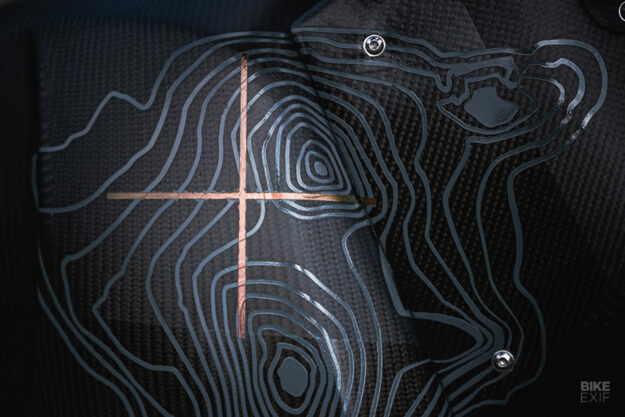
As an homage to Moto Exotica’s location, the colors used on the build were all inspired by hues found naturally in the rocky Himalayan countryside. The new carbon gas tank was painted with the contours of Mount Everest.

It seems no stone was left unturned, as this may indeed be the ultimate Himalayan for conquering the landscapes that this machine was named after. [Moto Exotica]

Custom Triumph Rocket 3 R by CW Zon
Triumph Rocket 3 R by Custom Works Zon Yuichi Yoshizawa of CW Zon is not a builder that follows trends or plays by any kind of rulebook. His builds are unique and immediately identifiable, even if the general style of each build varies greatly.

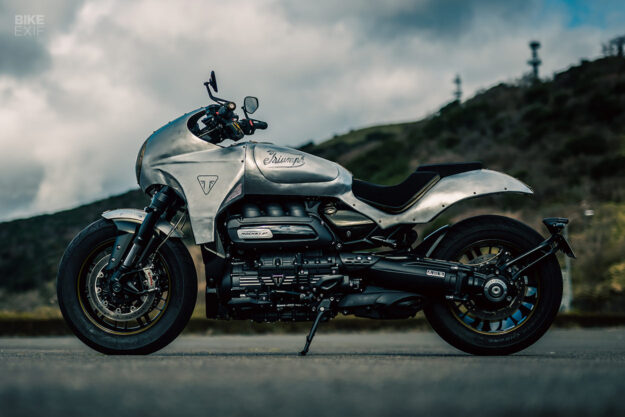
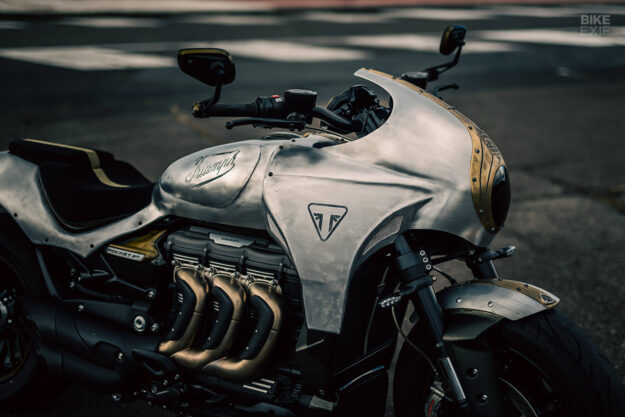
The latest wonder to roll out of the Japanese builder’s workshop is this Triumph Rocket 3 R roadster. It’s loaded with hand-formed bodywork that completely changes the look and feel of the bike, without altering the frame in any way.

Custom Triumph Rocket 3 R by CW Zon
Triumph’s Rocket 3 R is an absolute beast. The 2,458 cc three-cylinder engine puts out a claimed 165 horsepower and 163 ft-lbs [221 Nm] of torque. Zon’s build takes this Rocket, and covers it in hand-formed and hand-engraved aluminum, with bronze detailing. The result is an amalgam of the Rocket 3’s original roadster style, a futuristic café racer, and a steampunk locomotive.

As always with Yoshizawa-san, all fabrication was done at the highest level. And since the Rocket’s original geometry was not altered in any way, we know this bike will ride just as Triumph’s engineers intended.

Custom Triumph Rocket 3 R by CW Zon
CW Zon showed this Triumph off at the Mooneyes Yokohama Hot Rod Custom Show recently—but it wasn’t the shops only entry into the show. Yuichi took top honors with a Harley Shovelhead muscle bike that we will be featuring soon. Stay tuned. [Custom Works Zon | Images by Hiromitsu Yasui]

The Great Malle Mountain Rally short film
Malle Mountain Rally film Hosted by our friends at Malle London, the Mountain Rally is a six-day event that takes riders over 1,500 miles, through six countries, and through passes as high as 2,770 meters [9,088 ft]. The Mountain Rally is now the longest motorcycle rally ever completed, covering the entirety of the Alps Mountain Range, passing through all of the highest passes and wildest country before dropping back down to sea level at the finish line.

While the 2022 rally has now come and gone, a new film was just released to help bring you in and share the experience. Riders from all around the world meet in Austria. As we expect from an event hosted by Malle London, the same team that brings you the Malle Mile, there is an emphasis on style and many of the bikes are heavily customized.

The Great Malle Mountain Rally short film
Clocking in at over seven minutes and 40 seconds, the Mountain Rally short film tells the stories of riders exploring new roads, overcoming the challenges of a long and grueling journey, and bonding through the experience. Catch it below. [Malle London | Images by Shane Benson]


from Bike EXIF https://ift.tt/FdSx69l