Sunday, 3 November 2024

Speed Read: The new Royal Enfield Bear 650 scrambler and more

The latest OEM scrambler motorcycles, adventure tourers, and classic race bikes
The annual EICMA trade show is about to kick off, but some major OEMs haven’t waited to show off their latest offerings. We look at the new Royal Enfield Bear 650 scrambler and the Triumph Tiger 800 Sport. On the custom bike front, we profile two retro-fabulous racing restomods; a Suzuki GS1200SS from Japan and a Yamaha RD350 from Spain.

2025 Royal Enfield Bear 650 scrambler
2025 Royal Enfield Bear 650 Royal Enfield is back with another new announcement. This time it’s their beloved 650 cc twin that’s getting a new variant, in the form of the 2025 Royal Enfield Bear 650.

Inspired by Fast Eddie Mulder’s win astride a Royal Enfield 500 at the grueling Big Bear Run in the Californian desert in 1960, Royal Enfield has finally scrambler-ized the Interceptor 650.

2025 Royal Enfield Bear 650 scrambler
Straight away you’ll notice the upside-down Showa big-piston forks and the 19F/17R rear wheel combo. Shod with chunky tires, and sporting over seven inches of ground clearance, the Royal Enfield Bear 650 looks like an Interceptor in its health and fitness era.

Along with the suspension upgrades, the frame has been revised and strengthened. The scrambler-style seat is nicely contoured, and the rear subframe has been kicked up at the back.

2025 Royal Enfield Bear 650 scrambler
The engine has been left alone, but the new two-into-one scrambler exhaust lets the 650 lay down its torque lower in the rev range.

The large LED headlight is backed up with a tech-heavy, but still classic, dashboard. The large round TFT display features Royal Enfield’s ‘Tripper’ navigation, which can be linked to a smartphone running Google Maps. There is also LED lighting all around, which is a first for a Royal Enfield 650 twin.

2025 Royal Enfield Bear 650 scrambler
Even though the burly forks and chunky tires butter our toast, it’s the Royal Enfield Bear 650’s paint options that have us most excited. There are five liveries to choose from, and their names are wild; Boardwalk White, Petrol Green, Wild Honey, Golden Shadow, and the special edition, teal-framed Two Four Nine.

We’re having a hard time choosing between Petrol Green and Wild Honey [above], but the blue, white, and yellow stripes on the Wild Honey might have won us over. Prices in the US will start at $6,849 for the base model Boardwalk White and go up to $7,199 for the special edition Two Four Nine. Prices in the UK range from £6,749 to £6,949.

2025 Royal Enfield Bear 650 scrambler
The big takeaway here is how fun the Royal Enfield Bear 650 looks. We’ve pointed the Royal Enfield Interceptor 650 down a dirt road before, and came away thinking that it’s about the most fun you can have with 45 hp.

As far as we’re concerned, Royal Enfield has hit the nail squarely on the head. [Royal Enfield]

Suzuki GS1200SS restomod by Iida Racing Factory
Suzuki GS1200SS by Iida Racing Factory Give us the choice of any inline four-cylinder Suzuki, and we’ll pick the Suzuki GS1200SS every time. Even though its two-year production run was short-lived, we can’t get enough of its retro endurance vibes—and it’s highly likely to appreciate in value.

This wild Suzuki GS1200SS belongs to Hiroki Iida, owner and proprietor of Iida Factory Racing in Kawasaki City, Japan. Iida-san has owned, modified, and raced his GS1200SS for over 20 years and he thought it was time to improve on his initial designs. Taking another GS1200SS from his workshop, he set about building this; the Iida Racing Factory “Demo-Two”.

Suzuki GS1200SS restomod by Iida Racing Factory
The main focus was reducing weight and managing heat—but while the bike was torn down, myriad gussets and reinforcements were added in key areas, such as the frame neck and shock mounts. Carbon fiber bodywork from Custom Factory Tokaji adorns every surface, and it is perfection personified. An aluminum fuel cell is tucked away beneath the carbon shell, further reducing weight.

The 17” wheels are forged aluminum units from OZ Racing, which are slowed down (rather quickly) by beautiful Brembo calipers and Sunstar discs. The Öhlins FF521 forks are held in place by custom 7075 aluminum fork clamps and there are more Öhlins goodies out back, suspending a custom-braced swingarm.

Suzuki GS1200SS restomod by Iida Racing Factory
Then there is the engine. It was torn down and reassembled with Wiseco forged pistons, Yoshimura cams, and titanium bolts, and has a balanced bottom end. It was also punched out to 1,216 cc (about 60 cc over stock) and features a TSS slipper clutch, a full brace of Yoshimura TMR-MJN carburetors, and a titanium exhaust system.

Even with all these mods, Iida-san has kept the big GS road legal with lights and turn signals. He also managed to shave a whopping 40 kg [88 lbs] from the overall weight, which means this thing would absolutely fly down the road. As far as retro sport bikes go, this might be the pinnacle. [Source]

Yamaha RD350 restomod by Bolt Motor Co.
Yamaha RD350 by Bolt Motor Co. When handed a box of bits and asked to make something go, stop, and turn, the team at Spain’s Bolt Motor Co. knew they had their work cut out for them. Somehow, that box of bits used to be a Yamaha RD350 that their new client wanted to look good while paying tribute to three-time 500 cc World Champion, Wayne Rainey. Oh, and it had to be fast.

Starting at the pointy end is a complete front end from a Yamaha R6. The wheels and swingarm came from the R6 too, and allowed for modern rubber to be fitted—including a 170-section rear tire. The client requested good handling and safe stopping, so the Bolt team sourced oversized discs and Brembo calipers to match the R6 suspension.

Yamaha RD350 restomod by Bolt Motor Co.
The clip-on handlebars are from Rizoma and are capped with Motogadget bar end turn signals. A Domino throttle speeds up the right wrist action and a KOSO digital temperature gauge monitors engine heat. The LED headlight wears a custom 3D-printed cover and the mirrors are from Highsider.

The tank is factory, but the rear end is a single-seat fiberglass unit meant for racing. It’s topped off with weatherproof suede upholstery. The red and white livery was specifically requested by the client as a throwback to the monster 500 cc two-stroke GP bikes from yesteryear.

Yamaha RD350 restomod by Bolt Motor Co.
Speaking of 500 cc monsters, that’s exactly how Bolt fulfilled the requirement that the bike be fast. The stock 350 cc twin was torn down and rebuilt to 500 cc with new cylinders, pistons, and crankshaft. The reeds were upgraded and a new pair of carburetors was bolted on for good measure.

The bike was then re-wired from scratch to ensure optimum performance and reliability, and a custom Turbokit exhaust was bolted on, complete with prerequisite enormous expansion chambers. From a box of bits to a work of engineering art that will out-accelerate most modern sport bikes, Bolt Motor Co. knows what’s what. [Source]

2025 Triumph Tiger Sport 800
2025 Triumph Tiger Sport 800 The ever-growing ‘tall rounder’ segment has a new contender—the all-new 2025 Tiger Sport 800. Based on what we suspect is a bored and/or stroked version of Triumph’s 660 cc inline-triple, the new 798 cc engine pumps out about 113 hp and 84 Nm, and is wrapped in rather attractive bodywork (for an adventure-styled bike anyway).

Styled as a larger, more aggressive version of its smaller sibling, the new Triumph Tiger Sport 800 has a full-sized front fairing, an upright riding position, and a narrow tail. There is Showa suspension all around; the 41 mm separate function front forks are adjustable for rebound and compression, and the rear mono-shock is rebound- and preload-adjustable.

2025 Triumph Tiger Sport 800
The matching lightweight 17” wheels are wrapped in Michelin’s Road 5 sport tires, and this gives away the intended use. Smaller wheels, adjustable suspension, and sticky tires—it all points to a road bike with the upright ergonomics of an adventure bike.

Speaking of adventure ergonomics, Triumph notes the 32.48-inch seat height as ‘accessible’, but it’s not. Knocking two or three inches off the seat height would make it more approachable for a wider audience. That said, the wet weight of 214 kg [472 lbs] will make the tall seat height more manageable – especially for a bike that will spend all of its time on asphalt.

2025 Triumph Tiger Sport 800
Another letdown is the dashboard, which is simple, but a bit lackluster. An adjustable screen (with one-handed operation) and sleek daytime running LED save the day up front, as do the factory luggage options out the back.

The standard color is Sapphire Black, and it also comes in three premium colors; Graphite, Caspian Blue, and a very tasty Cosmic Yellow. We expect the new Sport 800 to be at the upper-middle level of the mid-sized touring segment, but the 16,000-kilometer [10,000-mile] service intervals might make it better, financially, in the long run. [Triumph Motorcyles]

2025 Triumph Tiger Sport 800


from Bike EXIF https://ift.tt/B6FKOfQ

Saturday, 2 November 2024

Road Tested: Motorcycle phone mount options from Quad Lock

Quad Lock motorcycle phone mount system
Attaching your phone to your motorcycle is risky business. Every phone mount system out there claims to be the best—but you don’t really know how secure your phone is until you’ve tried it. And then there’s the infamous iPhone camera and its propensity for failing under vibration.

Many riders I know and trust swear by Quad Lock’s products. So I was pleased as punch when the Australian company offered to send over a handful of products to test. I sent Quad Lock a list of five or six items that I thought would work, and they responded by sending a huge box of goodies for me to tear into.


Straight away, the Quad Lock system’s modular nature speaks to the gadget nerd in me. Everything product that they sent me was designed to integrate with the next, creating endless options. But if you’d like to keep it simple, start out with the bike mount and phone case that best fit your needs, then fine-tune your setup with the company’s myriad add-ons.

At the heart of my personal setup is the relatively new Quad Lock Handlebar Mount Pro and MAG Case. Those are augmented with a vibration dampener for the mount, and a colored accent ring and MAG Wallet for the phone case. That’s enough to tick most of my boxes—with the Quad Lock Weatherproof Wireless Charging Head and 12V to USB Smart Adaptor adding wireless charging capabilities to my setup.

Quad Lock Handlebar Mount Pro packaging
All of the parts are ridiculously easy to set up—and that starts with how well-packaged they are. Each item comes neatly boxed, with simple instructions, and every last part you need to install it is included. Every screw uses the same size Allen head and is pre-treated with thread lock, and every box has an Allen key inside.

Products like the wiring charging head even come bundled with multiple USB charging cables in varying lengths and head angles, plus cable ties. Installing and configuring the mounting system literally takes minutes, with no need to crack open your tool kit. It really is idiot-proof.

Quad Lock Handlebar Mount Pro

The Quad Lock Handlebar Mount Pro is a rugged CNC-machined aluminum mount (an upgrade over their base model nylon option) that clamps directly to your handlebars. It takes a one-size-fits-all approach, by using ‘collars’ that can accommodate diameters of 22 mm, 25 mm, 28 mm, 32 mm, and 35 mm. That means it’ll fit anything from regular 22 mm handlebars to tapered bars, and even some oversized options.

Fitting the mount to your bars involves figuring out the diameter at the spot where you want to install it, popping the heavy-duty nylon collar onto the bars, and then clamping the aluminum bracket over the collar. Notches in the aluminum clamp match nubs on the collar, ensuring a flawless fit.

Quad Lock Handlebar Mount Pro
The clamp itself is hinged on one side, with a single fastener on the opposite side to lock it down. Cleverly, the upper edge of the threaded hole in the bottom half of the clamp is countersunk, which helps to guide the securing bolt into place.

An aluminum arm bolts to the clamp to add some height and distance to the setup, with Quad Lock’s patented spring-loaded mounting head perched at the top of it. Both the head and the extension arm can be rotated 360 degrees, with fine teeth clicking them into place. Their teeth and threaded holes are identical, so you can just as easily ditch the extension arm and bolt the head directly to the clamp for a slimmer setup (my preferred configuration, as pictured below).


Rotating the extension arm and head, and rolling the actual clamp forward and backward around the bars, gives you a fairly decent range of positions to place your phone in. You do need to pick a fairly level section of the handlebars though, because there’s no way to pitch the mount left and right without adding Quad Lock’s optional $9.99 Knuckle Adaptor. Quad Lock sells spacer kits too, if you need a little more height at either of the Handlebar Mount Pro’s connection points.

Neither the knuckle nor spacers were needed to run the Quad Lock system on my Triumph Bonneville, nor a BMW F900GS that I had in my garage for a bit. Swapping the mount between the two bikes was easy enough too—although it did reveal that the black anodizing on the aluminum parts is prone to scratching if you fiddle with them too much.

Quad Lock Handlebar Mount Pro
The Quad Lock mounting head uses a simple press-and-twist method to attach your phone, while depressing the lever on the right releases it. Finding the right angle and amount of pressure to lock your phone in place takes a fair amount of practice—but the trade-off is that it feels hella secure once attached.

The Handlebar Mount Pro hides one more crafty feature—a small notch on the inside, filled by a removable rubber plug, that helps with cable management if you’ve added a charging kit to your setup.

[$69.99 | Available in black or chrome | More]

Quad Lock Motorcycle Mount Pro with Vibration Dampener
Quad Lock Vibration Dampener

The vibrations from some motorcycles are known to fry the image stabilizers in some smartphones. Quad Lock has a handy list of known culprits on the website, which includes my bike. So I installed the Quad Lock Vibration Dampener right out of the gate.

The Vibration Dampener mitigates high frequency vibrations by using twin ‘chassis’ plates, separated by silicon grommets.

Quad Lock Motorcycle Mount Pro with Vibration Dampener
Once again, setting it up is a doddle; remove the Handlebar Mount Pro’s standard head, bolt the Vibration Dampener on, and bolt the original head to the Vibration Dampener. Once again, everything you need is in the box, and setting it up takes less than two minutes.

The Vibration Dampener does add a few millimeters (and some visual heft) to the overall mounting system, and there’s a slight bit of bobbing while on the move. But if the alternative is a wrecked phone camera (I wasn’t about to mount my phone without it to find out), those are worthwhile tradeoffs.

[$19.99 | More]

Quad Lock MAG Case for iPhone SE
Quad Lock MAG Case

The Quad Lock mounting system is useless without having something on your phone for it to interface with—so their MAG Case (or one of their universal mounts) is a necessity. I’m that guy who deliberately chooses older, cheaper, and smaller phones (I’m currently using a third-generation iPhone SE), which can make it hard to find a suitable case. Luckily Quad Lock’s range is pretty extensive.

The MAG Case features Quad Lock’s signature twist-mount ring on the back, plus a magnetic ring that works with the brand’s range of snap-on magnetic mounts. Mounting functionality aside, it’s a damn good phone case too.

Quad Lock Motorcycle Mount Pro with Vibration Dampener
The design is slim, but buff enough to handle abuse. There’s a soft-touch lining inside, bumpers along the top edge to protect the screen, and an extra protective lip around the camera lens. The phone’s edge buttons are easy to operate, and the charge port is easily accessible.

There’s room for personalization too. I swapped out the magnetic ring for a red one to differentiate mine from my wife’s phone (which uses the same case)—a process that involves popping the old ring off with the supplied tool and clicking a new one into place.

Quad Lock MAG Case for iPhone SE
I also added Quad Lock’s brilliant MAG Wallet. Made from a synthetic material that vaguely resembles leather, it’s a spring-loaded slimline wallet that can take up to three cards and attaches to your phone magnetically. It’s also small enough to pop into a pocket when you need to mount your phone to your bike.

The fact that the MAG Case works with both twist-lock and magnetic Quad Lock mounts is a boon if you’re using multiple systems—such as the mount and magnetic head that I’ve set up in my car.

[$39.99 | More]

Quad Lock Mirror Stem Mount

My Triumph Bonneville shares garage space with a small, Taiwanese-made scooter—my go-to for errands and short-range missions. Handlebar space on a scooter is at a premium, so Quad Lock also sent me their new Mirror Stem Mount to try out.

Quad Lock makes more mounts than you can shake a stick at, including a fork stem mount, brake or clutch perch mount, handlebar clamp mount, and a bunch more. The Mirror Stem Mount is their newest, and it saves space by bolting to the same spot that your mirror does.

Quad Lock Mirror Stem Mount
Unbolt your mirror, use the supplied washer and spacer (which lets you fit it to both M8 and M10 mirror mounts), bolt the Mirror Stem Mount in place, and refit your mirror. The mount uses a die-cast aluminum arm with an offset to put space between it and the mirror. It ends in a gimbal head that offers a range of positions, with Quad Lock’s standard twist-lock mount bolted to it.

Like the Motorcycle Mount PRO, it can be upgraded with a Vibration Dampener (or any other Quad Lock parts). And like its fellow mounting systems, it’s dead easy to set up and use.

[$44.99 | More]

Quad Lock Weatherproof Wireless Charging Head

The Quad Lock Weatherproof Wireless Charging Head replaces the regular mounting head on any of the company’s brackets, making it an all-in-one mounting and wireless charging unit. There’s a USB version that plugs into your bike’s USB socket, or a version that can be wired directly to your bike.

I’ve used the USB version here, which comes with three different USB-A to USB-C cables—including one with a right-angle USB-C plug that helps when mounting the charging head in tight spaces. Yet again, installing the head is quick and easy, with clear instructions and all the bits you need bundled with the unit.

Quad Lock Weatherproof Wireless Charging Head
The head itself is constructed from a mix of reinforced plastics and die-cast aluminum parts, with a finned rear aluminum housing designed to help manage heat. The whole thing feels sturdy—but it’s also chunky, especially when mounted on top of the Quad Lock Vibration Dampener. So I’ve opted to only install it when I’m going on longer rides and want to keep my phone charged.

When it is installed, it works just like the regular mounting head; twist to lock, and press the edge of the charging head to release (albeit with a little more force). Once your phone is mounted, you benefit from wireless fast charging (up to 7.5 W with iPhones, 10 W with Samsung Galaxy phones, and 15 W with Google Pixel devices). I haven’t benchmarked the charging time, but I’ve started a long ride with an almost dead phone and ended it with a full one, and that’s all that counts.

[$74.99 | More]

Quad Lock Weatherproof Wireless Charging Head
Quad Lock 12V to USB Smart Adaptor

Since my Triumph Bonneville was built before putting a USB charging port on every motorcycle was a thing, the final piece of my setup is the Quad Lock 12V to USB Smart Adaptor. It’s a relatively compact unit, with a waterproof USB port on one side and a standard SAE plug on the other. Plug it into your existing SAE cable if you have one installed, or install the cable that comes with the adaptor directly to your battery.

The unit is, as I’ve come to expect by now, simple to install and use, and comes bundled with everything you need to set it up. The biggest hassle is finding a spot to stick the adaptor and routing the cable to your bike’s cockpit. I managed to find a spot under my seat, and used some adhesive hook-and-loop strips on the unit and my electronics tray to hold it in place.

A three-way switch lets you turn the unit on and off manually, or set it to an automatic mode that only sends power to the USB port when the bike is running. Of course, if the whole wireless charging caboodle is at odds with your bike’s sano handlebar space, the USB Smart Adaptor is a quick way to add a USB port to your setup for regular cable-assisted charging.

[$39.99 | More]

Quad Lock motorcycle phone mount system


from Bike EXIF https://ift.tt/br7JBlg

Friday, 1 November 2024

Narrow Focus: A board track-inspired Harley Shovelhead from Japan

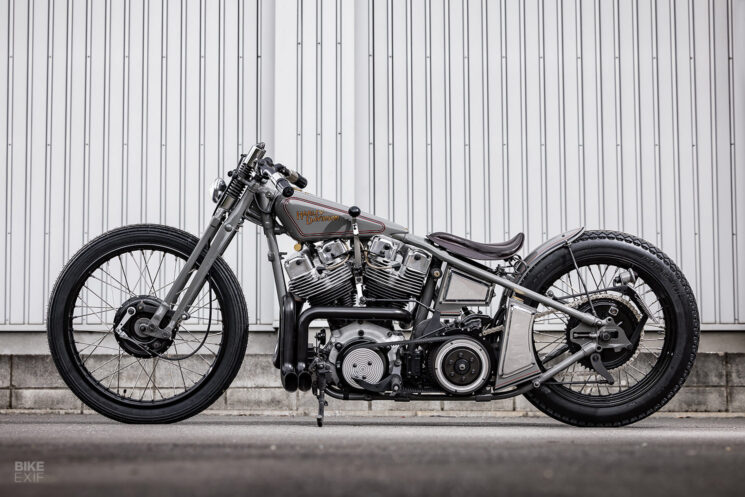
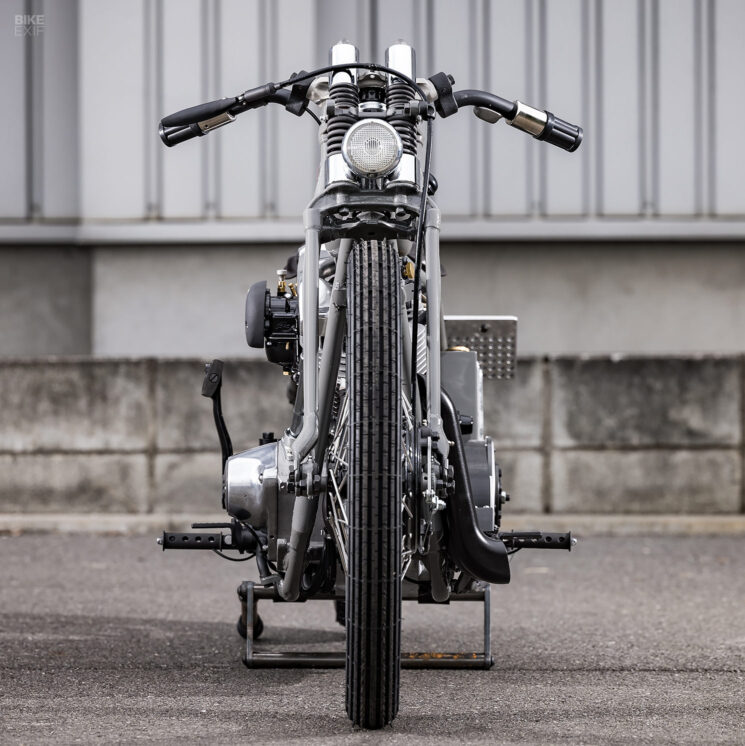
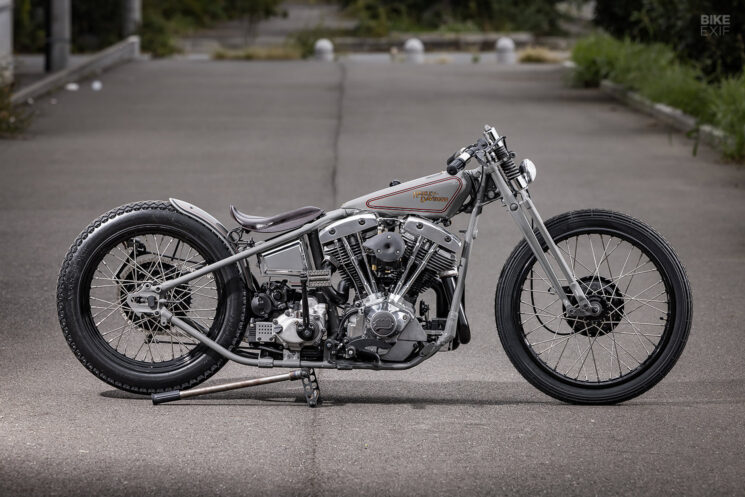
Board track-style custom Harley Shovelhead by Infinity Japan
Have you noticed how photographers often favor the right-hand side of a motorcycle? Sometimes it’s because the bike’s side stand has it leaning over to the left, making it awkward to capture a good angle. Other times, it’s because the right-hand side is simply more visually appealing than the left.

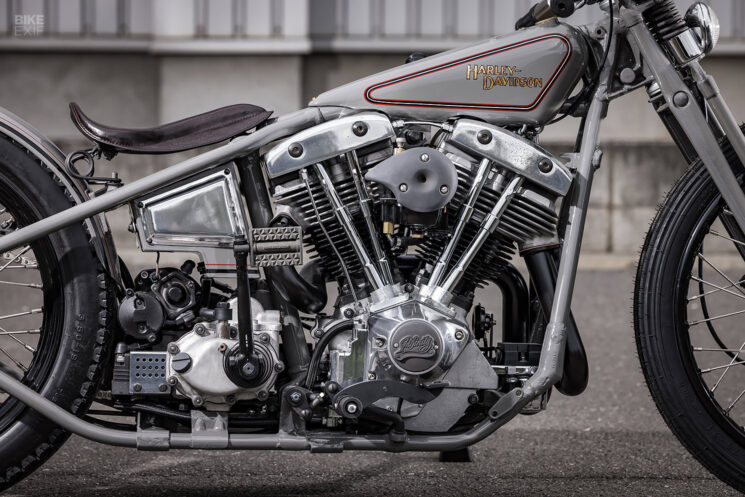
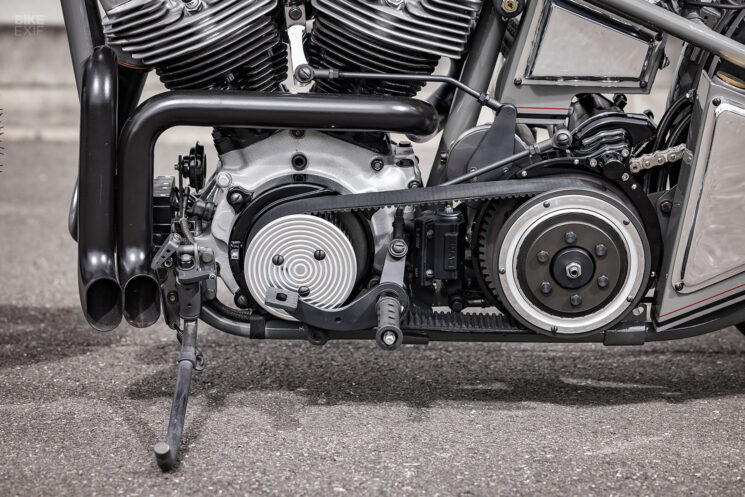
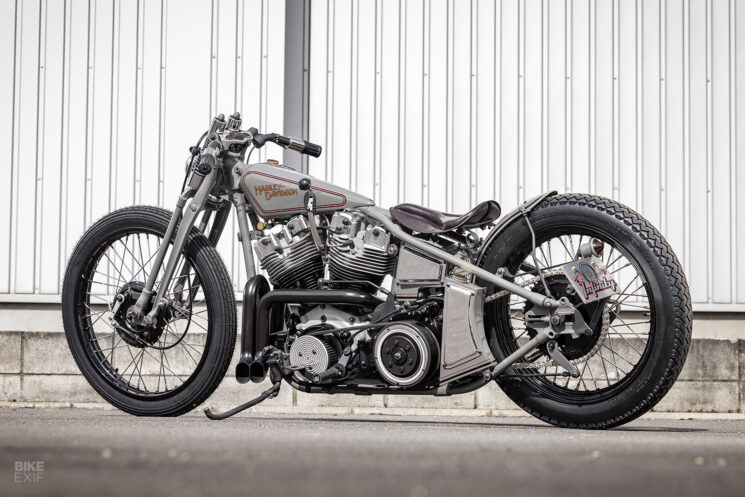
That’s not the case with this 1970s Harley Shovelhead, which features a burly open primary, a bespoke oil tank, a hand-shifter, and a handmade exhaust system—all on the left side.

Board track-style custom Harley Shovelhead by Infinity Japan
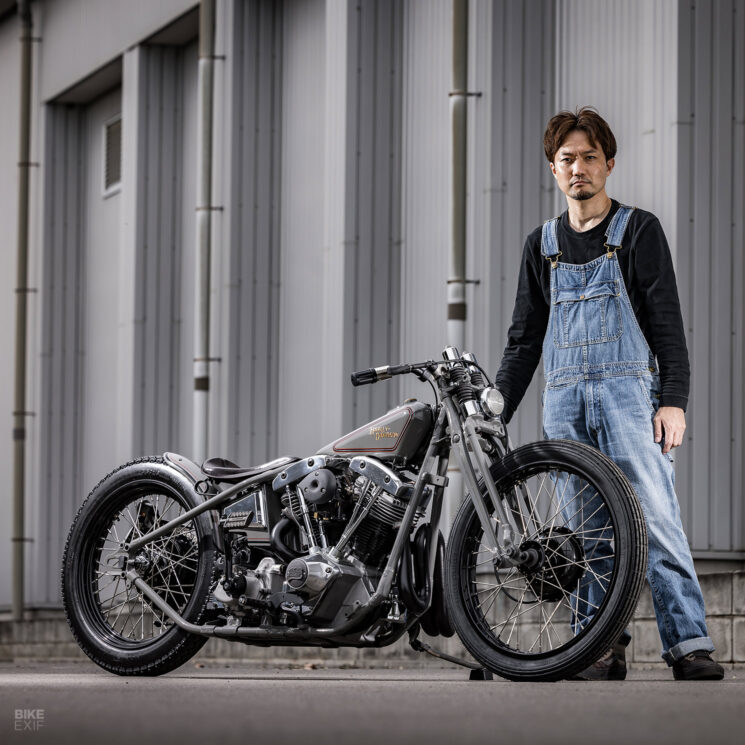
It’s the work of the Japanese custom bike builder Masumi Tsuchino, who operates out of Iruma in the Saitama Prefecture, just northwest of Tokyo. Tsuchino-san qualified as a mechanic out of school, then cut his teeth at a Toyota dealership. Later on, he took a job at Red Baron—a massive motorcycle dealer chain in Japan—where he learned the ins and outs of motorcycle maintenance and customization.

Next, he did a stint at the custom workshop Sure Shot in Chiba, honing his skills under the watchful eye of multiple Mooneyes award-winner, Takuya Aikawa. He finally branched out eight years ago, opening his own custom shop, Infinity Inc.

Board track-style custom Harley Shovelhead by Infinity Japan
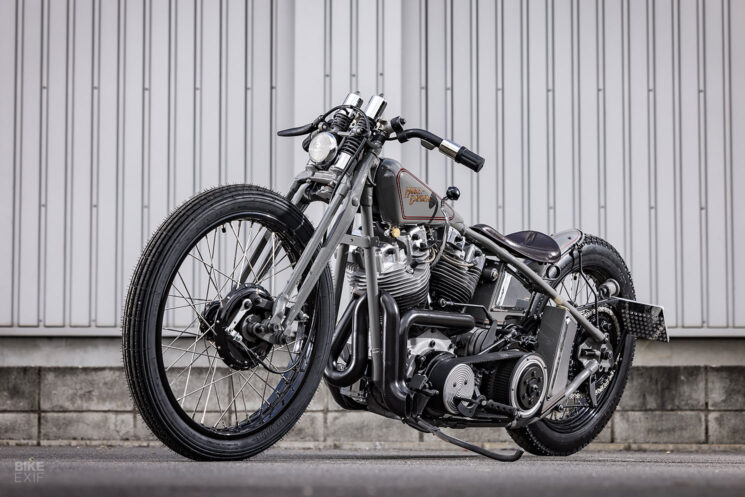
Inspiration for this 1975-model Harley-Davidson FXE came from vintage board trackers, so the overarching goal was to make the bike as skinny as possible. “I am very attracted to the board tracker, which has a very simple structure,” he tells us. “I like the style of the engine mounted on a bicycle-like frame, and the large wheels.”

“I wanted to make a bike that reflected the style of racing in the 1920s.”

Board track-style custom Harley Shovelhead by Infinity Japan
Masumi started by transplanting the Shovelhead motor into a vintage Panhead frame. The rigid frame is mostly stock, save for a subtle narrowing of the rear triangle.

Next, Masumi built a skinny new 21F/19R wheelset, laced with stainless steel spokes. The hubs are refurbished drum brake items from S-Proud. “They use a process called ‘super regeneration,’ which gives them stopping power comparable to that of disc brakes,” he explains.

Board track-style custom Harley Shovelhead by Infinity Japan
For the front end, Masumi sourced a replica vintage Harley VL springer fork, but soon discovered that it was too wide for the look he was after. So he promptly tore it apart, narrowed it, and put it back together. The top yoke comes from Visionary Cycle Products, and the ‘clip-on’ handlebars are one-offs by Masumi.

Masumi fabricated the grips too, which reference early Harley designs. The right-hand handlebar features an internal throttle and a rudimentary front brake lever, while the left sports just two switches. The whole arrangement is super-sano and delightfully retro.

Board track-style custom Harley Shovelhead by Infinity Japan
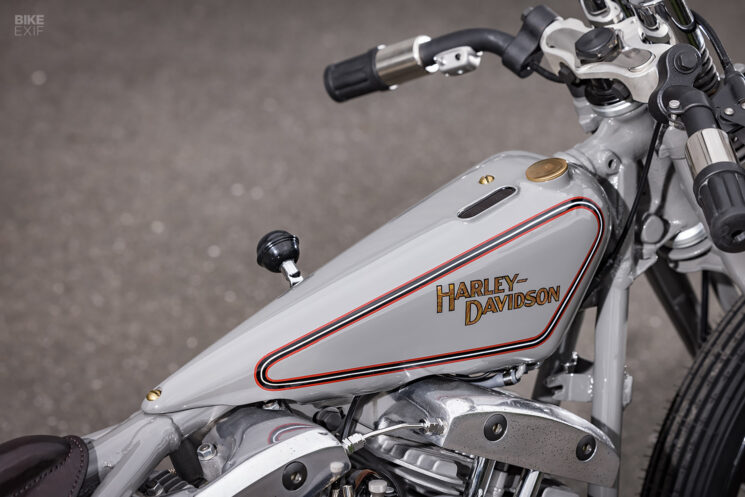
Trimming the Shovelhead down further is a sharply tapered handmade fuel tank, adorned with a brass filler cap and an integrated Motogadget speedo. There’s a second fuel tank below the seat, with a Yamaha DragStar fuel pump delivering fuel from both tanks to the carburetor. Oil is housed in a custom-made tank further back.

A Mesinger bobber seat sits atop the old Panhead frame, followed by a modified Sportster front fender. A swingarm-mounted bracket holds the license plate and a Hide Motorcycle taillight.

Board track-style custom Harley Shovelhead by Infinity Japan
The components adorning the left-hand side of the shovelhead engine are arranged with Tetris-like precision. Masumi’s biggest challenge was directing the custom exhaust headers to the left of the bike—something you seldom see on a Harley. Coated in black, the exhausts are astonishingly elegant.

Just behind the gaping exhaust openings sits an open primary kit from Belt Drives, Ltd., modified with hand-crafted front and rear covers. With very little space left, Masumi built a series of linkages for his custom hand-shifter.

Board track-style custom Harley Shovelhead by Infinity Japan
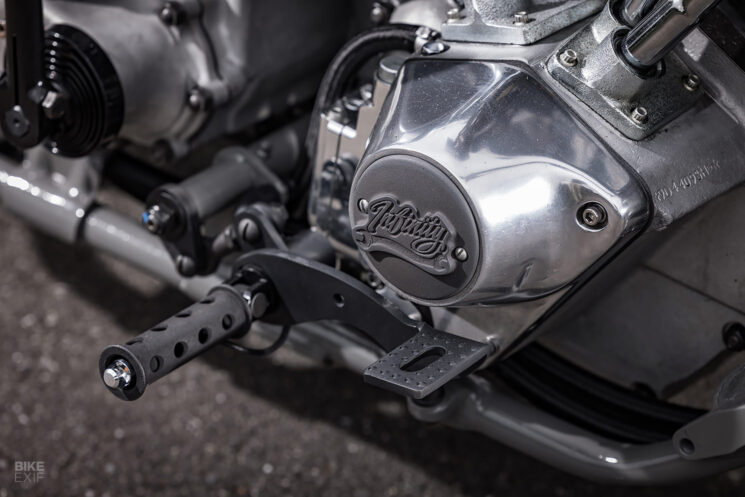
Despite the bike’s complexities, Masumi has taken steps to make it as easy to ride as possible—like relocating the foot pegs to compensate for the low position of the bars. “No matter how fantastic a bike is, there’s no point to its existence if it’s hard to ride,” he says.

Nicknamed BT4 (‘BT’ for board tracker and ‘4’ because it’s the fourth Infinity bike in this style), Masumi’s custom Harley Shovelhead is finished in a medium gray paint job that tips its hat to the beloved Suzuki Jimny. A handful of parts have been polished, while the custom points cover and air cleaner have been sandblasted and anodized, creating a unique matte black finish.

Board track-style custom Harley Shovelhead by Infinity Japan
Viewed from any angle, Infinity’s board track-inspired Shovelhead is flawless. It boldly displays not only Tsuchino-san’s craftsmanship, but his sharp eye and excellent taste too.

More, please.

Infinity Inc. | Facebook | Instagram | Images by, and with sincere thanks to, Kazuo Matsumoto

Board track-style custom Harley Shovelhead by Infinity Japan


from Bike EXIF https://ift.tt/mrIj28h