Sunday, 7 April 2024

Speed Read: A Ducati Indiana flat tracker and more

The latest custom motorcycles and rare classics
The most unlikely custom motorcycle tops this week’s assortment of machines; a Ducati Indiana flat tracker. We also profile a Honda Transalp from Bolt Motor Co., a cheeky Yamaha XSR155 scrambler, and an ex-Barry Sheene Suzuki TR750 that’s up for auction at Bonhams.
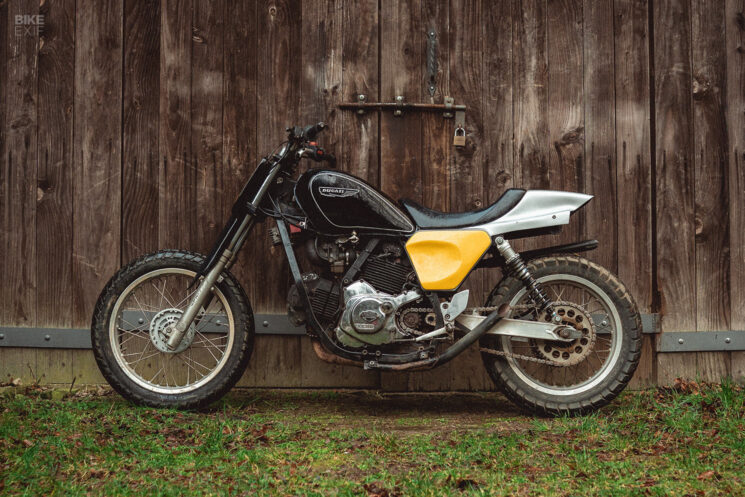
Ducati Indiana flat tracker by Francis Von Tuto
Ducati Indiana ‘Von Tracker’ by Francis Von Tuto History may have forgotten the Ducati Indiana, but those who lived it aren’t so lucky. There was a time when all the Italian marques all wanted a piece of America’s ‘factory chopper’ pie, with Moto Morini, Moto Guzzi, and Ducati all vying for a slice. The Ducati Indiana was particularly goofy, with a square-tube frame, swoopy tank, and raked front end.

When a professor from the University of Florence advertised a 1987 Ducati Indiana 650 for sale, Francis Von Tuto had a brain wave. Always on the lookout for new personal projects, Francis took pity on the maligned Ducati, and it followed him home.
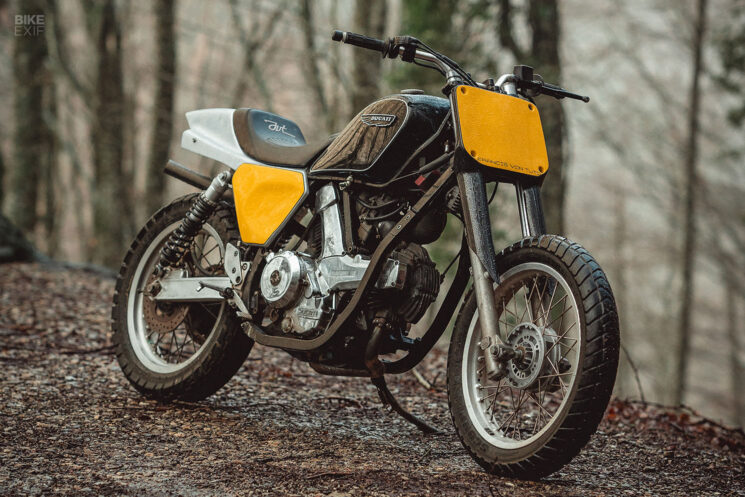
Ducati Indiana flat tracker by Francis Von Tuto
“For once, I wanted a custom motorcycle that I wouldn’t care if I scratched it, if it fell off the stand, or if I crashed it,” says Francis. “I wanted a bike I can repair quickly, that has balls, and that looks rad. A fun bike.”

The Indiana had been stored in a garden shed for years, but it had been meticulously covered in plastic wrap so it wasn’t in too bad a shape for Francis to get started. The cast wheels were ditched in favor of a 18F/17R set of spoked wheels, with the headlight, indicators, and front fender all removed. Francis set out to race the bike at the El Rollo flat track race at the popular Wheels and Waves festival, so the front brake was set aside, and flat track bars were installed with new grips and throttle mechanism.
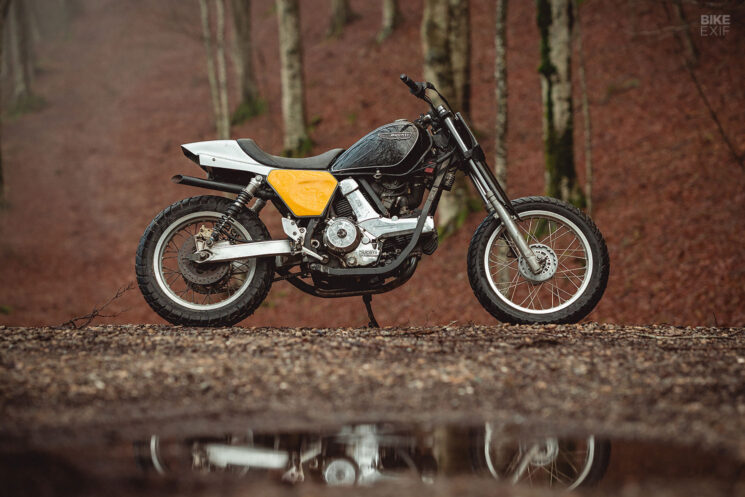
Ducati Indiana flat tracker by Francis Von Tuto
The front number plate was made from fiberglass (based on an old motocross bike that was lying around), and Francis modified a fiberglass flat track seat and side covers to fit the Ducati frame. A new seat from his friend at BF Tappezzerie was fitted. Amazingly, the bike’s frame and fuel tank were not modified in any way, but the footpegs were swapped out for less cruiser-like items from a Yamaha XJR.

The engine was given a new lease on life after it was pulled from the shed, with the factory Bing carbs replaced with 36mm Mikunis. A pair of Öhlins shocks were bolted to the back of the bike and the front forks were rebuilt with fresh seals and oil. The airbox was gutted in favor of a high-flow foam filter and the glorious Italian v-twin sound is unleashed with an open exhaust.
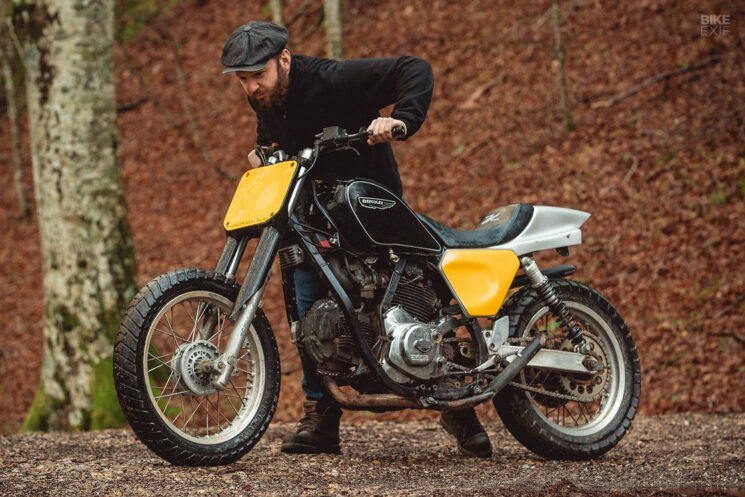
Ducati Indiana flat tracker by Francis Von Tuto
Despite eating dirt at the El Rollo flat track race (and busting two ribs in the process), Francis assures us that he’s doing okay and really enjoys riding the Indiana. He’s got plans to install a front brake and some lighting so he can get it road-registered, which is great news.

Francis has a history of turning ugly ducks into beautiful swans, and while this one is a bit rough and ready, there is a beauty in it that we can’t get enough of. [Francis Von Tuto | Images by Rafael Montañes Ruiz]
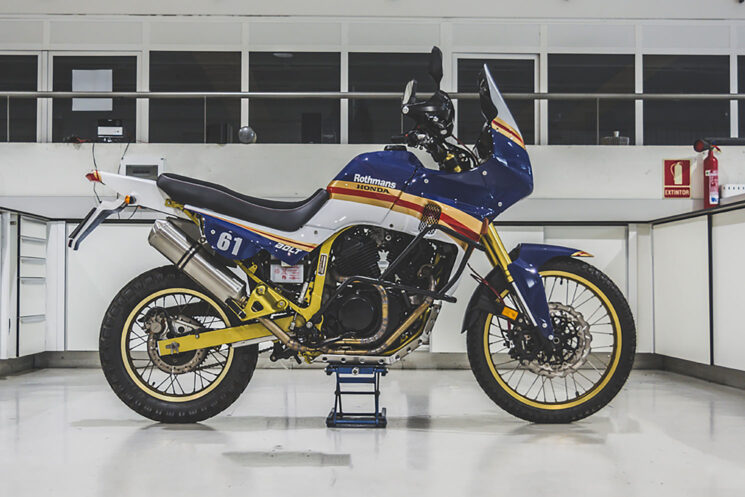
Honda Transalp by Bolt Motor Co.
Honda Transalp by Bolt Motor Co. Walk down the street in most European cities and you’ll find plenty of old Honda Transalps still kicking around. First released in 1987, the Transalp is an absolute workhorse that will probably outlast us all—which makes it a great candidate for an adventure bike restomod.

Bolt Motor Co. usually specializes in light, lithe café racers with speed in mind. But they are passionate about all things design, and particularly love the Dakar style of the 90s. So when a customer came knocking with a Transalp, the team jumped at the opportunity.
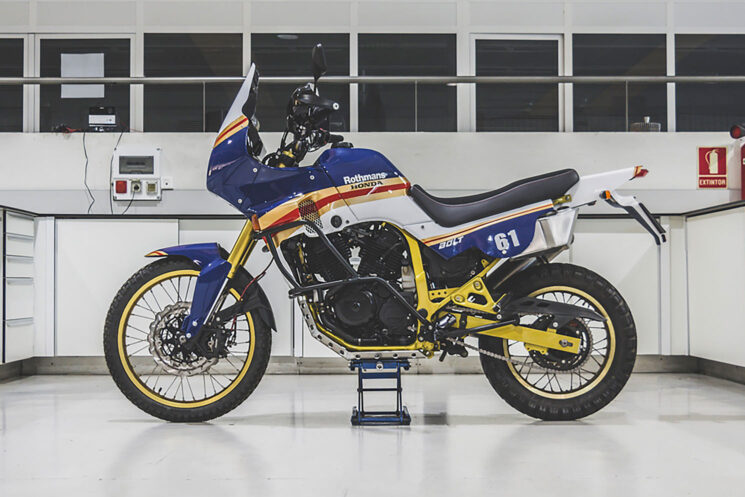
Honda Transalp by Bolt Motor Co.
The customer requested an outlandish look, but also wanted the performance to match the aesthetic. To achieve the latter, the Bolt team grafted a 2020 Africa Twin front end onto the Transalp. That added modern upside-side down forks, twin brakes, floating discs, and a new front fender to the equation.

All the factory bodywork remains, but it’s been lathered in an old-school Rothmans Honda Dakar-style livery. The windscreen was also covered, giving the factory gauges a bit more shade. The headlight was converted to LED for greater visibility, with heated grips and hand guards adding to the list of modern touches.
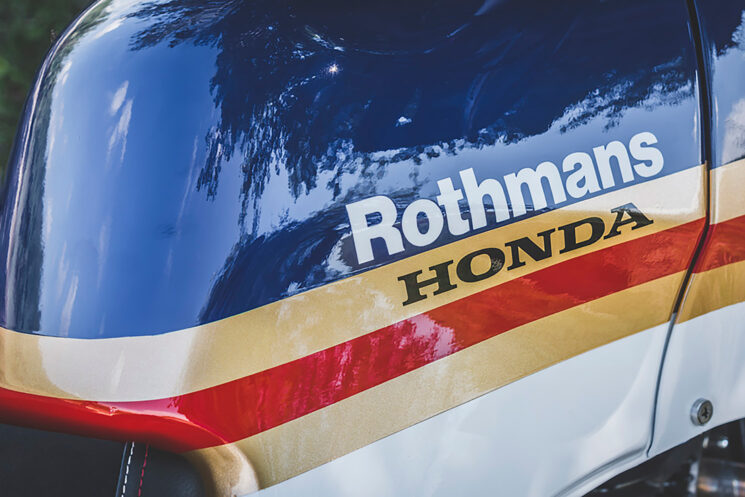
Honda Transalp by Bolt Motor Co.
The original seat was taken apart and had a gel insert embedded into it to make long days in the saddle a dream. It was then recovered in a waterproof fabric, which is handy when the going gets muddy.

The engine and electrical system were completely rebuilt for another 50 years of reliable running, but Bolt couldn’t help themselves when it came to the exhaust. They have made a custom exhaust system that snakes its way through along the frame rail to end in a stainless steel Arrow muffler. (They say it sounds pretty damn good, and we believe them.)
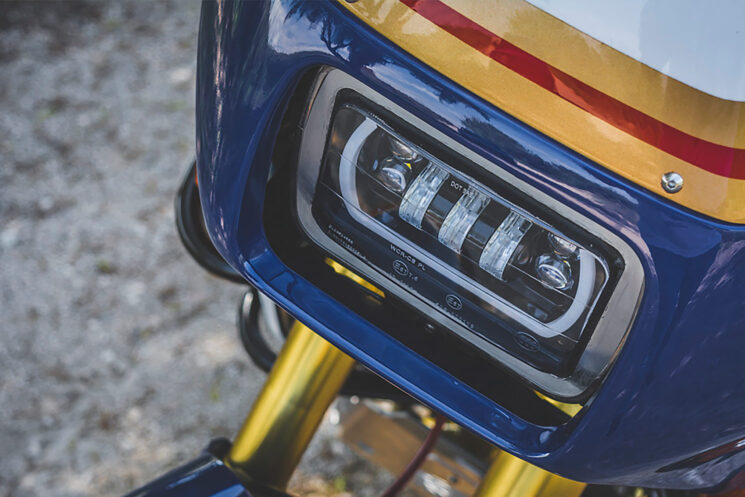
Honda Transalp by Bolt Motor Co.
To help those aforementioned long days in the saddle go even more smoothly, a one-gallon auxiliary fuel tank was mounted to the rear of the bike. Not only does it balance out the single muffler, but it also looks great and extends visits to the fuel station. The rear fender was completely redesigned, with LED lighting shrinking it down to modern proportions while still maintaining the Dakar vibe. [More]
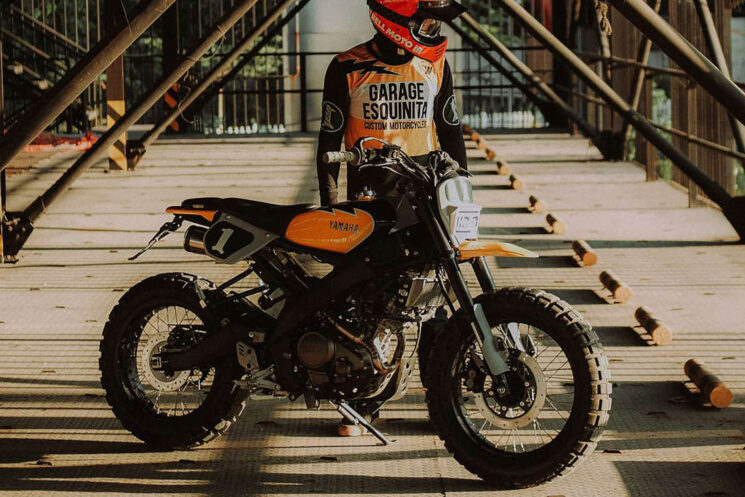
Yamaha XSR155 scrambler by Garage Esquinita
Yamaha XSR155 by Garage Esquinita Not a week goes by that we aren’t reminded of how good Yamaha’s XSR platform is for customizing. Ranging from small to large in engine capacity, stature, and price, there is truly something for everyone within the platform—depending on which country you live in.

This particular XSR showcases the work of Jed Patrick Oriña and the band of merry individuals behind Garage Esquinita. Based in the Philippines, Jed was invited by Yamaha to build a custom XSR155 for the annual Makina Moto Show. He was only one of three builders in the country to be invited, and as such, a brand new Yamaha XSR155 arrived at his doorstep a month before the show.
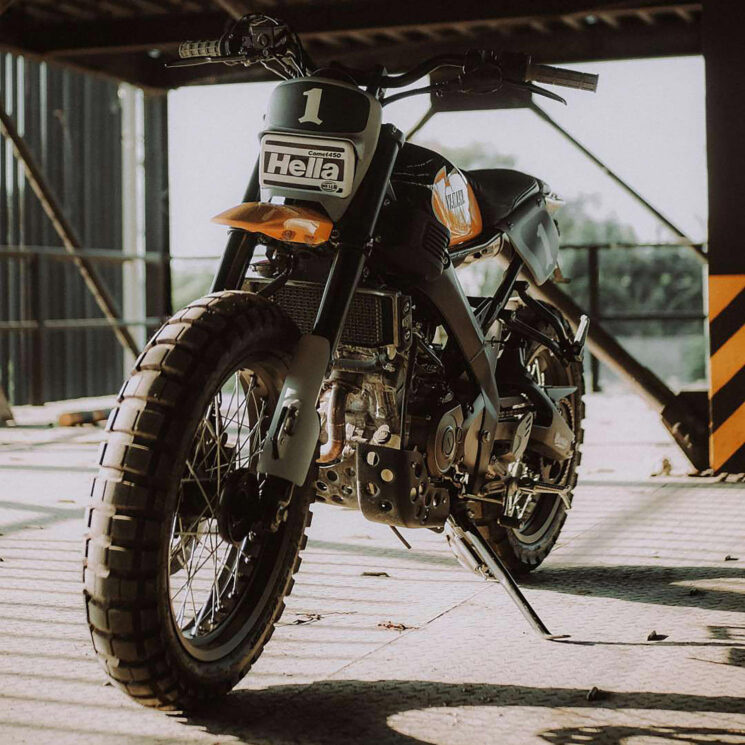
Yamaha XSR155 scrambler by Garage Esquinita
Jed is lucky enough to have a bunch of exceptionally talented craftspeople as part of his team. When the bike was rolled into the workshop, he and his two friends Karlo and Kenn got straight to work, under the watchful eye of Jed’s wife, Angela.

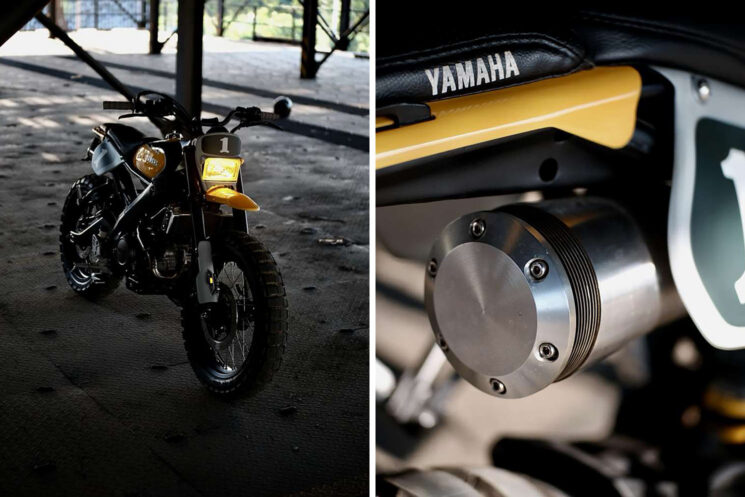
The scrambler-style build was inspired by the work of Rusty Butcher—specifically his Harley hooligan enduro. The stock wheels were replaced with spoked rims and off-road tires and the whole front end was reimagined. A Hella headlight was mounted using custom brackets and a high front fender and headlight cowl were made from scratch and fitted with an OEM-quality finish.
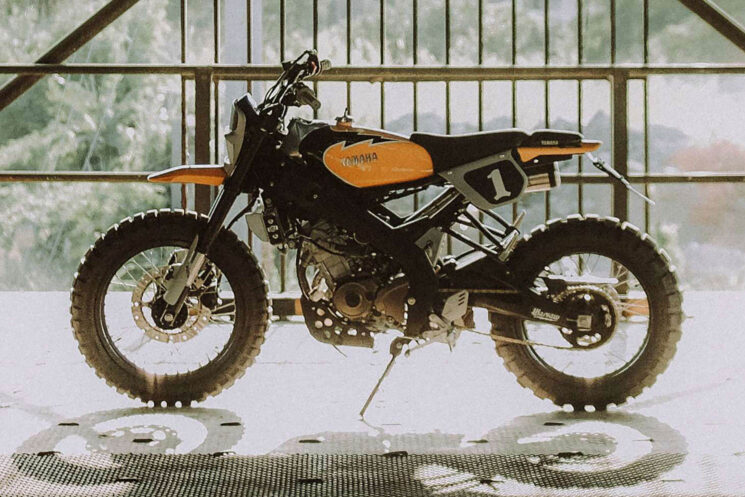
Yamaha XSR155 scrambler by Garage Esquinita
The stock tank was a little bulky for Jed’s liking, so they made a new one from scratch. Now sitting lower and with a more narrow profile, it suits the off-road vibe to a tee. To improve the look and ergonomics, the rear subframe was raised to allow the custom seat to flow into the tank, just like a dirt bike. Custom side panels were fabricated and installed, with the right-hand panel doing double duty as a heat shield for the custom exhaust.
Yamaha XSR155 scrambler by Garage Esquinita
The ignition was relocated to the left-hand side of the frame and the radiator got its own custom scoop made. The battery was hidden under the frame and Highsider LED lights were fitted up front to the custom fork guards. With the fabrication work done, a beautiful yellow, black, and white paint scheme was laid down to finish the build.

Sporting ‘1’ on the side panels and front cowl is fitting, as Jed and his team won the Makina Moto Show build-off challenge. With work this good, we can certainly see why. [Source]
Ex-Barry Sheene Suzuki TR750 at Bonhams
For sale: Ex-Barry Sheene Suzuki TR750 Although the Suzuki TR750 was based on the road-going GT750 of the time (Japan’s first liquid-cooled motorcycle), the two machines couldn’t be any different.

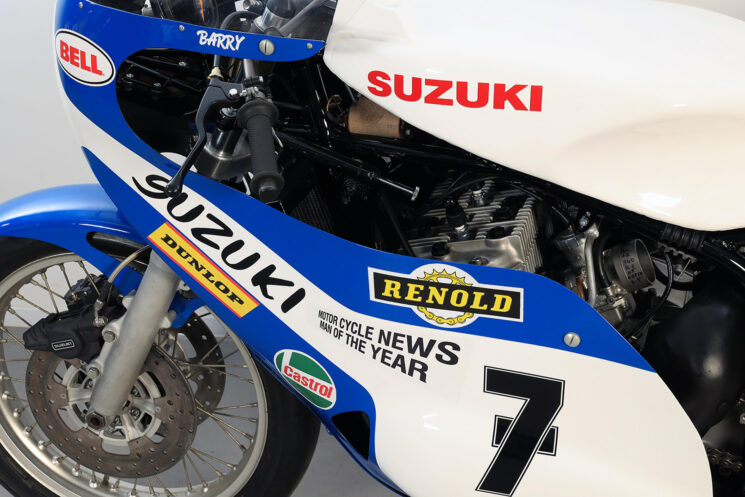
The TR750 was a thoroughbred racing machine, with its two-stroke, inline triple engine producing well over 100 hp. Triple 32 mm Mikuni carbs threw fuel down the barrels to meet fresh oil delivered by Suzuki’s ‘Crankshaft Cylinder Injection.’ To reduce weight, the frame was lightened—but this, along with reportedly weird weight distribution, may have been the reason that the highly-strung Suzuki earned its ‘Flexi-Flyer’ nickname.
Ex-Barry Sheene Suzuki TR750 at Bonhams
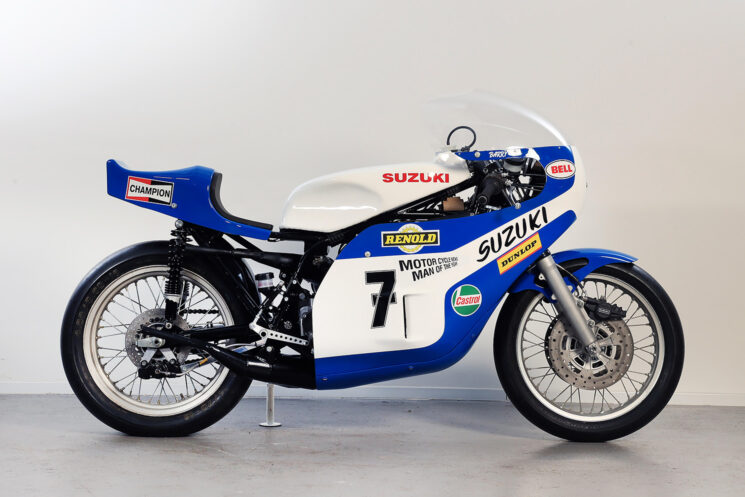
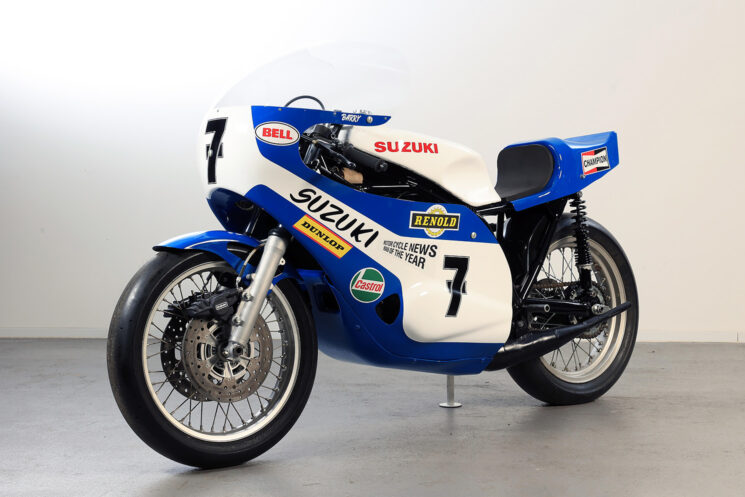
Barry Sheene, astride a Suzuki TR750, went on to win the Formula 750 championship in 1973, and was the runner-up in 1975. It must have been through sheer skill and determination that Sheene was able to bring the bike home for its brace of podiums and victories. Sheene used a number of factory race bikes in the day, with the bike shown here being produced in 1974 with the frame number GT750-45072.

Sporting a full-faring, absolutely zero rider aids, and not much in the way of comfort, this is a pure racing machine. To help harness the huge power, we’re glad to see triple hydraulic brakes and sticky racing rubber. While the blue and white livery might not be as recognizable as Sheene’s red, yellow, and black Heron Suzuki, we still think it’s just as iconic.
Ex-Barry Sheene Suzuki TR750 at Bonhams
Interestingly, 45072 was thought to have been lost some years ago, having disappeared from public record back in 1975. Sheene used this bike at Daytona in 1974, along with other races that year, including a victory at the ‘Race of the Year’ at Mallory Park. At the start of 1975, 45072 was removed from Suzuki’s listings, with everyone assuming Sheene kept the bike for himself.

With the extensive documentation that has surfaced with the bike shown here, 45072 has had quite the history. At some point, its engine was sold to a sidecar racer, with the rolling chassis ending up in New Zealand. A previous owner hunted the engine down and reunited the pair about 20 years ago.
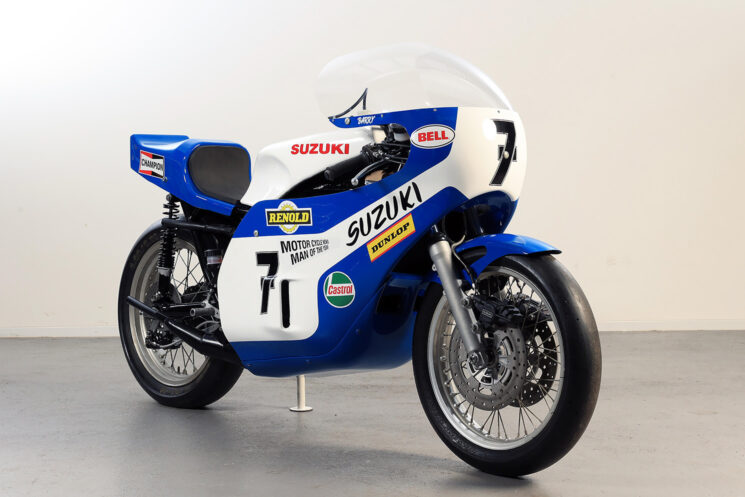
Ex-Barry Sheene Suzuki TR750 at Bonhams
A stringent restoration then followed sometime later, with the bike sporting as many original ex-Sheene parts as possible, right down to the engraved cylinder heads. Currently presented for sale by Bonhams, we’re sure this piece of motorcycle history will go for a pretty penny indeed.
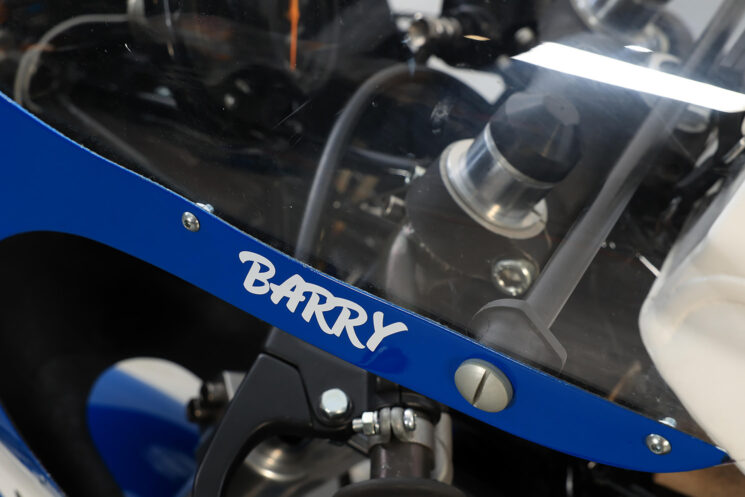
Ex-Barry Sheene Suzuki TR750 at Bonhams


from Bike EXIF https://ift.tt/ai940UY

Friday, 5 April 2024

Icon remixed: A custom Ducati Monster 821 by Jerem Motorcycles

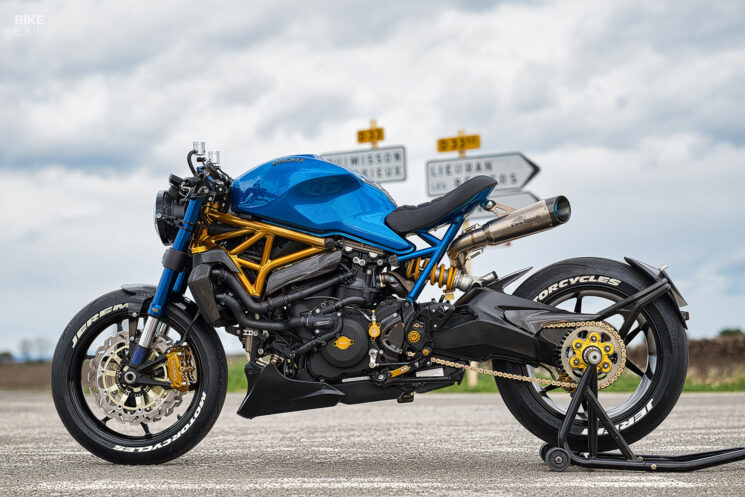
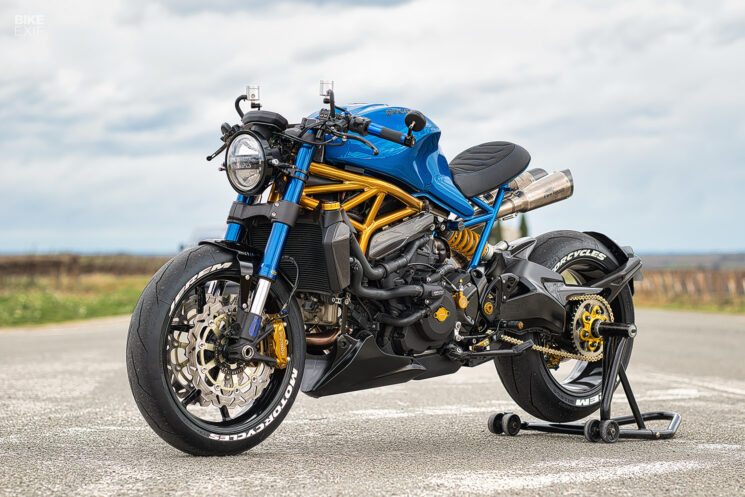
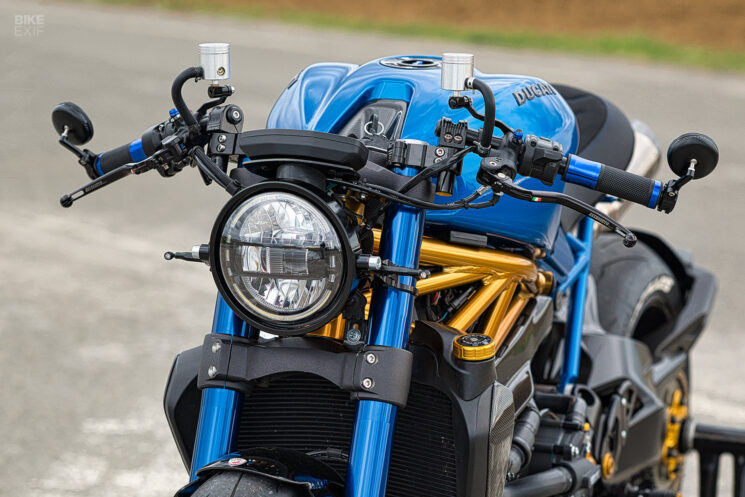
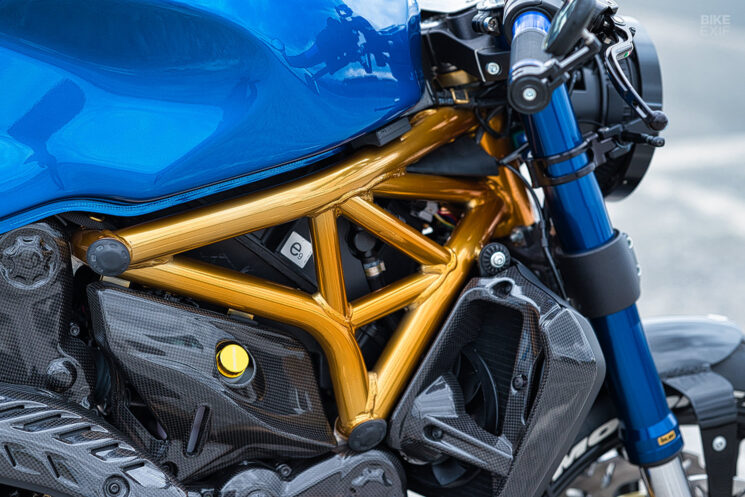
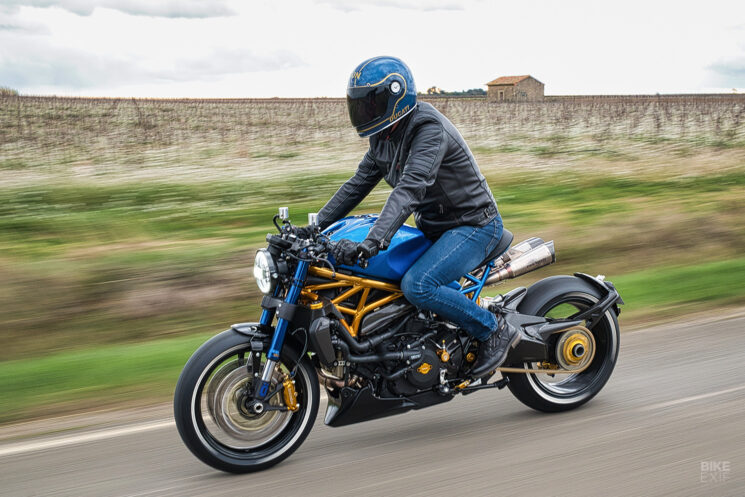
Custom Ducati Monster 821 by Jerem Motorcycles
Before Ducati took the Monster in a lamentable direction by removing its signature trellis frame and swathing it in plastic, the Ducati Monster 821 was the best new Monster you could get. Stacked alongside the smaller, air-cooled Monster 797, and the totally bonkers, liquid-cooled Monster 1200, it was more refined than the former and more manageable than the latter. The 821 was a perfectly proportioned package, packing a 112-horsepower wallop, and dripping with Italian swagger and brutal elegance.

This custom Ducati Monster 821 pulls back some of that elegance, and dials the 821’s inherent brutality up to the max. It’s the work of Jérémie Duchampt at Jerem Motorcycles in France, and it’s so audacious that we can’t help but love it.

Custom Ducati Monster 821 by Jerem Motorcycles
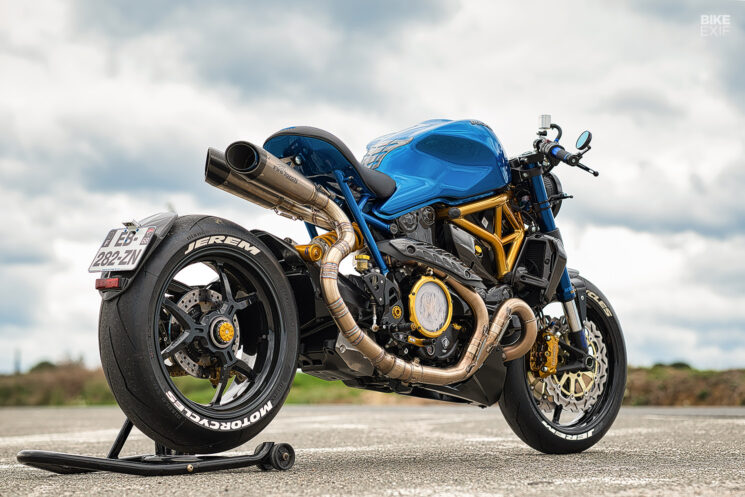
The biggest visual hit is the Monster 821’s radically redesigned rear end. Jérémie retained the OEM fuel tank but ditched everything behind it. Then he fabricated a compact trellis-style subframe, welding it directly to a new scooped seat pan.

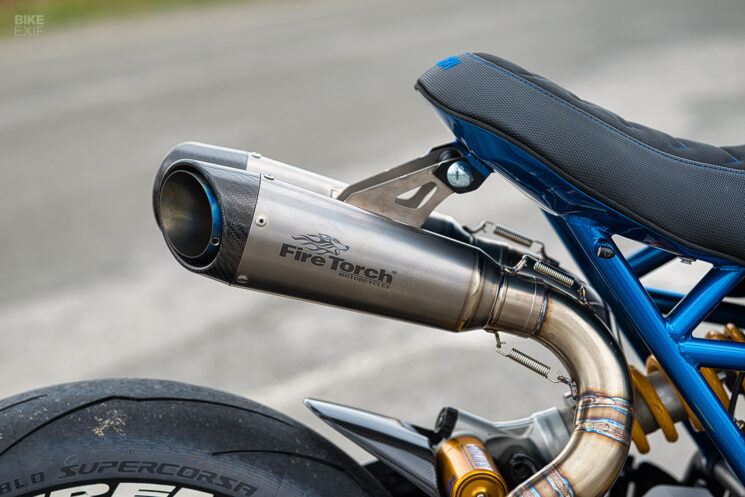
The custom saddle that sits atop it offers a similar amount of real estate as the original rider perch, sans the passenger accommodations. The upholstery is gorgeous; executed by Yaya Brush Sellerie, it uses two different fabrics with contrast stitching, giving it a modern muscle car feel.

Custom Ducati Monster 821 by Jerem Motorcycles
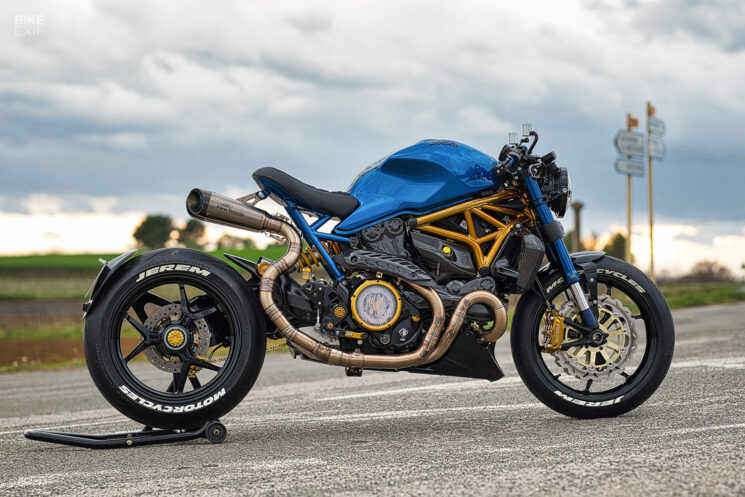
A pair of aftermarket mufflers pokes out from under the seat, paying homage to the under-seat exhaust systems on older Monsters. The cans are linked to the stock headers by way of handmade connector pipes. And if you take a closer look at the subframe, you’ll spot a pair of Kellermann combination taillight and turn signal LEDs, mounted on integrated stems.

Perceptive Ducatisti will notice that the 821 no longer wears its dual-sided swingarm. Instead, Jérémie adapted the burly single-sided unit from a Monster 1200S to fit. An Öhlins shock props up the rear.

Custom Ducati Monster 821 by Jerem Motorcycles
Jérémie also transplanted the bigger Monster’s wheels, which meant having to machine a handful of parts to make them fit. The 821 still uses its stock forks and Brembo brakes, but they’ve been rebuilt and anodized. Fresh discs and pads ensure that the Monster stops as good as it looks, while Pirelli Diablo Supercorsa tires optimize the bike for road use.

Next, Jérémie threw a truckload of delectable Ducati-specific hop-up parts at the 821. The list includes a hydraulic clutch conversion from Ducabike, a CNC Racing clutch slave cylinder, a GB Racing water pump, and upgraded plumbing.

Custom Ducati Monster 821 by Jerem Motorcycles
The cockpit features new clip-ons, with a Jerem-branded nameplate blanking off the original riser mounts. Jérémie kept the OEM switches and dashboard, but swapped out the grips and added CNC-machined bar-end mirrors. The brake and clutch controls are from Accossato, and the rear-set foot controls are from CNC Racing.

The front end is finished off with an LED headlight and Kellermann turn signals, mounted on custom headlight brackets. A handmade aluminum fender sits further down, while a custom belly pan adds a sporty touch to the Ducati.

Custom Ducati Monster 821 by Jerem Motorcycles
The Monster 821’s bold new aesthetic is bolstered by an even bolder livery. A candy alpine blue dominates the build, adorning the forks, fuel tank, and subframe. Gold acts as an accent color, coating a few select hard parts and the 821’s trellis frame, while visually connecting the top frame tube to the yellow rear shock spring.

The powertrain is almost completely blacked out. That’s partly thanks to an unending list of carbon fiber covers, but it’s also thanks to the wrinkle-black paint on the ignition cover.

Custom Ducati Monster 821 by Jerem Motorcycles
Boldly nicknamed ‘Icon,’ Jérémie’s reimagining of the Monster 821 is brash and unapologetic, but also tastefully executed. We certainly wouldn’t turn down a ride.

Jerem Motorcycles | Instagram

Custom Ducati Monster 821 by Jerem Motorcycles


from Bike EXIF https://ift.tt/zr807XH

Thursday, 4 April 2024

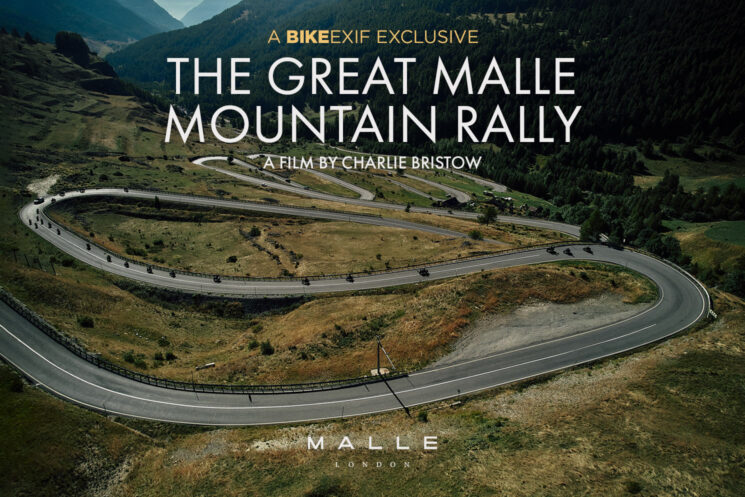
Short film: Crossing the Alps with the epic Great Malle Mountain Rally

A short film of the cross-Alpine Great Malle Mountain Rally
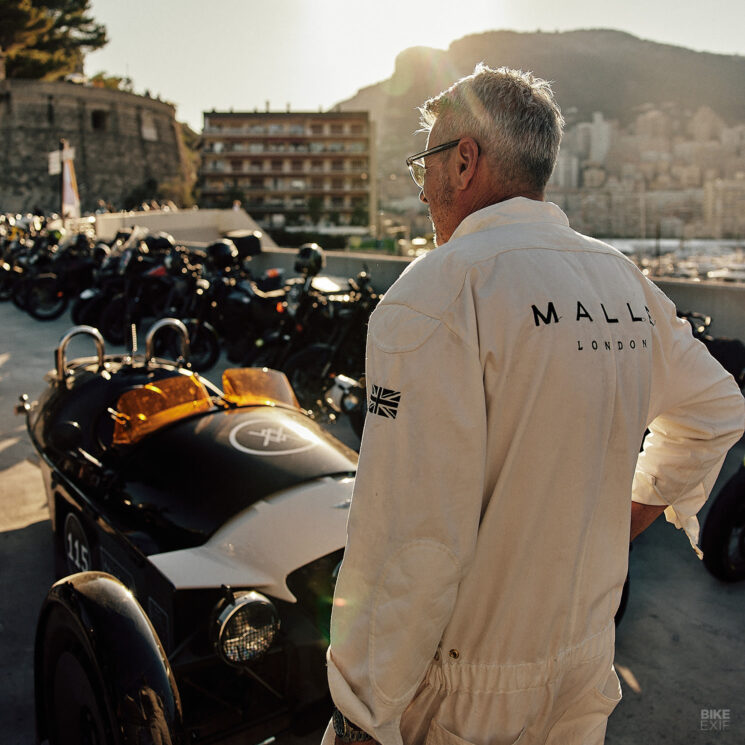
Our friends at Malle are nothing if not adventurous. When Robert Nightingale and Jonny Cazzola aren’t designing impossibly stylish motorcycle luggage from their London HQ, they’re out on the road testing that gear during the myriad events they organize annually. Events like the epic Great Malle Mountain Rally.

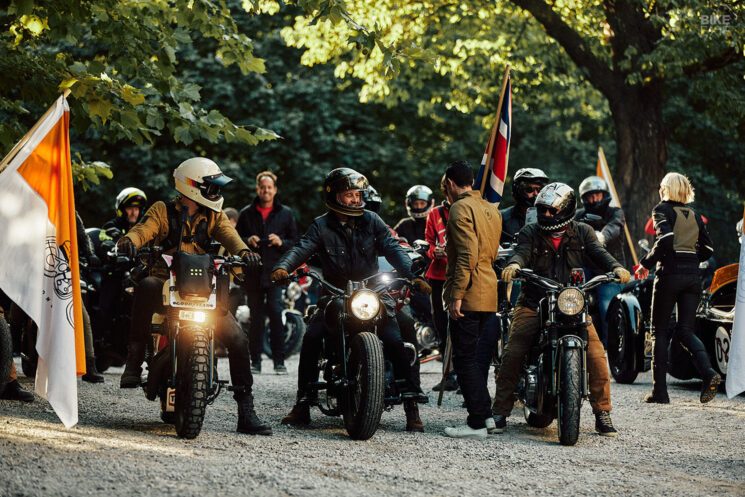
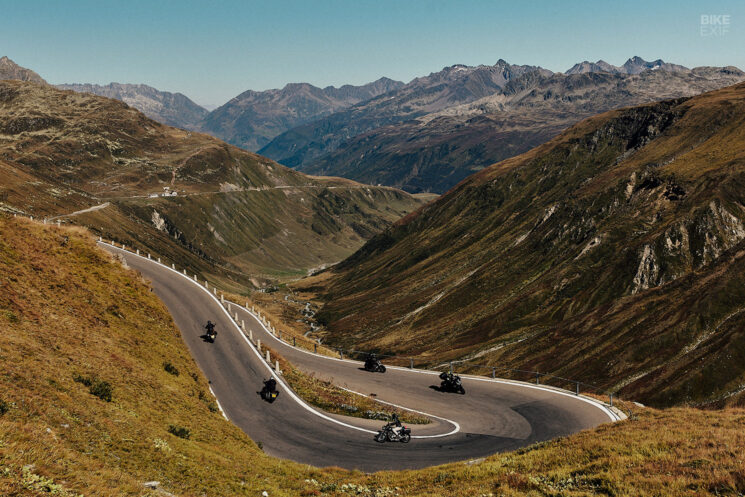
The Great Malle Mountain Rally is a supported 2,000-kilometer [1,243-mile] regularity rally, stacked with around 100 riders of custom, classic, and modern-classic motorcycles. Running over six days, the event starts in Austria and ends in Monaco. But what makes it so ambitious, is that it runs across the entire Alps mountain range—from east to west, and north to south.

Filmmaker Charlie Bristow joined the Malle team for the most recent running of the Mountain Rally, to capture the scenery, camaraderie, and madness associated with traversing the Alps with 99 other like-minded loons. His 12-and-a-half minute-long short film [above], which was screened last night in London, is a breathtaking snapshot of a ride that currently sits high on our to-do list.

Charlie documented the event from three wheels, strapped into a Malle’s radical rally-spec Morgan Super 3. That meant he could get closer and lower to the riders, immersing himself in the Rally as it crossed the Alps.

The Great Malle Mountain Rally
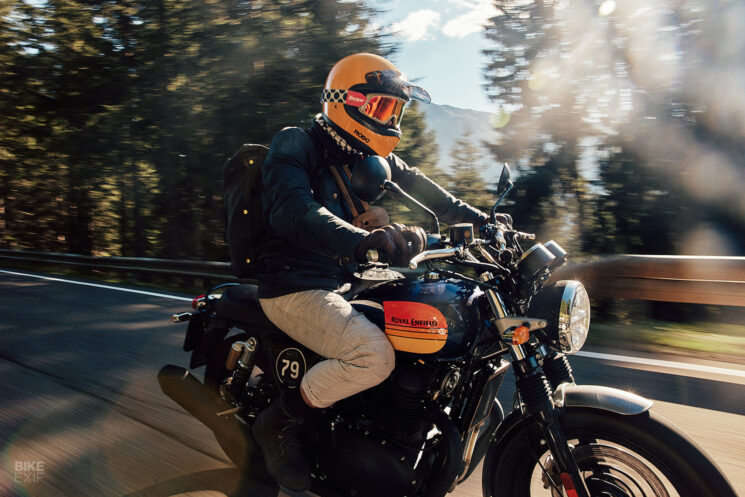
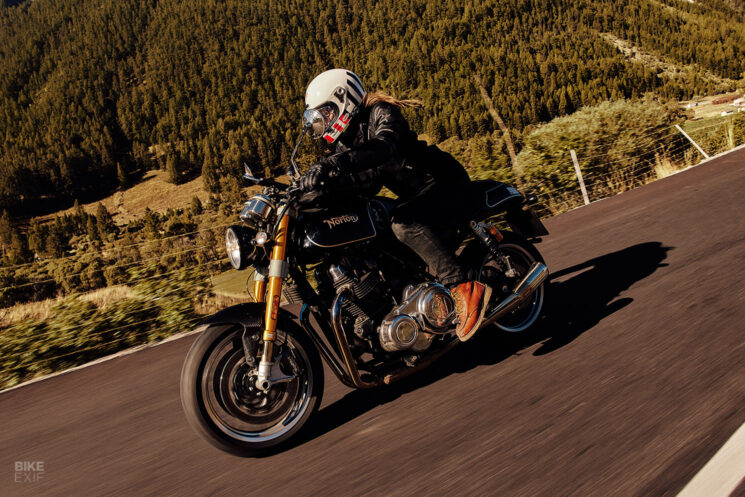
This edition of the Great Malle Mountain Rally was stacked with everything from a highly-customized Harley-Davidson Pan America, to other new and old Harleys, Royal Enfield 650s, Nortons, classic Paris/Dakar BMW boxers, and a handful of Triumph Scramblers and BMW R nineTs. Riders covered around 300 to 350 km [186 to 217 miles] each day while crossing five checkpoints and being timed by Malle’s team of marshals.

That sort of daily mileage doesn’t sound too nuts, but once you throw the highest roads in the highest mountains in Europe into the mix, along with unpredictable weather, and it soon becomes an endurance adventure. Riders compete in teams (some of which are put together on the starting line), where the focus is not only on completing each stage but taking care of each other too—all while enjoying some of the world’s best motorcycle riding.

The Great Malle Mountain Rally
As a regularity rally, the goal isn’t speed, but rather consistency. Speed limits must be adhered to, so the trick is to complete each stage as close to the allotted time as possible. A minute early or a few seconds late, and your team loses points.

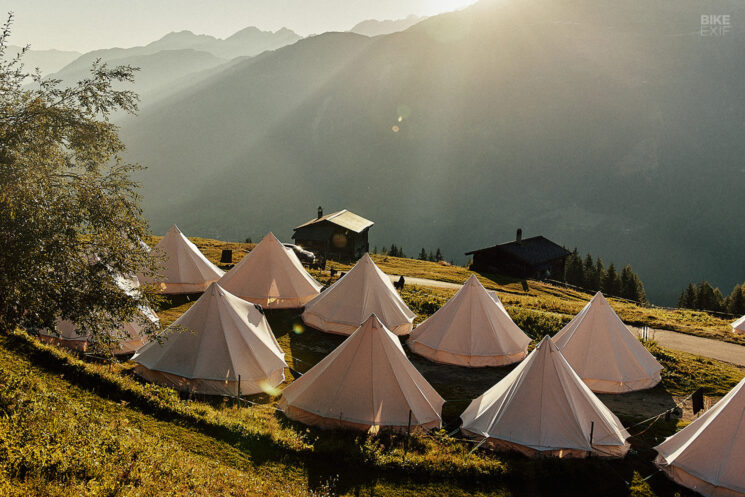
“On paper, it sounds like a very strange idea—strapping 20 liters of petrol between your legs, then setting fire to it slowly as you embark on the largest game of hide and seek across the entirety of the Alps mountain range,” says Robert. “But when you find yourself 2,500-plus meters up on the side of a mountain, in some remote checkpoint, staring across snow-capped peaks, downing strong Italian coffee and swapping rushed stories from the stage before, with a load of motorcycle-obsessed friends from all over the world… the camaraderie is like nothing else!”

The Great Malle Mountain Rally
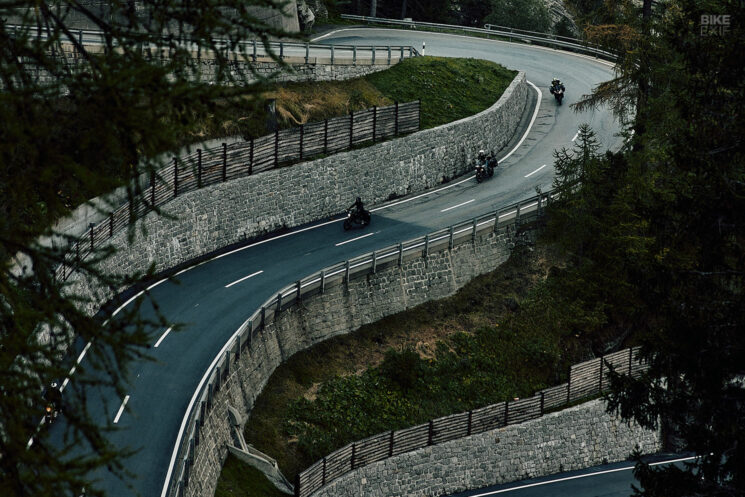
“All of us are in it together, working towards one single goal—to get every man, woman, and motorcycle across that finish line with as much fun and adventure as possible. For that one week, we get to escape the world, we just ride and ride. With a long-distance adventure like the Mountain Rally, it becomes so mediative—body and machine become one and your mind gets into this flow state, taking on 57 hair-pin bends back to back.”

“It takes pure concentration, but you get proper time in your crash helmet to think. Then to see the Alps through the eyes of new riders each year is amazing. When riders from downtown Los Angeles or Tokyo see some of these tiny rural places, it can be pretty mind-blowing.”

The Great Malle Mountain Rally
The Great Malle Mountain Rally takes on all of the well-known mountain passes, like Stelvio, Furkha, Splugen, Gotthard, San Bernardino, Col d’Iseran, and Passo Rollo, but also connects many lesser-known roads and Alpine passes. “The famous passes like Stelvio are great,” says Charlie, “but most people just do the famous hairpin bend section on the south side and then go back down the same way again. If you carry on to the ‘dark side’ of Stelvio it becomes really wild, with huge alpine forests that go on forever.”

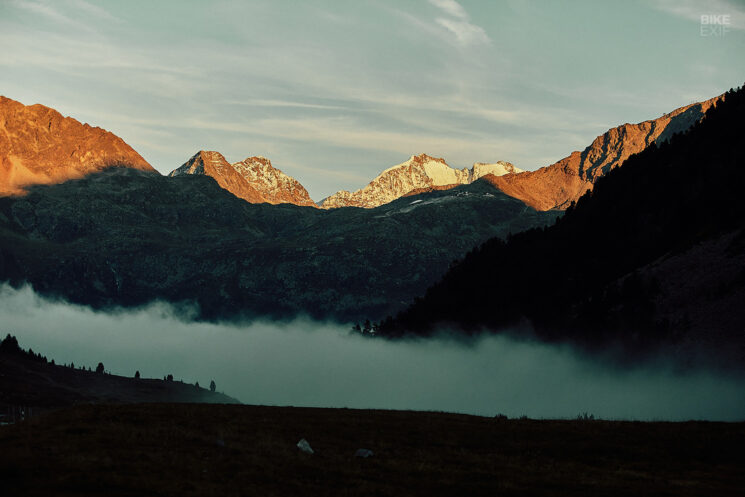
“When we were coming down the Maloja pass, we just caught the golden sunset at the top. Nearly all of the teams were back at the camp by then, but as the film team, we’re usually the last ones in, with the marshals and support crew. We were coming down to Maloja, and suddenly, as we turned the bend, there was this huge perfectly flat sheet of cloud, maybe 500 meters thick, in the valley.”

The Great Malle Mountain Rally
“As we plowed into the thick cloud layer beneath us, temperatures and visibility dropped dramatically, and we blindly followed the distinct sound of the three custom Malle Rally Royal Enfields to navigate the way. As we hit the lake on the valley floor, the cloud gave way slightly and I got these amazing shots of the final team all coming into camp. Riding above the clouds is something pretty wild.”

Several custom motorcycle builders also joined the Malle Rally team, including Alec Padron from Revival Cycles and Calum Pryce-Tidd from deBolex Engineering. “I feel really privileged to be a part of the Malle Rally crew,” says Calum, who’s been the lead engineer on the Rally for seven years now. “It’s one of the best weeks of the year, where I finally get out of the workshop and get to really ride bikes.”


“There are always mechanical challenges and very little sleep, but a big highlight for me was the 2022 Mountain Rally where we had two of our custom bikes on the adventure—a dB25 Ducati and our Kawasaki ZRX1200R. Being tucked up behind one of our projects and watching it dance around each bend was a really special moment.”

The Malle Rallies also attract their fair share of classic motorcycles. Alex Coco has now completed three Malle Rallies on various vintage machines, choosing a 1980 BMW R80/7 this time around. “I wasn’t on the oldest bike this year,” he says, “but it’s two of my favorite things: motorcycles and mountains.”

The Great Malle Mountain Rally
“There’s a stillness in the mountains that you just can’t get anywhere else. Mountains make you think. One’s riding improves with every bend or switchback. Nothing feels better than the stillness of the mountains against the noise of a classic motorcycle.”

We’re certainly convinced—which is why we’re marking our calendars for The Great Malle Arctic Rally in 2025.

Malle London | Facebook | Instagram | Images by Shane Benson | Short film by Bristow Films


from Bike EXIF https://ift.tt/izHkD9f

Wednesday, 3 April 2024

Fujara: A wispish Yamaha Virago café racer from Slovakia

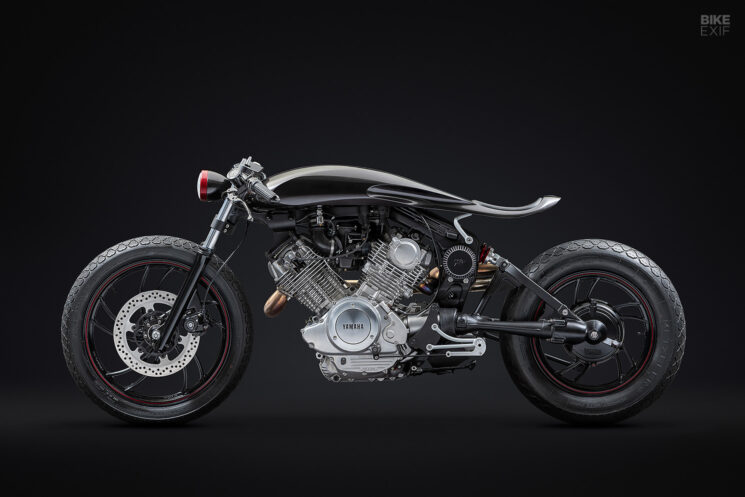
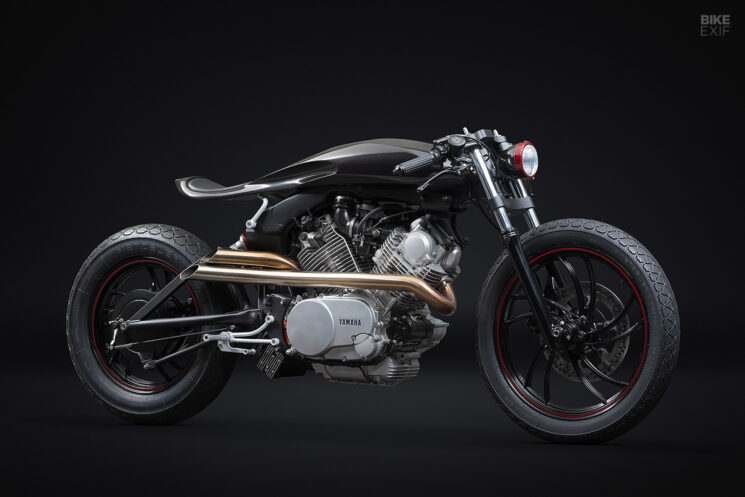
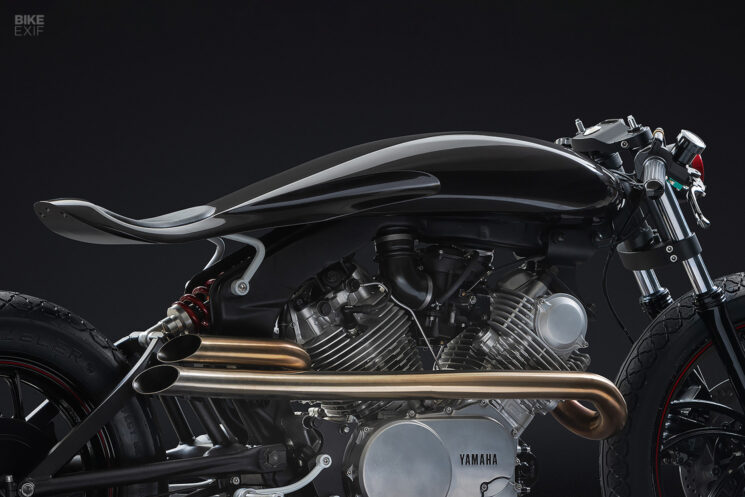
Yamaha Virago café racer by Earth Motorcycles
They say that you can’t make a silk purse out of a sow’s ear, but no one bothered telling Earth Motorcycles that. The Slovakian custom shop has just built an elegant and somewhat alluring café racer out of the most unlikely donor; a Yamaha Virago.

It’s not that Yamaha Virago café racers are uncommon—they’re just really hard to get right. In stock trim, the Virago boasts one of the most awkward layouts in modern motorcycling. So it takes a shrewd approach, and a little left-field thinking, to massage it into shape.

Yamaha Virago café racer by Earth Motorcycles
Earth Motorcycles circumnavigated those challenges, by choosing to highlight an unusual aspect of the oddball Virago. This build is all about what attracted Earth’s founder, Vlado Dinga, to the bike in the first place—its motor. Or, more specifically, the way the motor is mounted.

“Obsessed with the idea of a V-twin engine mounted from above, giving it a somewhat levitating feel, I decided on a Yamaha XV920 Virago as a donor bike,” Vlado tells us. Set on building a café racer—but also wanting to steer clear of typical café racer designs—he decided to cover the Virago in wispish bodywork that would accentuate its stonking V-twin mill.

Yamaha Virago café racer by Earth Motorcycles
“With that idea in my head,” he continues, “I approached an industrial designer, Konstantin Laskov from Sofia, Bulgaria. My design brief was to come up with a subtle shape, contrasting with the big engine, and respecting the core of the bike—the floating engine and the curved frame. On a philosophical level, the request was to follow three keywords: freedom, wind, and air.”

“Konstantin came up with a few sketches and finally delivered a simple idea of a single tight curve, with a peak above the engine and two tangents at the wheels. This became our design mantra.”

Yamaha Virago café racer by Earth Motorcycles
Vlado and Konstantin bounced some ideas around, eventually settling on a monocoque body. With the design fully rendered in 3D, it was time to bring it to life.

This all transpired a few years ago, before Earth Motorcycles was fully established. Around that time, Vlado’s fabricator friend, Aleš Tomis, moved from England back to Slovakia. Vlado brought him onto the Virago project and the two joined forces.

Yamaha Virago café racer by Earth Motorcycles
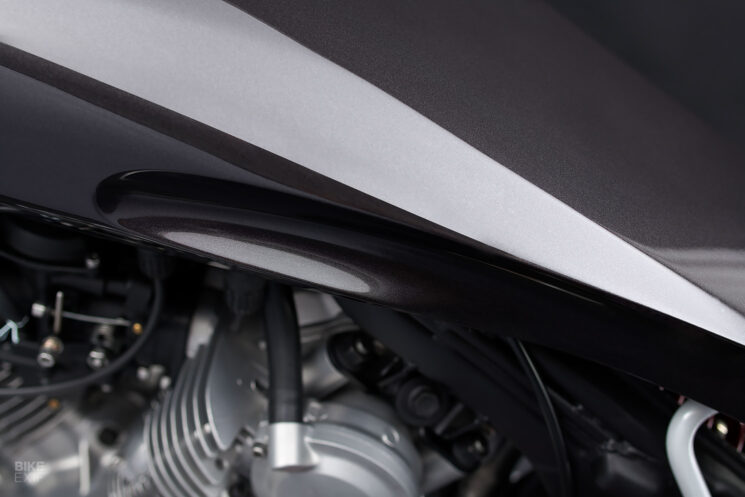
Taking the svelte bodywork from concept to reality was no walk in the park though. The guys wanted to use a production method that they could replicate, so they experimented with milling, casting, and 3D printing the body. In the end, they settled on good old-fashioned fiberglass, using a positive wood mold to create the final negative fiberglass mold.

That negative mold was then used to lay up the gorgeously sculpted one-piece body. It might not hold a lot of fuel or offer a lot of seating space, but it sure looks incredible.

Yamaha Virago café racer by Earth Motorcycles
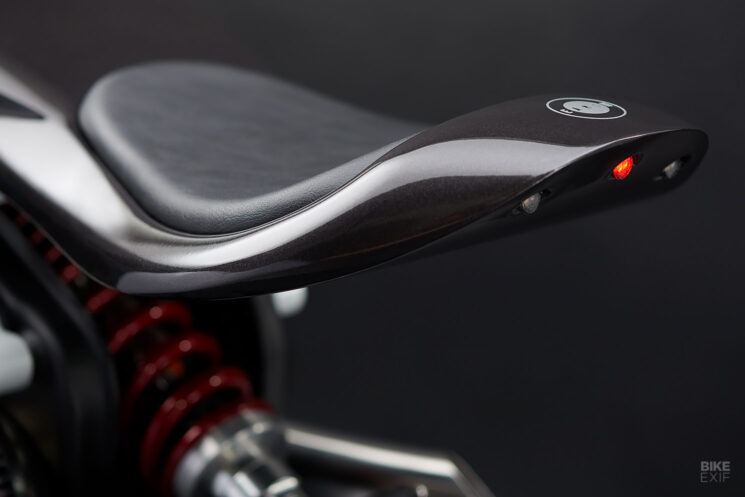
A flush-mounted gas cap does duty up front, while a slim seat pad sits neatly at the back, tucked into a recess in the bodywork rather than just slapped on top of it. Three LEDs are embedded into the tail; one each for the taillight and turn signals. Everything was carefully considered—from the deep paint to the subtle Earth branding.

The subframe that supports the Virago’s new body is equally graceful. A pair of handmade brackets mount directly to the bike’s stamped frame, arching upwards to support a baseplate under the rear half of the monocoque. That design is mirrored lower down in the custom-made rear sets.

Yamaha Virago café racer by Earth Motorcycles
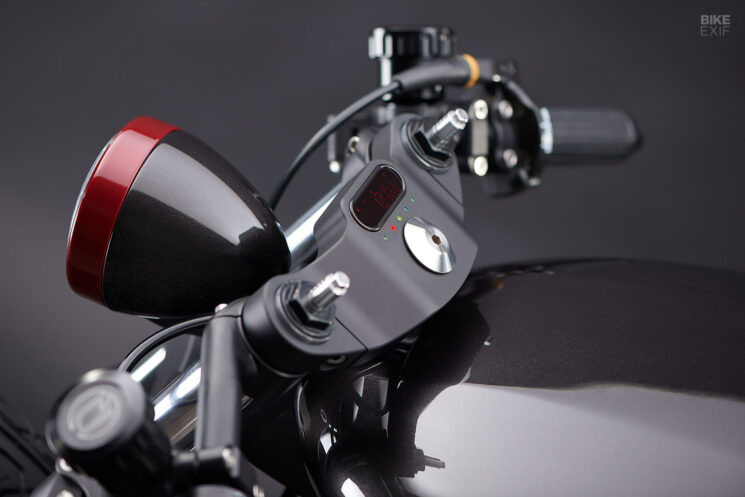
Moving to the cockpit, Earth rebuilt everything around a set of custom yokes. A Motogadget speedo sits flush in the top yoke, just above a row of LED warning lights. New clip-ons are fitted with Motogadget grips and switches, alongside upgraded levers and reservoirs, and LED bar-end turn signals.

The real trick here is that the flowing bodywork isn’t at odds with the Virago’s frame and boxy swingarm (which, admittedly, has been altered somewhat). That’s partly down to Earth’s judicious use of finishes. Most of the hard parts have been blacked out, while the freshly rebuilt engine shines as the centerpiece of the build.

Yamaha Virago café racer by Earth Motorcycles
Vlado took another brave decision, by retaining the Virago’s OEM wheels instead of swapping them for something a little less 80s. “During design research,” he says, “I came across dozens of modified XVs, but none of them used the original alloy wheels (except for some light shed modifications, naturally). But to me, the wheels had something unique in their structure and design.”

In the end, Vlado realized that the only thing he didn’t like about the stock wheels, was the inner ridges that ran between all of the spokes. So the guys milled those out, then finished the wheels in black with red accents.

Yamaha Virago café racer by Earth Motorcycles
There are other slick details strewn throughout the bike—like the way Earth has mounted a beefy K&N filter directly to the in-frame ‘airbox.’ Even the drag-style exhaust system has a rationale behind it. It’s designed to juxtapose the curved nature of the bodywork, with a philosophy of the bodywork being the sky and the exhaust being the earth.

“The pipes became a central visual element of the bike and gave the bike its name, ‘Fujara.’ In Slovak culture, a fujara is a traditional straight flute, used mainly by shepherds.”

Yamaha Virago café racer by Earth Motorcycles
No doubt this Virago is louder than a Slovakian flute—and it’s unlikely to be particularly comfortable to ride for more than a short blast. But it sure is nice to look at.

Considering how radically Earth Motorcycles has transformed the venerable Virago, we’re keen to see what other oddball donor bikes they can work their magic on. Any requests?

Earth Motorcycles | Images by Marian Svitek

Yamaha Virago café racer by Earth Motorcycles


from Bike EXIF https://ift.tt/p2vLObP

Tuesday, 2 April 2024

Revealed: The all-new 2025 Indian Scout looks to the past

2025 Indian Scout 101
Motorcycles are becoming more complex by the minute. All the technological frou-frou that the modern market demands makes it harder to create heritage-focused machines with clean lines and minimalistic styling. Released today, the brand new Indian Scout is a refreshing take on the tension between modern and classic.

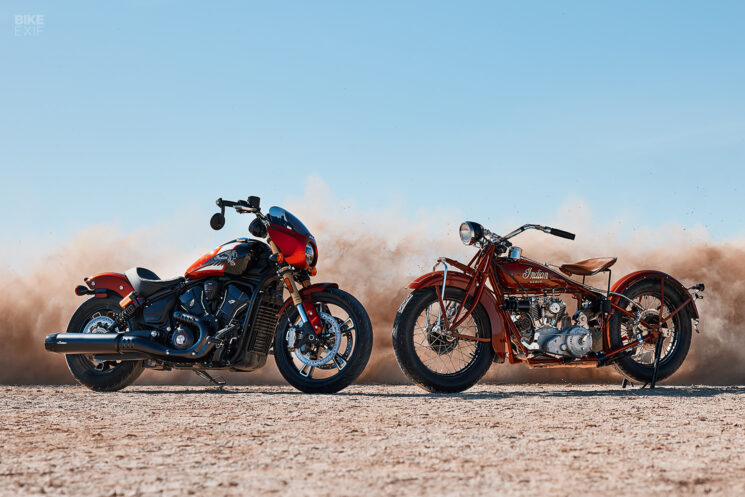
The Scout moniker is one of the oldest in motorcycling. First used on the 1920 Indian Scout, it has been associated with legends like Ed Kretz and Burt Munro, and the Indian Wrecking Crew that dominated AMA racing in the 1950s. The 2025 Indian Scout taps into this heritage in every way it can.

2025 Indian Scout 101
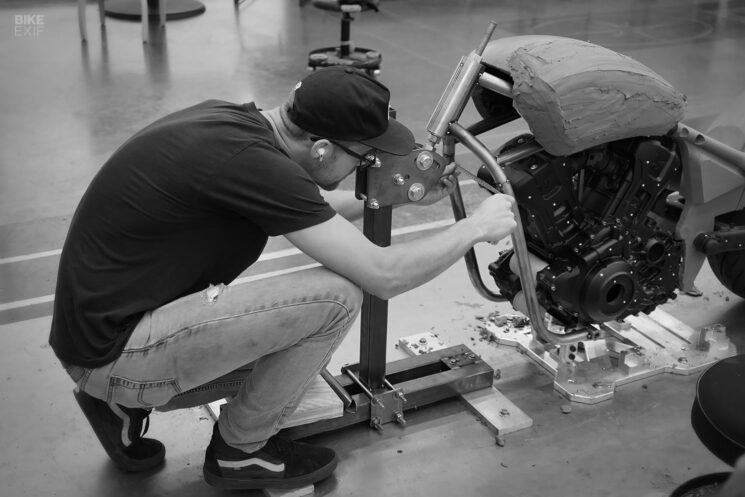
“Our top priority was to uphold the iconic namesake of Scout and ensure the new lineup is as timeless as all its predecessors,” says Ola Stenegärd, Director of Industrial Design at Indian Motorcycle, who spearheaded the Scout’s redesign. “For us, it was imperative to keep it clean, follow the iconic lines of Scout, and create a package that offered seamless customization. To achieve this, it all started with the steel tube frame and all-new, V-Twin engine.”

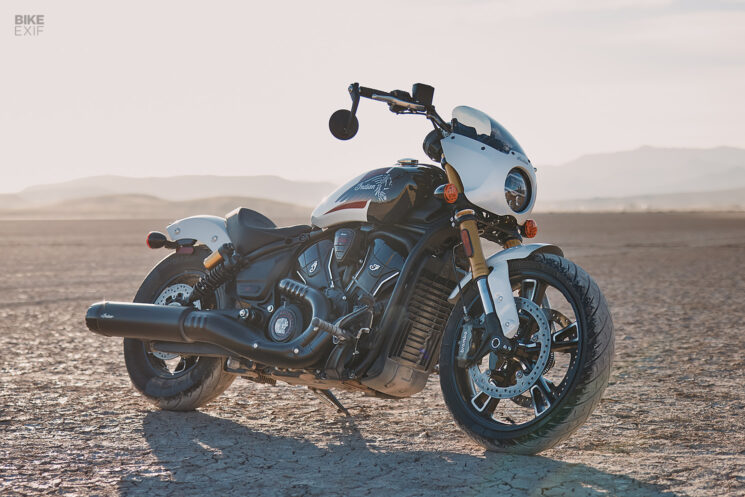
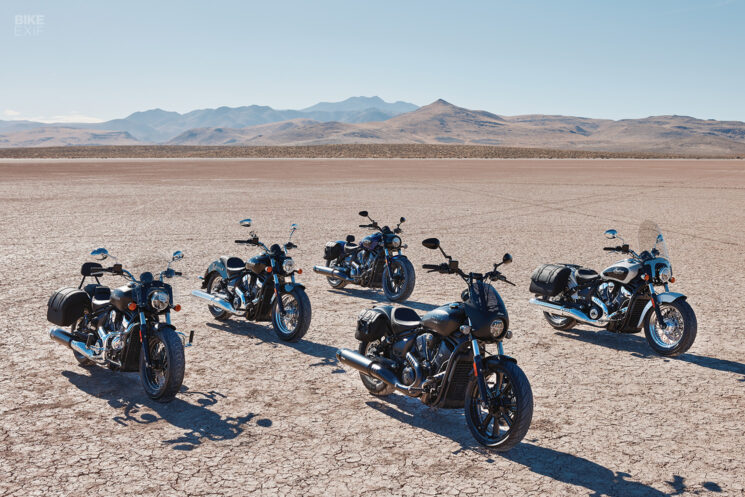
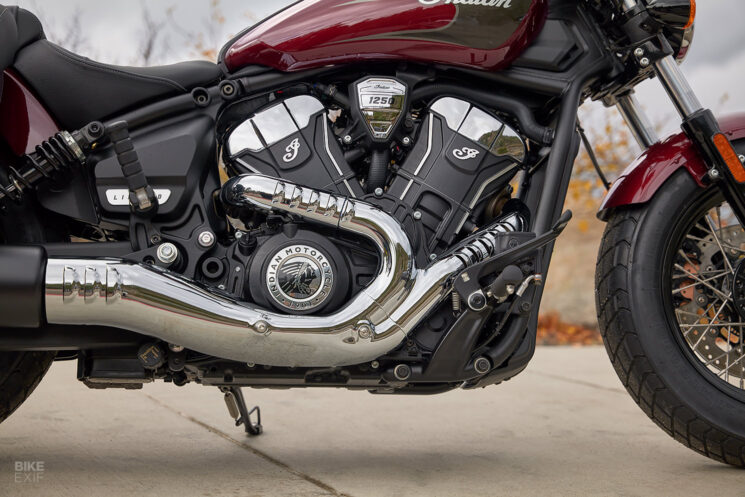
Redesigned from the ground up, the new Scout platform is shared across five models, including the Scout Bobber, Scout Classic, Sport Scout, Super Scout, and 101 Scout. Each is powered by Indian’s all-new, liquid-cooled 1,250 cc ‘SpeedPlus’ V-twin engine. With an extra 120 cc over the outgoing Scout motor, it makes between 105 and 111 horsepower at 7,250 rpm (depending on the model and trim), and 108 Nm of peak torque at 6,300 rpm.

2025 Indian Scout 101 range
On the tech side, the Scout gets ABS, traction control, and selectable rider modes (this, too, differs by model and trim). The transmission is a six-speed affair, the clutch is hydraulic, and power is delivered to the back wheel via a belt drive.

The Scout’s engine makes no bones about its liquid cooling, with a fin-less design that looks contemporary without looking tacky. If I’m being honest, I miss the machined details on the old Scout’s power plant—but this is a good-looking mill, nonetheless. The mostly-black donk is trimmed with contrasting lines and Indian logos, and some models get chromed heads.

2025 Indian Scout 101 development
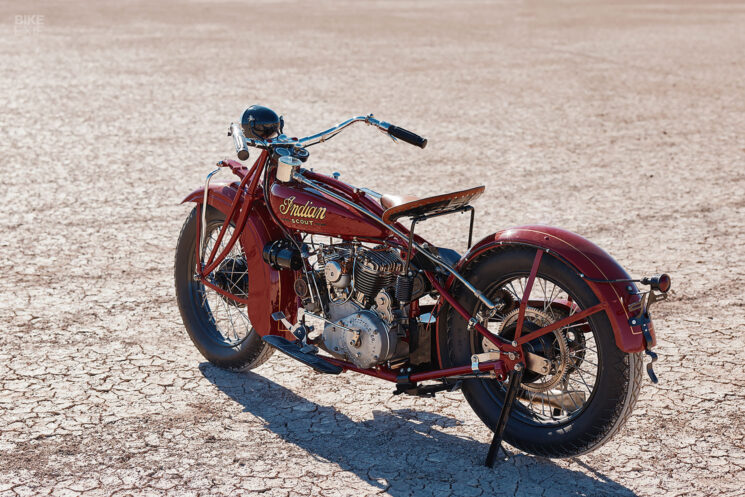
It’s packaged in an all-new steel tube frame, designed with the 1929 Indian Scout 101 in mind. Sure, if you park the brand-new Scout next to the iconic 101, you’d have to squint to see the resemblance; it is a 95-year-old motorcycle, after all. But talking to Indian’s designers via conference call, it’s clear that the 101 informed many nuanced design details on the new bike.

The new Scout’s swooping frame downtubes are a nod to the past, and if you trace a line around the Scout’s redesigned fuel tank and through its twin inline shocks, you’ll see shades of the 1929 Scout 101’s silhouette. The new tank sits a little further back now too, exposing more of the frame’s neck junction—a trick that Indian recently used on the new Indian Chief.

2025 Indian Super Scout
Indian has done an admirable job of finessing some of the Scout’s unavoidable modernities. The two-into-one exhaust system is predictably gargantuan, and the sprocket and chain cover on the opposite side of the bike is an eyesore (which is probably why Indian’s press materials contain barely any photos of the Scout’s left-hand side). But bits like the radiator and neck-mounted air intakes are tucked away nicely, adding functionality without adding bulk.

The fact that the rear shocks are ever-so-slightly off being perfectly in line with the frame rails wreaks havoc on my obsessive tendencies. On the flip side, the exposed bit of frame under the seat, and the way that the side covers are integrated with the chassis’ machined junctions, are neat touches. Keen eyes will also notice that the Scout’s rear fender struts are now hidden ‘inside’ the rear fender, decluttering the design further.

2025 Indian Scout Bobber
It’s easy to nitpick the Scout’s refreshed layout, but the one big win here is that it looks tidier than the outgoing model—which wasn’t ugly to begin with. It’s also good to see that Indian has shrunk the bloated Scout line-up to just five models, with each bike’s intended audience now a lot clearer.

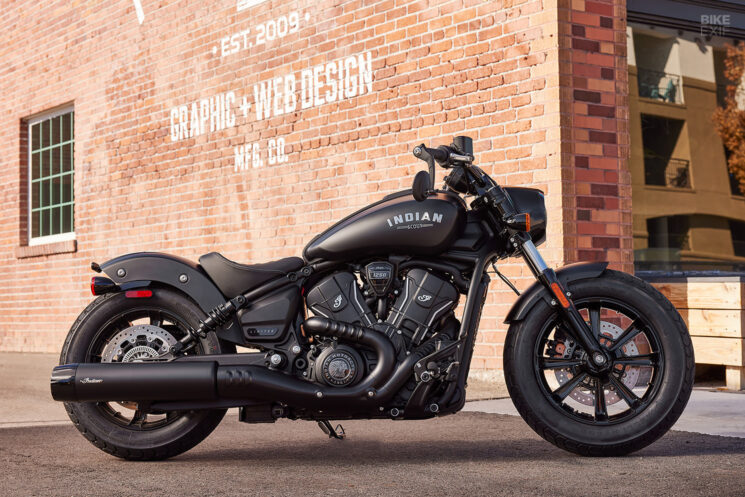
The Indian Scout Bobber [above] is the most pared-back model in the range, living up to its name with a bobbed seat and rear fender, blacked-out hard parts, beefy 16×3.5” wheels, and forward foot controls. It wears 41 mm forks with 120 mm of travel up front, with 51 mm of travel available from the preload-adjustable twin shocks. Its engine is setup to put out 105 hp, and it weighs in at 237 kilos [522 lbs] dry.

2025 Indian Scout Classic
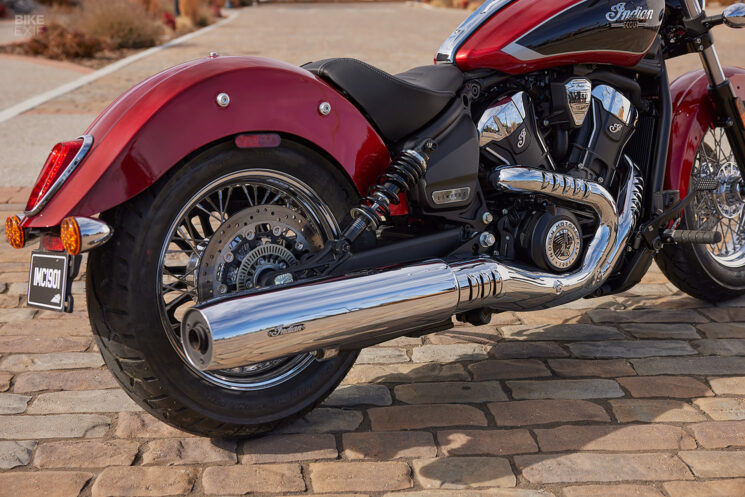
If your proclivities lean towards classic cruisers, the Indian Scout Classic [above] should tickle your fancy. Like the Bobber, it uses 16×3.5” wheels—except here, they’re laced. Big, swooping fenders add a hit of 60s style, while the back-swept bars, forward controls, and simple, round headlight all suit the Classic’s laid-back vibe.

There’s 120 mm of front wheel travel, 76 mm of rear wheel travel, and a seat height of 654 mm. Like the Bobber, the Classic makes 105 hp in standard form.

2025 Indian Sport Scout
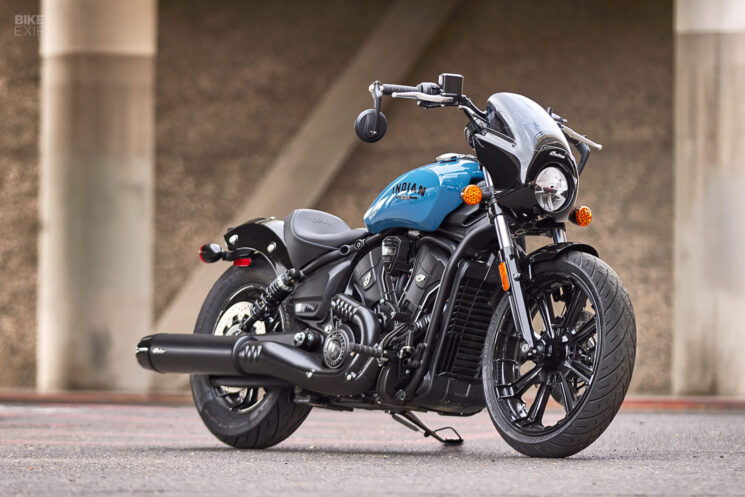
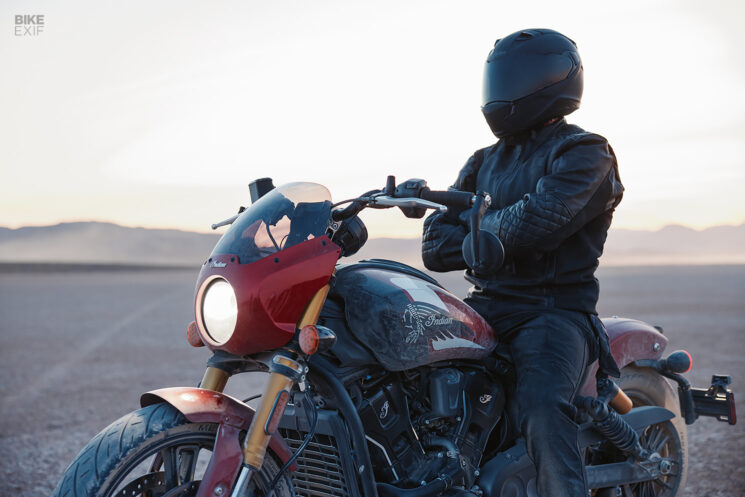
The Indian Sport Scout [above] adds some West Coast performance style to the Scout. It rolls on sporty 19F/16R alloy wheels, with its moto-style handlebars perched on 6” risers. The quarter fairing and sporty, stepped seat nail the brief. Like the Bobber, the Sport Scout has 120 mm of front suspension travel, but there’s 76 mm available at the back.

Numbers-wise, the Sport Scout is good for 105 hp, weighs 239 kg [528 lbs] dry, and has a 654 mm seat height. The trimmed front fender and angle-cut rear fender are slick details… but given that the bike has ‘Sport’ in its name, I’m left wondering why the Sport Scout’s engine doesn’t have the full 111 hp available to it. (Indian has hinted that the bike can be ‘uncorked’ by Indian dealerships, via software.)

2025 Indian Super Scout
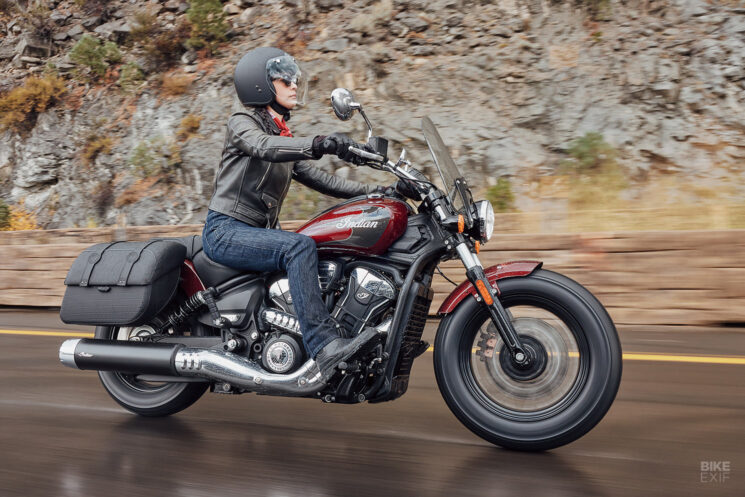
Next up is the Indian Super Scout [above], which resembles the Scout Classic, but comes fully loaded with saddlebags, a pillion seat, and a windshield. Complete with its luscious paint and chrome finishes, it’s got that nostalgic Americana vibe on lock.

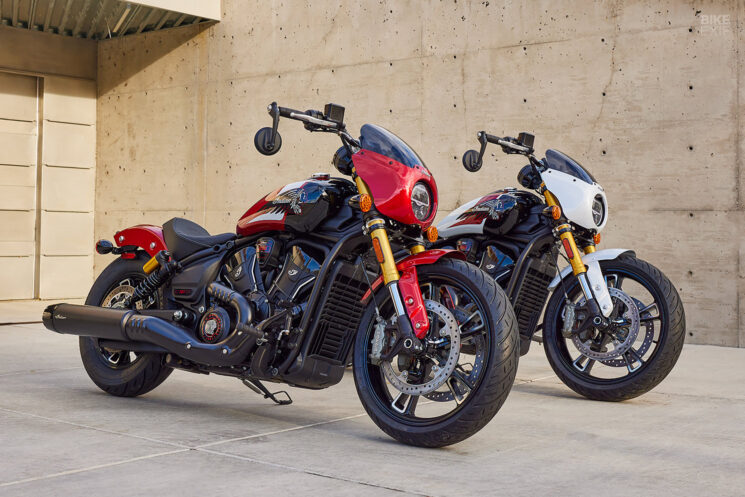
The final—and arguably the nicest—bike in the range, is the Indian 101 Scout [below]. A direct nod to the 1929 Scout 101, it unleashes the Scout’s full 111 hp output, and adds Brembo brakes (with dual front discs), adjustable upside-down forks, and adjustable piggyback shocks. The bars, risers, and quarter-fairing match those of the Sport Scout, while a stylish gunfighter-style seat tucks the rider in tightly.

2025 Indian Scout 101
All of the above bikes come in various paint schemes, trimmed with a host of tidy details and machined parts. They can also be purchased with three different levels of trim, which range from basic rider aids, LED lighting, and an analog speedo, to various electronic rider modes, a USB charger, cruise control, premium badging, and more.

At the top trim level (which is standard on the Super Scout and 101 Scout), a 4” TFT display replaces the analog gauge, adding smartphone connectivity with turn-by-turn navigation, ride stats, and a bunch of other app-enabled services. Oh, and you get a keyless ignition, too.

2025 Indian Scout 101
Available from May in the USA, the 2025 Indian Scout will set you back anything from $12,999 to $16,999, depending on the model, paint job, and trim level. And if a stock Scout just won’t do, Indian has an array of accessories and accessory packs available too.

The Scout’s price and engine size put it in the same ballpark as the Harley-Davidson Sportster S—but its aesthetic is far more cohesive and timeless. If ever there was a loud shot across The Motor Co.’s bow, this is it.

Source: Indian Motorcycle

1929 Indian Scout 101


from Bike EXIF https://ift.tt/AdgBIto