Friday, 8 September 2023

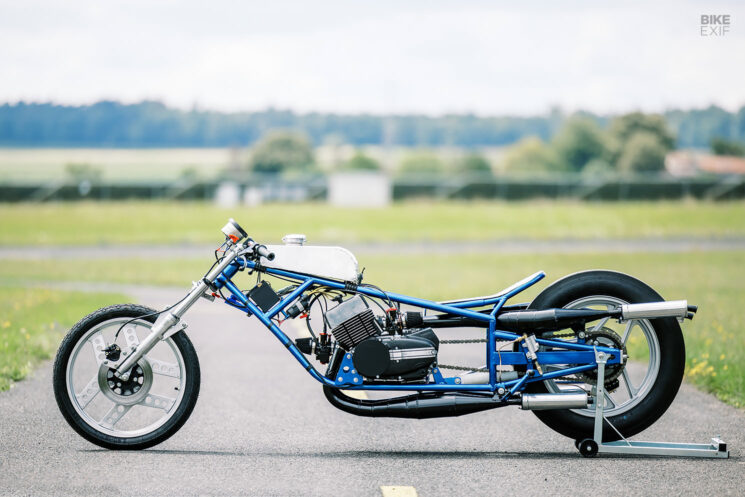
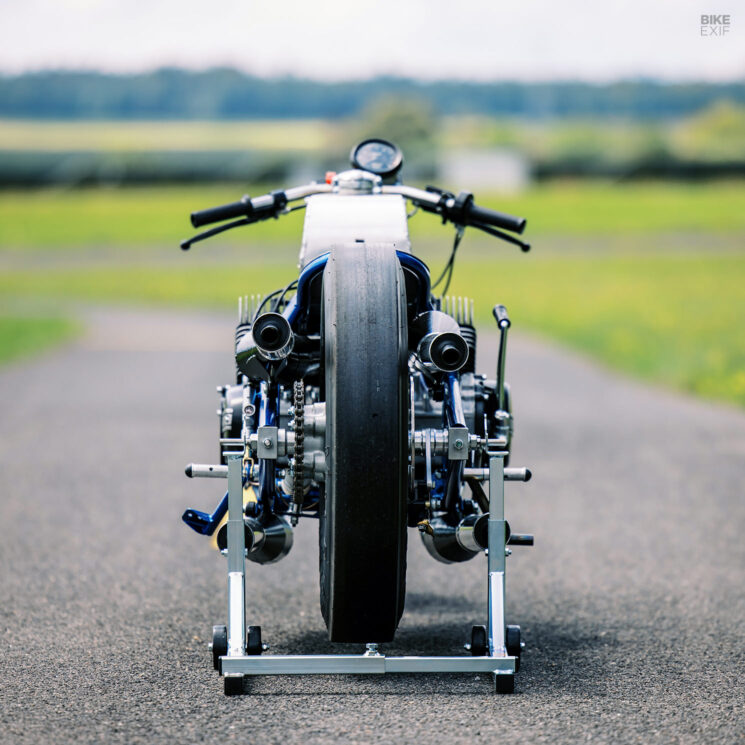
Two-stroke terror: A twin-engine Yamaha RD350 drag bike

Twin-engine Yamaha RD350 two-stroke drag bike
If you suffer from the misconception that Germans don’t know how to have fun, you’ve clearly never experienced the German sprint racing scene. Events like the popular Glemseck 101 are filled to the brim with wild and inappropriate motorcycles, all of which are guaranteed to make you smile. And what could be more fun than a twin-engine Yamaha RD350 drag bike?

This mad machine is the brainchild of Norbert Prokschi, a master mechanic based in the small Bavarian town of Johannesberg, just east of Frankfurt. He’s spent the last 37 years restoring classic British cars and motorcycles; everything from Jaguars and Morgans to Nortons and Vincents.
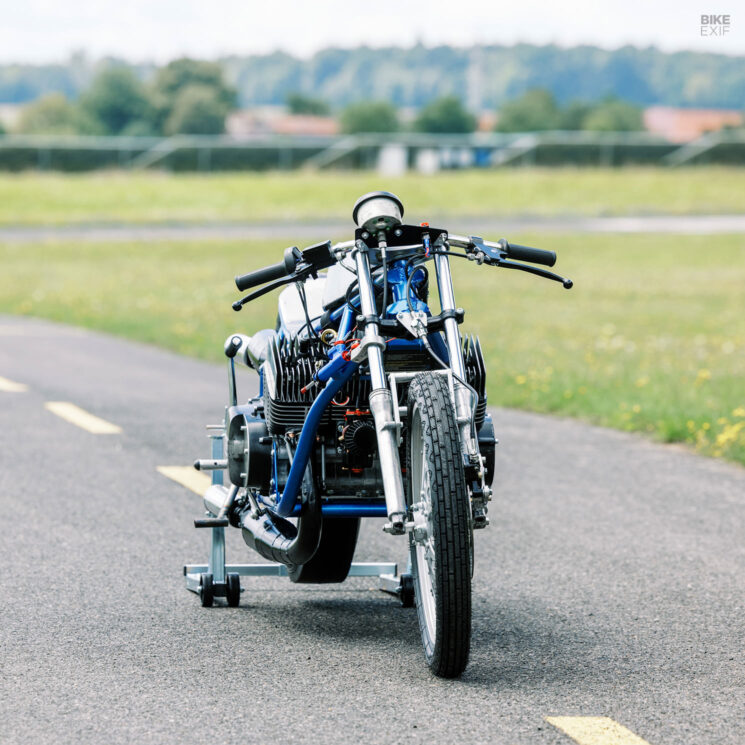
Twin-engine Yamaha RD350 two-stroke drag bike
Norbert doesn’t exclusively work on English vehicles though—he’s restored a number of Japanese and Italian bikes too, and has been racing Yamaha TZ two-strokes for the past five years. It’s his experience with rebuilding those TZ motors that gave him the confidence to attempt this zany twin-engine Yamaha RD350 build. But the inspiration for the project goes even further back than that.

“I’ve been interested in drag racing since the early 70s,” he tells us. “What you’d see at the time in films from the USA, you could then see in real life at the US Army airbase near Hanau. The drag racing dates were always announced on a Saturday morning on the military radio station.”
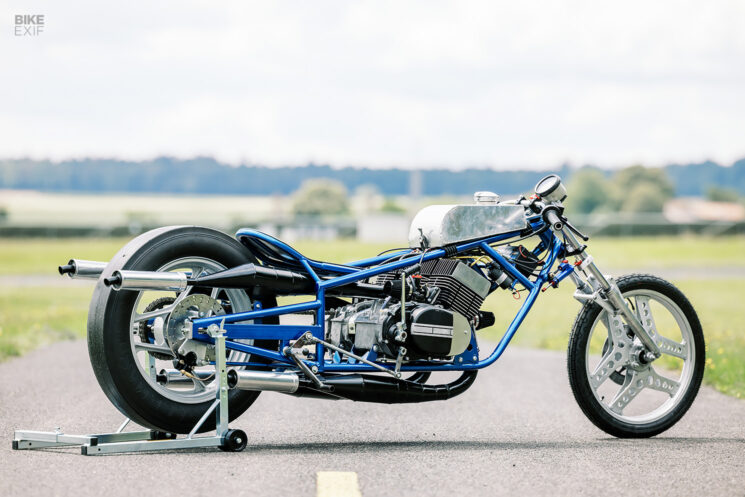
Twin-engine Yamaha RD350 two-stroke drag bike
“About 20 years ago I discovered an original dragster from the 60s at an auto jumble in England. I restored it, but so far I have not had the opportunity to use it, since I don’t want to damage this historic machine.”

Norbert’s hesitance to race his vintage drag bike prompted him to build something that he wouldn’t mind hurling down the strip. So he came up with the idea of combining a pair of two-stroke Yamaha engines into one beastly power plant and sticking it in a bespoke frame. With two 1974 Yamaha RD350 engines in hand, he got cracking.
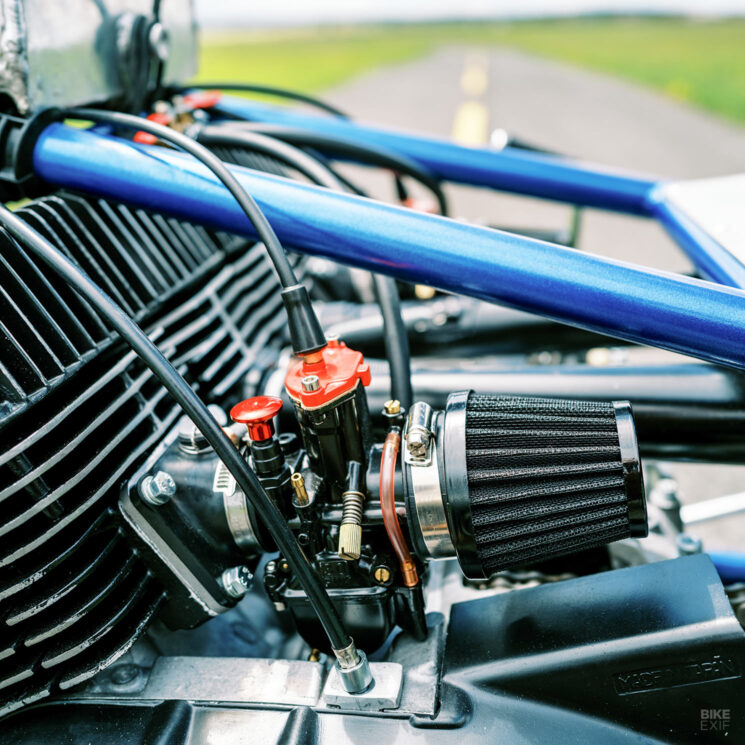
Twin-engine Yamaha RD350 two-stroke drag bike
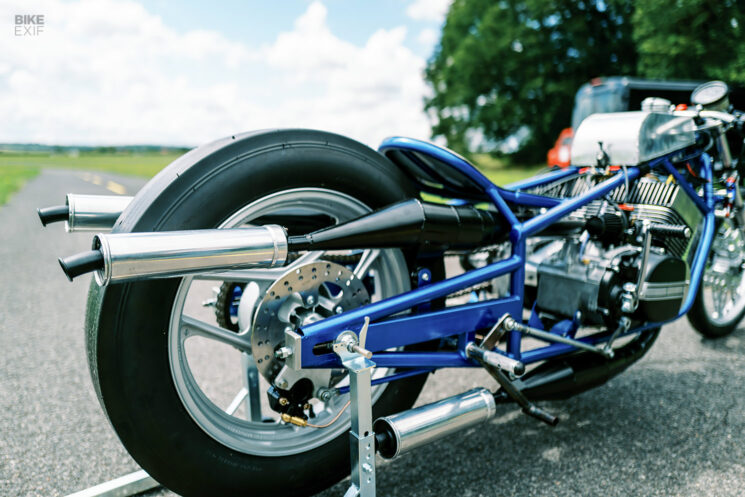
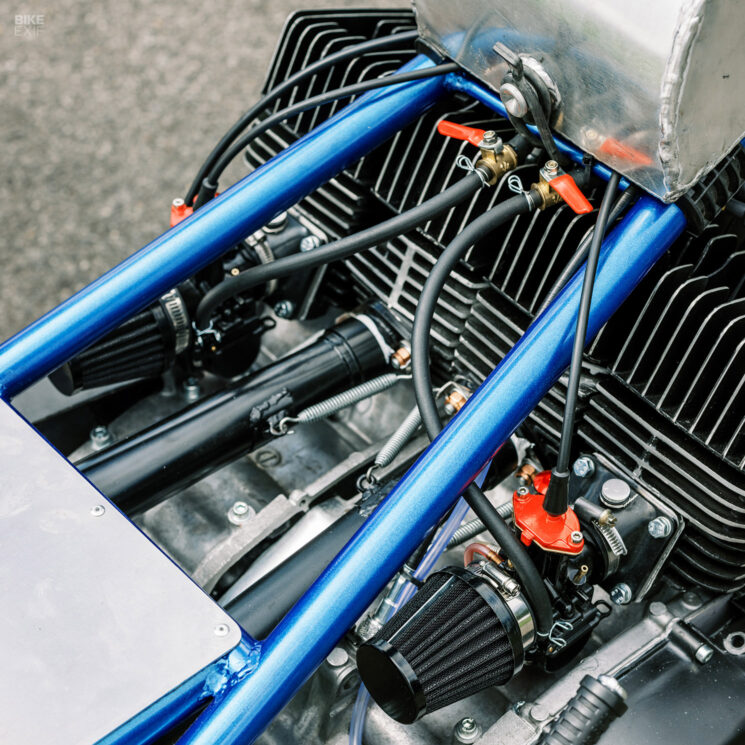
The work needed to turn two RD350 mills into one four-cylinder stonker could fill volumes, so Norbert’s just given us a broad overview. He started by splitting the cases of the two parallel-twin motors, then CNC-machined adaptor plates to mate them together. Then he grafted pieces from three different crankshafts together to create a single four-cylinder crankshaft.

Not content to stop there, Norbert also flipped the middle two cylinders around. He did this to make it easier to accommodate four separate exhausts, but also because it would look way cooler.
Twin-engine Yamaha RD350 two-stroke drag bike
Extensive work was done on the cylinders, and the compression ratio was increased in the process. Norbert ditched the original RD350 six-speed transmissions, favoring a single five-speed gearbox from a vintage Yamaha R5. It sits on the right-hand side of the bike, along with the gear shifter.

The carbs are modern aftermarket units and are slightly larger than the originals. Each cylinder exhales through its own exhaust; Norbert had the headers, expansion chambers, and silencers made to his spec by a British company, then welded everything up himself. It looks bananas and likely screams like a banshee.
Twin-engine Yamaha RD350 two-stroke drag bike
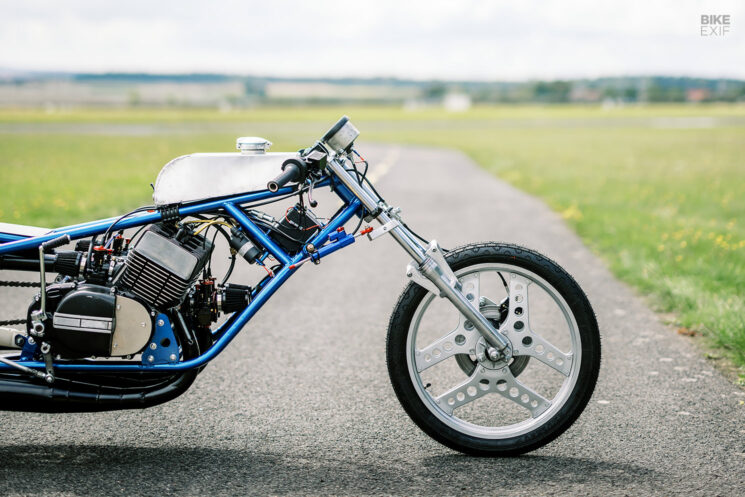
It’s obviously tricky to wedge an engine of this size into a regular motorcycle chassis, so Norbert built a new frame from scratch. First, his friend Heinz Lange drew the frame according to Norbert’s requirements. Then the two of them set up a jig and fabricated the hardtail frame out of steel tubing.

The front forks and 18” wheel were lifted from a 1980s Honda MBX80, while the 18” rear wheel comes from a first-gen Suzuki GSX-R750. A steering damper and custom-made fork brace add stability to the front end, while disc brakes at both ends handle stopping duties.
Twin-engine Yamaha RD350 two-stroke drag bike
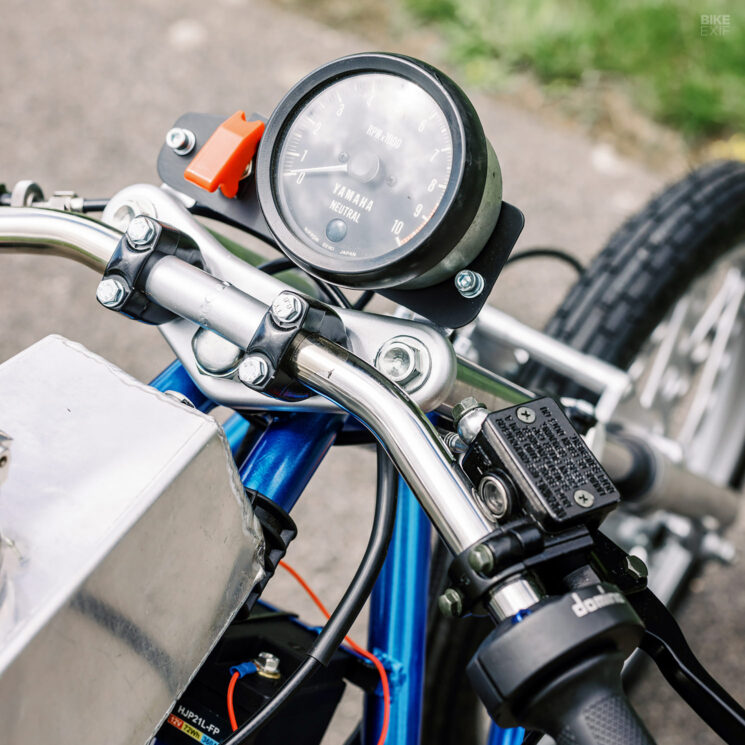
Norbert fabricated the Yamaha’s aluminum fuel tank and, uhm, ‘seat.’ He made the foot controls and linkages himself too, but the handlebars, grips, and switches are aftermarket parts. A single Yamaha RD350 tachometer dominates the cockpit.

With fresh paint on the frame and exhausts, but nowhere else, Norbert’s engineering and fabrication are on full display. His 700 cc two-stroke drag bike looks mental—and, more importantly, it looks like it means business. But is it quick?
Twin-engine Yamaha RD350 two-stroke drag bike
The truth is, Norbert doesn’t know yet. He’s only just buttoned it up, and is yet to start testing and tuning it. But once he has, he plans to unleash it on the classic racing circuit.

If we were his opponents, we’d be very afraid.

Images by, and with thanks to, Marc Holstein
Twin-engine Yamaha RD350 two-stroke drag bike


from Bike EXIF https://ift.tt/P2h8gKE

Wednesday, 6 September 2023

The BMW Motorrad ‘Storied’ Series: The art of Christopher Myott

The BMW Motorrad Storied Series with Christopher Myott
Christopher Myott can’t quite recall when exactly he decided to turn art into a career—or if he even made the decision consciously. As far as he was concerned, being an artist was his only possible future.

Myott lives with his wife in a Civil War-era house that he bought when he moved back to the small mill town he grew up in—Jaffrey, set alongside the Contoocook River in Cheshire County, New Hampshire. It’s an old house, but that suits Myott just fine. As far as he’s concerned, the more worn out something is, the more of a story it has to tell. And that rings true not only for his home but also for his daily runner—an old, well-worn BMW R 75.

The BMW Motorrad Storied Series with Christopher Myott
“The artists that I looked up to, even when I was younger, were artists like Picasso, or Jackson Pollock working in his barn. I always loved that traditional romantic idea of just being a painter that works in my studio every day, and that’s how I make my living. The house sort of brought that dream to fruition, that romantic idea of being a painter.”

“I felt like I was surrounded by all of the very things that I’m inspired by. I filled my barn with a bunch of motorcycles, so I’m going out there painting and looking at the bikes every single day, and the tools that are just laying around on the ground.”

The BMW Motorrad Storied Series with Christopher Myott
Myott’s love for old things is evident in his paintings. Using a unique set of techniques developed through years of experimentation, he imbues his work with an aged quality. But it’s not just in the colors he uses or the brush strokes he deploys; his paintings are layered and textured, begging to be touched as much as looked at.

He has a knack for taking the mundane and making it fascinating. Some artists will paint a bonsai tree; Myott will paint it planted in an empty chainsaw oil can, with a vice grip placed next to it. A potted plant on a table? Sure—but add a vintage wrestling figurine to the scene.

The BMW Motorrad Storied Series with Christopher Myott
Myott’s work is whimsical, disarming even. He delights in knowing that his work demystifies the concept of fine art, and takes pleasure in hearing how different people read different messages in his paintings. And he’s happy to play fast and loose with his subject matter, jumping from paintings of baseball cards to still-life studies, guitar pedal boards, and fireworks.

Motorcycles are a recurring theme in Myott’s work, and even those can’t escape his enigmatic approach to still-life art. “With a motorcycle, there’s all these little elements that come together that make the bigger picture … and they can all be off a little bit,” he says.

The BMW Motorrad Storied Series with Christopher Myott
“And when the whole thing is done, it’s still recognizable as a motorcycle, even if the tires are a little bit crooked or the bike’s a little bit longer than it should be. It still works.”

“It’s hard to describe it, but that old metal, old paint, and mechanisms—that’s part of what’s so inspiring about them. And specifically BMW boxer engines. They’re just so iconic—from any angle, you can tell that it’s a BMW. There’s something about that that I’m drawn to, these moving components that sort of make a bigger thing run, and that the BMW has all of that on display. It’s the perfect bike for drawing.”

The BMW Motorrad Storied Series with Christopher Myott
Myott’s current ride is a BMW R 75—but his first BMW was an R 27. And, like everything else he’s surrounded himself with, it has quite a backstory.

“There’s a bicycle repair shop down the road that’s also an art store,” he explains. “And the couple who worked there actually gave me a scholarship when I was going into college. They paid for all of my painting supplies, they would just let me come into the shop and pick up whatever supplies I needed.

The BMW Motorrad Storied Series with Christopher Myott
“Later on, when I moved back to Jaffrey, I would still go there to buy all my paint supplies. And the guy who owned the shop was getting older and needed help cleaning out the basement of his shop because he was moving it to a different location. He asked me if I would help him, and he told me that he had an old motorcycle in there that if I clear it up, I can take.”

“I went down in there—there were no lights, it was flooded—and the bike was actually an old BMW R 27. So, I pulled that out of the basement, fixed it all up, and I drove it back over to his house once I finished it just to give it back to him and say, ‘Thank you, but no thank you’.”

The BMW Motorrad Storied Series with Christopher Myott
“I mean, it’s an R 27! I wasn’t sure if he really knew what he was giving me. And he was so happy that I offered it to him and that I got it fixed up that he was like, ‘I’ve got a bunch more BMWs that you can just have’.”

Myott walked away with two basket cases—an R 50 and an R 69. The intention was to fix them up, but, as so often is the way with bike projects, they just sat there. Eventually, Myott traded them for the R 75 that he still owns and rides today.

The BMW Motorrad Storied Series with Christopher Myott
He hasn’t forgotten the R 27, though. He can’t forget the R 27. He has a tattoo of its key on his neck, something he had done on a whim at a sketchy tattoo shop in Texas.

“I don’t know, I was always sort of looking for ways to codify the fact that I’m an artist—this is what I do,” he shrugs. “I don’t have to do anything else. And a tattoo on my neck is almost a guarantee that I won’t have to work a job that I don’t like.”

Storied: 100 Years of BMW Motorcycling is a three-part video series and limited edition print piece by The Simple Machine, created with support from BMW Motorrad USA | Video directed and edited by Roberto Serrini | Art by Christopher Myott

Advertisement


from Bike EXIF https://ift.tt/k20xPRy

Tuesday, 5 September 2023

Mojave Flash LiDAR Suite Now Available Through Amazon and DigiKey Electronics

Highest Performing Near-field, Software-definable Flash LiDAR Provides Affordable, Powerful Sensing Capabilities for Robotics, Agriculture, and Industrial Applications

  Portland, OR – September 5, 2023 – PreAct Technologies (PreAct), an Oregon-based developer of near-field flash LiDAR technology, today announced the availability of its Mojave LiDAR, a high-performance, low-cost sensor solution to address a variety of applications including smart cities, robotics, cargo monitoring, education & university research, building monitoring, patient monitoring, agricultural, and much more.   The PreAct Mojave LiDAR is distributed globally by DigiKey Electronics and Amazon.

“I am incredibly proud of our team for getting Mojave ready to be available to the mass market, and these distribution partnerships are a major milestone for our company,” said Paul Drysch, CEO of PreAct. “As more industries are discovering the power of LiDAR sensors to provide high quality data while also maintaining individual privacy, we knew we had to make Mojave as widely available as possible. Now anyone – not just large companies – can purchase the highest performing near-field sensor on the market and customize it for a wide variety of use cases. The availability of such powerful technology at an affordable price is a game changer.” 

  Introduced to the sensor market in August, Mojave is the only flash LiDAR designed to meet the needs of non-automotive industries, as well as automotive applications. With its software-definable capabilities, depth accuracy error of less than 2%, and a single unit retail cost of $350, Mojave is the first truly mass-market LiDAR.

Mojave meets the stringent needs of sensors in robotics, agriculture, and other industrial applications. It has superior cliff and edge detection over any other sensor on the market, can provide over 1.4 million points per second of depth information, and has the ability to detect floor slope and camber. Mojave comes fully calibrated from the factory and both the software and firmware are upgradable, allowing companies to invest once in the hardware and continue to improve the sensor performance over time.

Mojave is now available to companies, organizations, and individuals looking to purchase single Mojave units or in volume through DigiKey and Amazon.

DigiKey is recognized as the global leader and continuous innovator in the cutting-edge commerce distribution of electronic components and automation products worldwide. Amazon is known for its fast, efficient distribution of products across the globe.

 For Mojave LiDAR specs, visit www.preact-tech.com/mojave.

Mojave LiDAR

 PreAct’s Mojave LiDAR is a high-performance, low-cost sensor solution that addresses the needs of a variety of applications including smart cities, robotics, cargo monitoring, education & university research, building monitoring, patient monitoring, agricultural, and much more. 

About PreAct Technologies  

PreAct Technologies is the market leader in near-field software-definable flash LiDAR technology and integrated SDK (software development kit). Its patent-pending suite of sensor technologies provides high-resolution, affordable LiDAR solutions to a wide range of industries including robotics, healthcare, ITS, logistics, security, industrial, consumer electronics, trucking, and automotive. With unmatched quality and accuracy, PreAct’s edge processing algorithms drive technology resulting in 3D depth-maps of small objects at sub-centimeter accuracy up to 20 meters. PreAct’s LiDARs and SDK enable companies and innovators to address the industry’s most pressing business and technology needs. The firm is headquartered in Portland, Oregon, with offices in Ashburn, Virginia, and Barcelona Spain. For sales inquiries, please contact sales@preact-tech.com. For more information, visit www.preact-tech.com.  

The post Mojave Flash LiDAR Suite Now Available Through Amazon and DigiKey Electronics appeared first on Automotorblog: Daily news on cars and motorcycles.


from Automotorblog: Daily news on cars and motorcycles https://ift.tt/x0zLPE6

Sunday, 3 September 2023

Speed Read: A Krauser BMW R100 café racer from Poland and more

The latest motorcycle news, customs and café racers
If you suffer from lower back problems, look away now, because all of this week’s Speed Read selects wear clip-on handlebars. We’ve got a Krauser BMW R100 cafĂ© racer from Poland, a Royal Enfield Interceptor 650 cafĂ© racer from America, and a Norton Commando drag racer. We conclude with a new retro-styled factory sportbike that’s emerged from China.


Krauser BMW R100 by Warkot Motorcycles Genuine Krauser parts are getting harder and harder to find these days, so Warkot Motorcycles really lucked out when a BMW R100 with a striking Krauser four-valve head conversion arrived at their workshop. But that’s not the only thing that’s special about this machine—even though the Polish outfit has been building custom bikes for years, this is their first cafĂ© racer.

The venerable and versatile BMW R100 was stripped, and the engine was cleaned and rebuilt, ready for decades of service. Pod filters were slipped onto the Bing carbs and twin custom exhausts now hang from the cylinder heads.


Up top, a larger /5-series BMW airhead tank was sourced and installed for a more vintage BMW look. The headlight is original, but it’s mounted to the rebuilt forks by way of custom brackets.

The whole frame was de-tabbed and given a fresh coat of black paint, as was the custom rear subframe. A new seat is perched atop it, trimmed in cognac leather. The under-seat area is free of clutter, thanks to the simplified electronics, which are now run by a full suite of Motogadget components.


Warkot also picked Motogadget items for the speedo, bar-end mirrors and turn signals, and rear ‘three-in-one’ LEDs. Lower down, the factory wheels were painted black and wrapped in fresh Firestones. Six-piston Beringer calipers sit on adapter plates up front, plumbed in with new HEL braided brake lines, while new YSS shocks prop up the rear.


The fuel tank and custom-made fenders were all painting in Porsche 356 brown, completing the vintage cafĂ© racer vibe in style. “The bike sounds awesome, accelerates great, and is very fun to ride,” the Warkot team tells us. “Building this motorcycle was a big challenge for us, but also gave us a lot of joy and satisfaction.”

And that’s exactly what building custom motorcycles is all about. Bravo, Warkot! [Warkot Motorcycles | Images by RafaĹ‚ GieleciĹ„ski]


Royal Enfield Interceptor 650 by Shed Motorcycles Royal Enfield’s twin-cylinder 650s are arguably some of the best value retro-styled motorcycles on the planet. The platform is incredibly versatile too, and it doesn’t take much to make them look and perform even better. Alberto Benito, a Spanish expat living in Providence, USA, shares that opinion.


“I fell in love with custom bike projects thanks to blogs, magazines, and social media,” says Alberto. “I considered purchasing a custom bike, but then thought, ‘Why don’t I build one instead?’”

With his mind made up, Alberto went out and bought a 2021 Royal Enfield Interceptor 650 (known as the INT650 in the US). Suffice to say, the bike didn’t remain in its original condition for long.


Alberto first purchased a solo seat from the Enfield accessory catalog, in the style of the Interceptor’s stablemate, the Continental GT. He trimmed the subframe for a more aggressive look, and finished the end off with a slim LED taillight. A slew of parts from K-Speed in Thailand then arrived—including new side covers, finned engine covers, rear-set foot pegs, and a fuel tank strap.

The upright handlebar setup of the Interceptor was replaced with low-slung CNC clip-ons, and the headlight was converted to LED with integrated turn signals. The factory gauge cluster was shelved in favor of a Motogadget Motoscope Tiny Speedster speedometer. Rizoma bar-end mirrors and Biltwell Inc. grips maintain the low-profile front end.


Chunky Shinko Superclassic E270 tires were spooned on, with longer Bitubo shocks and a new front fender installed to accommodate said chunk. The final piece of the puzzle was a custom exhaust, painted in matte black. Not only is it 60% lighter than the stock cans, but it also unleashes the full audio potential of the 270-degree parallel twin.

Alberto went into this project with little to no fabrication experience, a limited budget, and a small workspace. But he’s proven himself smart and resourceful—and he’s certainly got good taste. [Shed Motorcycles]


Norton Commando by Jets Forever The Norton Commando is up there with some of the best classic motorcycles ever made. From the iconic English-made 360-degree parallel twin to the innovative isolastic engine mounts and good looks, the Commando has it all. While we prefer classic or restomodded Commandos, some builders like to push the envelope.

Jeff Duval and his Jets Forever workshop have just unveiled this—their ‘Monterey Class MkIV Commando.’ Monterey Class is a category of drag racing that fits in about halfway between a road racer and a dedicated standing quarter-mile drag bike. Jeff has always been a fan of the category, so he set about building his own Monterey bike.


As with a lot of machines that line up on the drag strip, Jeff and a dedicated team of experts and enthusiasts started from scratch with this build. Jeff’s friend John Parry built the frame by hand in a custom jig using chromoly steel. The 37-degree rake angle is massively different from a factory Commando, but a big rake helps with stability at high speed—which is what this build is all about.

The front section of the frame is 5” longer than a normal Commando. 35mm Ceriani adjustable forks were slipped into polished fork clamps, with a custom tubular swingarm installed out back. Beringer brake calipers were installed front and rear for extra stopping power, gripping ISR discs.


The 21F/18R wheelset is from Apollo Wheels in LA, and is wrapped in Avon rubber. The exquisite tail section, stretched tank, and bikini fairing are all custom.

The late-model Commando engine, complete with its left side shift pedal, was built by Pete Lovall. The heads were gas-flowed, the crank was lightened and a 4S cam was installed. 34mm Smoothbore concentric carbs fuel the beast, and the hot gases exit through Commando SS-style headers and aftermarket slash-cut mufflers.


Bikes of this style aren’t everyone’s cup of tea, but we can still admire the incredible amount of precision and workmanship that went into the build. Jeff hasn’t said how fast the old Brit is, but we reckon it would wipe the floor with a factory Commando. [Source]


Zeths ZFR 525 R Avenger With the café-custom craze hitting some of the largest motorcycle manufacturers in the world, the styles of the 60s and 70s are here to stay. Royal Enfield, Triumph, and Moto Guzzi all continue to produce the modern classics that have buoyed their sales in recent years. Honda, Yamaha, and Husqvarna have also dipped their toes in the retro market, but with a decidedly more neo-classic twist closer associated with the late 70s and 80s.

Extrapolating this trajectory through the decades, it must mean that the late 80s and early 90s are next in line, right? Yes, and we’re here for it.


Meet the Zeths ZFR 525 R Avenger. We’d never heard of Zeths before today, but they’ve been producing bikes for the Chinese market since 2016. Perusing their website shows two svelte bobbers, akin to a small-displacement Zero Engineering chopper, but they’re also developing a 1000 cc V-twin engine.

Skipping a few decades from their 50s-style bobbers, the Zeths ZFR 525 R is small-displacement retro sportbike with miles of early-90s style. Powered by a 494cc parallel twin (perhaps a Honda CB500 clone), Zeths is claiming around 50hp with 50 Nm of torque. The upside-down forks, aluminum frame, and single-sided swingarm are all positive signs; the radial-mounted twin front brakes and ABS, even more so.


We adore the twin round headlights and the smooth lines of the fairing. The tank is just modern enough for our taste, as is the sculpted tail section and single reverse cone muffler. No, there aren’t any wings or flying buttresses (we’re looking at you, Ducati), but that’s the whole point.

If the return of retro sportbikes is wrong, then we don’t want to be right. [Source]


from Bike EXIF https://ift.tt/Qm4wrCK

Saturday, 2 September 2023

Start ’em Young: 5 Fun and Friendly First Motorcycles for Kids

First Motorcycles for Kids
The bicycle is the first
freedom machine most of us experienced, but you never look at life the same after your first motorcycle. Whether it was an XR50, a YZ80 or the classic Trail 70, we put these machines through the ringer, likening ourselves to Jeremy McGrath, Bob ‘Hurricane’ Hannah and Evel Knievel. The turf in the backyard was never the same, and our cherished first kids motorcycles endured all the broken levers, tank dents and wrinkled fenders that came with testing your limits on two wheels.

Most of those old relics are gone now, and for many of us, it’s time to pass that enthusiasm down to the next generation—hopefully with a little less daredevil activity. Thankfully, there are loads of options out there for getting kids off the couch and in the saddle, with a whole lot more safety and parental control. Consider your child’s size and riding aptitude, and your budget as well, but any one of these five machines is sure to ignite a passion for two wheels.

Yamaha PW50
Yamaha PW50 The everpresent Yamaha PW50 has served as the first mount for countless riders over its four decades in production. While it’s hardly changed since its inception in 1980, there are still plenty of reasons to consider the PW for the youngest of riders, even if you’re not loyal to Team Blue.

Yamaha PW50 Engine
Yamaha’s PW50 is based on old-school architecture, consisting of a steel backbone frame, drum brakes, twin rear shocks and a telescopic fork—each returning around 2” of travel. The powerplant is still two-stroke, a 49 cc reed-induction single that will return around 3 hp for years to come. Equipped with maintenance-free mag wheels and a driveshaft, there’s no need to tighten spokes or service a chain, and the auto-lube system means no premixing, as long as you remember to fill the oil reservoir.

Yamaha PW50
The PW50 scores big points in packaging as well, as it’s one of the most accessible bikes for beginners aged roughly 3 to 7. It’s lightweight at just 90 pounds, and the seat sits just 18.7” off the ground. The PW is also fit with a centrifugal automatic transmission, so there’s no clutch or gearshift to worry about—just twist the throttle and go. Like many other bikes in the segment, an adjustable throttle stop helps keep parents in control of speed progression.

For absolute beginners, the Yamaha PW50 is one of the easiest bikes to learn on and it’s relatively maintenance free. If you want to split hairs, the PW is pretty expensive for what it is, considering it’s only $100 cheaper than the CRF50 at $1,699. [Yamaha]

Honda CRF50F
Honda CRF50F Building on decades of mini-moto excellence, the Honda CRF50F has earned its place as the standard for youth motorcycles. Priced right and built to last, the CRF50F is a capable machine that kids can grow into, as long as they can keep the grown-ups out of the saddle; remember this bike almost singlehandedly built the 50 cc pit bike scene.

Honda’s 50 cc formula hasn’t changed in years, even since the XR days, but I’m convinced there’s nothing that needs fixing. The SOHC 50 cc air-cooled four-stroke makes just over 3 hp, and it’s hooked up to a three-speed transmission with an automatic clutch. That’s a small step up in complexity over the PW50, and will require a lesson on gear shifting, but the auto-clutch means you’ll never have to worry about stalling.

First Motorcycles for Kids
Most other features on the CRF are pretty standard, including 10-inch spoked wheels, drum brakes, chain drive and an adjustable throttle stop. Suspension travel is a step up at around 3” of travel, courtesy of an inverted fork and rear monoshock.

Honda CRF50F Pink
The CRF50F weighs in at 111 pounds, and the seat sits at 21.6,” making it an ideal fit for riders 4 to 9 years old. Any rider who can get a rough idea of how the shifter works can ride the CRF, thanks to the numerous training wheel kits on the market. The concept of shifting gears is a hurdle, but it’s an aspect that gives bikes like the CRF staying power. It’s hard to mess it up while you’re learning, and improving your shifting game will keep the bike fun until you’re ready for a 110.

Riding the Honda CRF50F
There’s nothing especially unique about Honda’s CRF in the 50 cc youth segment, but the MSRP is certainly a huge bonus. Priced at $1,799, the CRF50F is $780 cheaper than the Suzuki DR-Z50, but the Suzuki does have electric start. I guess you have to pick your battles. [Honda]

KTM 50 SX MINI
KTM 50 SX MINI Better equipped for the track than cruising trails on the back 40, the KTM 50 SX MINI is somewhat of a fringe fit for this list. But for every 10 parents that buy a bike for their kids to tool around on, there’s certainly one that has visions of podiums, and that’s what the KTM 50 SX was built for.

KTM 50 SX MINI
The 50 SX MINI takes all the race-caliber features of KTM’s 50 SX and crams ’em into an even smaller package. The frame is chromoly steel, you’ve got a reed-induction, liquid-cooled 49 cc two-stroke with an expansion chamber and real-deal WP XACT suspension—returning nearly 6” of travel in the rear and 4” in the front. Like its big brothers, the 10-inch wheels have black anodized aluminum rims, disc brakes and MAXXIS MX-ST tires.

In most every way, the 50 SX MINI is more of a miniature KTM motocrosser than a child’s plaything, but that doesn’t mean it’s not a blast to ride. The bike uses a muti-disc, automatic clutch, so it’s a simple twist the throttle and go sort of affair, and the clutch can be easily adjusted to the track and rider using a tool-free clicker system. A power reduction kit is also available over the counter for improving safety when they’re learning the ropes.

First Motorcycles for Kids
While it’s certainly the stuff of childhood dreams, the KTM 50 SX MINI is really a purpose-built track machine. It’s more high-strung, kick-start only and that big hot expansion chamber should encourage parents to supervise riding closely. It’s also quite expensive at $4,199, which is a bitter pill, even if they receive top honors on Santa’s Nice list. [KTM, Fotografie Mitterbauer, Markus Berger]

STACYC 12eDrive
STACYC Electric Stability Cycles From fueling up to changing oil and cleaning carburetors, there’s no denying that the operation and maintenance of a conventional motorcycle isn’t for everyone. Even most diehard ICE loyalists can imagine a scenario where they’d rather snap a fresh battery in and let the kids play, and bikes like the STACYC 12eDrive help establish the basics at a younger age.

First Motorcycles for Kids
STACYC Electric Stability Cycles are some of the most popular electric strider bikes, and their low-slung frames and lightweight construction make graduating from Flintstoning it to twisting the throttle a breeze. The 12eDrive is STACYC’s most accessible option for ages 3 to 5, with a seat height of 13,” and weighing just 17 pounds ready to ride. The 20 Volt, 2 Ah Lithium-ion battery allows for 30 to 60 minutes of riding on a charge, and the bike has three different power modes permitting top speeds of 5, 7 and 9 mph.

STACYC 20eDrive
STACYC has several different models to choose from, and the top-dog 20eDrive model is fit with a MANITOU front fork, hydraulic discs and is capable of 20 mph. If you’re close to a BMX track, there are youth classes where bikes like the 12eDrive and 16eDrive can race, and STACYC will cover your USA BMX membership for the first year.

The explosion of the E-bike scene in recent years has caused all of us to rethink the definition of a motorcycle. Really, if they were supposed to be internal combustion only, wouldn’t it be an enginecycle? That’s a really terrible pun.

SSR SX50-A
SSR SX50-A
Even if you stay away from exotic offerings like the KTM 50 SX, there’s no denying that a motorcycle is one of the priciest things a kid could ask for. Thankfully, there are alternatives to the big names, and the SSR SX50-A is one of the most affordable options out there. Having put an SSR 125 pit bike through a significant amount of abuse, I can tell you that these machines are actually pretty good considering the price point.

Priced at just $569, you know the SX50-A is a pretty basic motorcycle, but there are a few pleasant surprises on the spec sheet. It’s powered by a carbureted 50.53 cc air-cooled two-stroke, and engine output is competitive at 2.4 hp. The transmission is fully automatic, there’s an adjustable throttle stop and the bike is a featherweight at just 48.5 pounds. We also appreciate that the SSR is fit with a tether switch to shut the engine off in the event of a crash.

Considering the hard use a youth motorcycle sees, affordable bikes like the SSR SX50 are worth a look. While they’ve come a long way in recent years, I’d make sure there’s someone mechanically inclined in the family to take care of the occasional loose fasteners. [SSR Motorsports]


from Bike EXIF https://ift.tt/PXyDZVi