Wednesday, 27 July 2022

Blurred Lines: Turning a humble 200 into a street tracker

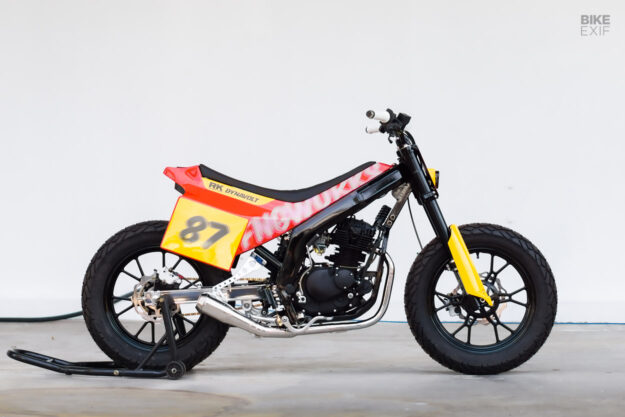
MLE XTM 200 street tracker by FNG Works
Flat trackers make for a compelling argument as practical, everyday street bikes. They’re lightweight with comfortable ergonomics, but don’t tower seven feet off the ground like dirt bikes. So it’s a mystery why more manufacturers don’t make factory-issue street trackers.

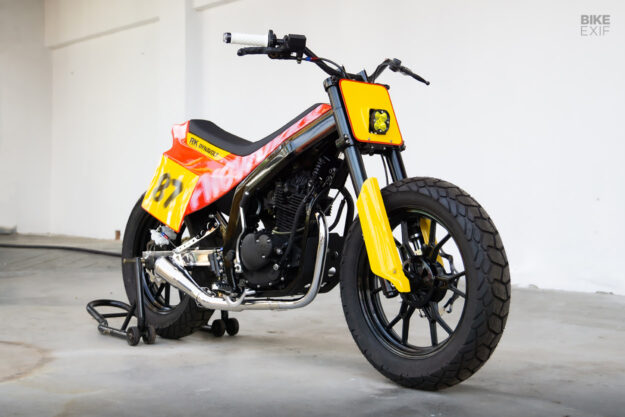
Someone else keen on the flat track style is Irwann Cheng, of the Malaysian custom bike outfit FNG Works. He’s just worked his magic on a customer’s bone stock MLE XTM 200; a Chinese-made supermotard sold in Malaysia.
MLE XTM 200 street tracker by FNG Works
The project was a well-timed one. With the world slowly shutting down a few years ago, Irwann was forced to take on motorcycle work that he didn’t particularly love. Sure, it paid the bills—but it was smothering his creative flame.

Luckily, a customer approached FNG Works for a flat track-style bike. It was just the right project to rekindle Irwan’s love for customization—especially since the customer gave him full creative control.
MLE XTM 200 street tracker by FNG Works
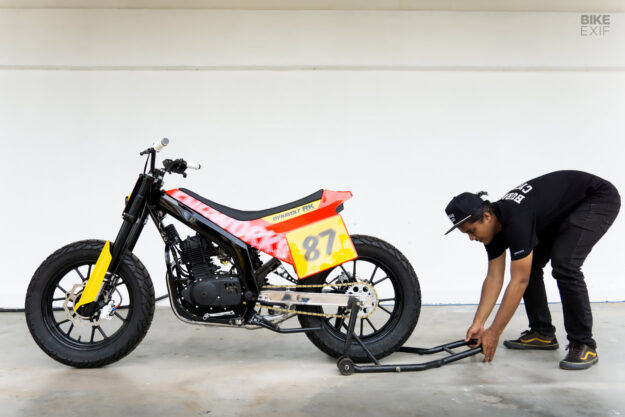
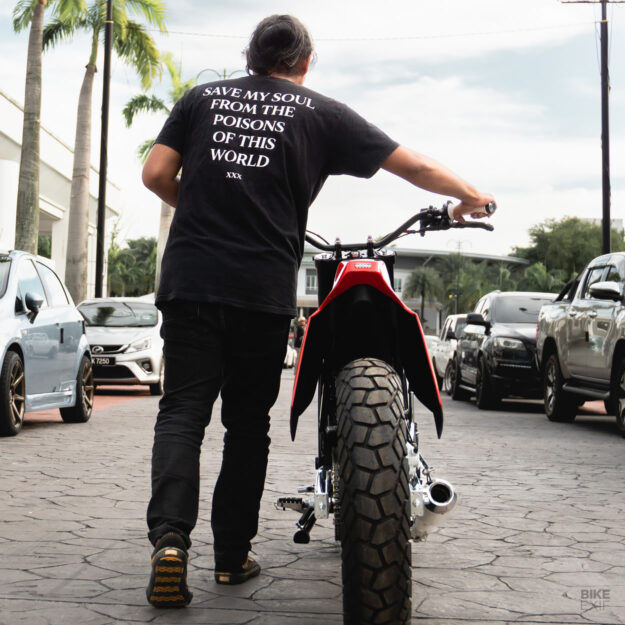
Street trackers are all about stance, so this is where Irwann started. The stock front end was lowered internally by four inches, and the wheels were wrapped in new dual-sport rubber. Irwann chose to stick with the 17” wheels, as he thought that matching 19” wheels would be disproportionate—and it was a good way to keep the cost down.

The MLE’s swooping bodywork design is unusual, but there’s a particular thought process behind it. “The frame of this bike is a twin-spar type,” explains Irwann. “I have seen others make a tank that wraps around the frame to create a horizontal bone line but I decided that instead of working against the frame, I should cooperate with it.”
MLE XTM 200 street tracker by FNG Works
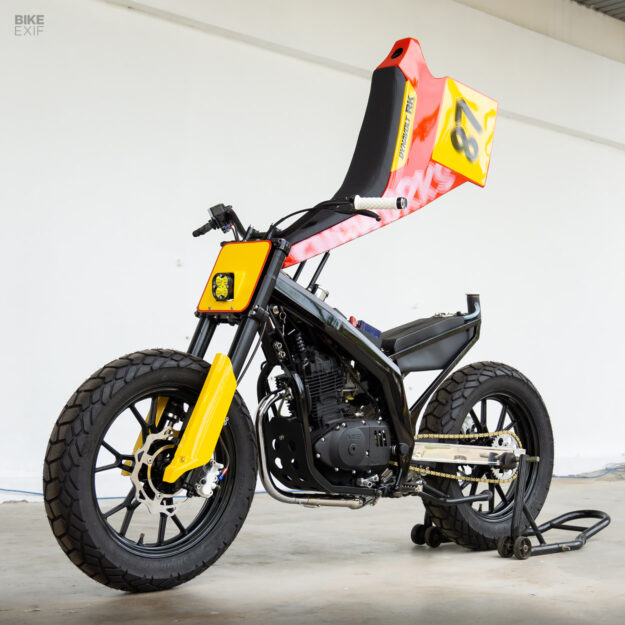
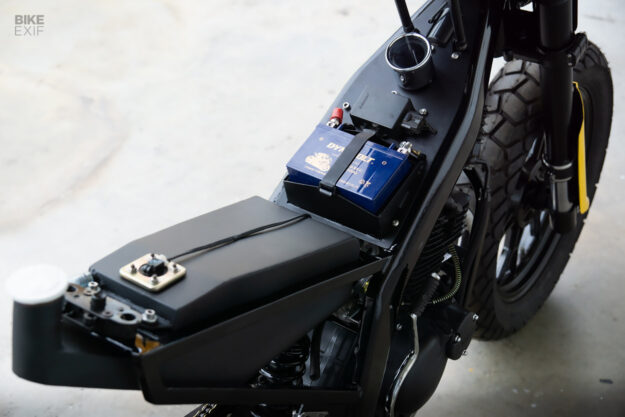
It’s quite refreshing to see someone work with what they’ve got, and Irwann has pulled it off superbly. Instead of making the body out of fiberglass, Irwann decided to stick to what he knows, and build it entirely from metal. The monocoque construction lifts up on gas struts to reveal the genius that lies beneath.

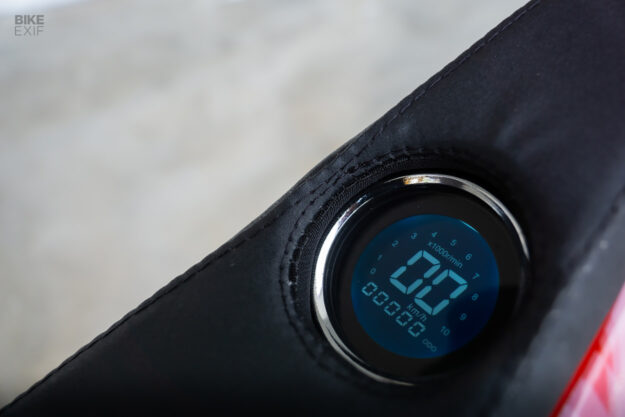
The speedometer, engine electronics and Dynavolt Nano Gel battery are all housed above the engine. The speedometer protrudes through the bodywork—a simple touch that makes so much sense in terms of practicality and design.
MLE XTM 200 street tracker by FNG Works
With the electronics up front, there is one glaring omission: the fuel tank. You’ll find it tucked snugly between the rails of the rear subframe. The 7.8 liter go-juice container not only looks cool underneath the tail, but having a rear tank also helps with weight distribution.

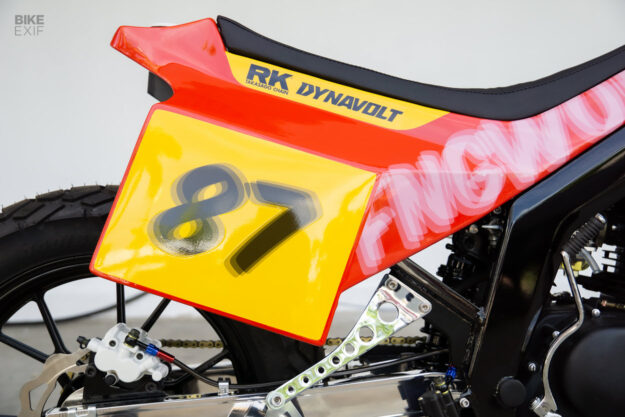
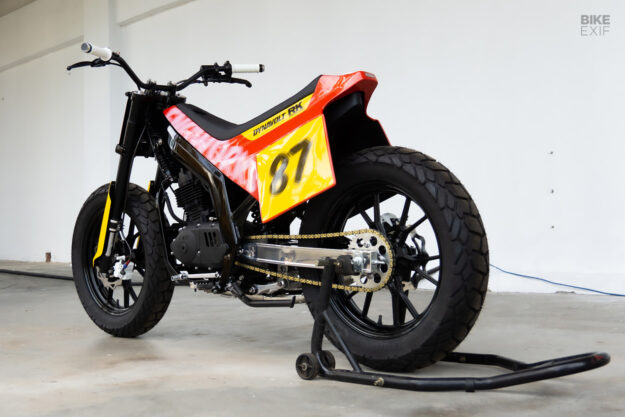
The striking bodywork needed a paint job that could keep up. Irwann decided on a red and yellow scheme—a throwback to his younger years spent watching Malaysian Cub Prix racing. We can’t stop looking at it, even if it does hurt our eyes a little.
MLE XTM 200 street tracker by FNG Works
“The ‘FNGWORKS’ and ’87’ were made to look blurry like an out-of-focus camera, because I like the effect,” says Irwann. “I like to imagine, maybe in a race, that it will make the other racers feel dizzy looking at it.”

The number is in reference to the owner’s birth year, and the Dynavolt and RK Takasago logos are a nod to Irwann’s sponsors for this build. The engine and frame were powder coated black, and the swingarm was swapped out for an aluminum unit, which Irwann polished to a shine. Eagle-eyed viewers will spot a clear float bowl on the carb—a nice touch that ties in with the paint scheme.
MLE XTM 200 street tracker by FNG Works
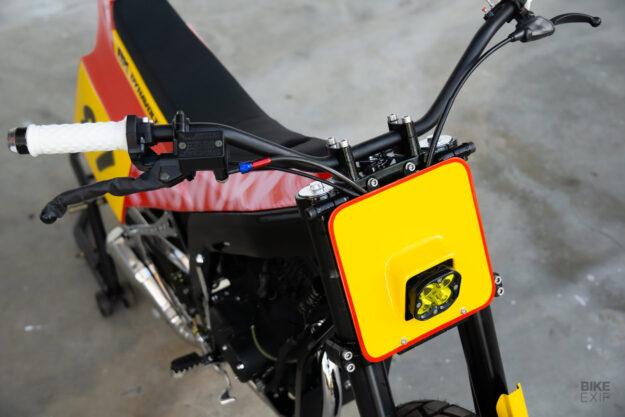
Back up top, the stock handlebars were swapped for a set of blacked-out flat track bars. The switchgear was whittled down to a bare minimum, as was the lighting. Motogadget mo.blaze disc bar-end turn signals run through the bars.

The LED headlight is actually a spotlight that was lifted from a car. Nestled inside the front number plate, it helps the bike look like a proper flat track racer, especially with the trimmed fork guards that Irwann had painted to match. A small LED tail light is buried into the rear of the monocoque.
MLE XTM 200 street tracker by FNG Works
With Malaysia’s mega-popular Art of Speed show on the horizon, Irwann decided to enter the bike. Then, with a mere ten days to go, he hit a road block: the bike wouldn’t start.

Irwann quickly figured out that the 200 cc MLE engine is based on the Suzuki GN125, and that the wiring is a copy of the Suzuki Thunder 125. Armed with that knowledge, he rewired the bike and brought it back to life.
MLE XTM 200 street tracker by FNG Works
“For the last ten days at the shop, with only 2 to 3 hours of sleep every day, I hustled to finish the bike,” states Irwann. “I didn’t even celebrate by birthday with my wife and son. I felt like I was on the other side of the world, even though they were only about 30 minutes away.”

The juice was certainly worth the squeeze. FNG Works bagged the International Guest Favorite Pick of the Show award, chosen by Mama Tried’s Scott Johnson, along with three other awards. If we were there, we surely would have picked it too.

FNG Works Instagram | Facebook | Images by Amin Hamid
MLE XTM 200 street tracker by FNG Works


from Bike EXIF https://ift.tt/VZPzsvf

Monday, 25 July 2022

Vincent Black Flash: Dark brilliance from Fuller Moto

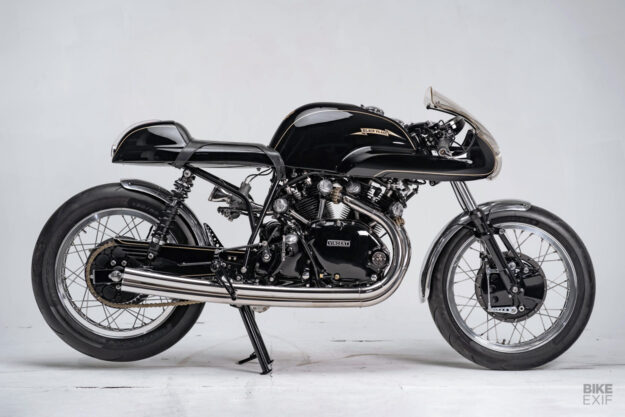
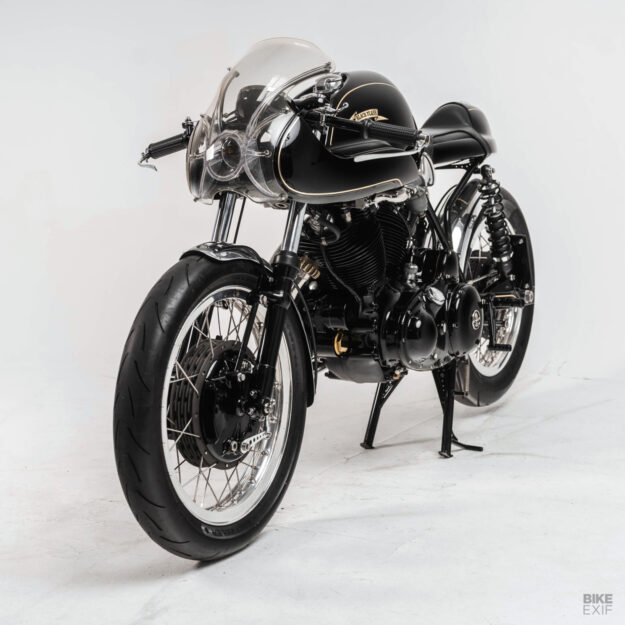
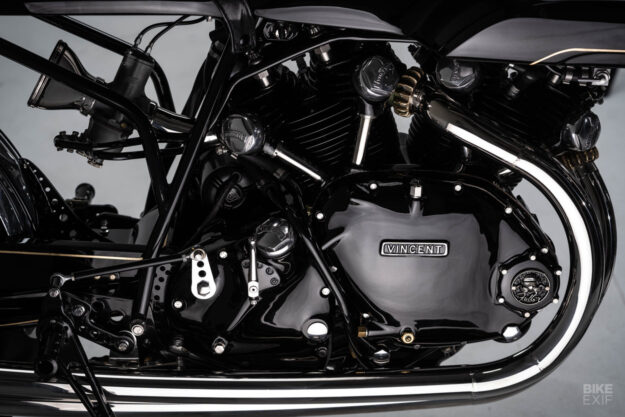
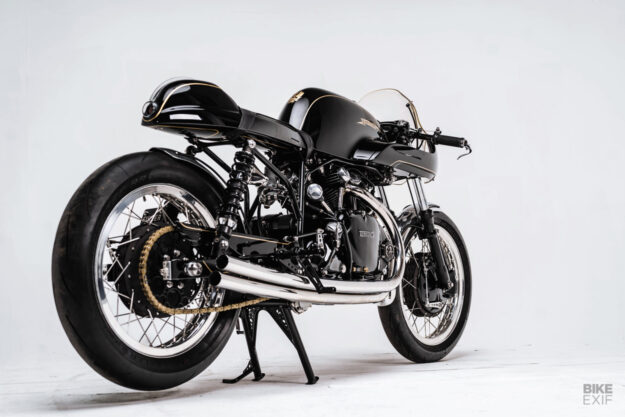
Egli-Vincent cafe racer by Fuller Moto
Bryan Fuller is one of those guys who can work magic on anything with wheels and tires. He’s a next-level fabricator who learned his skills with legends such as the So-Cal Speed Shop and Chip Foose, and today he’s at the top of the custom tree in the USA.
Despite his regular TV work, he still gets on the tools in his Atlanta, Georgia shop—and he aims as high as ever. This incredible Vincent has been three years in the making, and it’s one of his most exciting builds yet.

Egli-Vincent cafe racer by Fuller Moto

“When I first was exposed to these quirky-looking engines, I thought they were overrated,” Bryan tells us. “But after a couple of decades in the custom industry, my view of Vincents has changed. These motorcycles are masterpieces that combined engineering, art, and speed—far ahead of their time.”

The story of this build starts in 2019 when Fuller’s client Shaun Lamb bought a reproduction Vincent Series C 1000cc engine. He arranged for it to be shipped to the Fuller Moto workshop.

Egli-Vincent cafe racer by Fuller Moto
As well as the engine, Bryan received “a nice pile of parts” including a modern 12V charging system, electronic ignition, basic wiring and gauges, and an electric start. “The parts list also included a reproduction Egli frame with the oil tank built into the top tube, and a swingarm … with some mediocre shocks.”

Egli-Vincent cafe racer by Fuller Moto
“When the parts showed up we did a full inventory and began the mockup process,” says Bryan. “Shaun liked our ‘Misty Green’ Norton Commando from a few years ago, but the frame mockup just wasn’t quite ‘there’ for either of us.”

Bryan removed any parts that weren’t hitting the mark and began redesigning the entire foundation. To start with, the rear frame area was too wide and bulky, and not suitable for the tidy little tail section that Bryan had in mind.

Egli-Vincent cafe racer by Fuller Moto
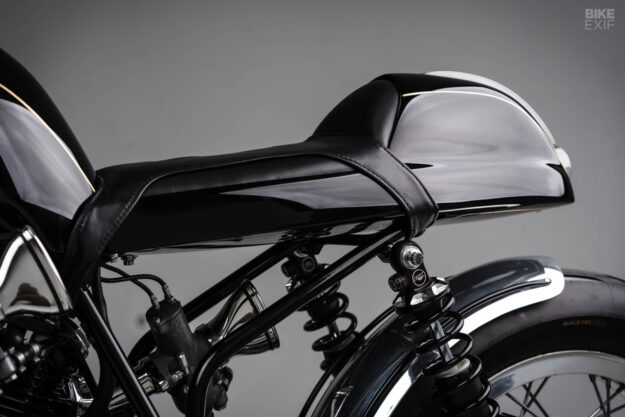
So, he scrapped the tubing from the oil tank backward and fabricated new Chromoly tubing in its place. Fox shocks now suspend the rear.

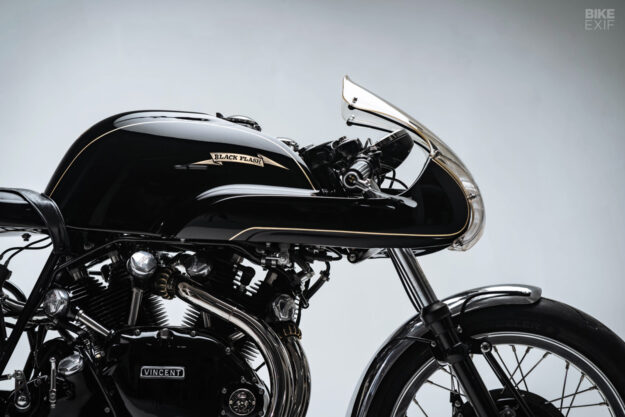
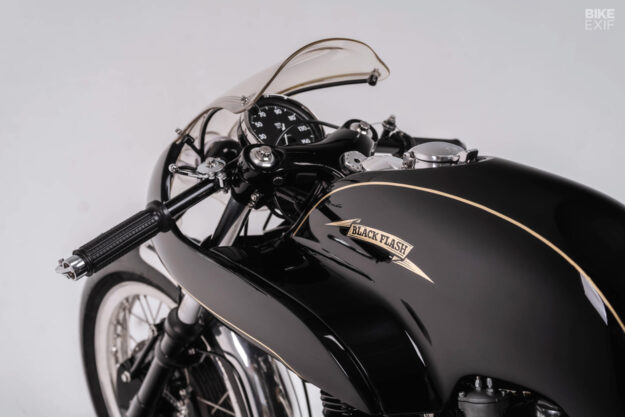
Then he took Ducati’s Imola-style tank design and integrated it with a compact fairing. “This was a function of necessity; we wanted to get at least two gallons of gas capacity while keeping the large tubular oil reservoir.”

Egli-Vincent cafe racer by Fuller Moto
The center portions of the tank and tail started life as a five-inch-wide strip of aluminum. Bryan then water-jetted a custom die for his Pullmax [metal shaping] machine to keep the shape consistent in the front and rear.

“This is a great way to get started and keeps the design cohesive. The tail and seat came together pretty good after some tweaking and tacking.”

Egli-Vincent cafe racer by Fuller Moto
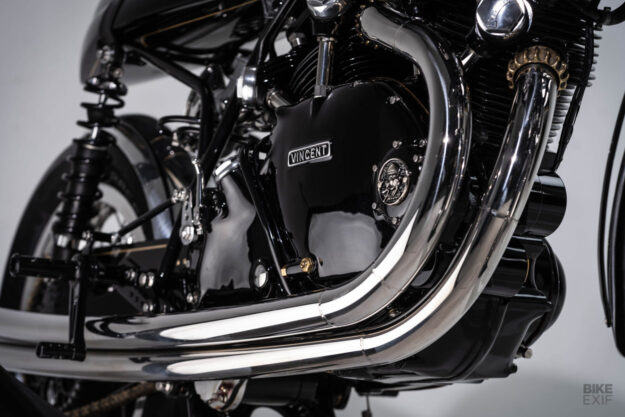
Next was the stainless exhaust, which uses 1¾-inch tubing rolled on a three-wheel roller to get the long swooping pieces. “The u-bends were then made on a mandrel bender and are spliced together to create the rest.”

“It’s very tight in the head area, and since the header flanges are threaded, we needed to be very careful that they didn’t get stripped. We made a special tap to chase the threads at one point.”

Egli-Vincent cafe racer by Fuller Moto
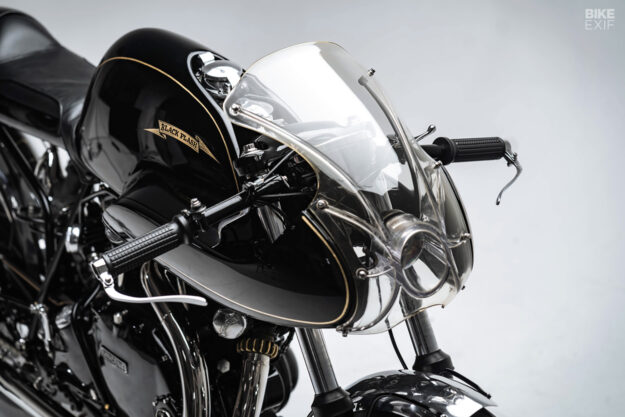
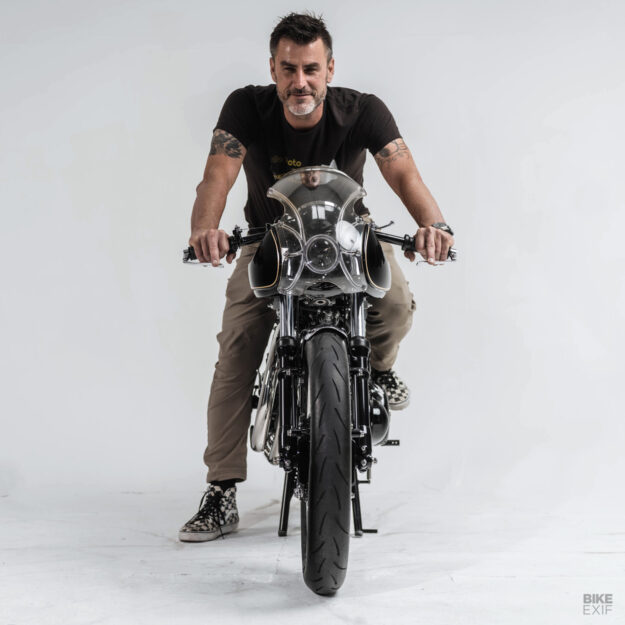
The windscreen is much higher tech. “The concept was to be able to look straight into the bike and see directly into the guts of the triple tree and headlight area,” says Bryan. Dallas-based 3D printer Adam Tulin took Bryan’s cardboard templates and made (as far as we know) the first printed motorcycle windscreen.

“It took a few sample prints to get things dialed in,” Bryan notes. “Adam nailed the design, and we even integrated the factory mounts of the headlights into the print—which made assembly very easy.”

Egli-Vincent cafe racer by Fuller Moto
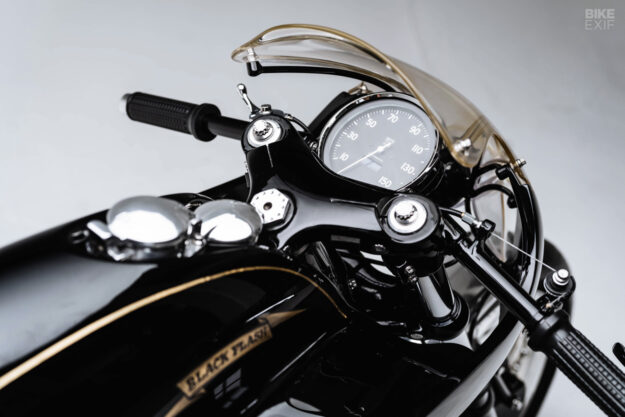
Shaun requested a Smiths tachometer be put on the bike, to match the originals. Bryan didn’t have the unit in his hands until very late in the build, but a roll of 2-inch masking tape worked as a placeholder.

The birdcage bracketry uses bungs made on the lathe and a ¼-inch steel rod painstakingly bent into configuration. “There was a good deal of back and forth adjusting, untacking, retacking and making sure each hole lines up just right. This screen is about as tight as you can make it.”

Egli-Vincent cafe racer by Fuller Moto
The brakes and triple trees are reproduction magnesium units from Argentina, supplied by Shaun. “I was worried the raw mag finish was going to look weird with this highly polished machine,” says Bryan. “So we powder coated and then painted the side plates to have the most visible parts match.”

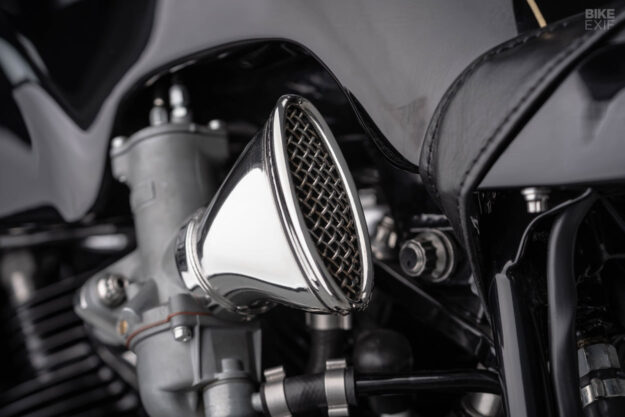
A trickier job was printing oval titanium intake runners and stacks. “Custom-making intake tubes can take some time, and metal finishing is always a long process,” Bryan explains. “We printed several mockups out of plastic to get the positioning just right.”

Egli-Vincent cafe racer by Fuller Moto
“Metal printing is an amazing technology that we are using more and more on our projects. I’ve yet to find an impurity in the stack of parts we’ve done so far.”

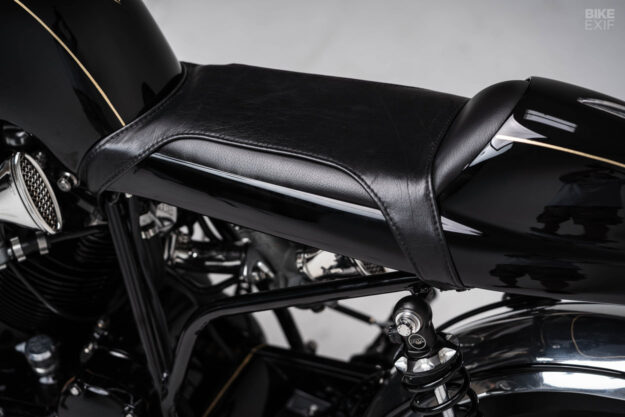
After a little extra finesse for the lines of the tank and fairing, Bryan sketched out the flying buttress seat cover idea with Fuller Moto staffer Cato. “We had an old leather jacket to use as the seat material. I love how the design came together—I don’t remember seeing another like it.”

Egli-Vincent cafe racer by Fuller Moto
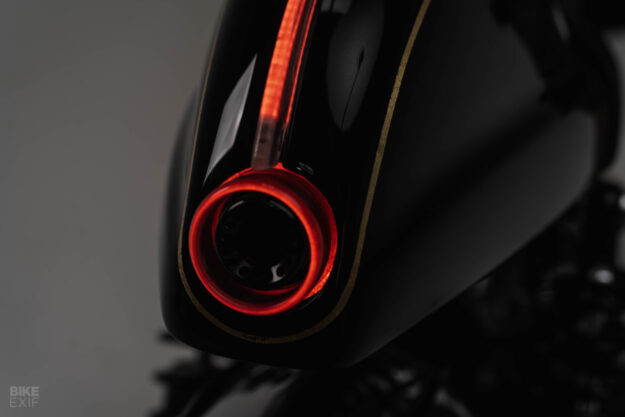
The compact tail unit hides the electronics and a battery compartment, and Bryan has water-jetted a clear ‘spear’ that runs over the top and around the cylindrical taillight. It’s a neat see-through trick that adds a touch of magic in the dark.

As with all Fuller Moto projects, almost every fastener on the Vincent was swapped out with ARP stainless 12-point fasteners. (“This project was an even harder swap than usual, due to the mixture of Wentworth, Standard, and Metric thread patterns and sizes.”)

Egli-Vincent cafe racer by Fuller Moto
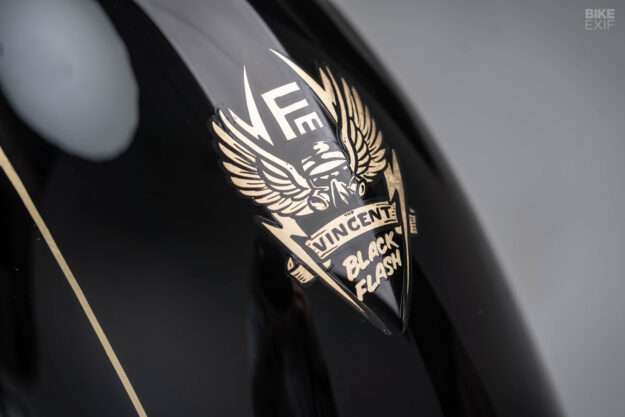
After a couple of years of on-and-off work, everything was ready for painting and polishing. “Our in-house paint shop laid out some flawless, killer black flat paint. Chastin Brand came in to help with the logos and stripes.”

Bryan says that the name ‘Black Flash’ was an easy choice: “One of the few names in the Vincent family not used, as far as I know.”

Egli-Vincent cafe racer by Fuller Moto
‘Black Flash’ has just finished touring the shows in the US, and she’s now ready for a real shakedown. “I’m getting chills thinking about heading down an open road, getting the throttle open, and seeing that Smiths head towards redline!” says Bryan.

And who wouldn’t? Black Flash is as close to motorcycle art as you can get—and a brilliant homage to the classic Egli cafe racers.

Fuller Moto | Facebook | Instagram | Images by Steve West

Egli-Vincent cafe racer by Fuller Moto


from Bike EXIF https://ift.tt/Nzm4BwZ

Sunday, 24 July 2022

Speed Read, July 24, 2022

Latest motorcycle news and customs
We kick this week’s edition of Speed Read off with further proof that Yamaha SRs make great café racers. We also cover news of Guy Martin’s latest exploits, and a custom Yamaha RD400 and Honda CB750.


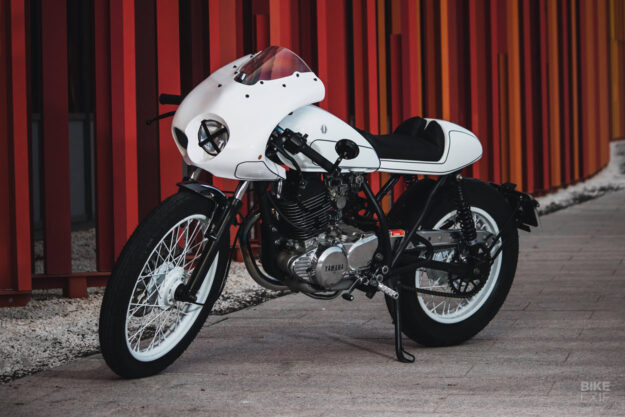
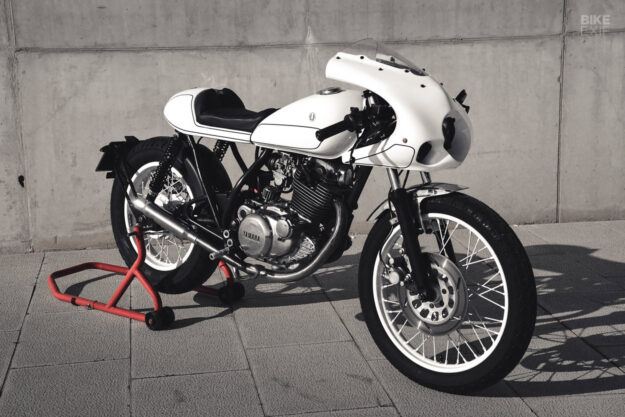
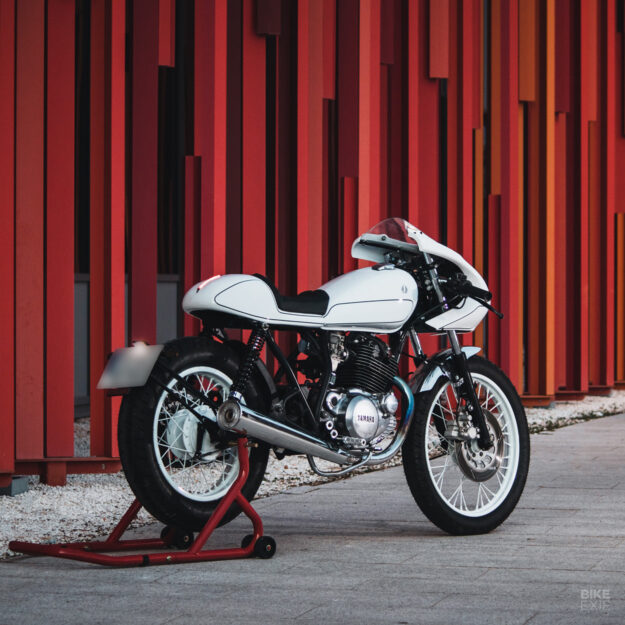
Yamaha SR250 by deWolf Moto Co. Built in his hometown of Zaragoza, Spain, this is Santi deWolf’s third build under the deWolf Moto Co. banner. Santi started with two donor Yamaha SR250 donors; the first SR to go under the knife was turned into a bobber, with the second patiently waiting its turn. This is that second SR, and the end result of a lot of hard work.


Yamaha’s SR platform is perfect for custom builders, and it looks like Santi has taken full advantage of this. Small, lightweight and extra fun, deWolf has transformed the diminutive commuter bike into a full-blown neo-classic café racer. When he’s not building bikes he’s a mechanical engineer, working for a large home appliance company, so he’s used his engineering skills to good effect.

“Why can’t small bikes be fun, perform better than stock and be classy?” asks Santi. “The objective was to build a much different café racer with modern flare on a very tight budget. It was a non-runner—wrecked but cheap.”


With this ethos in mind Santi got on with it, tackling every aspect of the build himself except the paint and the upholstery. The front fairing and seat were mocked up using foam blocks before being made in fiberglass. Everything was rebuilt, including the engine, suspension and wheels.

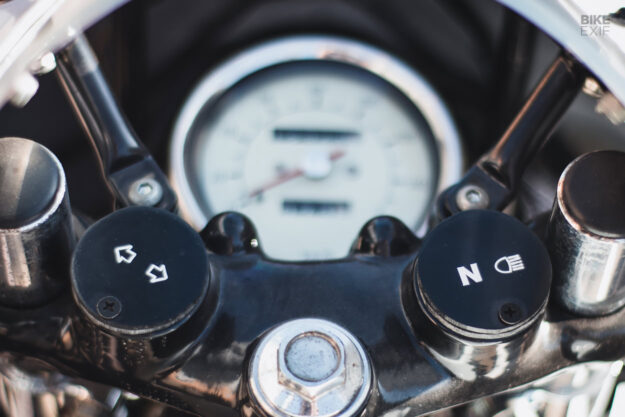
The rear subframe was modified to fit a new seat unit, with the electrics all cleverly hidden away. The frame was powder coated, and the bike was entirely rewired, since the donor bike had come in a sorry state.


Santi has proven that he has what it takes to build a stunning machine, and even scored an invite to this year’s Bike Shed Motorcycle Show in London. The bike is currently for sale, so that Santi can move onto his next project, a Honda SLR650.

We will be watching with great interest. [deWolf Moto Co. Instagram]


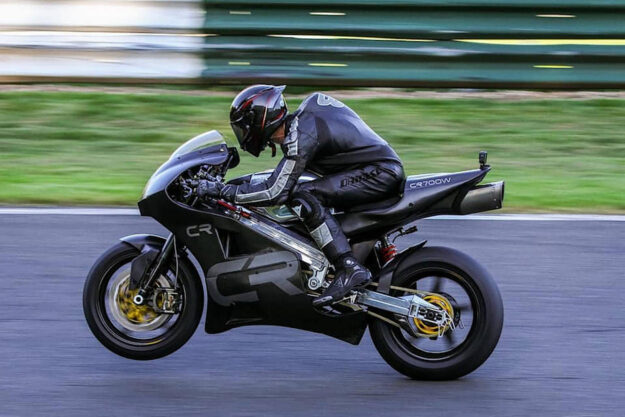
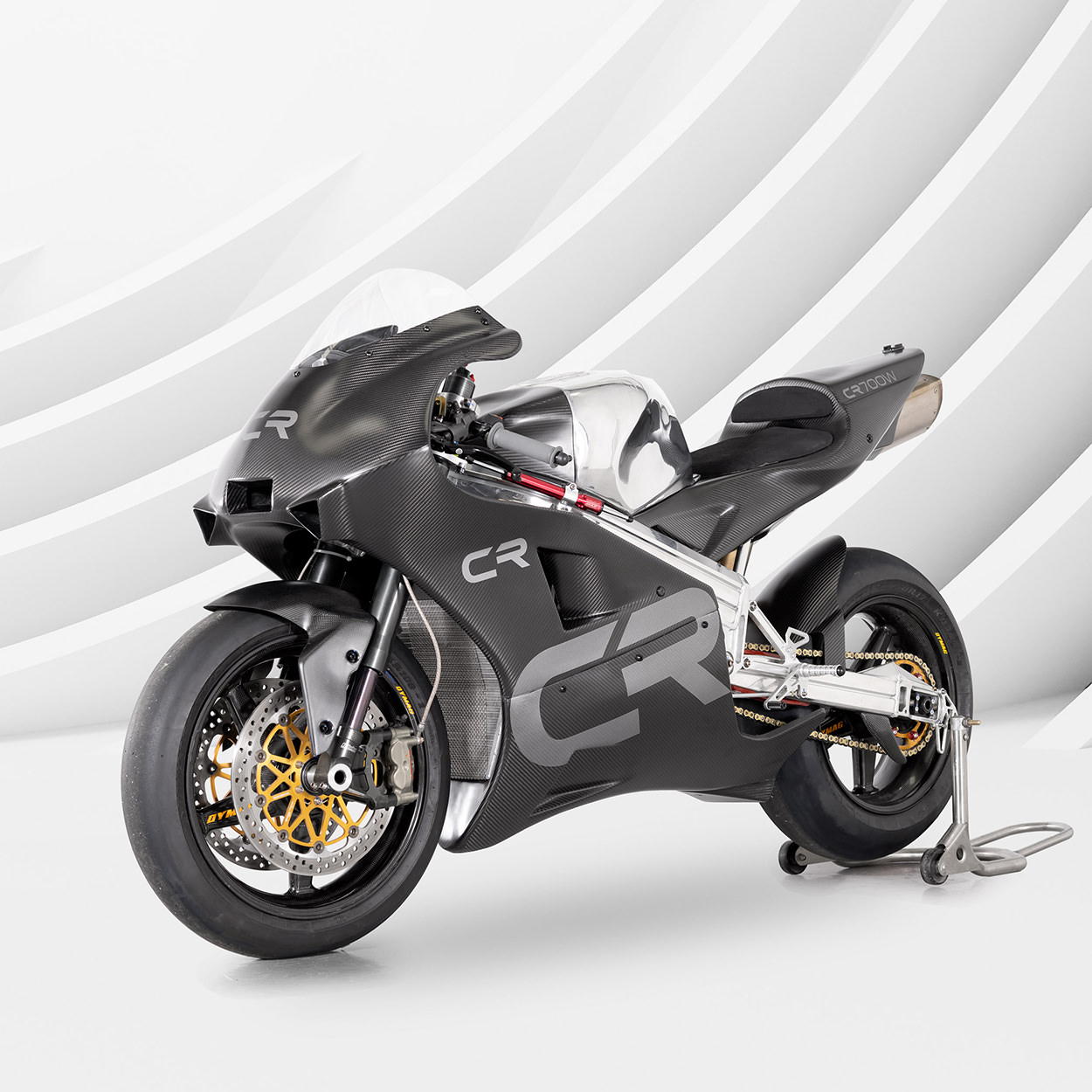
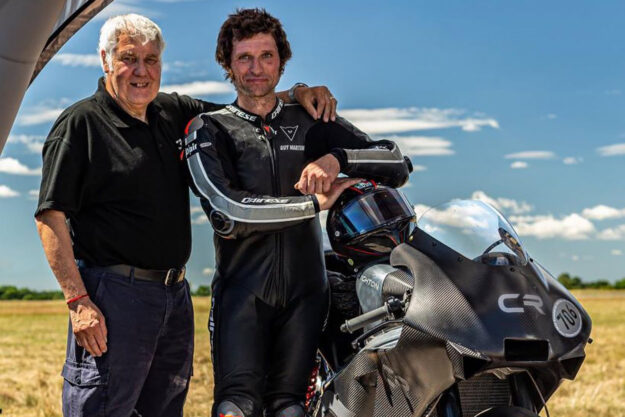
Guy Martin on the Crighton CR700W Guy Martin is at it again. No, he’s not building another Spitfire—he’s out to break another land speed record. This time he’s aiming to double the ton (200 mph) on the rotary-powered Crighton CR700W.

Brian Crighton is the man behind the machine, and the very same guy who worked for Norton all those years ago, when they were leading the rotary charge on the race track with the iconic JPS Nortons. Working out of a garden shed in the Norton factory grounds, Crighton took it upon himself to prove to the Norton higher-ups that rotary power and motorcycles were a match made in heaven. Quickly making breakthroughs, Norton was, all of a sudden, back at the top of the timing charts.

Crighton CR700W rotary motorcycle
The Crighton CR700W is the direct descendant of those first rotary-powered Nortons. As if the aluminum frame, swingarm and carbon fiber bodywork weren’t impressive enough, the engine is the standout feature. An excerpt from their website puts it all into perspective:

“220 hp at 10,500 rpm from the CR700W’s fuel-injected twin rotor 690 cc engine means 319 hp per liter. By comparison, the most powerful normally aspirated Formula 1 engine—the Ferrari F2004—generates 309 hp per liter at a frantic 18,500 rpm, and the very latest MotoGP bikes deliver around 300hp per liter.”


Piloted by Martin, the team have already cracked 188 mph, 16 mph faster than the previous record. With a myriad of options to choose from (like different gearing and fairings) it sounds like another record will soon be added to Martin’s already-impressive resume. [Via]


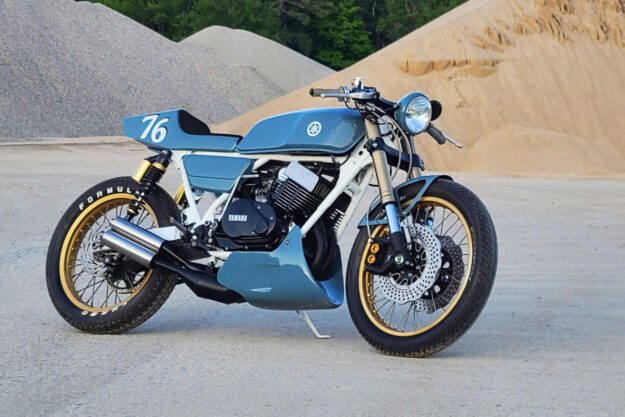
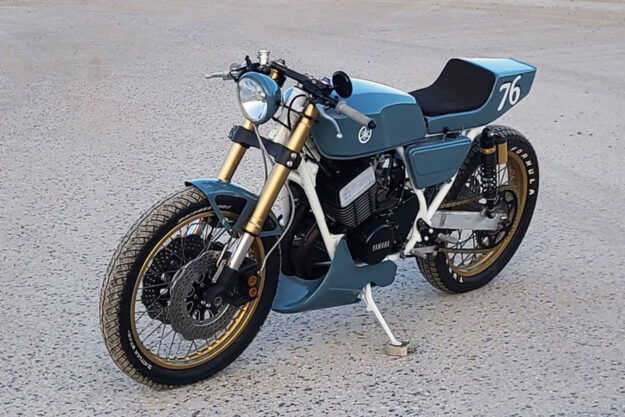
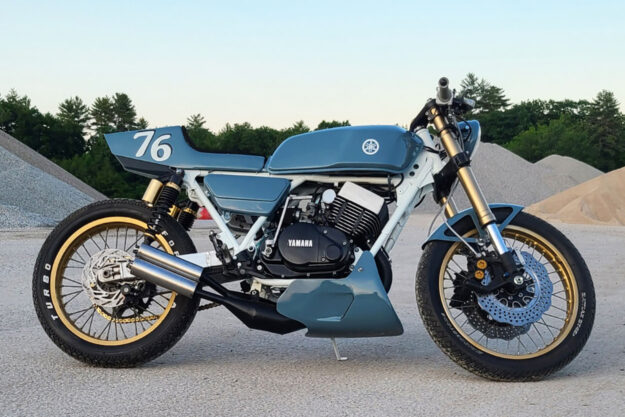
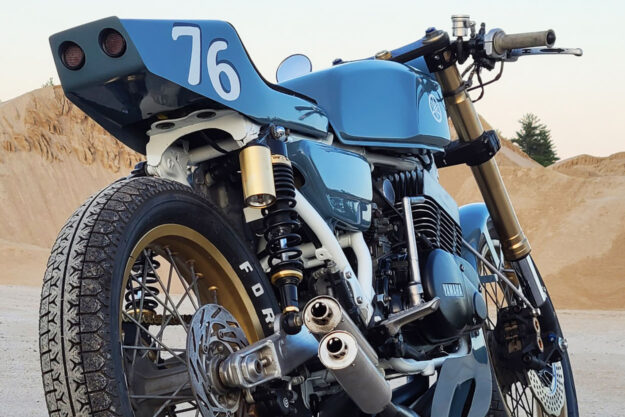
Yamaha RD400 by Coti Sanders Moving onto another bike that benefits from lubricated fuel, is this: a 1976 Yamaha RD400 built by Coti Sanders. Hailing from the south of Maine in the USA, Coti grew up with two-stroke dirt bikes and quads. When he got his first classic it was always going to be a smoker.


Picking up the RD400 12 years ago, it was around the time a certain global epidemic hit that Coti tore into the bike in earnest. Getting the party started was a complete front-end swap, donated by a Suzuki GSX-R.

The spoked front wheel is from a Suzuki GT750, rotating before a custom-made belly pan. The engine is running Banshee pistons, with the work to make them fit carried out by Coti himself. He also made the entire exhaust system.


The tank is original, albeit treated to a fresh coat of Jaguar ‘Underhood Blue’ and a recessed fuel cap. The flat track style seat is new, and sits above the swingarm and rear wheel from a KTM. Coti, a self-confessed “cheap bastard,” found parts for the bike from all over, the aforementioned KTM parts coming from the local rubbish dump.


Even though the bike is quite literally a parts bin special, I think Coti has done a bang-up job. I’m not the only one impressed with his skills, either—Coti landed himself an invite to the Handbuilt Motorcycle Show in Austin, Texas.

With his first build under his belt, I’m excited to see what he comes up with next. [Via]


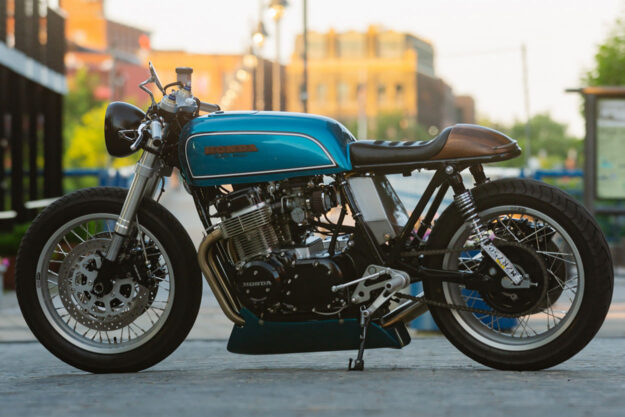
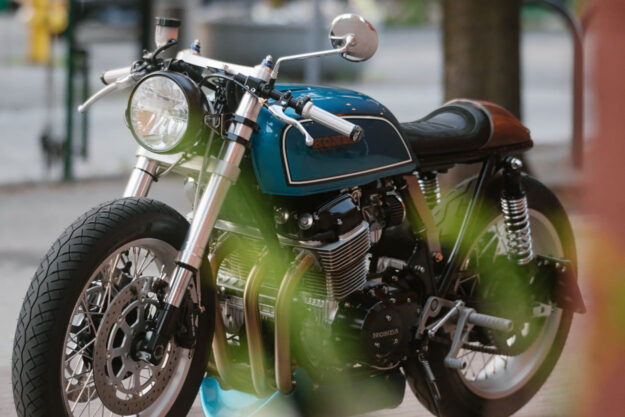
1975 Honda CB750F by Mile Zero Racers When I was getting into bikes all those years ago there was an incredible Honda CB750 that was featured on Bike EXIF. It has lived rent-free in my mind ever since, so to this day I have a soft spot for Honda’s legendary inline-four.

Thomas Manno of Mile Zero Racers has the same love for the CB. He rescued his from a seller on Facebook Marketplace in 2020. This means that has no problem finishing what he starts, as evidenced by two things. Firstly, the bike itself. Secondly, the fact that he actually followed through after the initial “Hi, is this still available?”


To top things off, Thomas was at college when he started his custom motorcycle journey, and also had little previous experience with wrenching or fabrication. Teaming up with Honda CB guru Mike Rieck of Cycle X to rebuild the top end, Thomas tackled the bottom end himself. Talk about throwing yourself into the deep end!

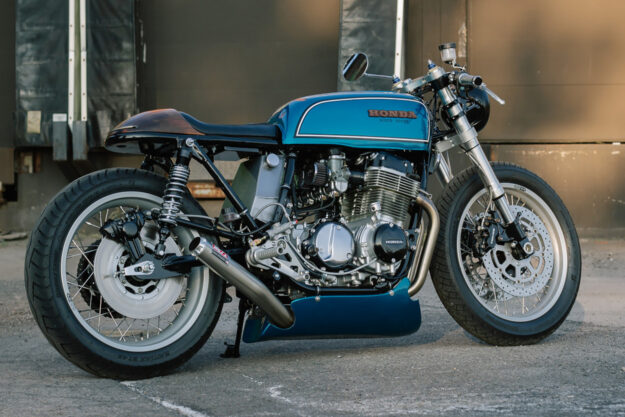
The front end is from a Suzuki GSX-R (this week’s custom bike builders front end of choice) which reportedly does wonders for the ride. The bike was rewired with a complete suite of Motogadget gear, and it looks like every nut and bolt was replaced at some point along the way. I particularly like the sporty-looking belly pan which barely hides the new four-into-one exhaust.


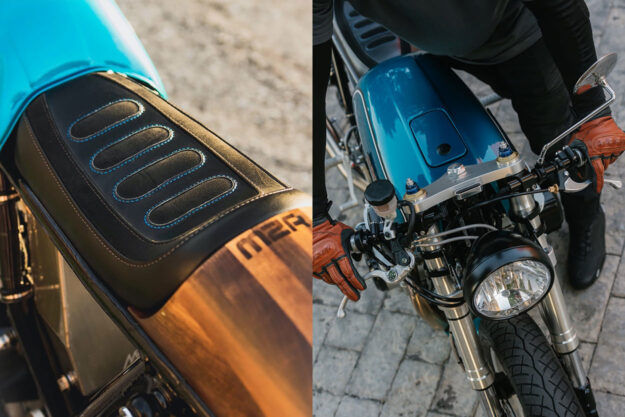
Traditionally motorcycles are more about metallurgy, but from the beginning of the build, Thomas wanted to add timber details. The tank badges and seat hump were made with help from a friend with woodworking experience. They really look the business, especially with how the tail light is recessed into the hump.

Thomas also took inspiration from Porsche Clubsport racing cars but wanted to retain as much of the CB as possible. All of my CBias aside, this is a cracking good build and it proves that you can do anything you set your mind to. [Via]


from Bike EXIF https://ift.tt/g8X0cTF

Friday, 22 July 2022

Pre-unit perfection: Recreating a 1950s desert sled

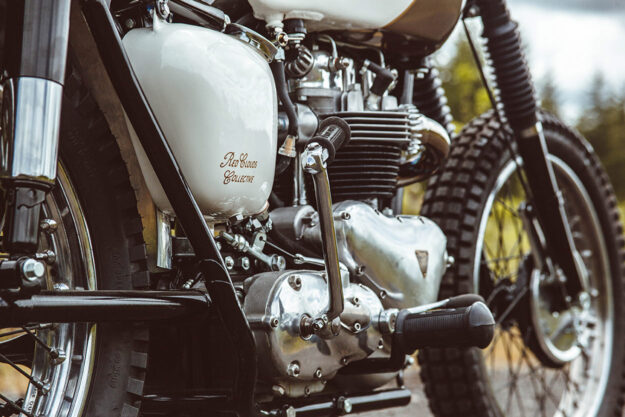
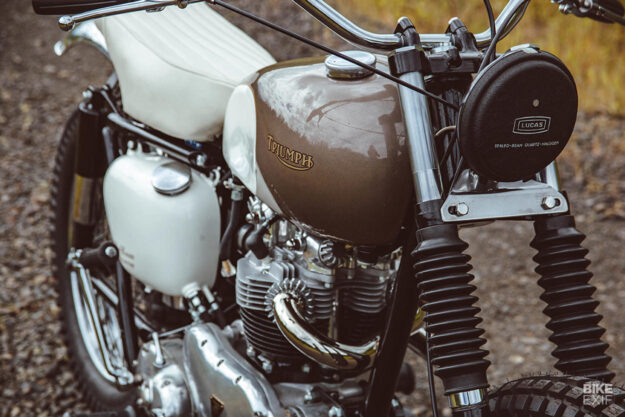
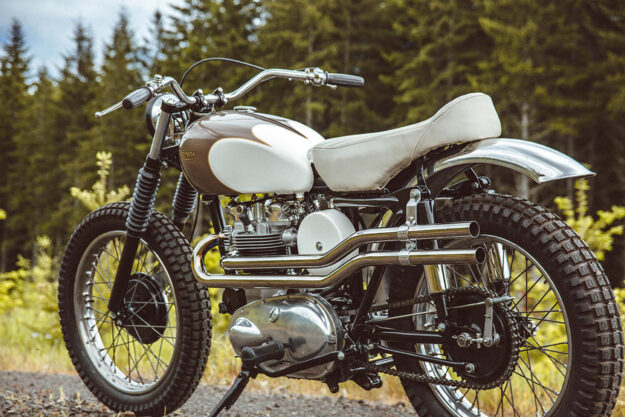
Triumph desert sled by Red Clouds Collective
When you buy a new dirt bike, you expect the factory to offer you a stripped-down, light-as-can-be machine, ready to ride away. But in the early days of off-roading, this wasn’t the case.

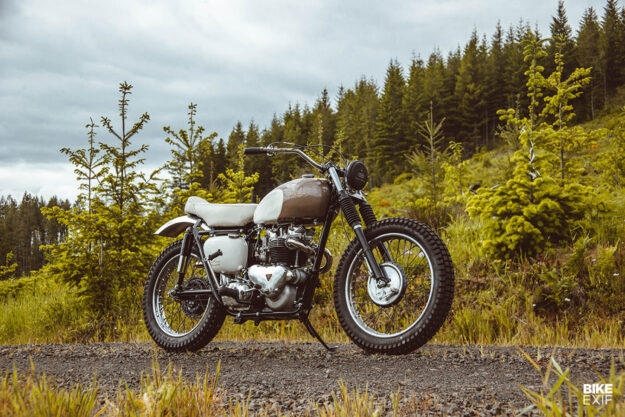
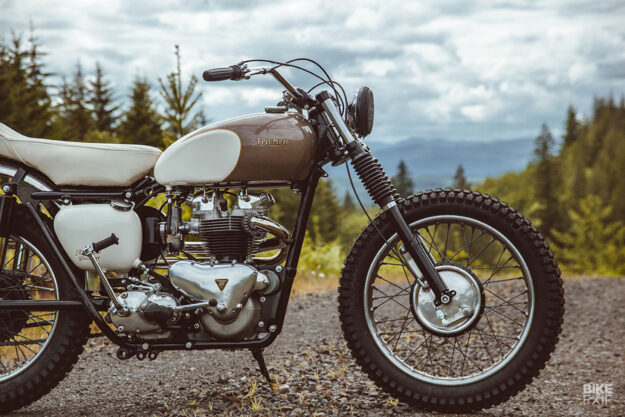
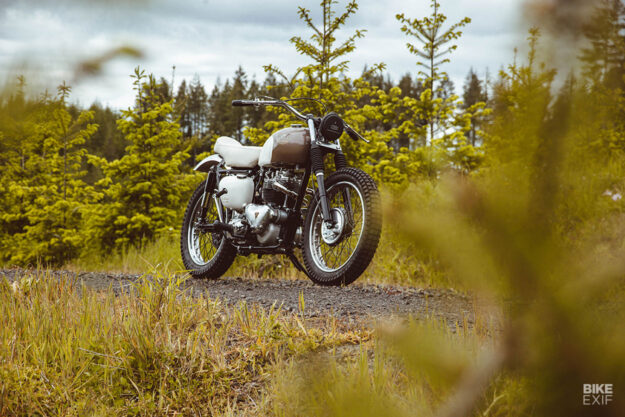
Most dirt bikes were essentially road bikes that customers stripped down and lightened themselves, with no dedicated off-road steering or frame geometry. This 1956 Triumph TR6 ‘Desert Sled’ is a typical example—and that’s how Seth Neefus of Portland, Oregon likes it.

Triumph desert sled by Red Clouds Collective
“I always dream about what a dirt bike or dual sport bike would look like if it rolled out of a factory back in the 1950s,” says Seth. “Just something simple and fun, with a little bit of style—to catch the eye of people when the motorcycle came roaring through the streets and off into the desert.”

As if building up a pre-unit Triumph from the 50s isn’t hard enough, Seth also started his desert sled project with nothing but a box of mismatched parts.

Triumph desert sled by Red Clouds Collective
Luckily, the engine had already been rebuilt and the frame had a clean title so it could be registered for road use. Unluckily, Seth still had a lot of missing parts to find.

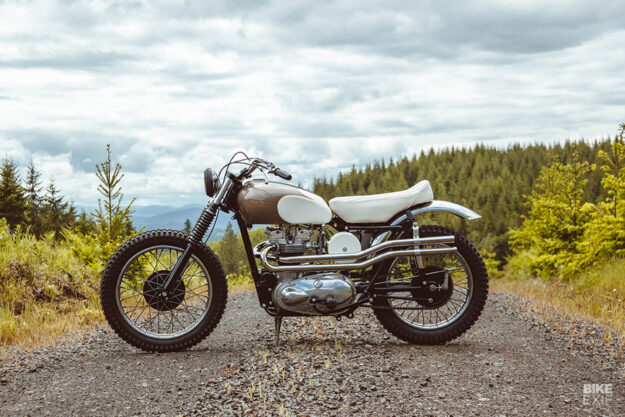
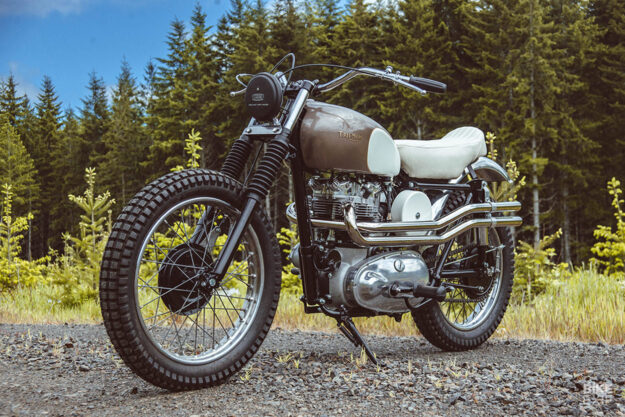
Seth rebuilt the forks with heavier springs and gave the wheels the same treatment, before wrapping them in trials-style tires. Like the ‘hare scramble’ bikes of yore, there is no front fender, speedometer or anything else that could break or weigh down the bike. However, there is a headlight—an old 6-volt Lucas that still has its original cover.

Triumph desert sled by Red Clouds Collective
The frame, fork lowers and swingarm were powder-coated in gloss black, which pops nicely against the chrome of the new exhaust, engine covers and rear fender.

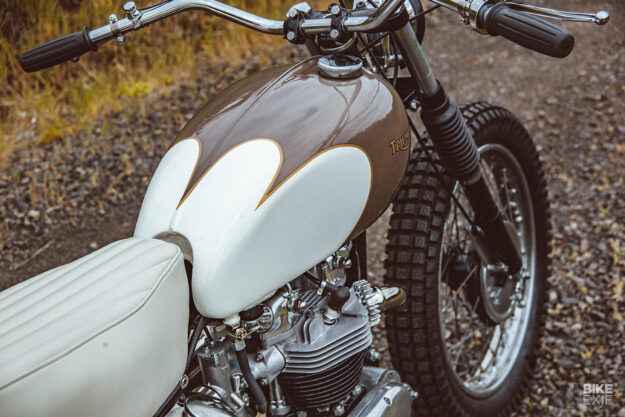
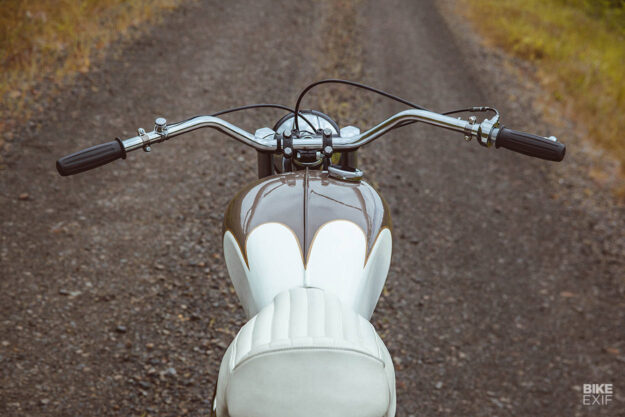
After finding an old, dented fuel tank, Seth painstakingly repaired it and got it ready for paint. “The paint design came naturally, and I knew I wanted to hand paint the pinstripe with one shot like they did back in the day,” he says.

Triumph desert sled by Red Clouds Collective
“The color combination is something I have been wanting to bring to life for a long time and it just felt like it was meant for this bike.”

While Seth was mulling over the tank, his brother Casey made a custom Bates-style desert sled seat. The Neefus brothers have been collecting Bates seats for some time, so they took design elements from several to create this custom unit.

Triumph desert sled by Red Clouds Collective
Seth and Casey own a company called Red Clouds Collective—a clothing and accessories brand that specialize in waxed canvas, selvedge denim and leather. This meant that Casey could also do the upholstery, a touch that Seth is quite fond of.

And they’re so proud of how the seat turned out, they are considering doing a small batch production run in the future.

Triumph desert sled by Red Clouds Collective
The previously rebuilt engine came fitted with a Bonneville T120 head, which is twin carb. But Seth wanted to simplify the Triumph as much as possible—especially in regards to the engine. So he’s opted to replace the T120 head with an original TR6 head.

Once back to a single carb setup, a brand-new Amal Premier concentric unit was married to the intake. Seth also found a Webco-style air filter and it too was slipped on, allowing the bike to run like brand new.

Triumph desert sled by Red Clouds Collective
Gregg Poirer took care of the charging system by way of a new magneto and generator.

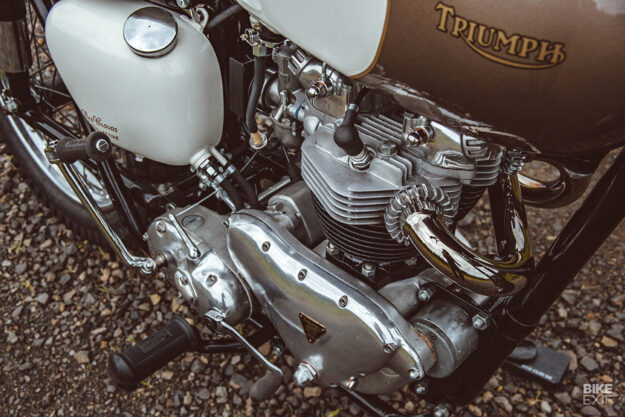
The timing and primary covers were polished to a shine, and the rocker box fins were shaved off to mimic the design found on other pre-unit Triumphs. The oil tank looks to be from an early Triumph, with Seth having to modify the mounting tabs to fit it onto the frame. The asymmetrical air filter/oil tank pairing are dressed up to match the gas tank, and sure look the part.

Triumph desert sled by Red Clouds Collective
“This Triumph was made up from random boxes of forgotten parts, and swap meet scores,” says Seth. “Plus endless miles of driving around the northwest searching for 60-year-old parts that had been left to rust. But this bike gave those parts a new life, and I enjoyed every minute of it.”

The Neefus brothers finished the desert sled just in time for the One Moto Show, held in their Portland neighborhood. Then they headed a thousand miles south to California, for the recent Born Free Pre-Unit/All Desert Sled show.

Triumph desert sled by Red Clouds Collective
Right now, Seth and Casey have still got most of the riding season ahead of them in the USA. That’s not the case for most of us southern-hemisphere folks, but it’s builds like this that get us through a wet, cold winter’s day.

Red Clouds Collective | Facebook | Instagram | Images by Seth Neefus

Triumph desert sled by Red Clouds Collective


from Bike EXIF https://ift.tt/brEp1jL