Sunday, 5 June 2022

Speed Read, June 5, 2022

The latest motorcycle news and customs.
Ever heard of the Fantic Koala? Educate yourself below, then check out an unlikely BMW R1100RS café racer, a rare Bonneville TT Special, a lively Ducati Panigale V4S and a Yamaha XSR900 from Deus.
Custom Fantic Koala by Animal Motor Company
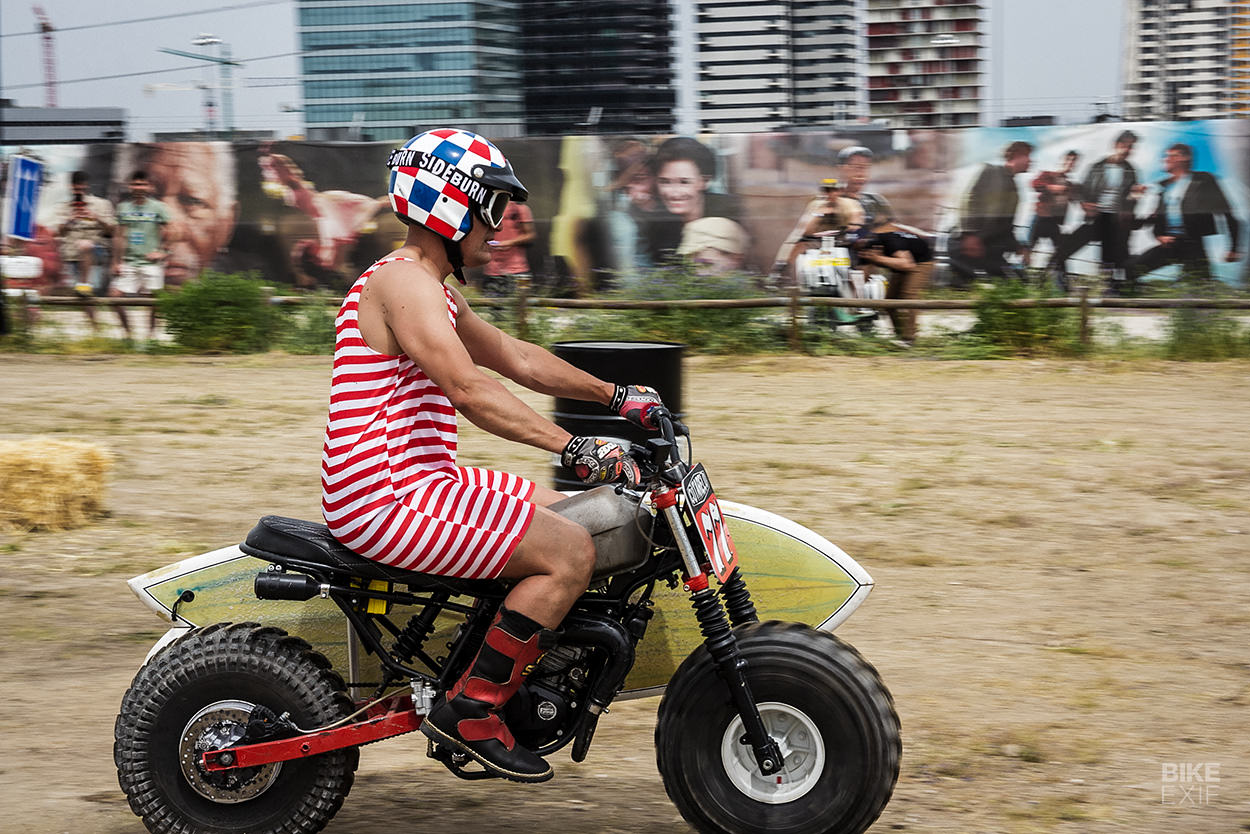
Fantic Koala by Animal Motor Company I’ll be completely honest, I’d never heard of the Fantic Koala until Wes sent me this set of photos. So, until I’m locked away for this heinous crime, I might as well tell you a bit more about this bike.

This is a 1987 Fantic Koala. It’s an 80 cc two-stroke, and apart from the engine it’s pretty much an Italian Suzuki VanVan or Yamaha TW200. Sadly, Google won’t tell you much much more, but looking at these pictures does make one thing clear: they’re a whole lot of fun.
Custom Fantic Koala by Animal Motor Company
This particular example was customized by Ruben Cotarelo of Animal Motor Company, and it was pretty much incomplete when it arrived at their workshop. If I can’t even get information on the bike from Google, I’m going to assume that getting original parts is also somewhat difficult. From this, I can see why Ruben chose to customize, rather than restore.
Custom Fantic Koala by Animal Motor Company
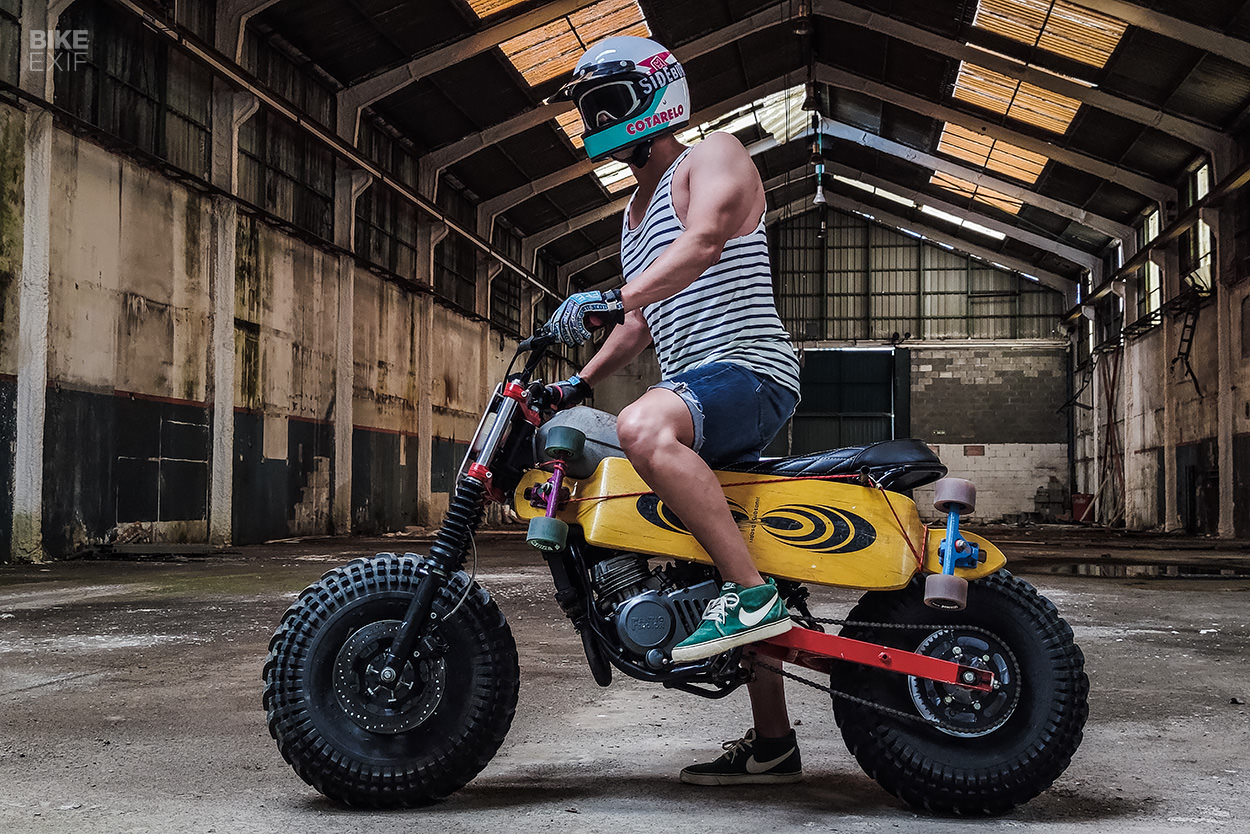
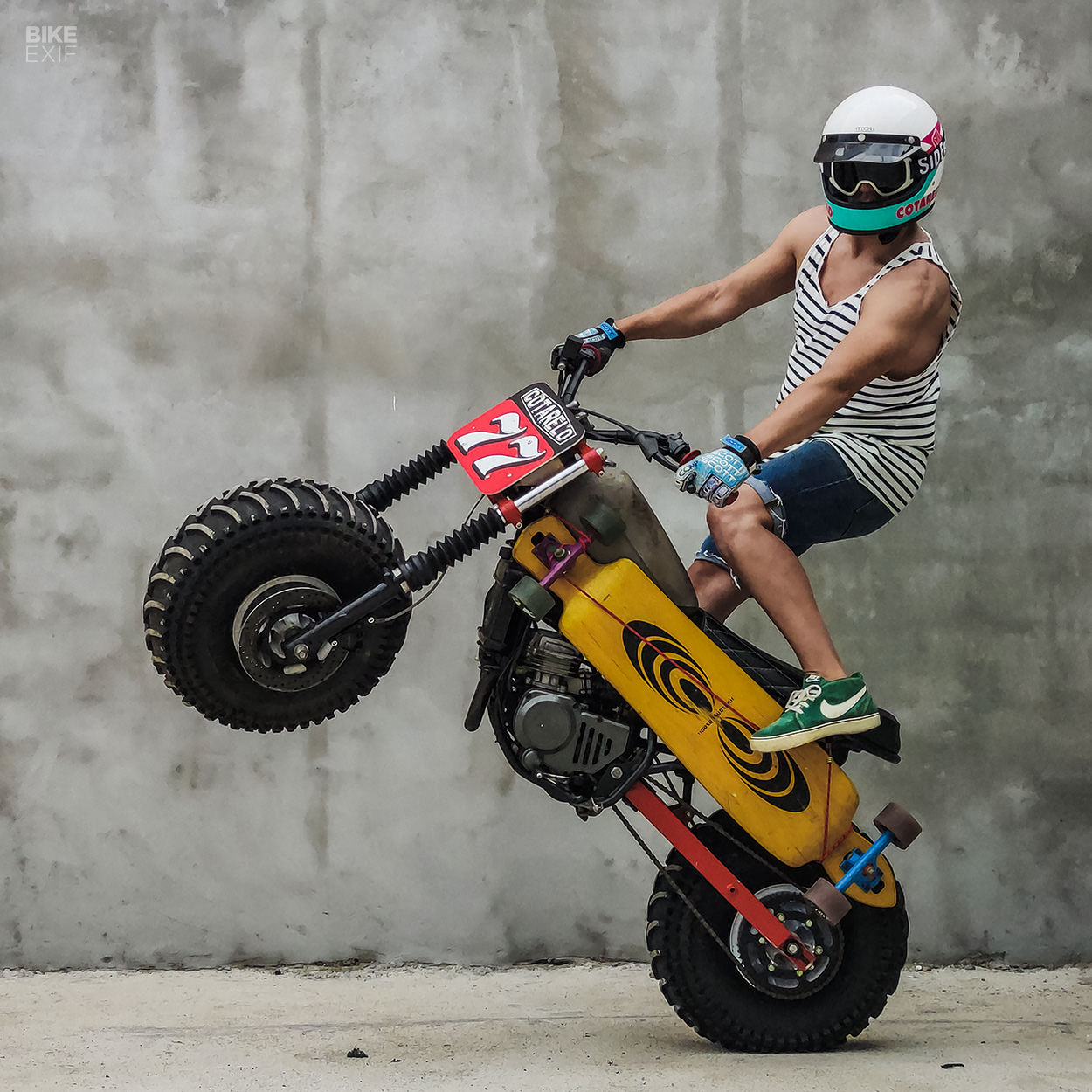
The huge balloon tires are the factory size so there is only one purpose for this bike—off-road adventures. Animal decided to lean into this and build a beach cruiser. The factory motorcycle features dirt bike-style plastics so they were all discarded in place of custom bodywork.

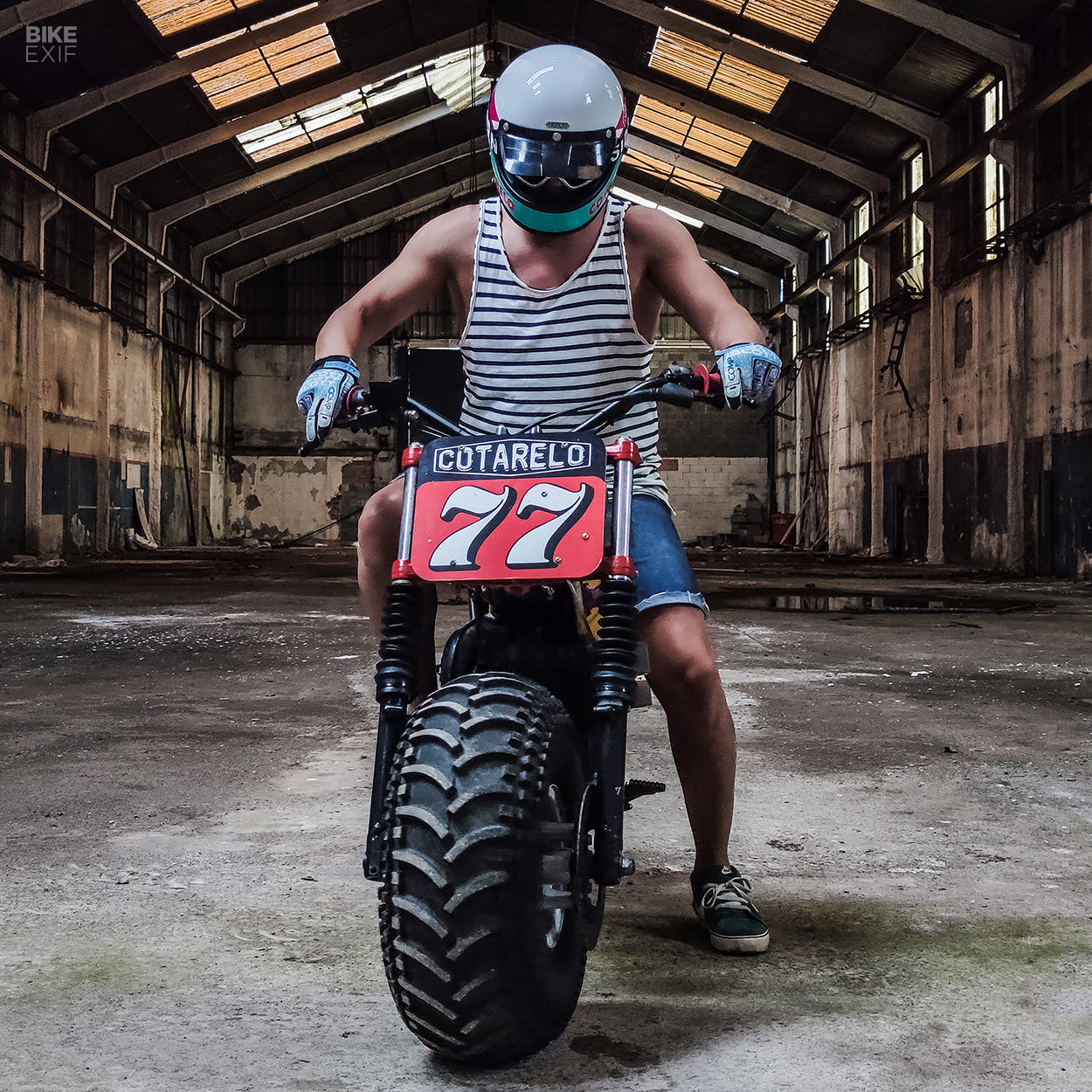
A new tank, flat seat and Renthal handlebars have transformed the diminutive Fantic into a very good looking street tracker. The number plate up front hides the coolant reservoir, and bolted to the left side of the bike is a surfboard/skateboard rack.
Custom Fantic Koala by Animal Motor Company
There are no lights (or even a license plate) that I can see. However, if all you need is something to run you up and down dirt tracks to hidden surf spots, I can’t think of a better mode of transport. [Animal Motor Company]
BMW R1100RS cafe racer by Cafemoto
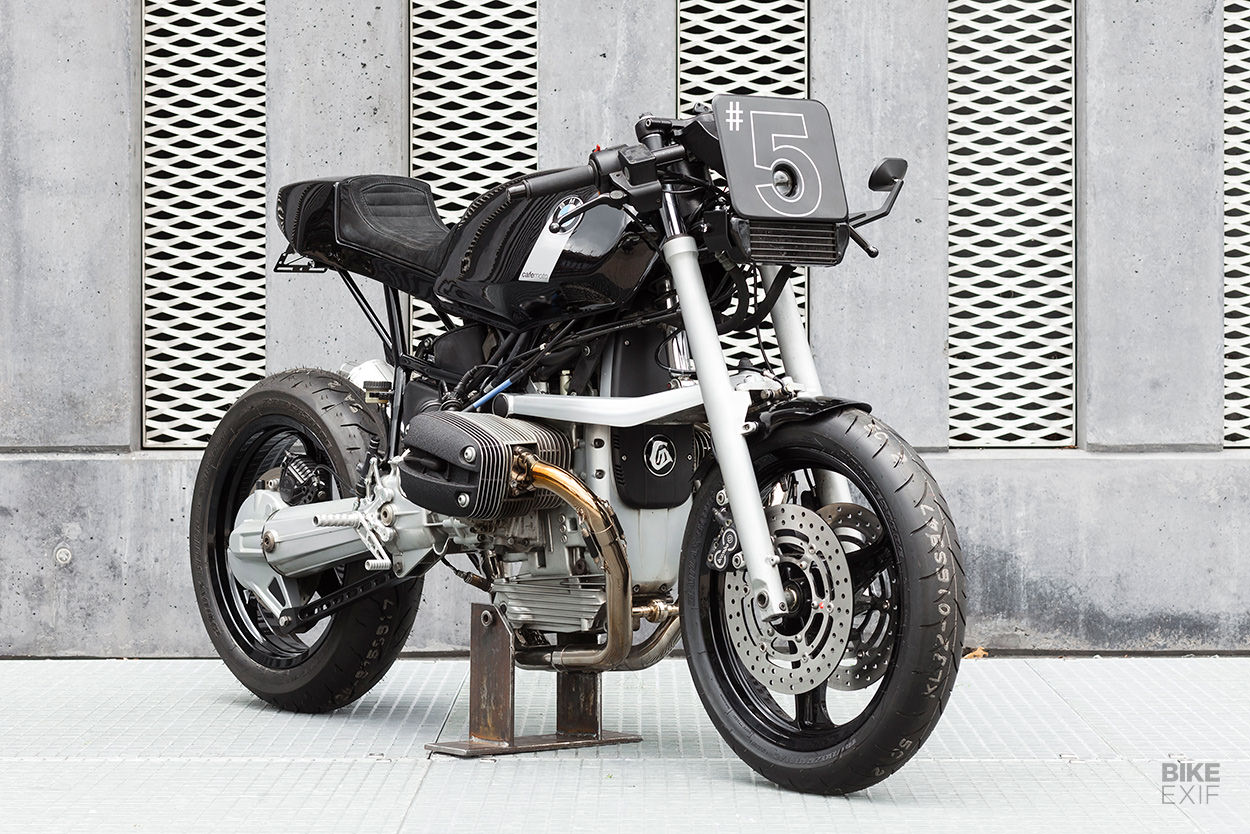
BMW R1100RS by Cafemoto I don’t think anybody has ever referred to the BMW R1100RS as svelte. Sure, it’s lighter than a Goldwing, but at 540 lbs wet, it’s not exactly a purebred race bike. Georg Godde and Holger Maninger, the brains behind Cafemoto in Gelsenkirchen, Germany, aimed to change this.
BMW R1100RS cafe racer by Cafemoto
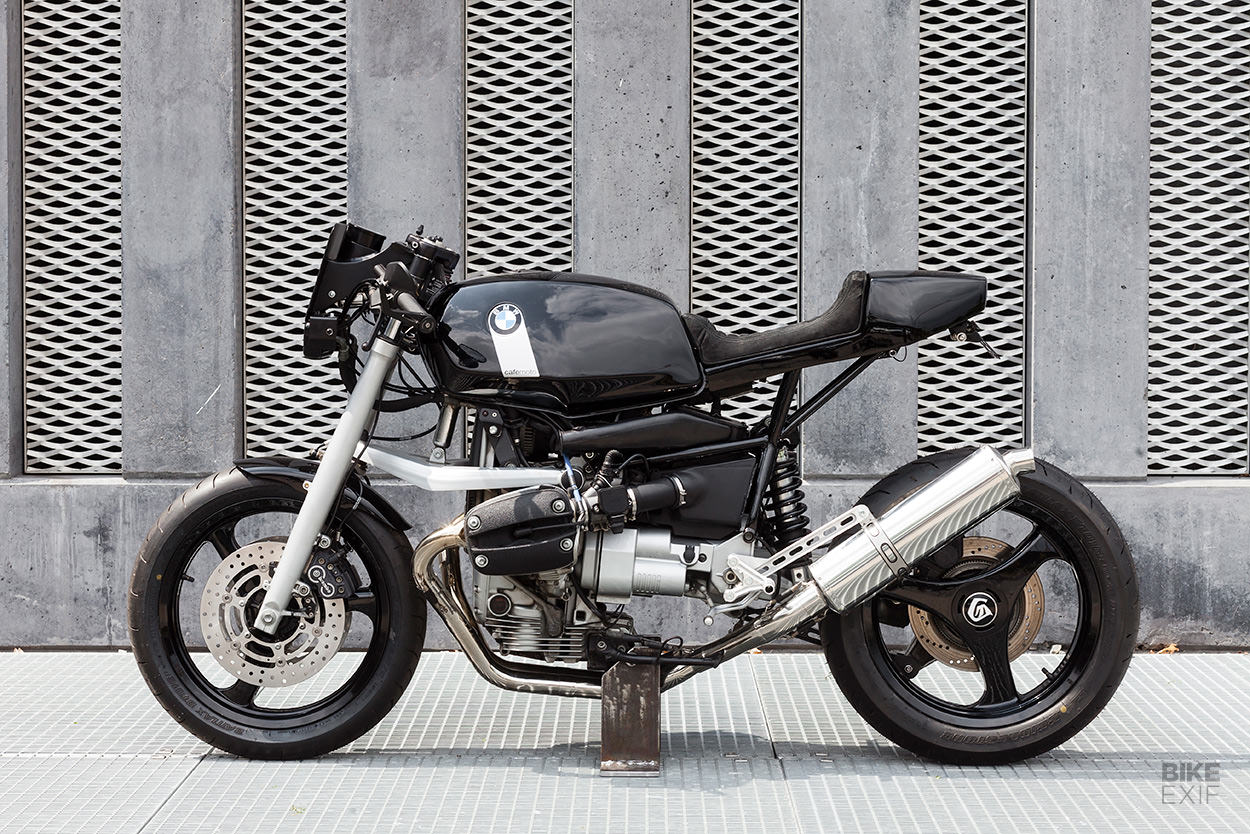
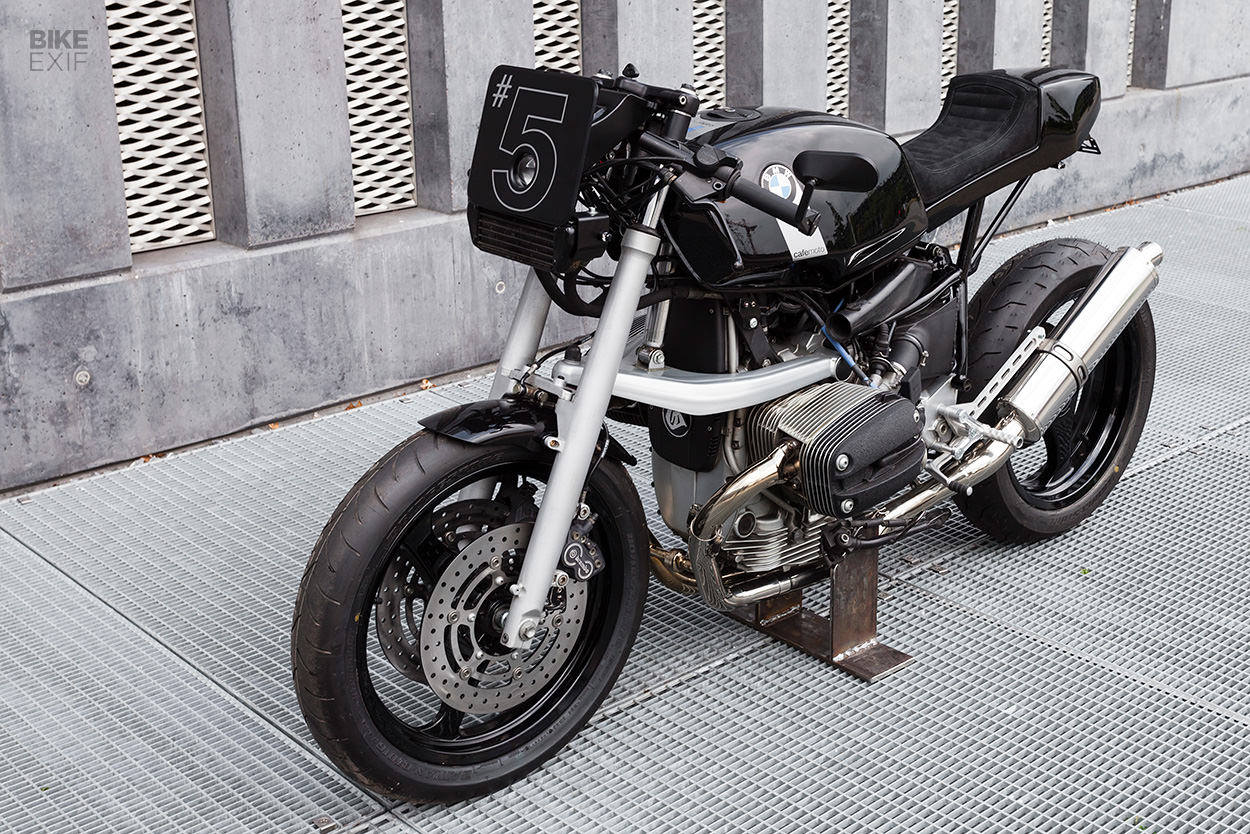
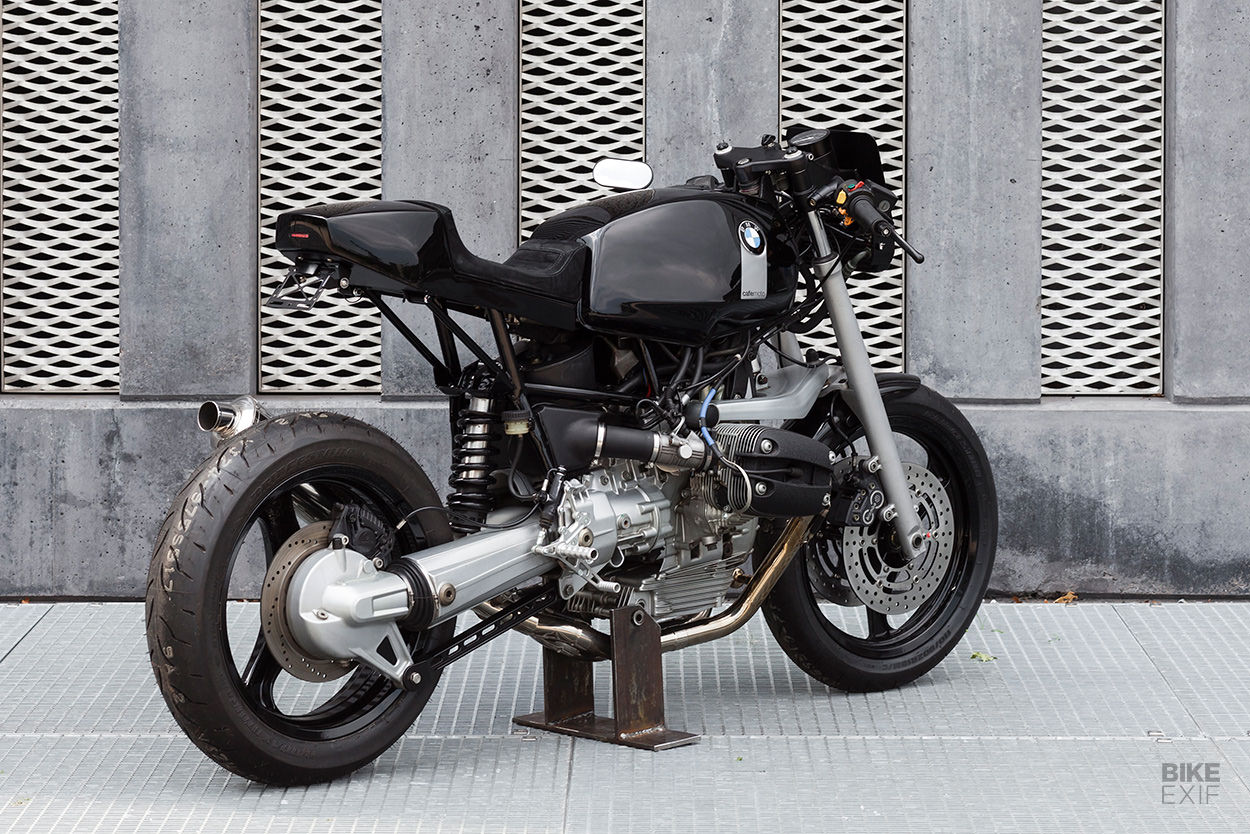
This is ‘Cafemoto 005’ and it’s Georg and Holger’s answer to the BMW R NineT. The elephant in the room is the BMW telelever front suspension, which the guys actually chose to keep. I’ve ridden a few BMW telelever bikes and they are brilliant at soaking up bumps, which is why the suspension was left alone on this build.

In fact, along with the suspension, the engine and most of the frame remain from the original bike. Cafemoto chose to focus on weight reduction, rather than power gains, so the first thing they did was ditch the stock bodywork.
BMW R1100RS cafe racer by Cafemoto
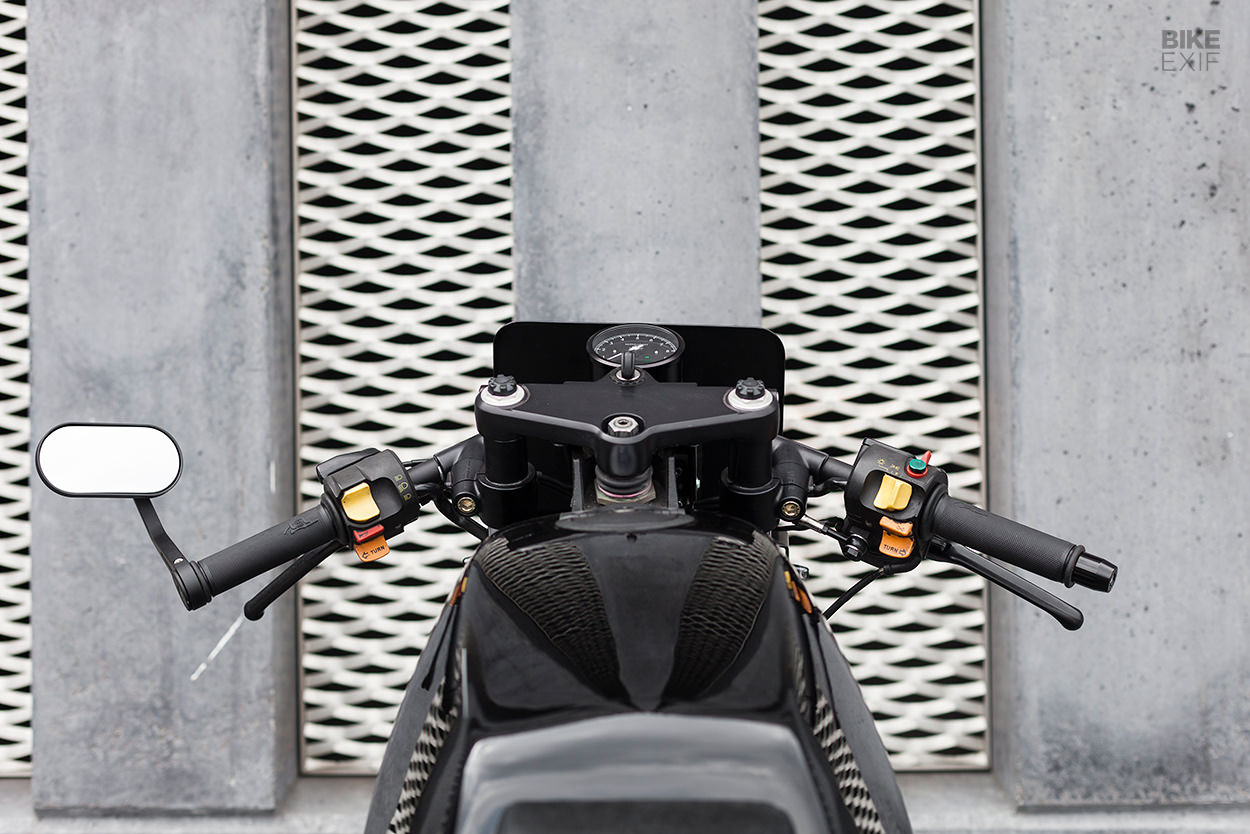
The number plate on the front forks houses a new Motogadget Chronoclassic speedometer, an LED headlight and an oil cooler. Telefix Racer clip-on handlebars were slid into place, while the turn signals are also from Motogadget.

The fuel tank is from a BMW R45 and a lot of time was spent blending it into the bike. To get the fuel pump in, the bottom was cut out and reshaped before being aligned properly with the frame. Continuing through to the tail of the bike, the rear section of the subframe was modified and a new handmade seat was fitted.
BMW R1100RS cafe racer by Cafemoto
After a lick of paint (BMW ‘Avus’ black) with Cafemoto branding, new Bridgestone rubber was wrapped around the wheels. Cafemoto chose a 180-section rear tyre (up from 160) and they swapped the 17” front wheel out for an 18” unit.

The total weight saved at the end of the build? 121 lbs, bringing the weight down to 439 lbs with a full tank of fuel.
BMW R1100RS cafe racer by Cafemoto
With 90 hp on tap from the 1,100 cc twin, regardless of what you think of the looks, you can’t deny this would be a hoot on a bumpy back road. [Cafemoto | Images by Michael Larssen]
Triumph Bonneville TT Special steeplechase race bike
1967 Triumph Bonneville TT Special I have quite a few friends who ride British bikes—but I’m more inclined towards Italian machinery. So I tend to spread the snide remarks about English bikes on pretty thick (all in good fun, of course).

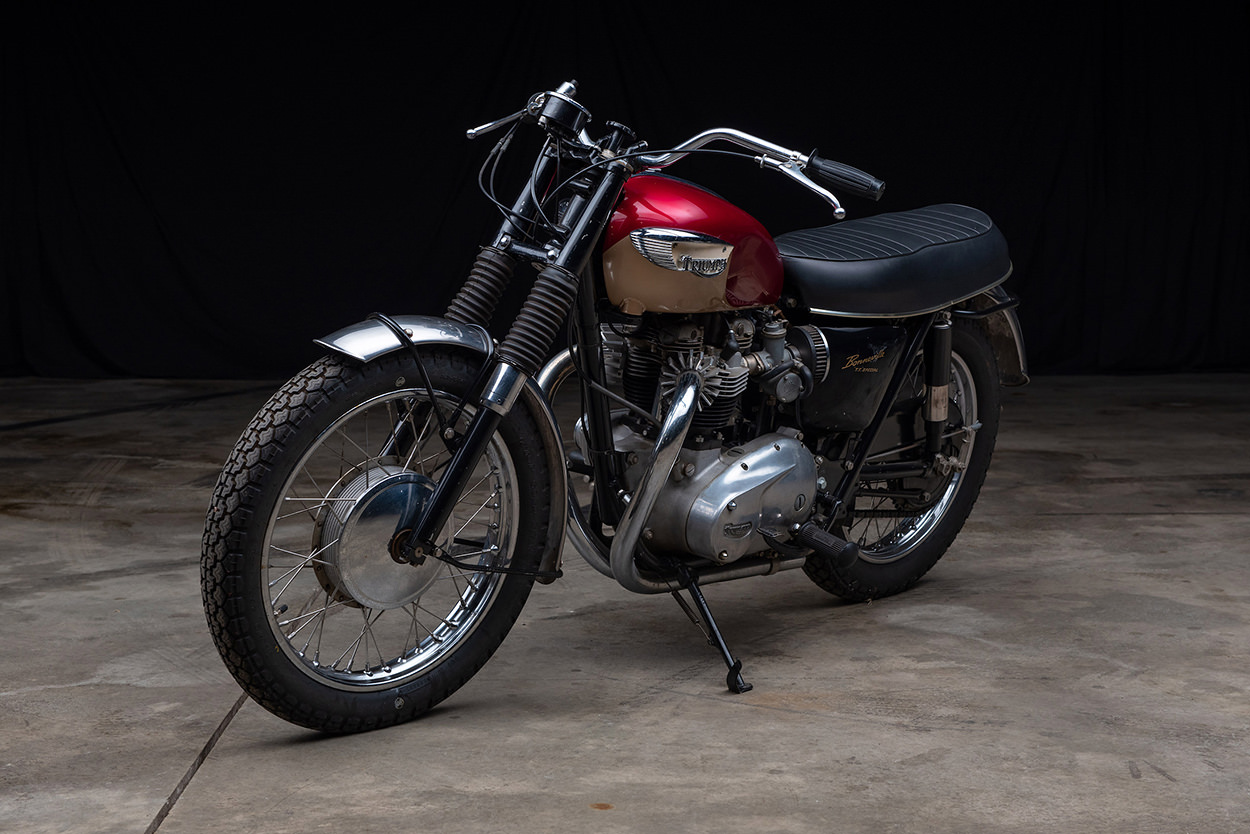
That said, it’s astounding what I would give for one of these; a 1967 Triumph Bonneville TT Special. Besides the lack of headlight, you’d be forgiven for assuming this is just an ordinary Bonneville. It’s the parts inside the engine (and the heritage), however, that make this Special special.
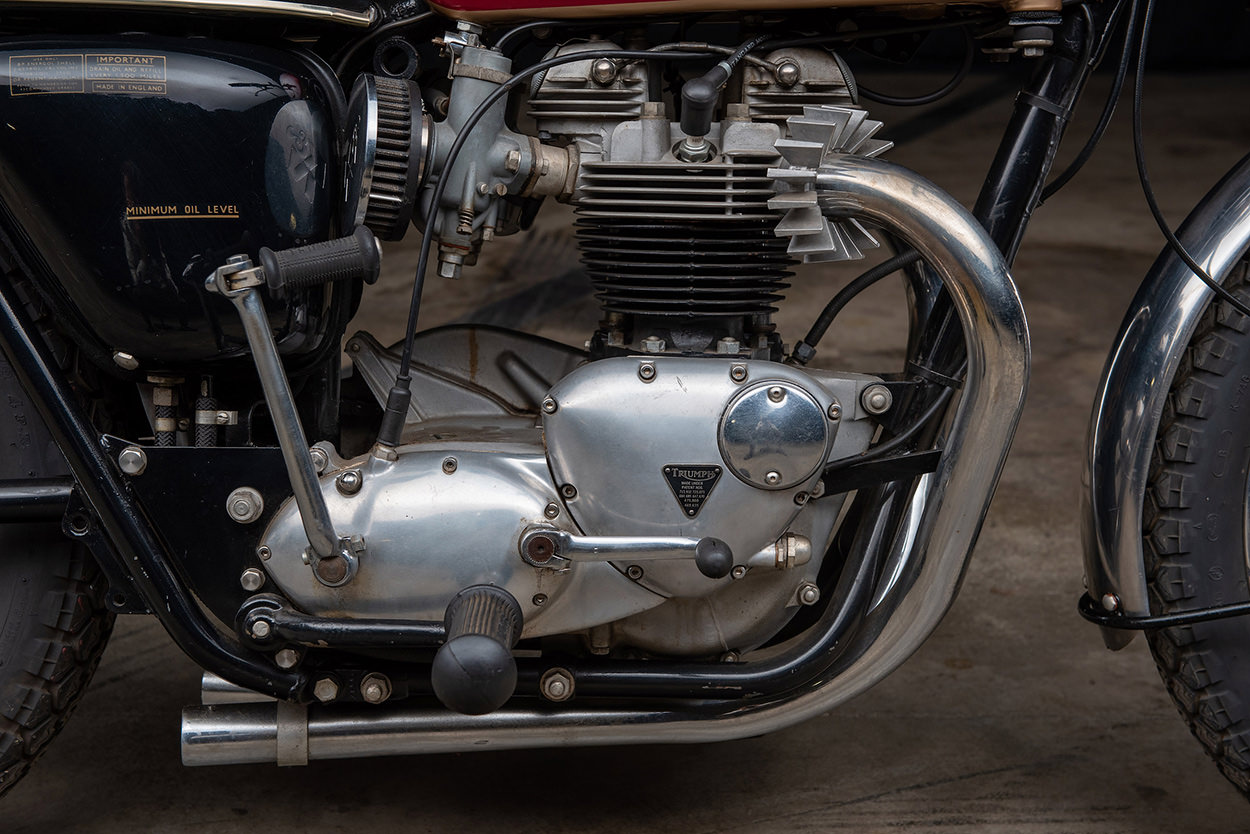
Triumph Bonneville TT Special steeplechase race bike
First released in 1963, the Bonneville TT Special was offered by two dealers in America and designed to compete in TT steeplechase events. A TT Steeplechase was similar to flat track Racing, but involved at least one right-hand turn and a jump. From that description, you bet these races were popular.

Hiding inside the 650 Bonneville engine cases are 12:1 high compression pistons and a 17-tooth gearbox sprocket. Up front is a single Smiths tachometer, and nothing else; no headlight or speedometer. An ET ignition, larger 1 3/16” Amal carburetors and an open, short exhaust help the engine breathe a whole lot easier.
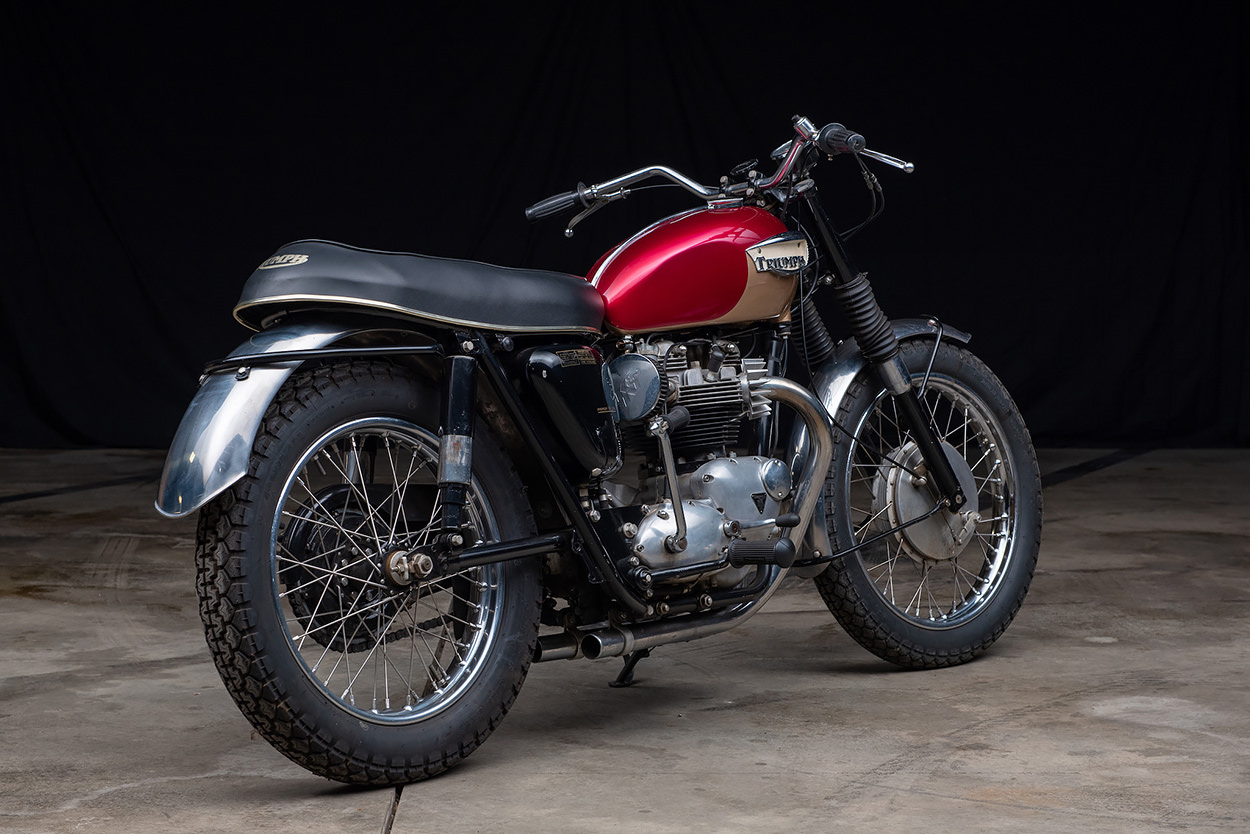
Triumph Bonneville TT Special steeplechase race bike
As was the case with a lot of factory specials in those days, not all bikes were produced to the same spec. Some had 11:1 compression ratios and 19T gearbox sprockets, and I’m sure Triumph-cognoscenti will be able to spot other minor differences.

Because the TT Specials were built to be raced, there aren’t a lot of surviving examples. Only produced for five years, the rarity and race heritage should mean they would do well at auction.
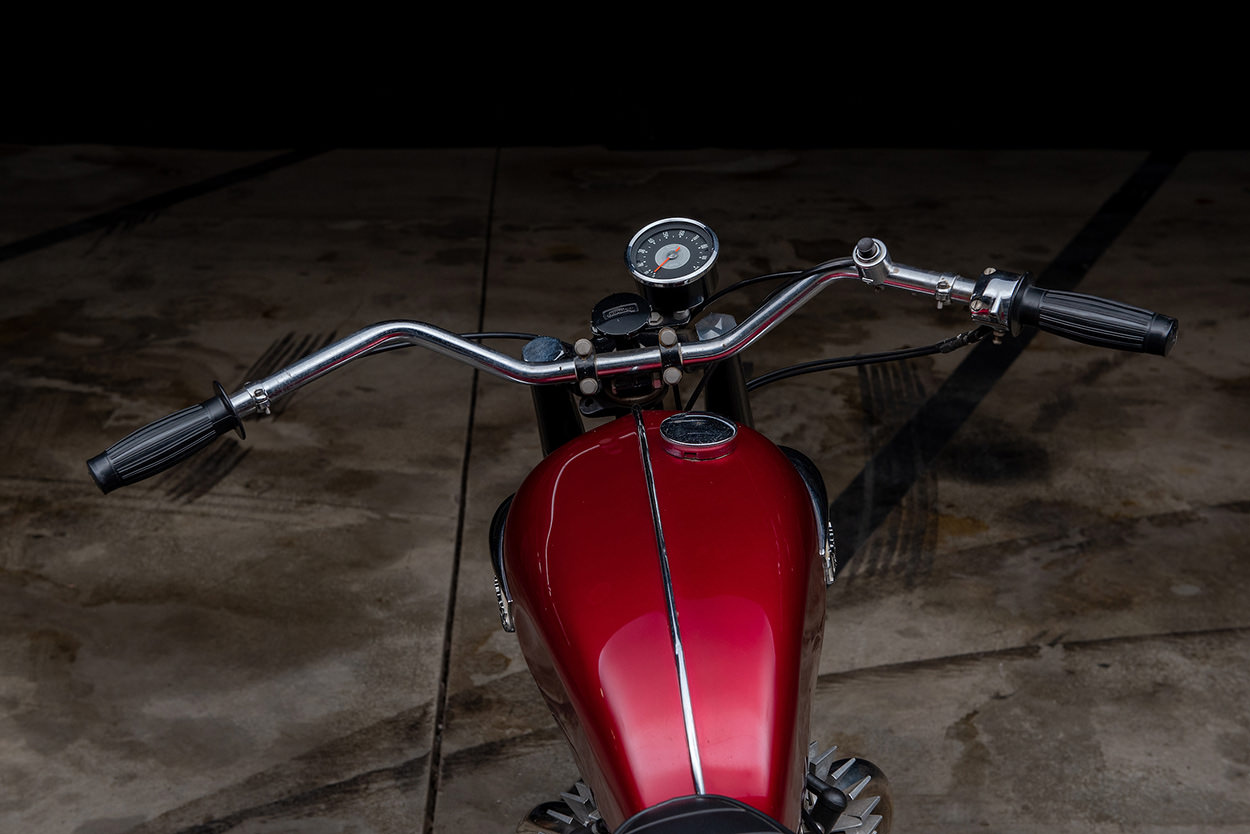
Triumph Bonneville TT Special steeplechase race bike
This particular, well kept, matching numbers example just sold at RM Sotheby’s for $7,200—which is lower than the $10-12,000 that it was expected to fetch.

Price aside, the two-tone paint, exhaust and desert sled vibes really do it for me. It’s not quite enough to draw me away from European exotica, but it comes close. [Via]
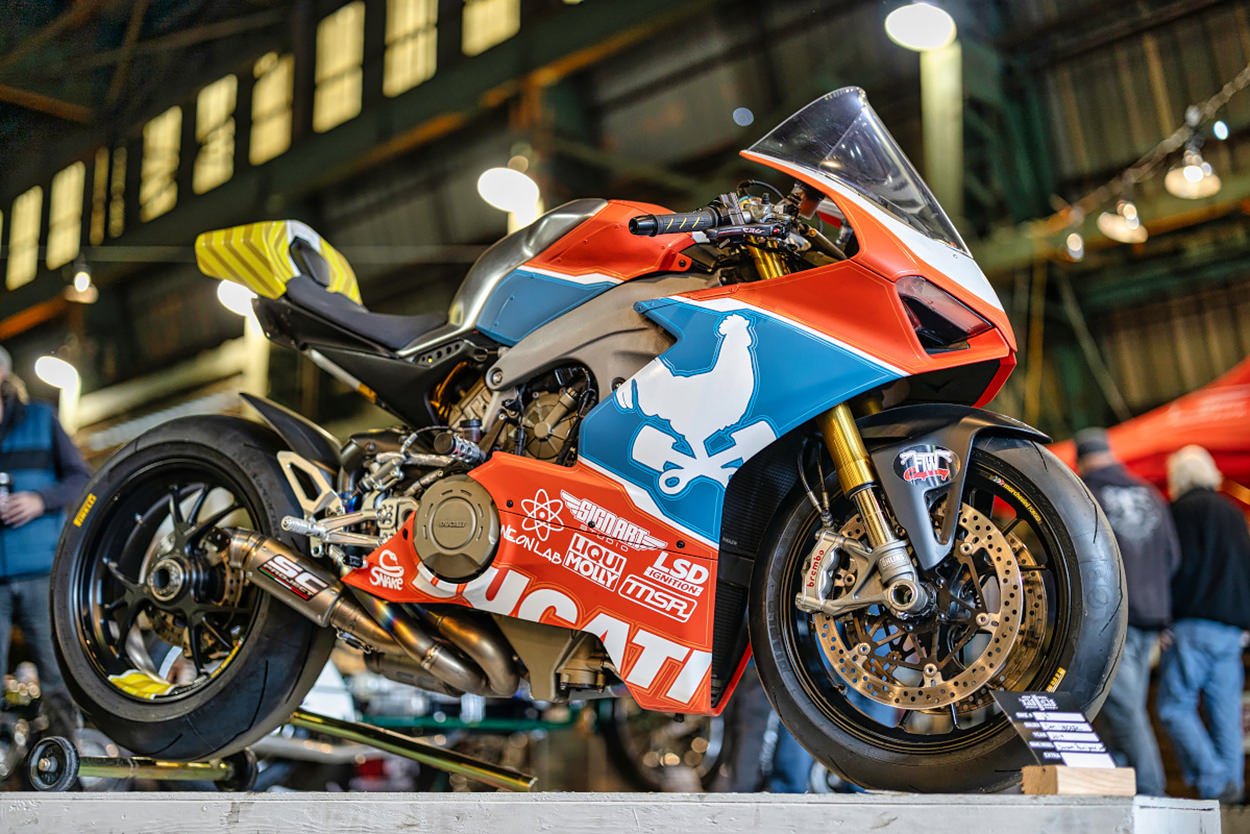
Custom Ducati Panigale V4S
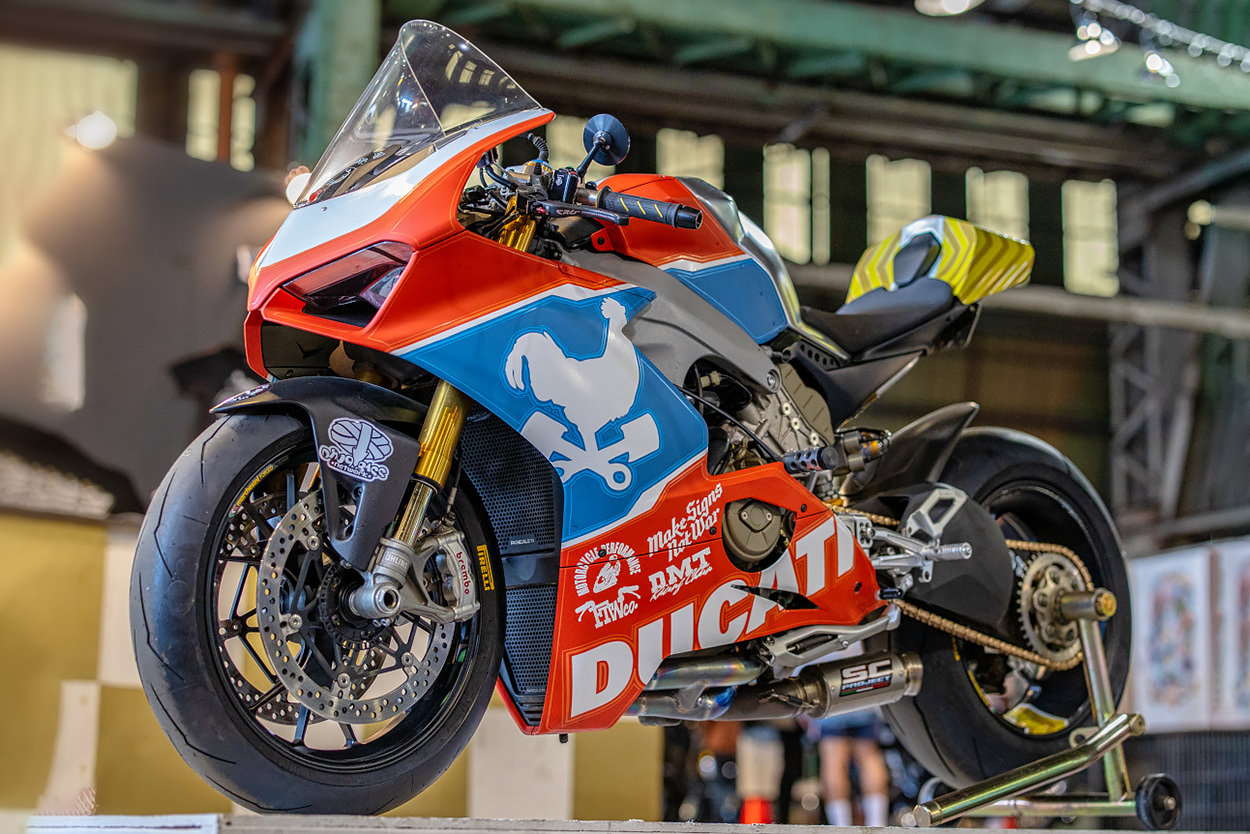
Ducati Panigale V4S by Dan Yoder Speaking of European exotica, this is a 2019 Ducati Panigale V4S and it was built by Dan Yoder in Mount Horeb, Wisconsin. Recently on display at the One Motorcycle Show in Portland, Oregon, this 211 hp Italian stallion has the show to match the go.

Dan is a sign maker and painter by trade, and yes, he painted the bike himself. What you might not realize is that Dan also built the aluminum tail section and other bodywork for the bike by hand.
Custom Ducati Panigale V4S
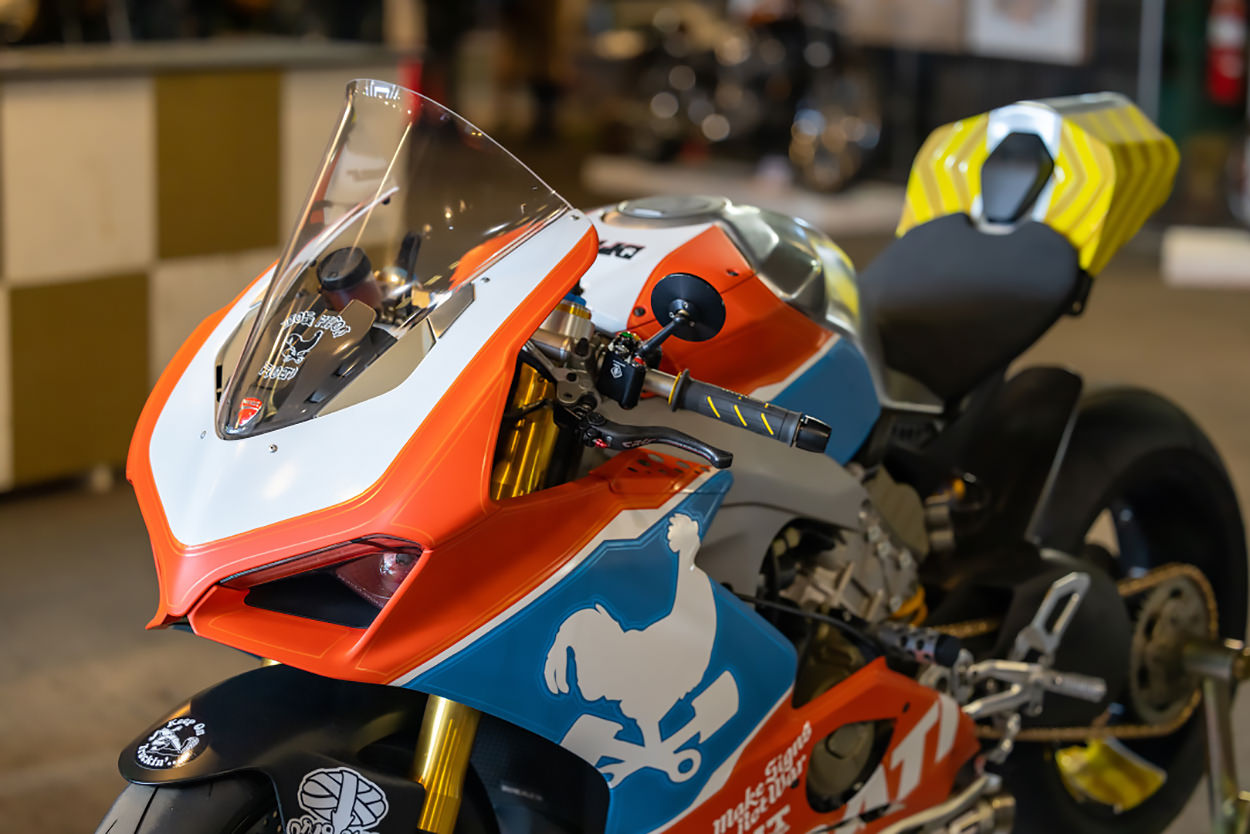
Dan’s company, Make Signs Not War, specializes in hand-built signage so he wanted the bike to show off his aluminum fabrication and painting prowess. All the paint was laid down using matte clears and the graphics were all hand-painted by Dan with gloss enamel. The pin striping around the headlights is particularly delicious.
Custom Ducati Panigale V4S
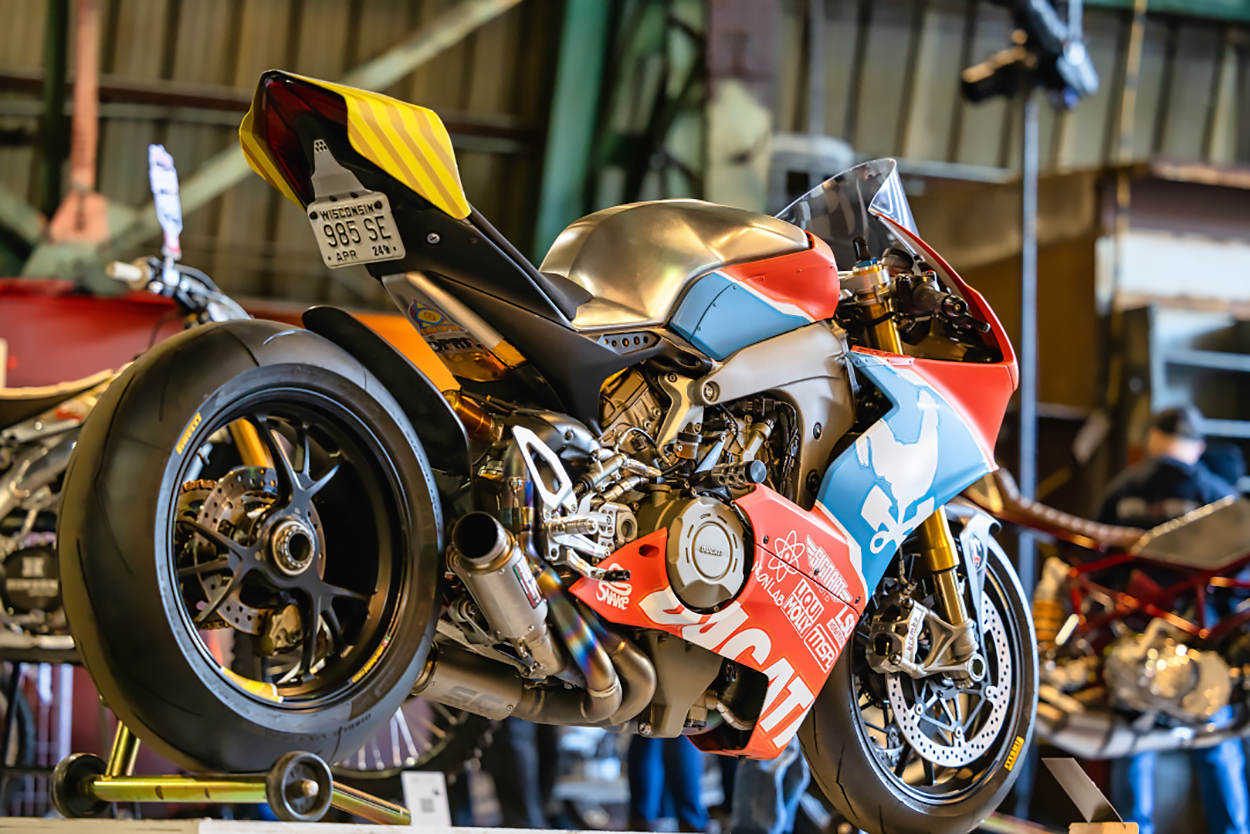
From the factory, the V4S front fairing blends into the fuel tank. Dan wasn’t a big fan of this design so he chose to cut up this expensive Italian motorcycle. In my opinion, he’s pulled it off beautifully and has somehow made a sporty bike even more sporty.

The lower part of the fairing was trimmed back to expose more of the engine, and the exhaust shield had a haircut as well. The ends of the Termingnoni exhaust were extended so Dan could use SC Project slip-on mufflers, and the mirror mounts were blocked off with aluminum plates.
Custom Ducati Panigale V4S
“I didn’t have a certain influence or concept other than giving the refined Italian bike a little more grit,” says Dan. “I always remember Roland Sands saying something along the lines of ‘make it punk rock.’”

This bike ticks all my boxes—it’s Italian, has outlandish graphics, a good back story and, to top it all off, it gets ridden as much as possible. [Via]
Custom Yamaha XSR900 by Deus Australia
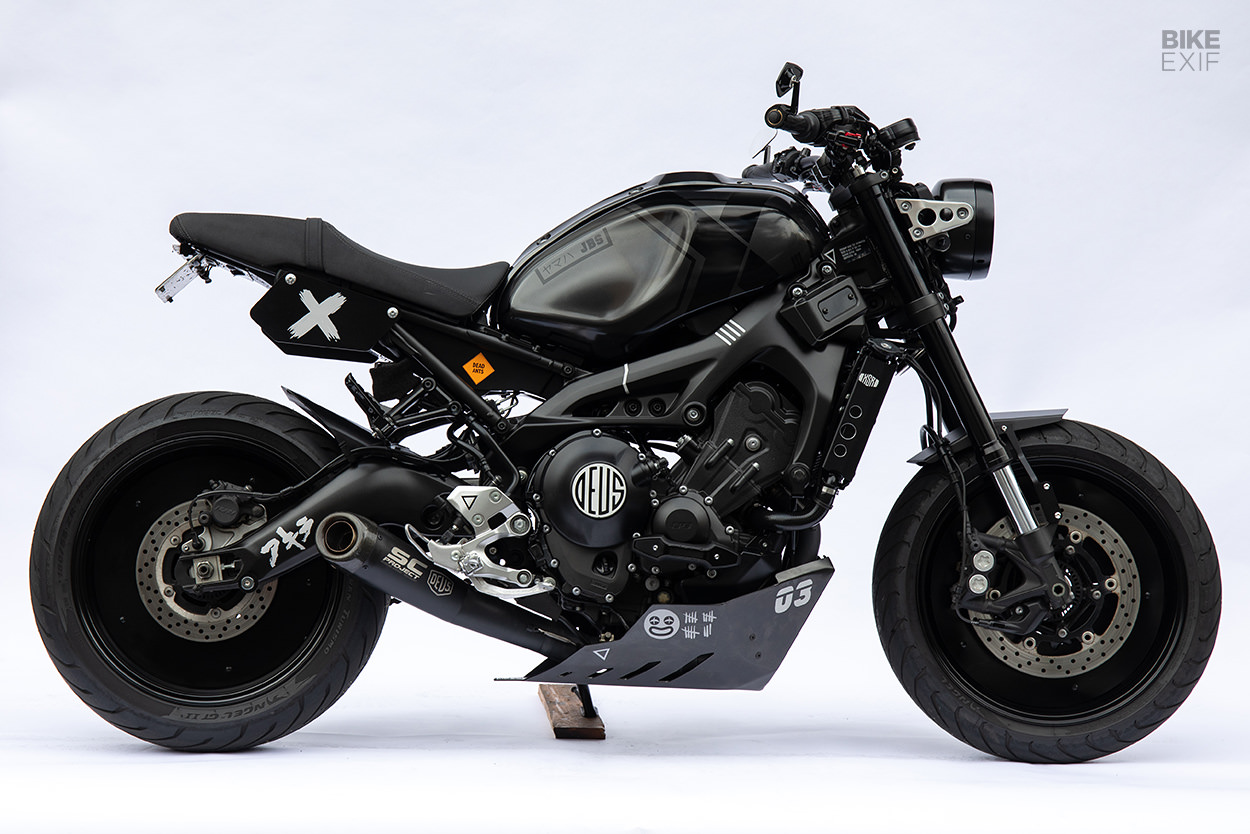
Yamaha XSR900 by Deus ex Machina Seven years since its initial worldwide release, the Yamaha XSR900 is a popular choice for custom bike builders. With modern suspension, good brakes and gobs of power from the 847cc inline triple, it’s easy to see why. This particular XSR is the latest creation from Jeremy Tagand of Deus ex Machina Australia.
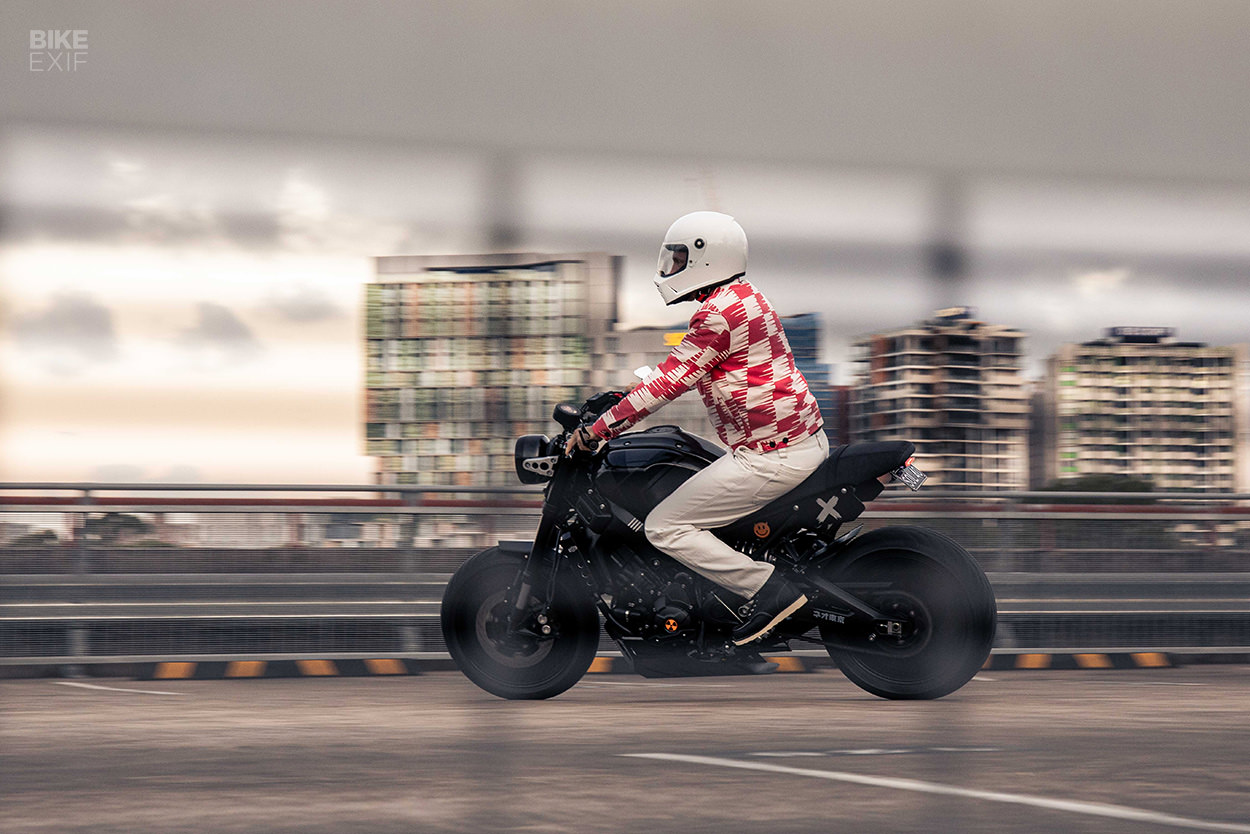
Custom Yamaha XSR900 by Deus Australia
Built for a friend of Jeremy’s, this XSR900 has styling cues that may look familiar to fans of the 1988 cult classic film, Akira. Set in neo-dystopian Tokyo, Akira follows the story of ShĹŤtarĹŤ Kaneda and Tetsuo Shima, best friends and leaders of the vigilante BĹŤsĹŤzoku motorcycle gang, the Capsules.

Jeremy didn’t set out to replicate Kaneda’s iconic red bike, but rather to carry the film’s neo-Tokyo vibe over to the modern Yamaha. The dark, moody paint job with ghosted graphics by Marc Houssenloge at Sydney Custom Painting, drives that point home.
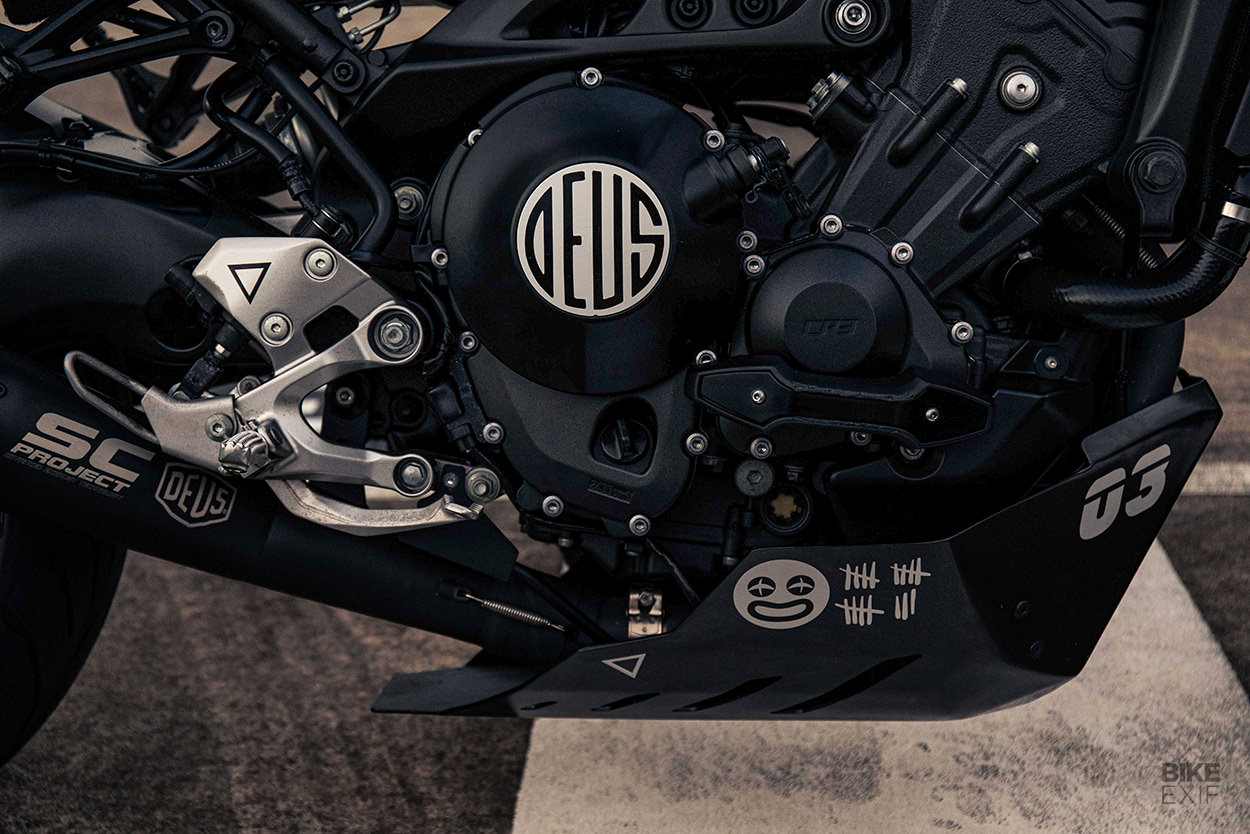
Custom Yamaha XSR900 by Deus Australia
It’s hard not to notice the custom-built solid wheels that adorn the bike. These were created especially for Jeremy at Deus by Mario at Ricci Engineering and set the aggressive tone of the build perfectly. Adding to the theme is a Yamaha Tracer 900 skid plate from Givi, which was extensively modified to fit over a new SC-Project exhaust.
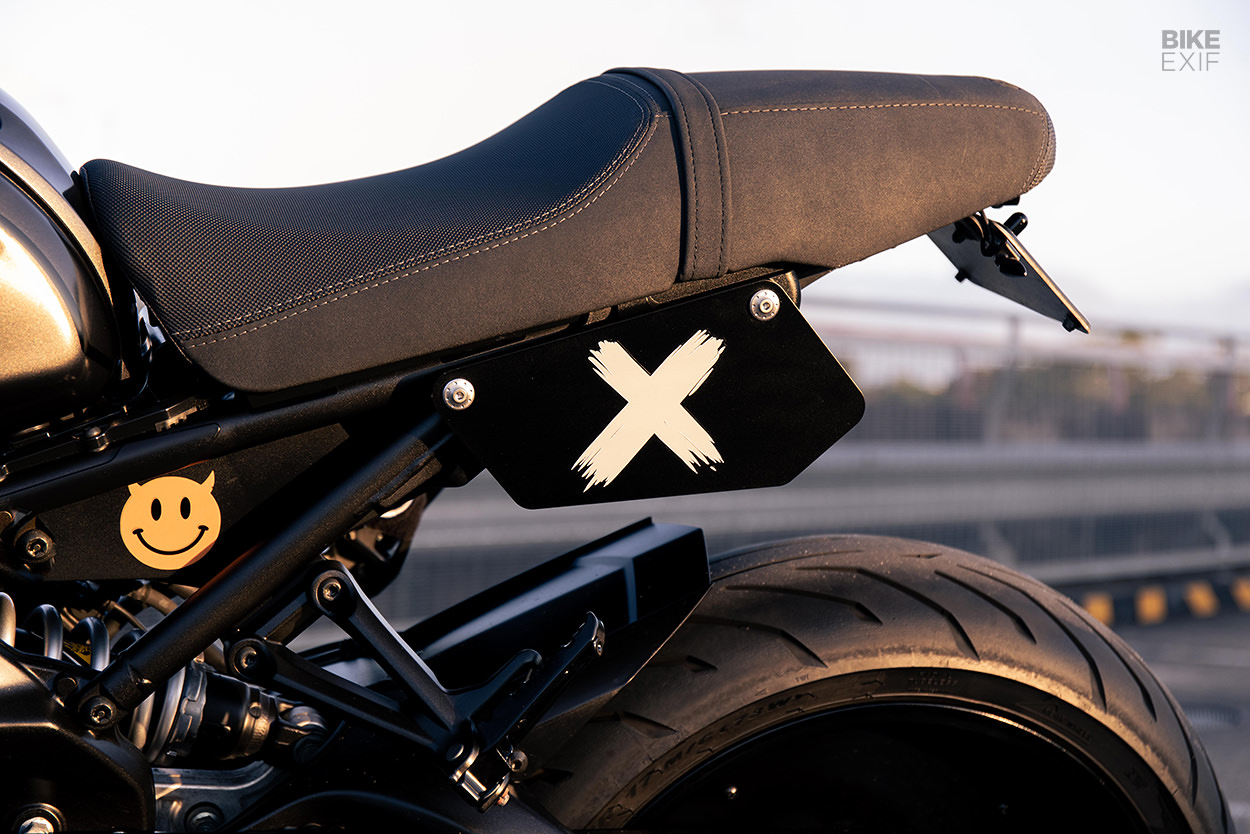
Custom Yamaha XSR900 by Deus Australia
The front fender, rear-wheel hugger, chain guard and speedometer relocation brackets are all ‘Monkeebeast’ parts from Kedo, designed by The Wrenchmonkees. Lighting duties front to back are shared by S2 Concept, Motogadget and Kellerman parts. Rounding out the more subtle details of the bike are tapered bars from Rizoma, in black, naturally.

I’ve never been overly enamored by the XSR900 in stock form. However, when people like Jeremy and the Deus team get their hands on them, I sit up and take notice. [Deus ex Machina Australia]
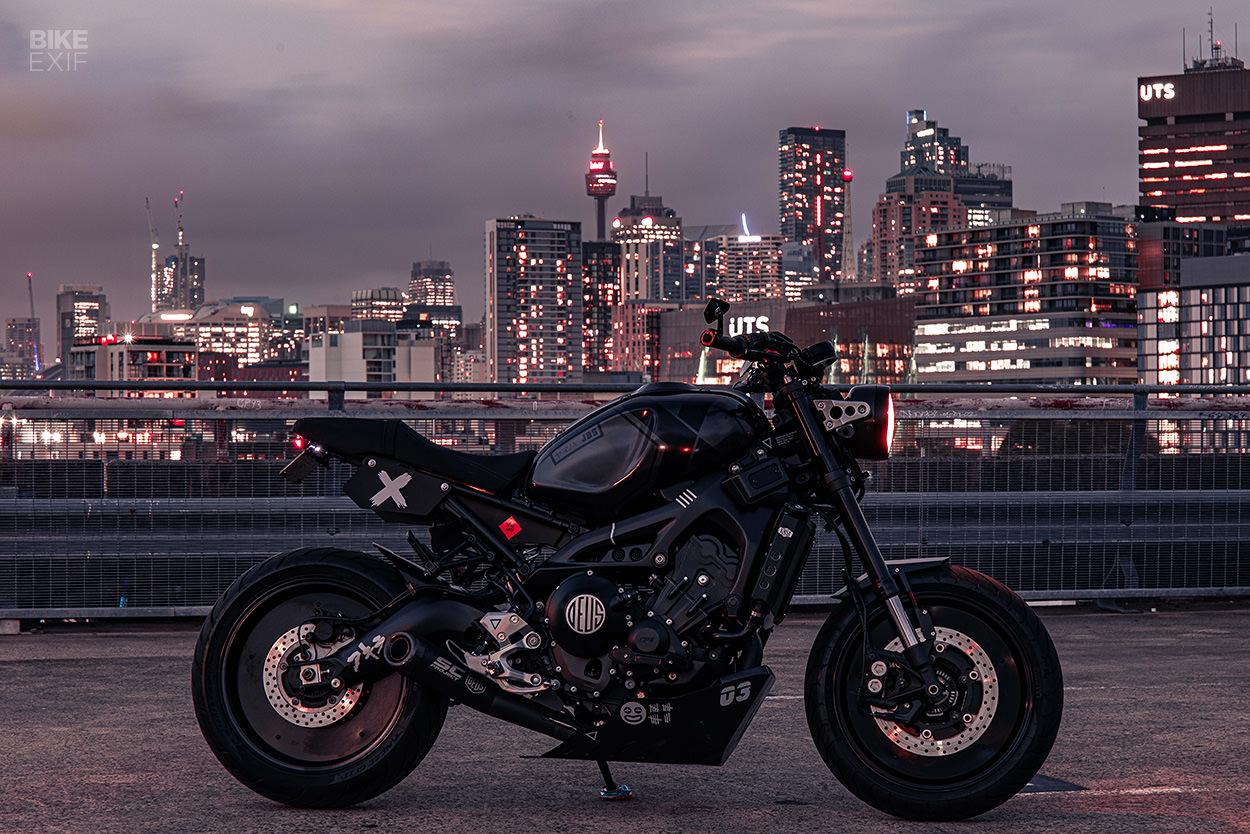
Custom Yamaha XSR900 by Deus Australia


from Bike EXIF https://ift.tt/ka36yYM

Friday, 3 June 2022

By the Book: A Sportster street tracker from Mule

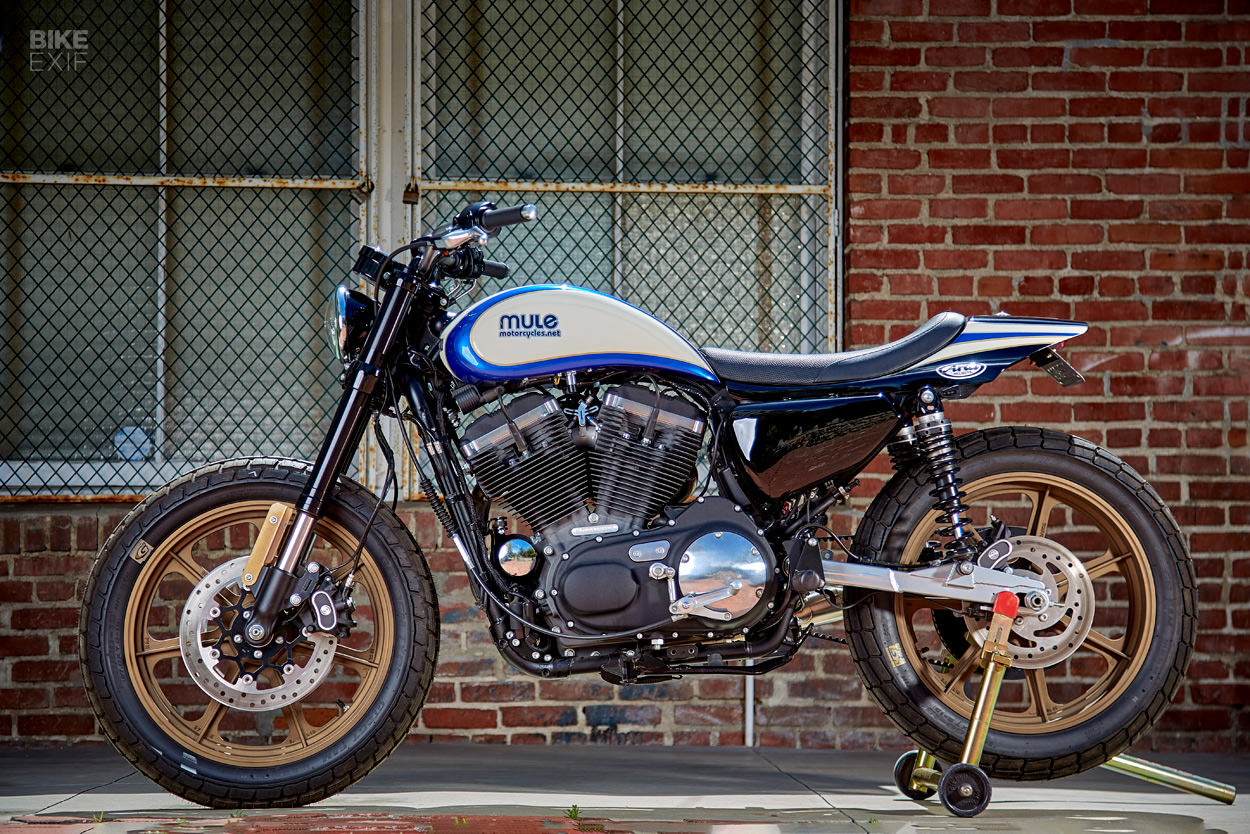
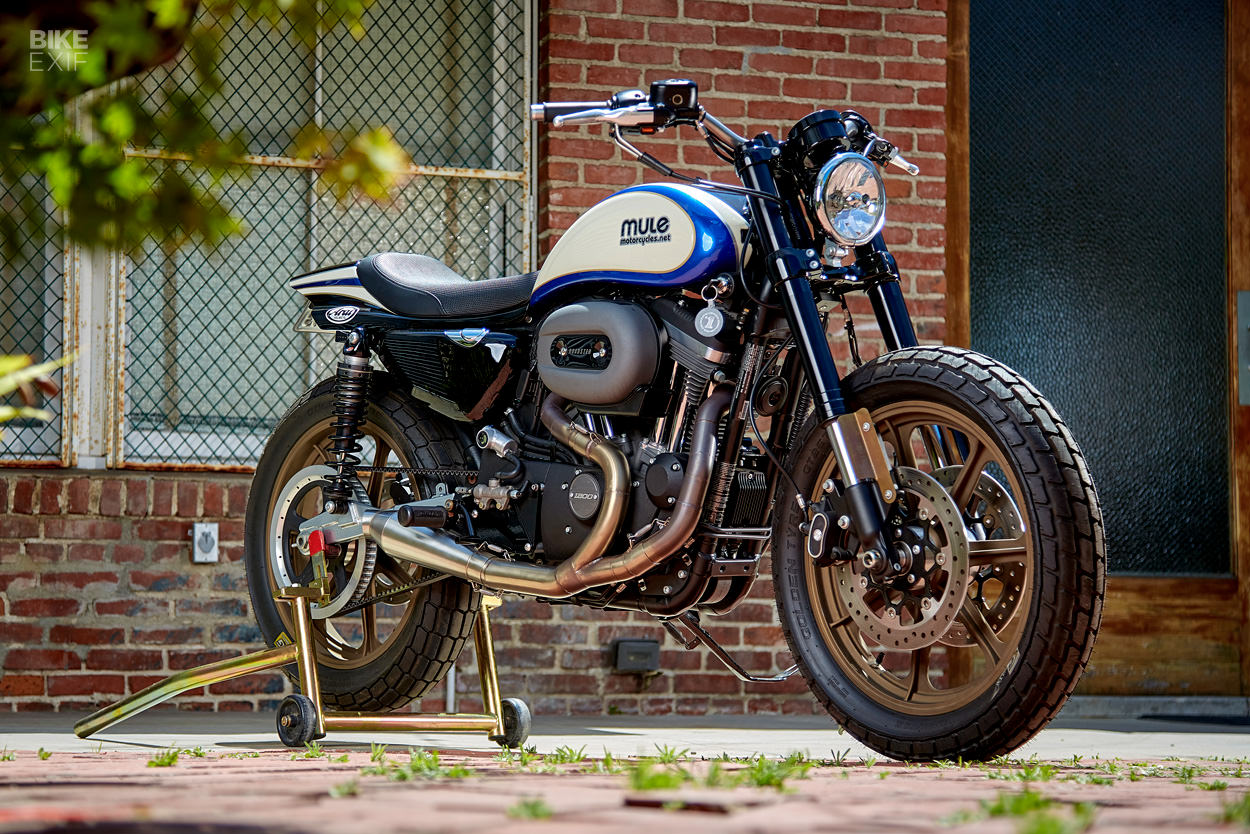
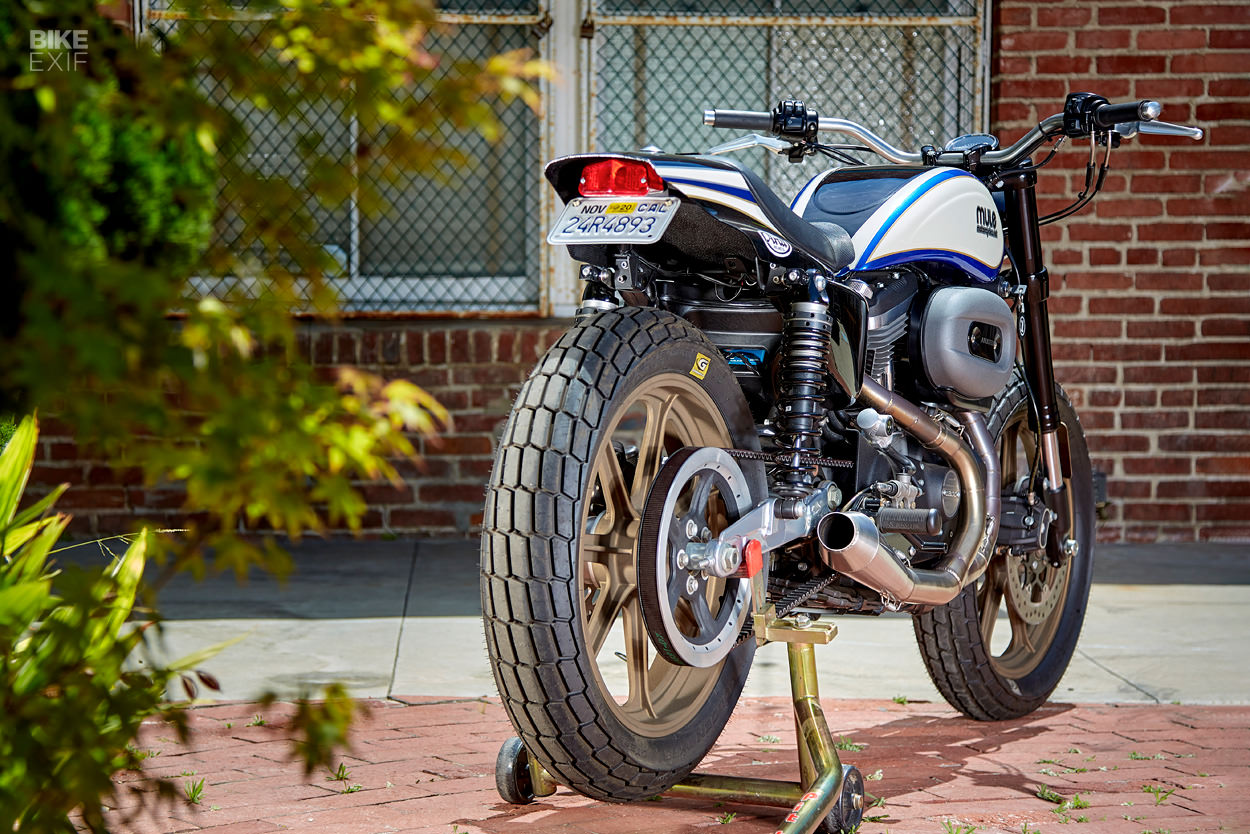
Harley-Davidson Sportster Roadster street tracker by Mule Motorcycles
If we had a stock Harley-Davidson Sportster and a hankering for a top-shelf street tracker, we’d probably call Richard Pollock. Better known as Mule Motorcycles, the man has loads of experience and talent—and a knack for building machines that look like they’ve rolled straight off the dirt oval and onto the street.

You wouldn’t tell by looking at it, but this 2019-model Harley-Davidson Sportster Roadster is actually a modest build by Mule’s standards. There’s nothing over the top here—just perfect proportions, a well-judged parts spec and a host of custom touches done as only he can. The brief came from a friend, with a specific request for a modern Sporty as the donor.

Harley-Davidson Sportster Roadster street tracker by Mule Motorcycles
“The goal was to build a trick-looking modified Sportster that already had a 1200 cc, fuel injected, rubber-mount motor,” Richard tells us, “without going crazy on the budget. I really liked the gloss black triple clamps and upside-down forks on the ‘Roadster’ model. Even though they aren’t high-end, they work well and look good.”

Richard also kept the Sportster’s original controls, speedo and classically-styled headlight, along with its air filter cover. “I don’t mind the ‘ham can’ Harley air cleaner covers,” he says, “and it does contain a K&N air filter inside, so there is a small boost in performance.” A set of 1” Mule flat track bars were thrown into the mix.

Harley-Davidson Sportster Roadster street tracker by Mule Motorcycles
Even though it stands taller than most factory Sportster models, the Roadster still suffers from a common cruiser issue; it sits low at the back. So ‘fixing’ the bike’s stance was high on the list of priorities.

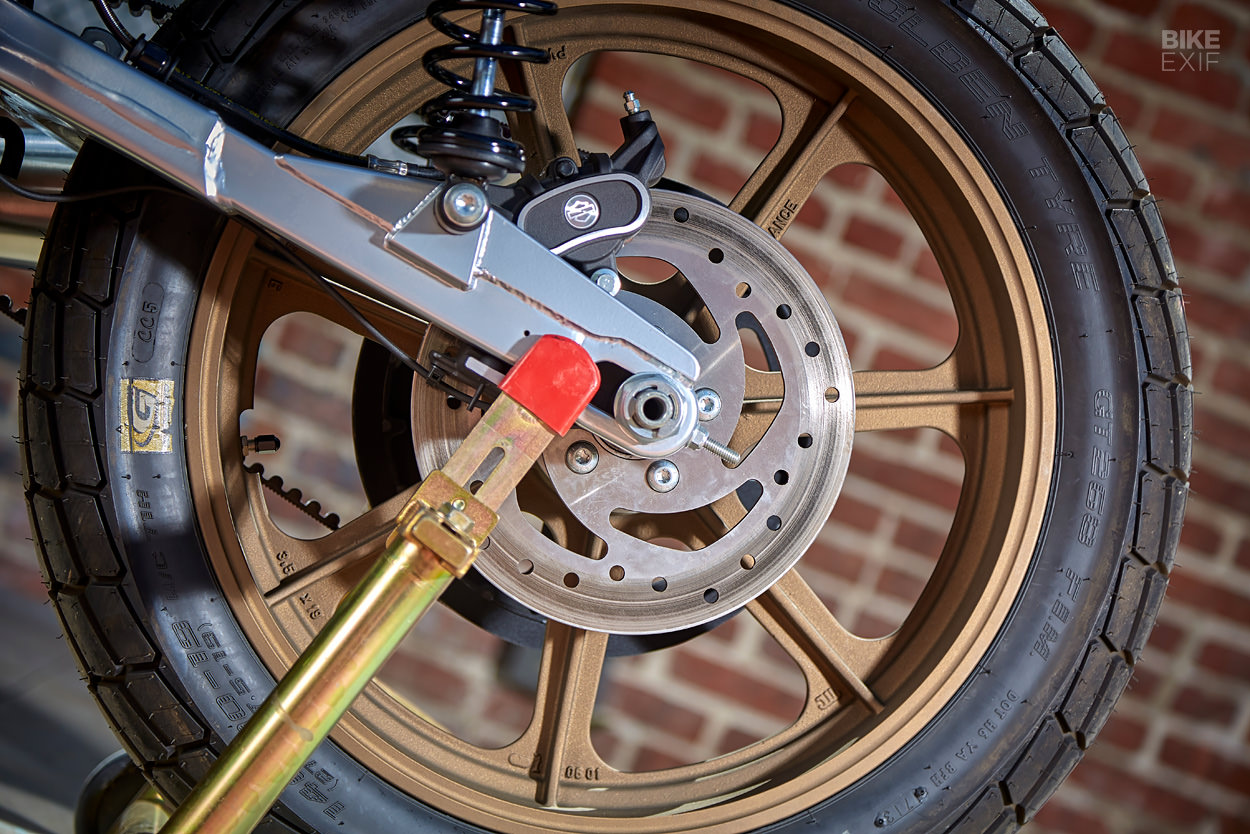
Richard wanted to retain the original shocks, so he opted to fettle the swingarm instead. The old shock mounts were shaved off, and new ones mounted 6” forward, along with custom gussets for strength. Not only has it lifted the rear end, but it’s also ‘softened’ the stiff OEM shocks.

Harley-Davidson Sportster Roadster street tracker by Mule Motorcycles
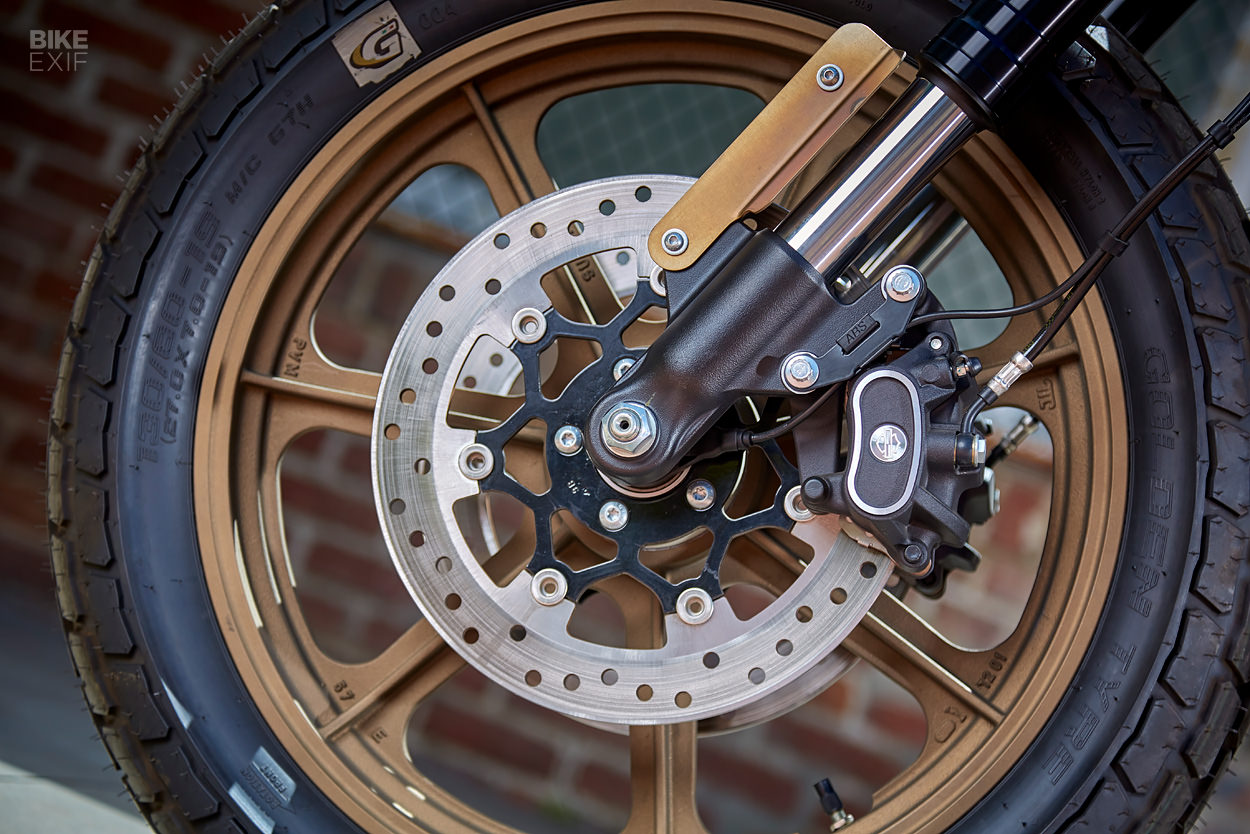
As is customary for flat trackers, this Mule Sporty rolls on 19” magnesium wheels, from Sundance in Tokyo. Measuring 2.50×19” up front and 3.50×19” at the back, and wrapped in Goldentyre DT rubber, they use custom carriers to mount the Harley brake discs and rear pulley. The stunning finish on them is a ‘burnt bronze’ color from Cerakote.

A friend of Richard’s, Mel Cary, fabricated a small pair of stainless steel fork guards, then took a torch to them to create a bronze effect that matches the wheels. They mount directly to the original front fender mounts on the fork lowers, negating the need to shave those off.

Harley-Davidson Sportster Roadster street tracker by Mule Motorcycles
One detail that most won’t notice at first glance, is this street tracker’s retro-styled foot pegs. “I like to make my own foot peg setups,” says Richard, “and that includes the Bates rubbers which I run on all my flat track and street tracker builds. They feel good under your feet, help with the traditional Harley vibes and are available new.”

Richard fabricated the mounting brackets himself, along with a rear brake fluid reservoir, using a sight glass borrowed from a Yamaha.

Harley-Davidson Sportster Roadster street tracker by Mule Motorcycles
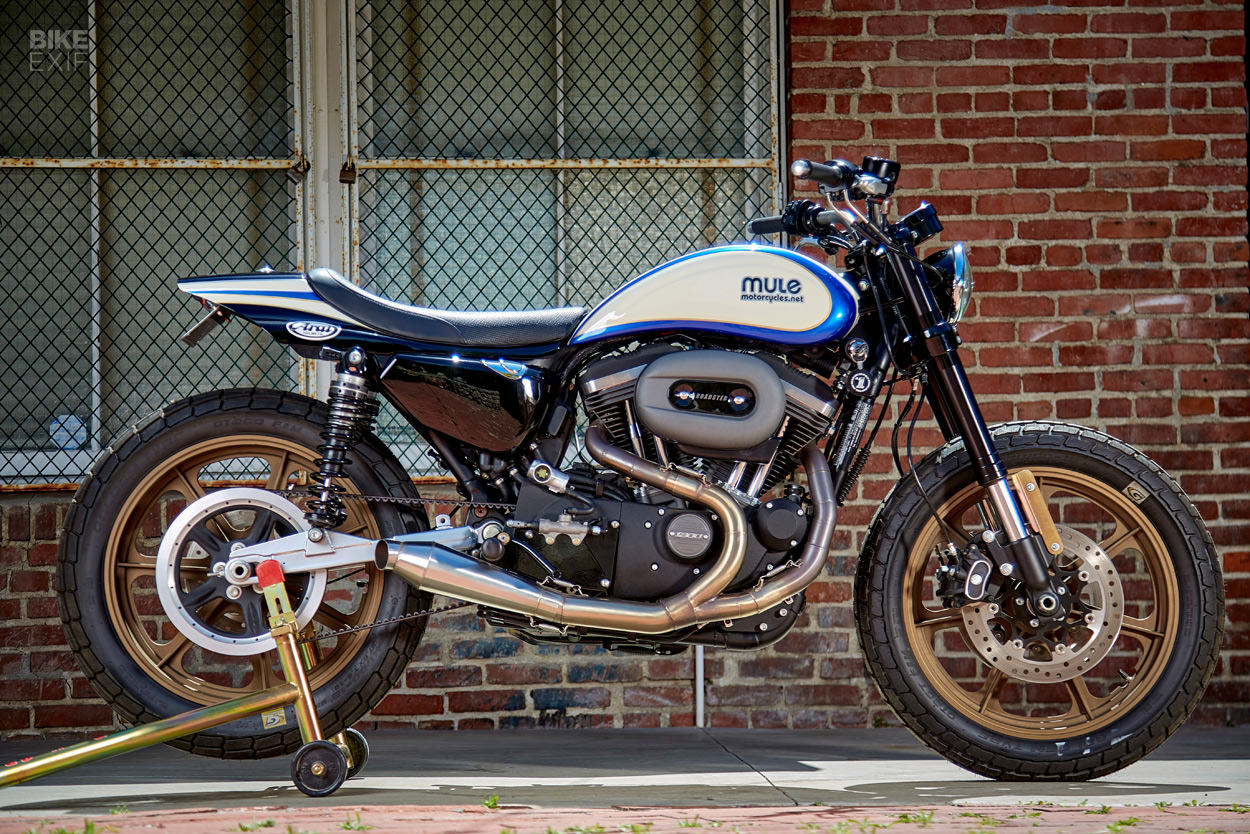
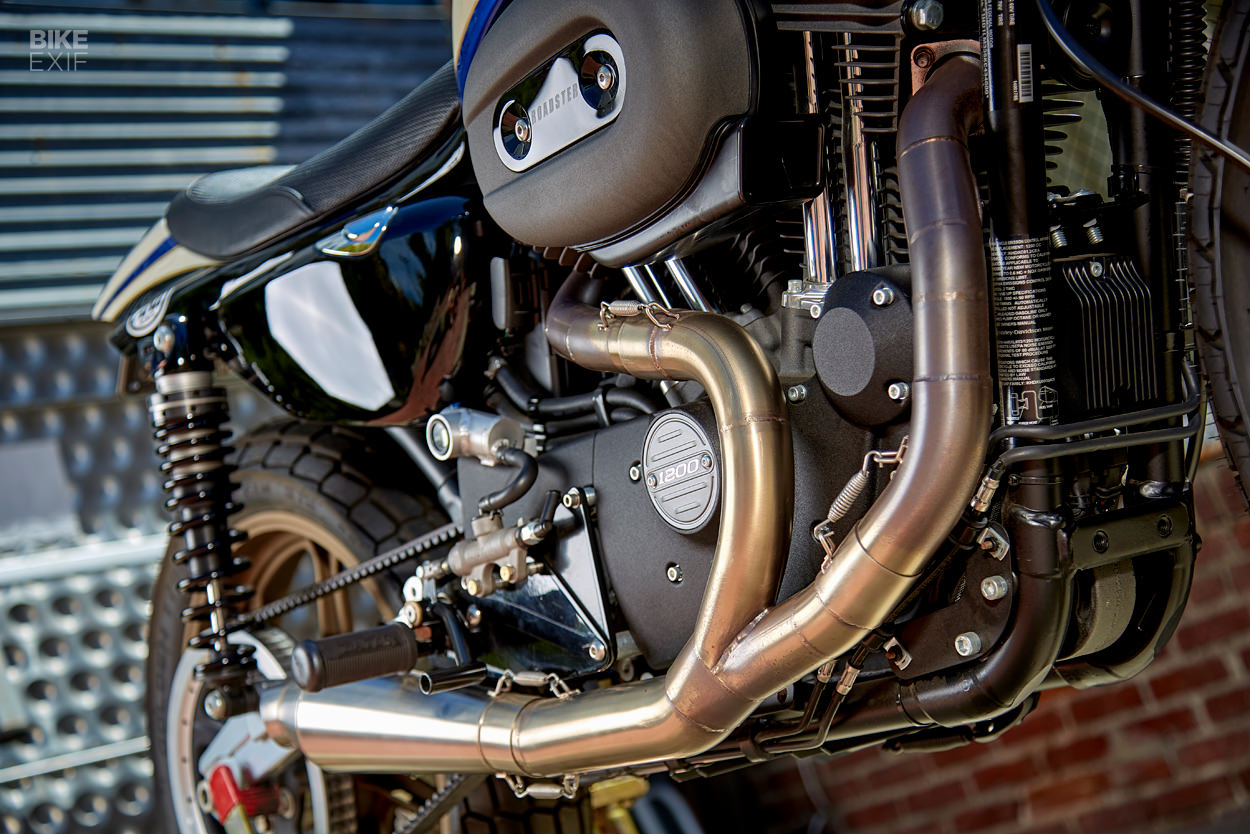
The exhaust took some doing to get right too. Richard kept the 3” section of each header pipe that contains its O2 sensor fitting, but fabricated the rest from scratch. The initial idea was to hang an aftermarket muffler intended for an Indian FTR1200 off the end, but that didn’t pan out.

“As the motor is rubber-mounted, the exhaust all the way to its tail end has to move freely with the motor,” explains Richard. “The muffler was a bit heavy to hang in the breeze without substantial mounting, so I reverted to a Cone Engineering megaphone… worlds lighter! The exhaust is short and tucked in super tight, so a small extension was added to direct the heat away from the shock and drive belt.”

Harley-Davidson Sportster Roadster street tracker by Mule Motorcycles
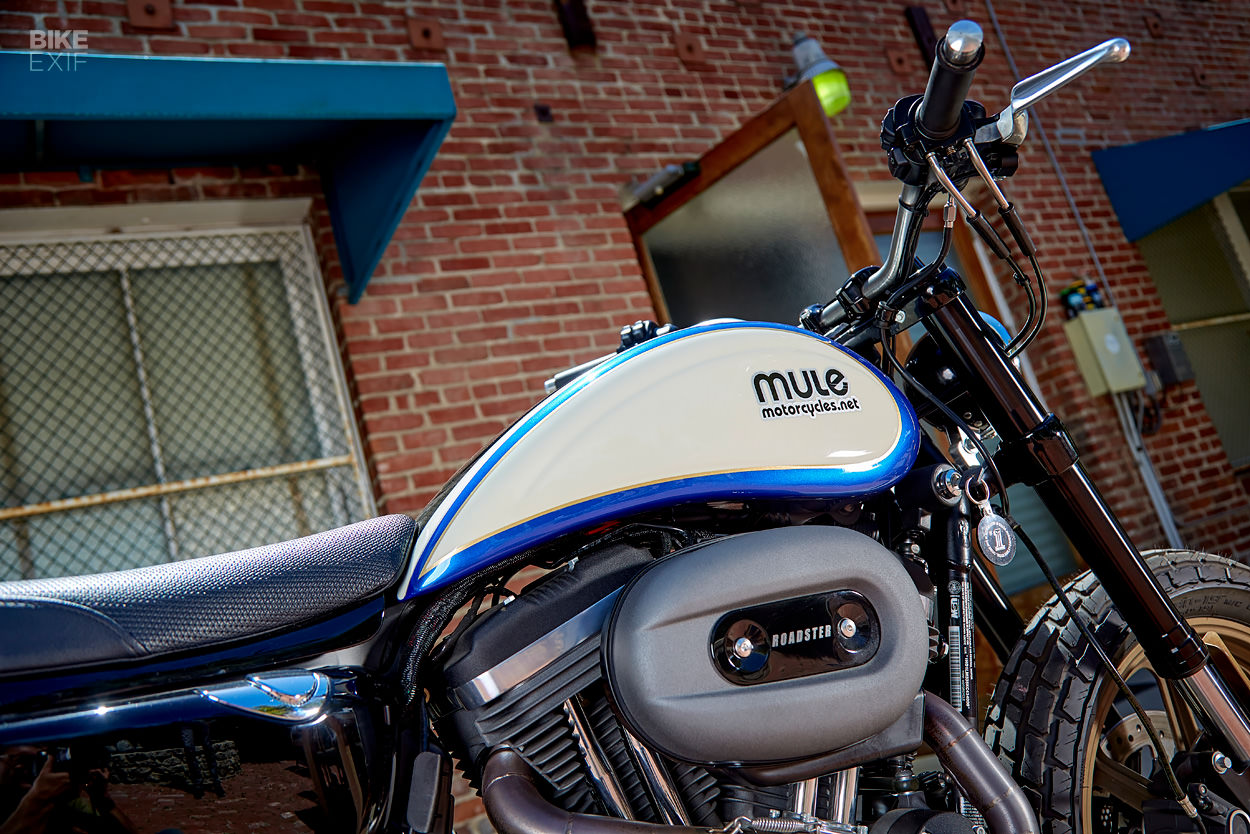
Moving to the bodywork, Richard turned to Storz Performance for a classic flat track tank and tail combo. The tank is made from aluminum, and includes provisions for the modern Sportster’s fuel pump.

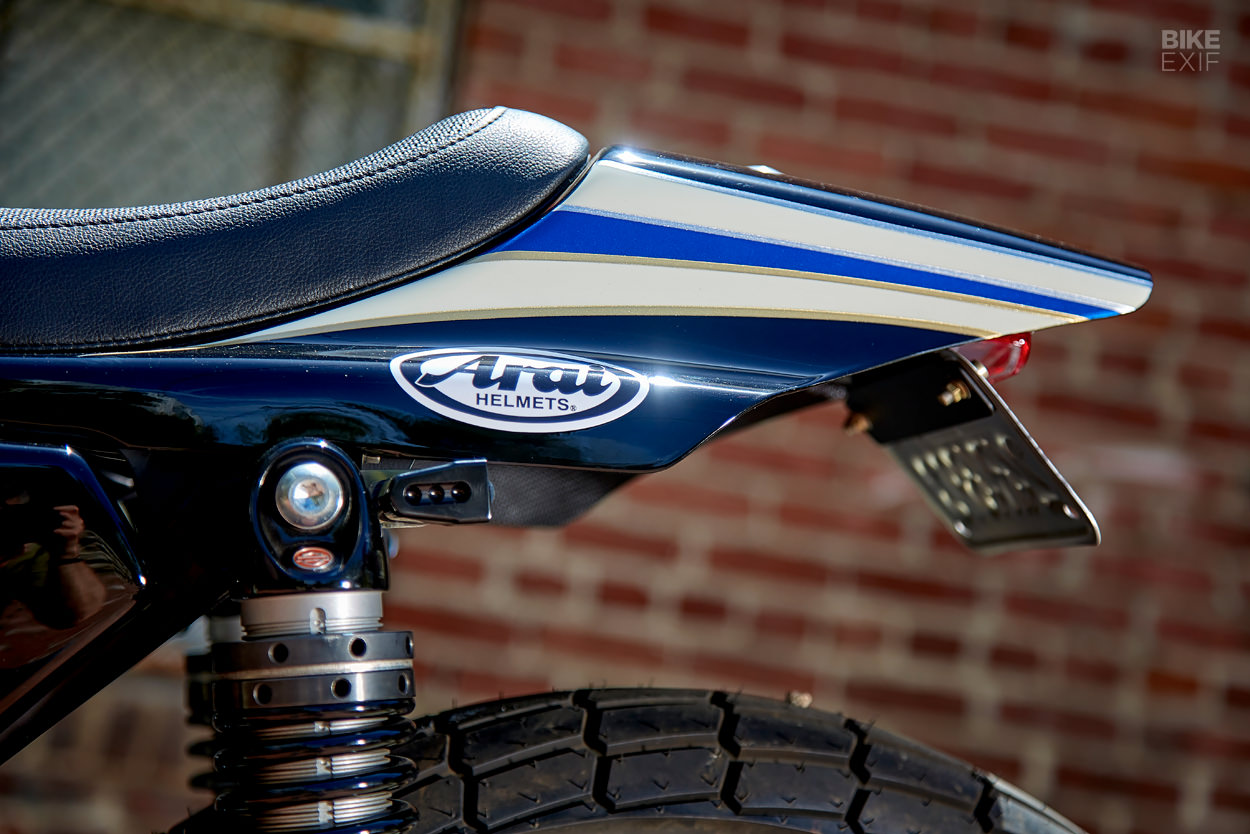
The fiberglass tail section was shortened by about 3”, then fitted with a seat pad from Saddlemen (“which is as good as you can get,” says Richard). The tail is mounted on a custom subframe, complete with new seat brackets and a tidy rear loop, and weighing far less than the original Harley fender struts.

Harley-Davidson Sportster Roadster street tracker by Mule Motorcycles
For the livery, Mule commissioned David Tovar at SBK Paint in San Diego to lay down a Yamaha-inspired combination of blue, white and black. A handful of tasteful graphics add to the race-bred vibe.

Looking factory fresh with not a hair out of place, this street tracker is proof that you don’t need to go overboard to build a great looking Sportster—provided that, like Richard, you know what you’re doing.

Mule Motorcycles | Instagram | Outdoor images by Olivier de Vaulx

Harley-Davidson Sportster Roadster street tracker by Mule Motorcycles


from Bike EXIF https://ift.tt/f6yW2du

Wednesday, 1 June 2022

Heirloom: Doing up a passed-down Sym Wolf 125

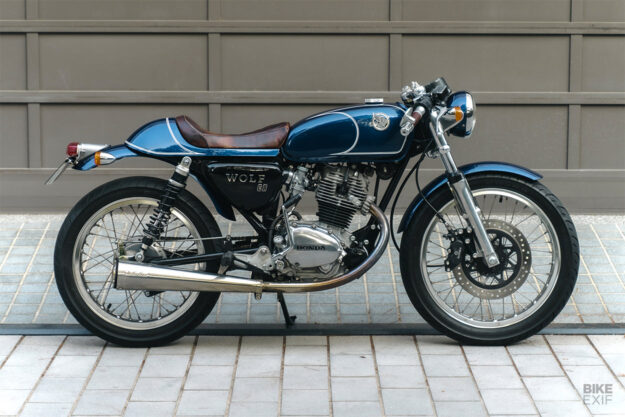
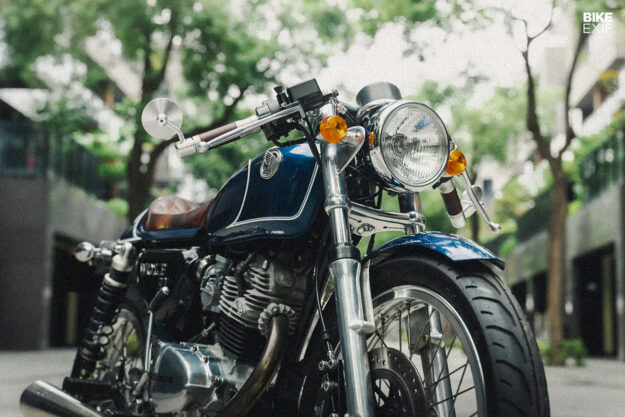
Sym Wolf 125 by Charlie Huang Design
Most customs look nothing like a factory bike, with radical styling and, let’s face it, often dubious legality. But occasionally we see a machine that could have rolled straight off a production line.

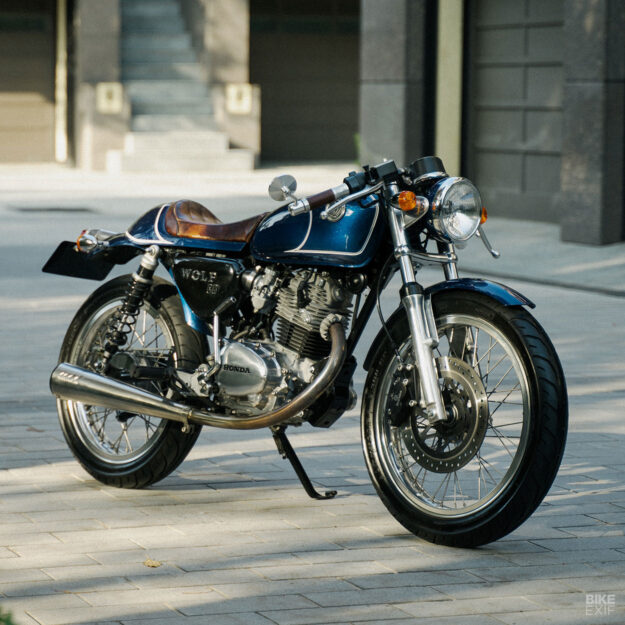
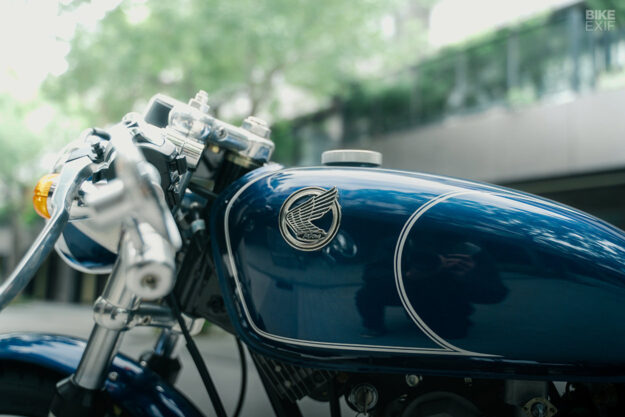
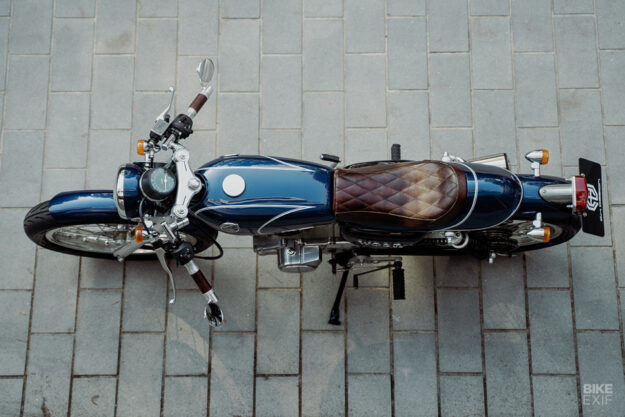
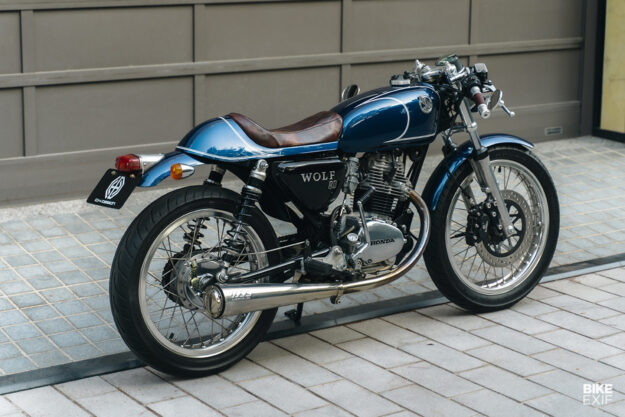
This custom Sym Wolf looks it could have been a ‘retro’ made by a Japanese factory in the 1980s—with a similar vibe to bikes like the Honda GB500. But it’s the work of student Charlie Huang, who also gives us an interesting insight into Taiwanese custom culture.

Sym Wolf 125 by Charlie Huang Design
Charlie lives in Taichung, but also spends time in California—where attends the renowned ArtCenter College of Design.

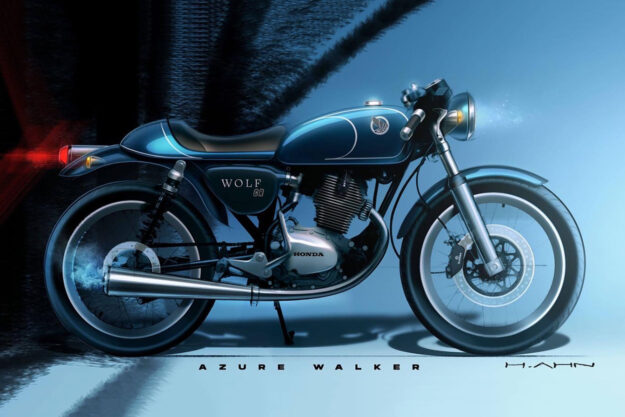
His bike is a 1994 Sym Wolf 125, which started life as a somewhat inelegant commuter tool. “It belonged to my uncle, until he passed it down to me in 2020,” Charlie tells us. “It had been my dream bike since I was a child, so I wanted to honor it—by enhancing it and bringing it back to life.” He started with a sketch.

Sym Wolf 125 by Charlie Huang Design
Passing down motorcycles is common in Taiwan: young people often take on the bike used by a grandfather or father, and the Wolf has long been the most popular motorcycle in the country.

Customizing is less common though. “Due to a ban on large motorcycle imports in the late 60s, there was a big gap in our motorcycle culture,” Charlie explains. “This is why our custom bike culture started very late, and small-engine motorcycles are the main theme.”

Sym Wolf 125 by Charlie Huang Design
Charlie’s goal was to not only rebuild the Wolf 125, but also enhance its styling and performance without resorting to the fat-tire, mini-bobber look that afflicts a lot of local customs.

“The biggest modifications here include a full engine and transmission rebuild. I upgraded the original four-speed transmission to a more efficient six-speed, and also increased the engine from 125 to 164 cc.”

Sym Wolf 125 by Charlie Huang Design
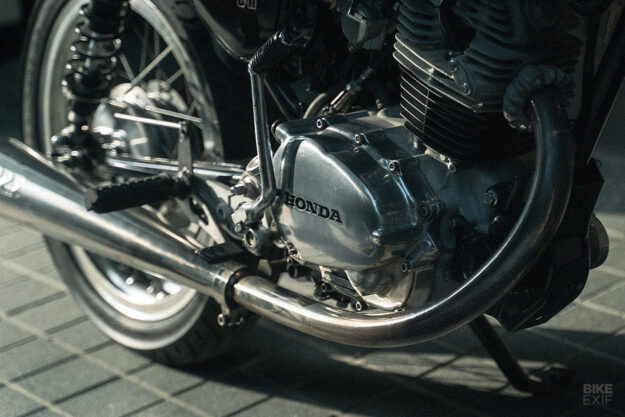
To stay on the right side of the law, Charlie had to keep the powertrain cases, along with their stamped numbers. It helped that the Wolf 125 uses a development of the Honda CB/CG series powertrains, and some of the engine internals on this machine are now Honda CB125S parts.

The valves have also been enlarged and polished to accommodate the larger displacement, and a Keihin PE26 carb improves the fuel supply.

Sym Wolf 125 by Charlie Huang Design
The transmission uses Chinese-made internals, and there’s a new high-spec FCC clutch plate too. For the exhaust pipe, Charlie sourced a handmade stainless steel header from a Taiwanese craftsman to create a beautiful curve, and added a SuperTrapp muffler.

Alongside is a modified swingarm that uses Kymco KTR parts, hooked up to a pair of adjustable RPM RR shocks. It’s not stretched: “A longer swingarm with big tires has a huge impact on small displacement motorcycles,” Charlie notes. “It makes the handling worse, and because of the small horsepower, large tires also reduce acceleration.”

Sym Wolf 125 by Charlie Huang Design
The front fork is refurbished and shortened slightly to improve the stance. “Since there is no ideal triple tree on the market, I did 3D modeling and commissioned a CNC manufacturer to make a fully customized triple tree.”

Sym Wolf 125 by Charlie Huang Design
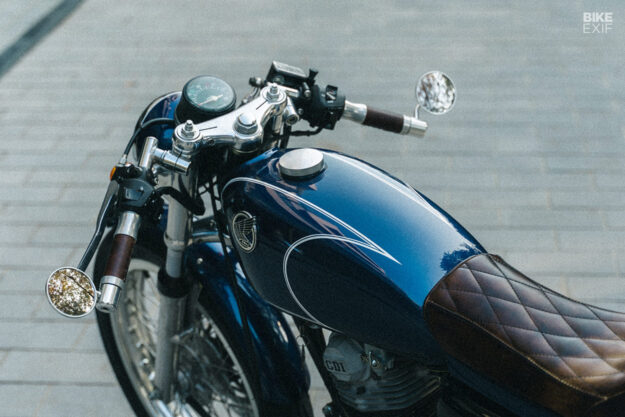
For the tank, Charlie wanted to return the Wolf 125 to its perfect proportions, which came from the Honda CB125S. So he tracked down a CB100 K3 tank in Indonesia—which has the same outer shape as the CB125S—and changed the mounting points so that it would fit on the frame.

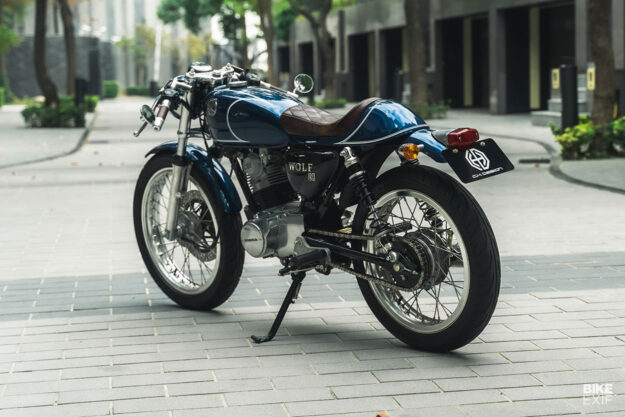
The wheels are Shanghai Unison vintage-style aluminum rims, in a F18/R17 set. The tires are Dunlop’s grippy TT900GP compound, in deliberately slim profiles to keep the handling crisp. Charlie’s kept the original rear drum brake, but chose Brembo calipers for the front—painted black to stay in tune with the color scheme.

Sym Wolf 125 by Charlie Huang Design
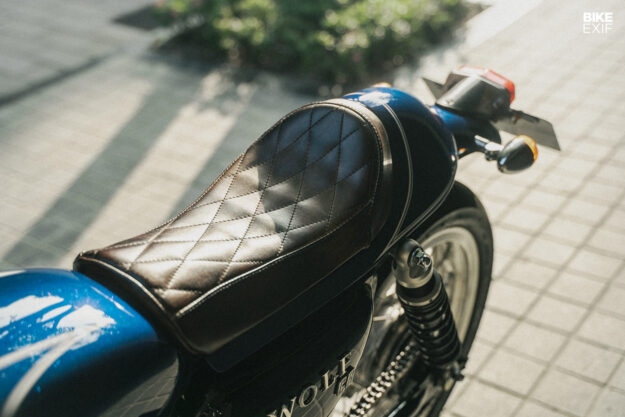
The cafe racer-style tail was handmade by a Taiwanese sheet metal store, SanHe Garage, and Charlie had the subframe modified to accommodate a new rear fender.

The seat is upholstered with cowhide that Charlie dyed himself. A Taipei specialist helped with the shaping of the foam and the stitching.

Sym Wolf 125 by Charlie Huang Design
Jeffrey Chang handled the sumptuous blue paint. “He’s a master painter in Taiwan, and has worked with many famous custom bike builders,” says Charlie. “The color of this bike was specially commissioned—it’s not an existing color in the market. I wanted a bright color that would contrast against the grey architecture of Taiwan.”

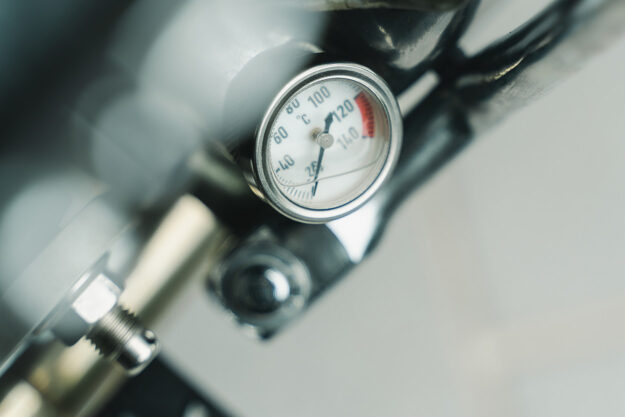
Virtually every smaller part on this Sym Wolf has been replaced or upgraded, right down to the lighting, the grips, and the speedo, which is a replica CB100 unit.

Sym Wolf 125 by Charlie Huang Design
It’s an exercise in improving aesthetics without compromising performance, and it all hangs together beautifully.

Charlie’s goal was to show that smaller bikes don’t need to replicate the style of heavyweight machinery—and also to influence the local custom bike culture along the way. A laudable aim, and we hope he succeeds.

Charlie Huang Design Facebook Group | YouTube channel | Photography by Johnny Ho

Sym Wolf 125 by Charlie Huang Design


from Bike EXIF https://ift.tt/tvQeDTL