Friday, 13 May 2022

VR1000 tribute: A two-faced Buell S1 from GDesign

VR1000 replica Buell S1 from GDesign
If there’s a bike that symbolizes the uneasy relationship between Harley-Davidson and sporting performance, it’s the VR1000. Developed in the late 80s to compete in the AMA Superbike series, it finally appeared on track in the mid 90s.

By that time it was down on power compared to the competition, and despite excellent handling, never achieved the wins that Milwaukee hoped for. Still, it was an excellent machine in some respects, and it has many fans today, over 20 years after the race program was canned.

VR1000 replica Buell S1 from GDesign
One of those fans is the Italian customizer Giacomo Galbiati—who builds under the name GDesign. He’s been working on bikes and engines since he was 13 years old, and has never stopped since.

‘Double Face’ is his brilliant homage to the VR1000, using a reworked Buell S1 that was registered in 1999—making it one of the final S1s to leave the Michigan factory.

VR1000 replica Buell S1 from GDesign
Giacomo’s builds focus on details, design and aesthetic: his attention goes first to shapes and colors, he tells us, and then he works on performance. He also describes himself as being ‘mad about history and motorcycles’ and fueled by a desire to build something out of the ordinary.

“I’ve always liked Harleys,” he explains, “but seeing them in the same custom context all the time made me give up on them—despite their engines, torque and unmistakable sound.”

VR1000 replica Buell S1 from GDesign
But then Giacomo saw a VR1000 superbike—one of just 50 that exist today. It was love at first sight and he was inspired to create something new. “I already had the idea to build a custom on a Buell S1 base, but seeing the VR1000 in its most iconic color made me understand what I really wanted to do,” he says.

For Giacomo, a Harley engine represents a pure riding experience, able to transmit ‘the sensations of a real motorcycle’ without electronics. And the Buell S1, with its tubular frame, is a much better performing bike than a typical 90s Harley.

VR1000 replica Buell S1 from GDesign
It’s also blessed with ample power—just under 90 horses—from its air-cooled 1,203cc V-Twin. And like most pushrod motors of that ilk, it’s got substantial torque. With 78 ft.lbs on tap, it almost renders the five-speed gearbox redundant.

With the donor bike in his Milan workshop, Giacomo set about building a classic Harley café racer—except each side looks different. Everything is painted black on one side and Harley’s traditional racing orange on the other. That’s from the engine to the frame, right down to the brake calipers and the paddock stand.

VR1000 replica Buell S1 from GDesign
The fairing was recovered from a demolished Benelli 500 and adapted for the project, with a small cut-out on the lower front to keep it in harmony with the lines of the S1. The dashboard has been repositioned to suit.

“The double headlights are a reminder of night endurance races,” says Giacomo. “All the lights on the bike are now LEDs, with the exception of the yellow high beam, and repositioning the oil cooler under the fairing improves engine temperatures.”

VR1000 replica Buell S1 from GDesign
The new ‘tank’ is, in reality, a fiberglass cover sitting over the original tank, and derived from a 1980s Ducati 750 SuperSport. It’s been tweaked with softer curves in the rear and on the sides of the tank are 3D printed badges that unite the logos of Harley and Buell.

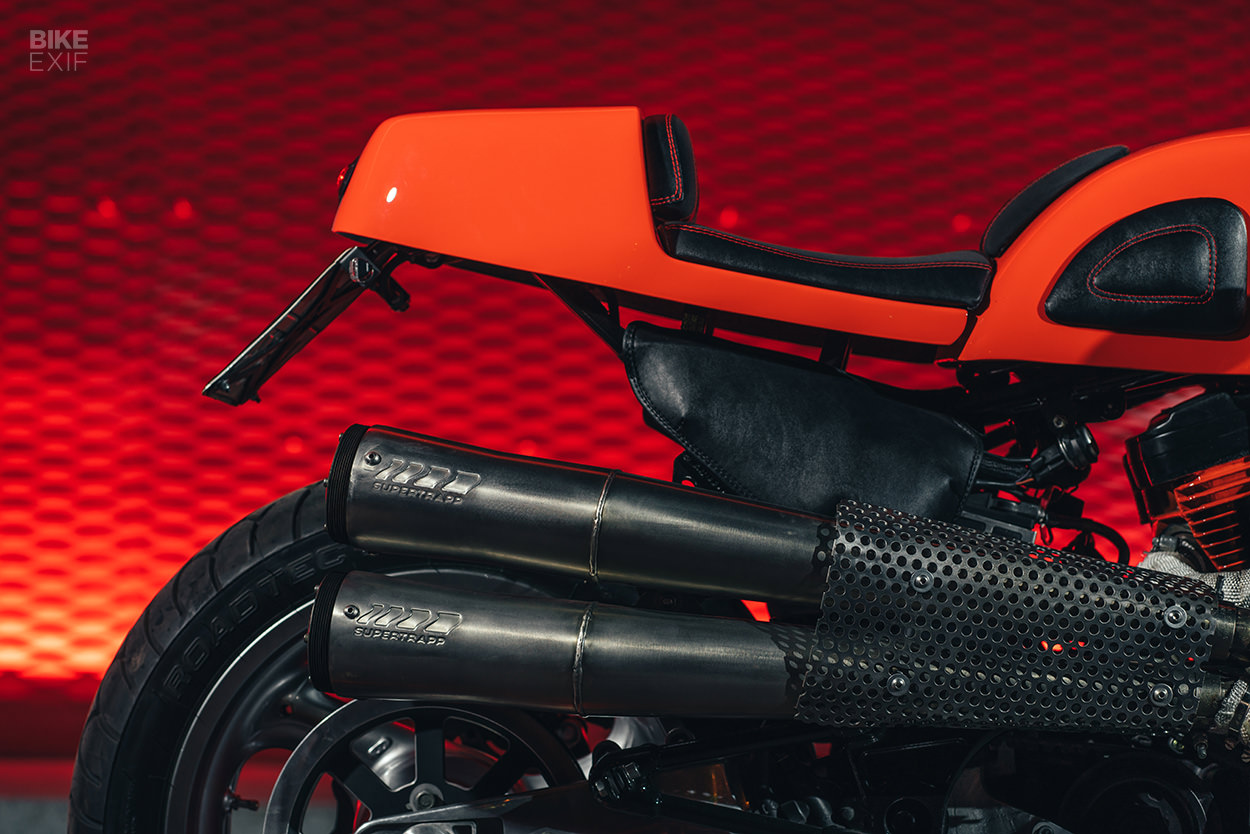
The tail is fiberglass too, taken from a mold used by endurance motorcycles, and finished with a leather saddle designed by L. R. Leather Goods.

VR1000 replica Buell S1 from GDesign
Another change that catches the eye is the exhaust system. Most Buells, including the S1, had a muffler set low under the engine as standard, but Giacomo wanted something different. So he’s modified the manifolds to fit a SuperTrapp exhaust originally designed for the XR1200.

At the front, there’s a new braking system with custom-made double discs and Discacciati brake calipers, and Tommaselli clip-on bars with a USB outlet (and cellphone holder). The rims look as good as new, but they’re not—they are the stock S1 wheels with a slinky ‘gray chrome’ finish.

VR1000 replica Buell S1 from GDesign
The engine gets a fillip via a DynoJet control unit, which is hidden behind the leather side panel. With the new exhaust and a foam air filter, it’s made the Buell ‘a real fiery horse.’

It’s one of those bikes that we’d love to throw a leg over and ride, but sadly, that isn’t going to happen. But if you’re lucky enough to be visiting the Biker Fest in Lignano Sabbiadoro in a few days, you’ll see this stunning machine on display there.

VR1000 replica Buell S1 from GDesign
And towards the end of May it will pop up in London, at the Bike Shed show, alongside a previous GDesign creation—the ‘Elettracker’ board tracker that we featured last year. That’ll be a stand worth visiting.

Giacomo Galbiati Instagram | Images by Mattia Negrini Fotografo

VR1000 replica Buell S1 from GDesign


from Bike EXIF https://ift.tt/u8bgaCA

Wednesday, 11 May 2022

Unbound: A custom Moto Guzzi Griso 1100 from Japan

Custom Moto Guzzi Griso 1100 by Katsu Motorworks
Like many of Japan’s top motorcycle customizers, Kenji ‘Katsu’ Katsumoto got his start with vintage Harleys. But he’s not bound to any one brand or style these days—so when a client requested a Moto Guzzi Griso café racer with street fighter underpinnings, he didn’t hesitate.

Operating as Katsu Motorworks in Fukuoka, Japan, Katsumoto-san built his first Moto Guzzi café racer four years ago. Based on a rare V11 Sport Scura, it bagged him the ‘Best Café Racer’ award at the massive Mooneyes show. And it inadvertently led to this project.

Custom Moto Guzzi Griso 1100 by Katsu Motorworks
According to photographer Kaz Matsumoto, the client for this build originally reached out to Katsu about the possibility of buying the V11 Sport Scura, and the two struck up a friendship. Before long, the client had commissioned his very own custom Moto Guzzi, requesting the Griso as a donor.

The 1,151 cc Griso 8V would have been the ideal platform, but Kaz tells us they’re hard to come by in Japan. So Katsu sourced a 2006-model Griso 1100 instead, and decided to upgrade it with a few key Griso 8V parts.

Custom Moto Guzzi Griso 1100 by Katsu Motorworks
Even though Katsu’s award-winning V11 inspired this build, this is no carbon copy. As the project materialized it headed in a fresh direction, dictated by the client’s proclivities and a couple of particular requests. “The customer said he liked street fighters and café racers,” explains Kaz, “so Katsu decided to combine both.”

“Also, the owner is a speed freak, and so Katsu came up with a sharp, angular design.”

Custom Moto Guzzi Griso 1100 by Katsu Motorworks
One specific request was that all the bodywork be shaped in aluminum—and left unpainted. So Katsu ditched all the Moto Guzzi bits, and began fabricating their replacements, starting with the fuel tank. It wasn’t all plain sailing though, and it took a lot of trial and error to achieve the aggressive, geometric vibe that this Griso now wears so well.

It takes a few passes to pick up all the subtle details. Just in front of the gas tank is a separate handmade housing for the ignition—a small part that undoubtedly took much effort to produce. We also love the air ducts that are integrated into the custom side panels, and the frame rails that Katsu built to sit underneath them.

Custom Moto Guzzi Griso 1100 by Katsu Motorworks
The short boxed tail section hides a bespoke subframe, leaving the impression of a floating rear end. Details abound here too; a tiny LED taillight embedded in the back, a splash guard lower down, and a stylish hit of Alcantara on the seat. And if you’re looking for the turn signals, you’ll find them mounted to either side of the custom-made license plate bracket.

The front end is tidy too, with a hand-made fender that feels organic, but doesn’t clash with the other angular pieces. Higher up is a custom headlight nacelle, with two embedded LED headlights.

Custom Moto Guzzi Griso 1100 by Katsu Motorworks
Katsu installed a set of CNC-machined yokes just behind that, so that he could run clip-ons without cluttering the cockpit with a pair of ’empty’ bar mounts. The bars are off a Ducati 999S and are fitted with Nissin controls. A Motogadget speedo sits perfectly in the gap in front of the top yoke.

Those yokes also hold a set of fully-adjustable upside-down forks from a newer Griso 8V. Katsu also wanted to use the 8V’s radial-mount Brembo calipers, but they wouldn’t match up with the 1100’s retro-fabulous three-spoke wheels. In the end, a set of custom disc spacers with new Pro Brake discs solved the problem.

Custom Moto Guzzi Griso 1100 by Katsu Motorworks
Katsu didn’t tear into the Moto Guzzi’s engine internals, but he did clean it up on the outside and treat it to fresh paint. The airbox has been tossed in favor of a pair of K&N filters, while a burly stainless steel exhaust system provides the soundtrack.

Finishing parts include new rear-sets, and a set of grippy Michelin Power GP tires.

Custom Moto Guzzi Griso 1100 by Katsu Motorworks
Before launching Katsu Motorworks, Katsu cut his teeth in a Harley-Davidson dealership for twelve years, focussing on metalwork and paint. His portfolio is stacked with gorgeous paint jobs, but he respected his client’s wishes here and let the aluminum shine through.

The client did want at least some color on the Griso, so Katsu picked a deep candy burgundy from House of Kolor and coated the frame. With accents on the wheels and cylinder heads, it’s the perfect touch to offset the jagged bodywork.

Custom Moto Guzzi Griso 1100 by Katsu Motorworks
It’s hard to believe that a modern café racer like this could roll out of the same workshop as a Shovelhead chopper—but it’s true, and it’s awesome. Here’s hoping that Katsu never settles.

Katsu Motorworks | Facebook | Instagram | Images by (and with thanks to) Kazuo Matsumoto

Custom Moto Guzzi Griso 1100 by Katsu Motorworks


from Bike EXIF https://ift.tt/BR7YxVr

Sunday, 8 May 2022

Speed Read, May 8, 2022

The latest motorcycle news and customs.
Norton has just acquired a jaw-dropping collection of 55 rare classics from a single source. We also profile a custom Ducati Scrambler 1100, a classy BMW R80 café racer, a Royal Enfield Himalayan, and a Honda CB50 that was built in a spare bedroom.

1930 Norton DT speedway bike
Norton’s heritage collection It’s only been two years since India’s third-largest motorcycle manufacturer, TVS Motor Company, purchased the storied British marque, Norton Motorcycles. But while the future of the brand slowly unfolds, one thing is abundantly clear: its new owners are big on its heritage. They still build Nortons in the UK, and, as if to drive the point home, they’ve just acquired a collection of 55 classic Norton motorcycles.

Norton heritage vintage bike collection
Spanning from 1916 to 1992, these bikes are the opening salvo in Norton’s heritage collection. Remarkably, they were all purchased from a single collector—his name is Ian Loram, and he’s been buying up classic Nortons since the 90s. A true enthusiast, he admits that he would never pass up on the opportunity to buy a rare Norton that’s gone on sale.

The collection is not only impressive in size, but it boasts some pretty special bikes too. There’s a 1921 Model 1 ‘Big Four’ in the set [below], which was said to be founder James Norton’s favorite bike. (He actually rode a sidecar-equipped Big Four 3,000 miles across Africa to visit his brother in South Africa in 1921.)

1921 Norton Model 1 'Big Four'
Then there’s the extremely rare 1930 DT speedway bike, equipped with a 500 cc twin port engine and a three quarter gallon fuel tank. Norton only ever built 53 of these, and loaned this particular one to Oliver Langton to race.

Other notable inclusions include a 1990 Norton F1 Rotary [below], which was the road-going version of the RCW588 race bike, and the 1929 CJ350, which was designed by Walter Moore.

1990 Norton F1 Rotary
Plus there’s a fully restored 1938 Clubman International, a 1929 JE350 that’s one of only six remaining examples, and a race-specced 1950 Norton Manx.

Perhaps the most British of the lot is the 1968 Norton Atlas Police bike. Used for Royal Family escorts, it has ridden alongside the Queen, the Queen Mother and Prince Charles. Some of the bikes will be on show at Norton’s new HQ in Solihull, which will be open to the public in the future.

1929 Norton CJ350
It’s a stunning collection that begs for its own museum, but it’s also an encouraging sign of where the brand’s headed. As their press release puts it: “it’s vital that we continue to celebrate the great products of our past, because they will impact and steer our future.” [Norton Motorcycles]

Custom Ducati Scrambler 1100 by Nico Dragoni Motociclette
Ducati Scrambler 1100 by Nico Dragoni Motociclette I’m going to out on a limb here: the Ducati Scrambler 1100 is massively underrated. Ducati’s confusing nomenclature belies what it truly is—a chunky roadster that, while not as fast as some of its stablemates, is arguably more stylish. And it responds well to light fettling.

This one belongs to a gentleman named Paolo Ferri, who had a desire to make the bike just a bit more compact, and better suited to his riding style. So he roped him the Italian shop Nico Dragoni Motociclette to help him bring his vision to life.

Custom Ducati Scrambler 1100 by Nico Dragoni Motociclette
The first big job was to redesign the rear end. The Scrambler’s stock subframe was replaced with custom made trellis unit, bolted to the original’s attachment points. It’s actually a two part frame that bolts together, and was designed to work around the stock electronics box so that nothing had to be relocated.

A custom seat was made by first editing the stock seat pan, before shaping the foam and upholstering it. Next, the exhaust headers were modified to tuck a pair of SC Project mufflers in high and tight. Lower down, a hand-made license plate bracket mimics the subframe’s design.

Custom Ducati Scrambler 1100 by Nico Dragoni Motociclette
The fuel tank looks stock at a glance, but it’s actually been narrowed by over an inch on each side. It was more than just a quick cut-and-shut job though, since the team put the side sections through a bead roller to add some contours to them.

Up front is a flat track-style aluminum number board, with two Highsider LEDs to light the way. The front end also wears low drag bars, and the original front fender, trimmed.

Custom Ducati Scrambler 1100 by Nico Dragoni Motociclette
The final finishes include swathes of matte black, gloss black, a hint of metal flake, and Ducati’s classic magnesium color. l’Officina Delle Toppe handled the seat cover, KBike built a custom dry clutch kit for the bike, and Roberto at MB Corse helped Paolo on the mechanical stuff.

The Scrambler 1100 is quite a looker out the box—but this one’s just the right amount more radical. Bravo! [Nico Dragoni Motociclette | Images by Manuel Croci]

Custom BMW R80 by Matt Watkinson
BMW R80 by Matt Watkinson Classic BMW boxers are a great choice for first-time custom bike builders, because they’re easy to take apart, and there’s no shortage of inspiration out there. Even so, it’s remarkable how many ‘bad’ BMW customs we see—you need a sharp eye and good judgement if you want yours to stand out from the rest. And California-based Matt Walkinson has both.

Custom BMW R80 by Matt Watkinson
This ultra-sharp BMW R80 café racer is his first build, and it’s a total stunner. His goal was to “create something very clean and minimal that rides as well as it looks,” with quality parts and attention to detail high on the list. He’s done most of the work himself too, despite having nothing more than an Ikea toolkit when he started.

Part of Matt’s winning formula is the fact that he’s picked key bolt-on parts from the best in the business. The subframe and battery box are plug-and-play parts from WalzWerk in Germany, while the seat’s leatherwork was done by the ever-popular Silvermachine in the Netherlands.

Custom BMW R80 by Matt Watkinson
Cognito Moto supplied the yokes, front fender and foot pegs. The yokes hold a set of Suzuki GSX-R forks—re-valved and re-sprung by Ed Sorbo at Lindemann Engineering. There’s a custom-built Penske shock out back, and Matt’s installed a full Beringer brake set with Venhill lines.

The cockpit is sporting the sort of parts you’d usually on find on high-end pro builds. The list includes Woodcraft clip-ons, a Domino throttle, and Renard Speed Shop switches that share space with the Beringer controls.

Custom BMW R80 by Matt Watkinson
There’s a full complement of Motogadget parts too; the grips, speedo, turn signals, mirrors, keyless ignition and electronic control box all come from the German brand.

Matt also rewired the bike with an Antigravity Lithium-ion battery, and a few upgraded components from Euro MotoElectrics. Motodemic brackets hold an LSL headlight, with Kellerman LEDs handling taillight and turn signal duties.

Custom BMW R80 by Matt Watkinson
The engine, gearbox and carbs have all been rebuilt, the frame’s been powder coated, and the headers and off-the-shelf mufflers have been Cerakoted. But the tank is original—right down to its paint and the patina on the roundels. (The yellow fuel lines are a nod to how old BMW badges age.)

It’s a stellar build—and not just for a first timer. Matt clearly has the goods, and we’re looking forward to whatever he builds next. [Matt Watkinson]

Pantelis Manessis' Honda CB50 cafe racer
Honda CB50 by Pantelis Manessis Small bikes appeal to different riders in different ways. But Pantelis Manessis in Kalamata, Greece loves them for myriad reasons. “Call it a money shortage, call it the sheer joy of traveling around at 25 mph, or the lack of a big racing track where I live,” he quips.

That’s why when he stumbled upon a beautiful, but rusted, Honda CB50 that used to be a rental bike, he couldn’t resist snapping it up. The café racer scene was taking off in Greece at the time—so a custom build was on the cards for sure.

Pantelis Manessis' Honda CB50 cafe racer
But Pantelis had one major challenge to overcome first: he had no money with which to fund the build. “I asked my boss at the coffee business I was working at as a technician if he would like a café racer,” he says. “The answer was ‘yes,’ and there was the money.”

The other challenge was finding some key components that had been rusted beyond redemption. But after calling everyone he could think of in Greece, he finally managed to source a good gas tank, a decent used OEM exhaust and a pair of slightly more modern disc brake-ready forks.

Pantelis Manessis' Honda CB50 cafe racer
Things took off from there. Pantelis sandblasted everything, chopped a few bits off and sent the aluminum parts off for polishing. The engine got a top end rebuild with a bunch of new parts, but the bottom end just needed a new capacitor, a contact point and a cam chain. “Nothing else… because Honda,” he says.

Wheels from a Japanese-made moped were laced up with new spokes, and a modified C-Racer tail section was bolted on top of a handmade aluminum battery tray. The wiring was done from scratch, and features a Kreidler Florett headlight with the tacho embedded in it, and an aftermarket Jeep turn signal for a taillight.

Pantelis Manessis' Honda CB50 cafe racer
There are too many scalped parts to mention—from the Zundapp handlebars to smaller bits like the front fender, levers, brake master cylinder and light switch. A few parts, like the number plate bracket, were made by manipulating stainless steel with a vice and a blowtorch.

The shiniest bits are the Aston Martin inspired paint (done by a friend who’s a pro), the gold pin stripes by Tiki Tony, and the Biltwell Inc. grips that were gifted to Pantelis by Nicko at The Real Intellectuals.

Pantelis Manessis' Honda CB50 cafe racer
All done and dubbed ‘Stretto’ (because it’s small and strong), this cheeky little 50 cc racer revs into the high 13s and clocks 70 km/h [43.5 mph]. Oh, and did we mention that Pantelis built it in his spare bedroom? [Pantelis Manessis Instagram | Images by Mike Vryonis]

Royal Enfield Himalayan scrambler by Giorgio De Angelis
Royal Enfield Himalayan by Giorgio De Angelis We’re not sure how many custom scramblers are ever truly put to the test off-road—but we do know that this Royal Enfield Himalayan will be. Giorgio De Angelis built it to tackle La Ruta Del Nabab—a 1,000-plus kilometer off-road ride through Morocco.

Royal Enfield Himalayan scrambler by Giorgio De Angelis
Tough and capable were higher on Giorgio’s list than pretty, so that’s where he focused his efforts.

The first step was to remove the Himalayan’s clunky front fairing and subframe, and replace it with new brackets to hold the OEM headlight and clocks, and a new front fender. Behind those are a new set of tapered handlebars, mounted on risers and fitted with handguards.

Royal Enfield Himalayan scrambler by Giorgio De Angelis
Further back is a custom-made luggage rack where the passenger seat used to be. The tail end’s been tidied up with a new license plate mount, and a vintage-style LED taillight.

Giorgio also installed a remapped ECU and a handcrafted titanium exhaust system, to put a little more pep in the Royal Enfield’s step. The ABS system has been deleted too, and the brake hoses upgraded to Frentubo parts.

Royal Enfield Himalayan scrambler by Giorgio De Angelis
Finished off with a simple titanium grey paint job, a burly sump guard and Mitas knobblies, this Himalayan looks like it’d be fun to rip through the desert on. Happy trails, Giorgio! [Giorgio de Angelis Instagram | Images by Victoria Dusko]

Royal Enfield Himalayan scrambler by Giorgio De Angelis


from Bike EXIF https://ift.tt/zmNWiU8