Thursday, 14 April 2022

Silver Ant: Hookie Co.’s Cake Ösa electric drag racer

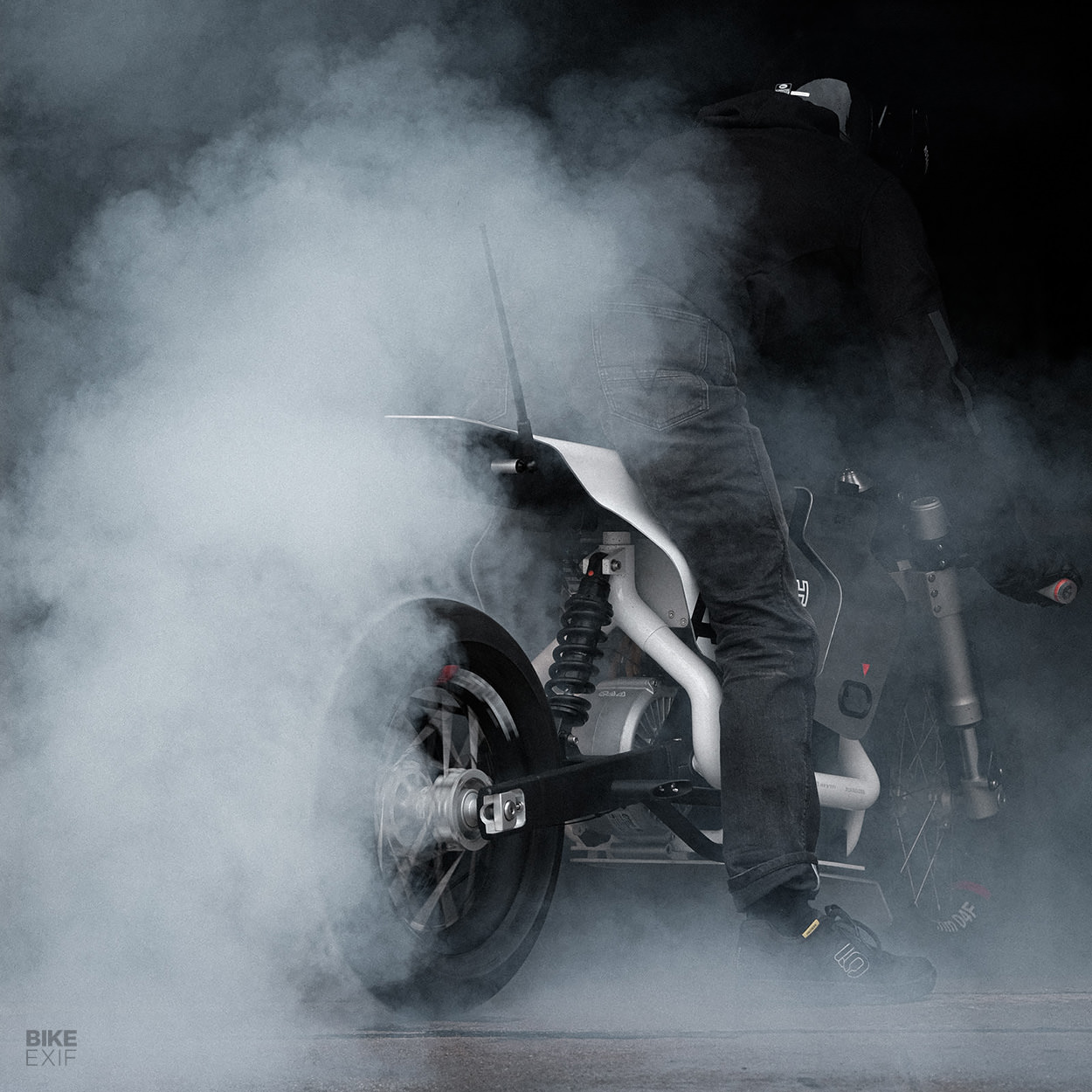
Cake Ösa+ electric drag racer by Hookie Co.
Cake’s electrical motorcycles look exactly like you’d expect high-end products from Swedish designers to look: slick, utilitarian and minimalist. So who better to customize one than Germany’s Hookie Co.?

The Dresden-based custom house is known for their sharp eye and fresh style—and they’re familiar with Cake’s drivetrains. Their otherworldly Tardigrade moon rover concept is Cake-powered, and they’ve produced a bolt-on kit for Cake’s Ösa electric utility bike. Now they’ve taken the second concept further, with an Ösa-based drag racer.
Cake Ösa+ electric drag racer by Hookie Co.
The idea of a silent drag race might sound weird, but that’s exactly what’s happening this September. The massive Glemseck 101 festival is finally back after a long pandemic-induced hiatus—and it now includes an electrics-only race. Hookie Co. will be lining up on this sharp little whip, dubbed the ‘Silver Ant.’

Hookie Co. picked the up-specced Ösa+ model for their build. Cake pitch it as being equivalent to a 125 cc petrol-powered scoot, with a 10 kW motor and a top speed of 90 km/h [56 mph]. But this one’s a little quicker.
Cake Ösa+ electric drag racer by Hookie Co.
Hookie have ripped into the controller software to eke out as much power as possible. They’re still tuning it, but they know what their goal is; 160 km/h [100 mph].

It’s not just about top speed though. The acceleration curve on this Ösa+ is way different from stock, and the engine braking’s been adjusted to the point that the bike only needs one brake. It’s a whole new world of performance tuning.
Cake Ösa+ electric drag racer by Hookie Co.
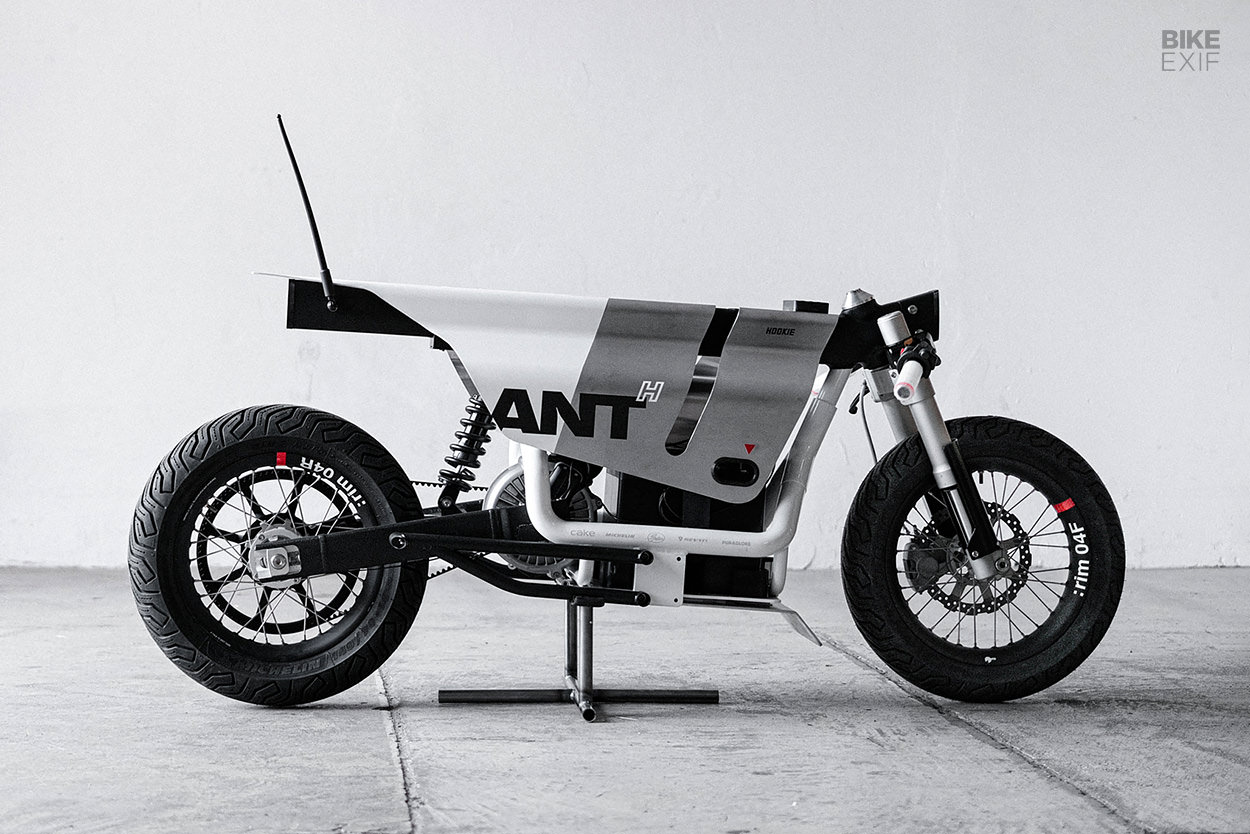
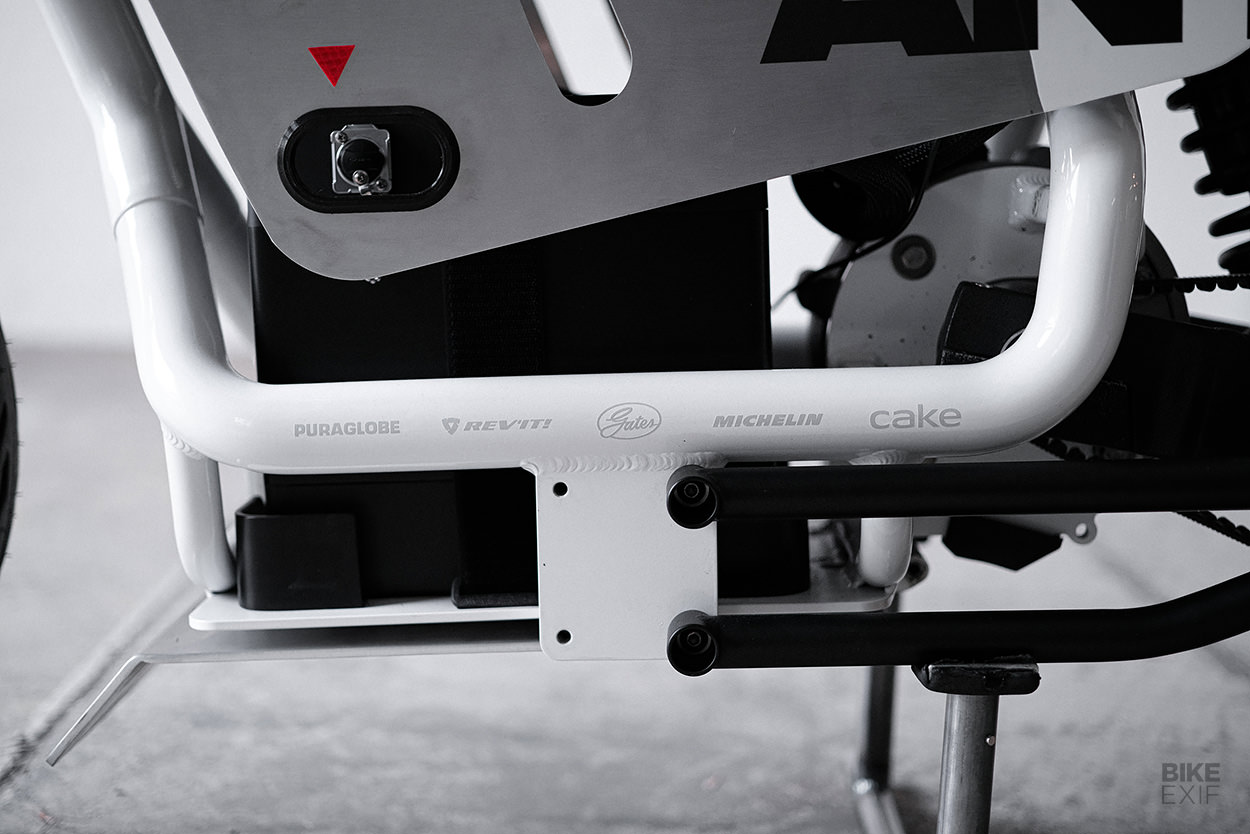
Out the box, the Ösa+ is made for commuting and hauling cargo, with ergonomics to match. Hookie needed to tweak its stance for the drag strip, so they swapped out the forks for a lowered set from the Ösa Lite. They kept the OEM swingarm, shock and 14” wheels, but added a set of Michelin City Grip 2 tires.

The rest of the frame is bone stock—which was a key aspect of this project. Hookie Co. are well-versed in the science of building plug-and-play kits, and the Ösa+ is made to be modular. So other than a fresh coat of wrinkle black on the swingarm and the main frame’s backbone, nothing’s been fettled on the chassis itself.
Cake Ösa+ electric drag racer by Hookie Co.
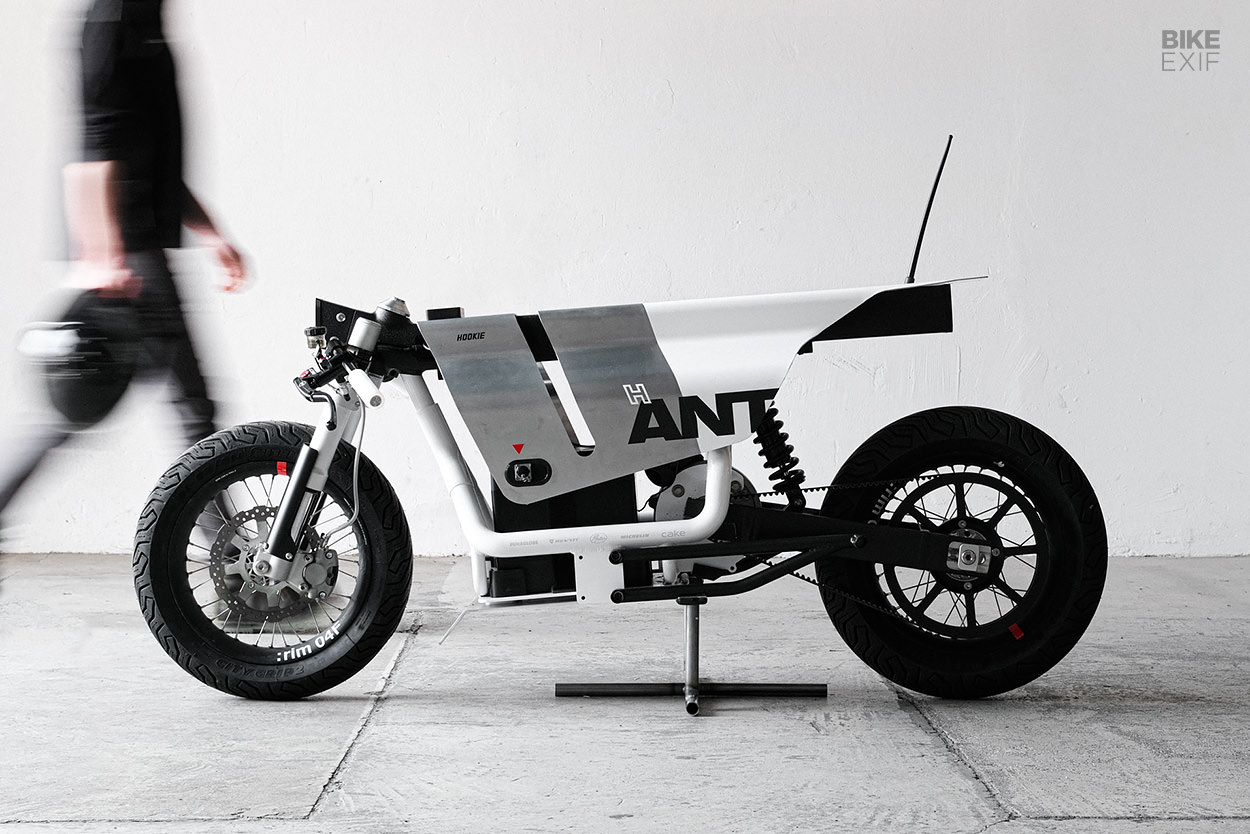
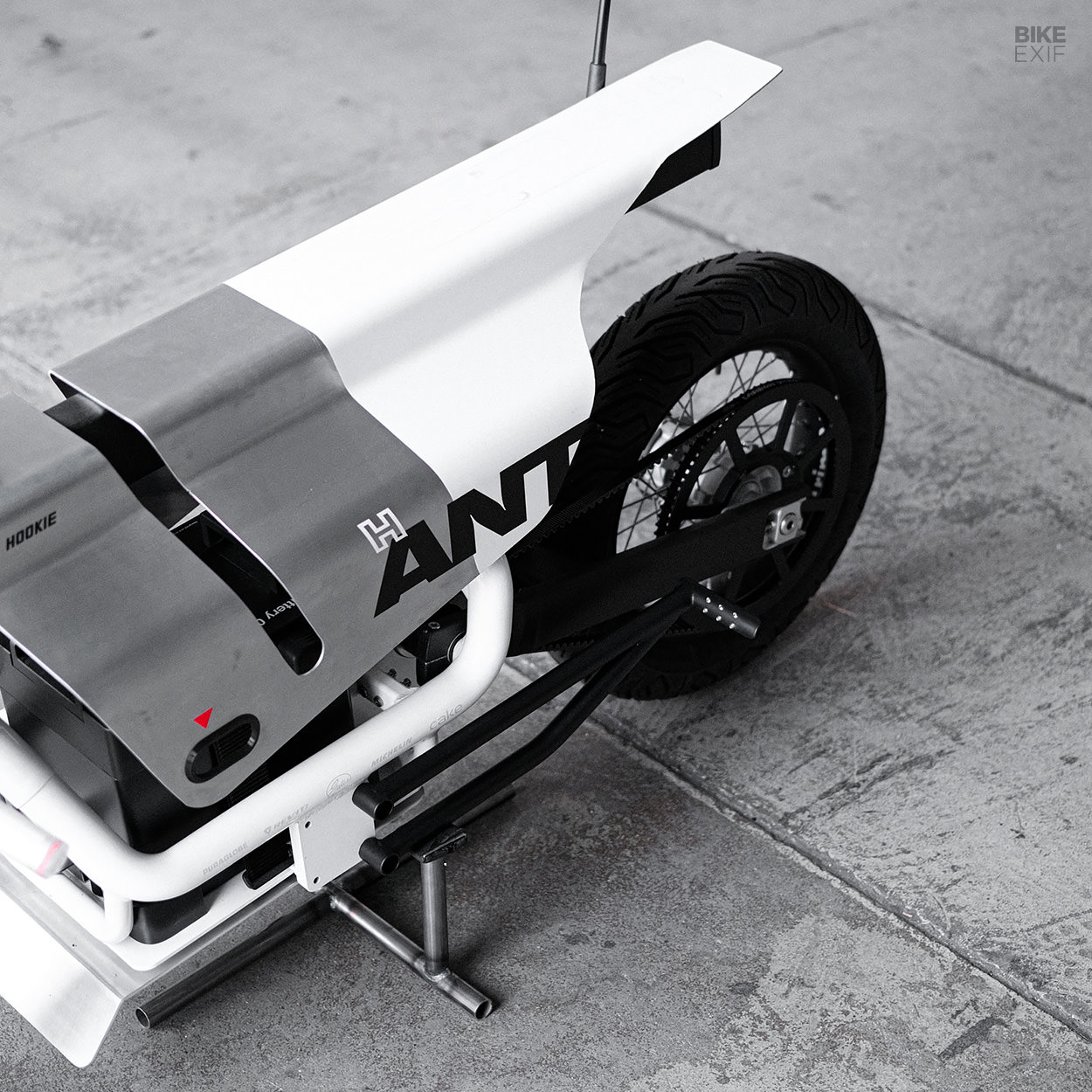
Hookie simply unbolted the stock trimmings, and slapped on an alternate version of their ‘Ant‘ body kit. The one-piece aluminum cover bolts onto the bike’s existing mounting points, with a little more coverage than Hookie’s original Ant design. There’s no seat on this one either—just some grip tape to keep the rider from sliding off the back.

The Cake’s digital dash has been moved from its traditional perch, to on top of the body kit, just behind the bars. A cut-out on the left side of the main panel offers access to the charge port.
Cake Ösa+ electric drag racer by Hookie Co.
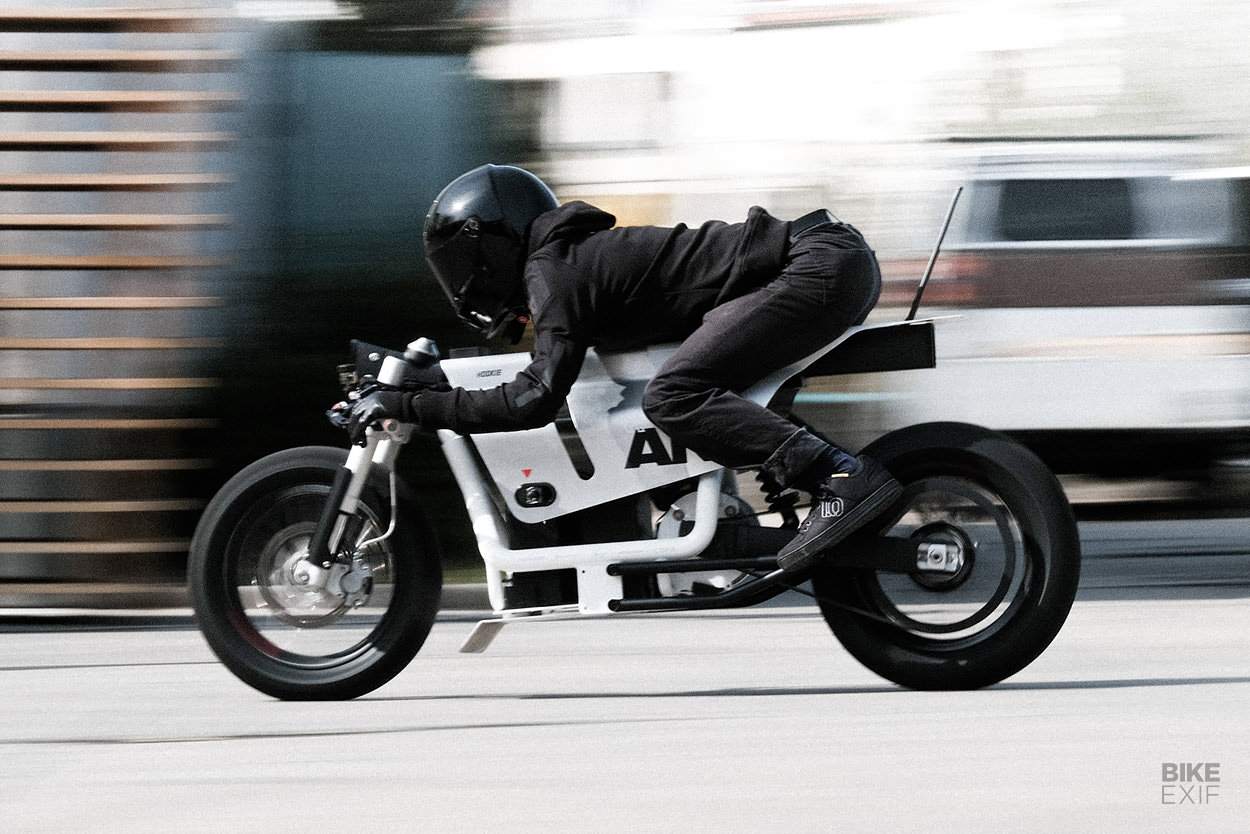
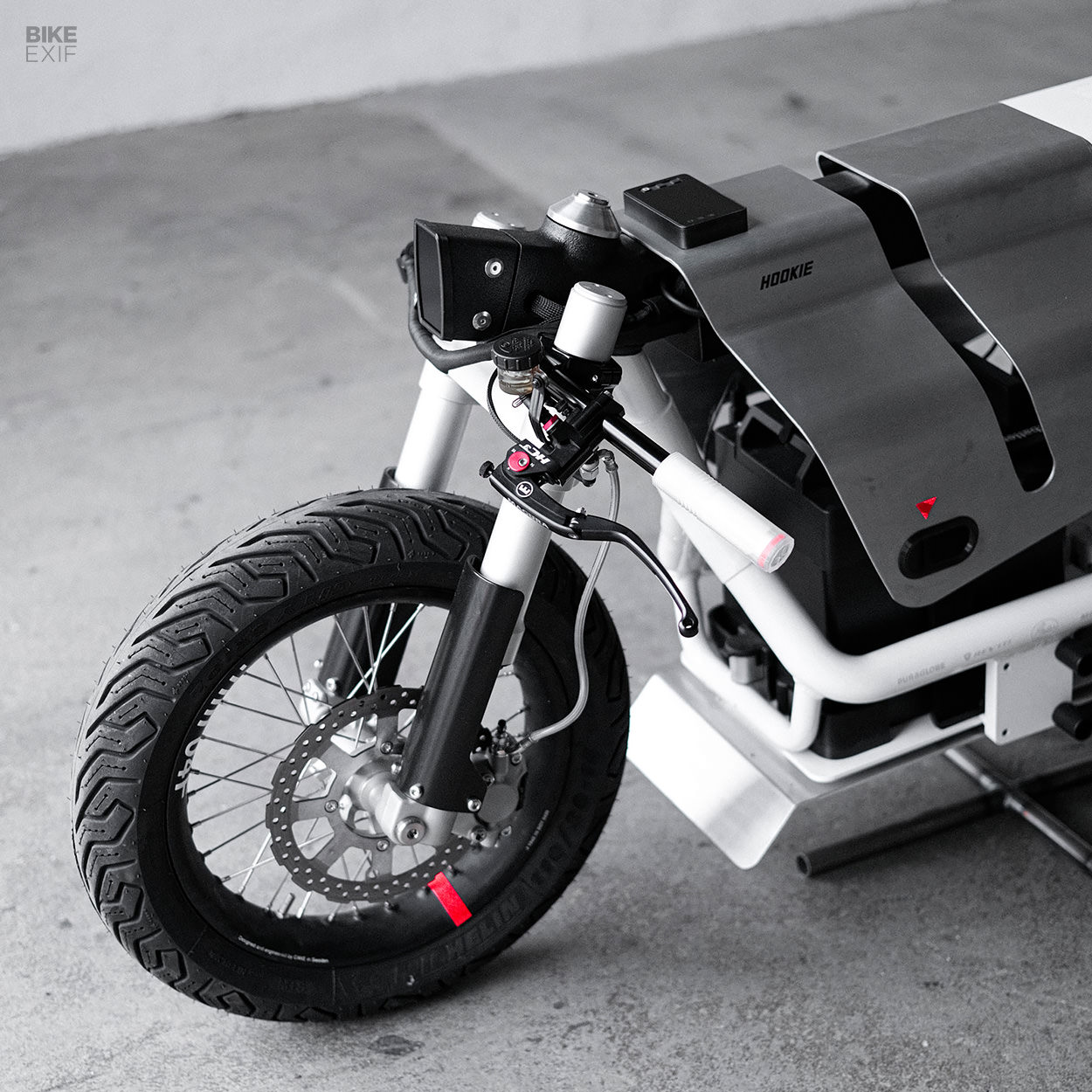
The riding position is as dedicated as you’d expect for a bike that’s designed for straight line sprints. Clip-ons are mounted ultra-low up front, fitted with Hookie’s own translucent ‘Frozen’ grips.

The controls are about as basic as they come. The right side features the starter switch and throttle, and the left features a Magura hydraulic clutch control that’s been repurposed to operate the front (and only) brake. The foot pegs and their perches are custom, and sit as far back as possible.
Cake Ösa+ electric drag racer by Hookie Co.
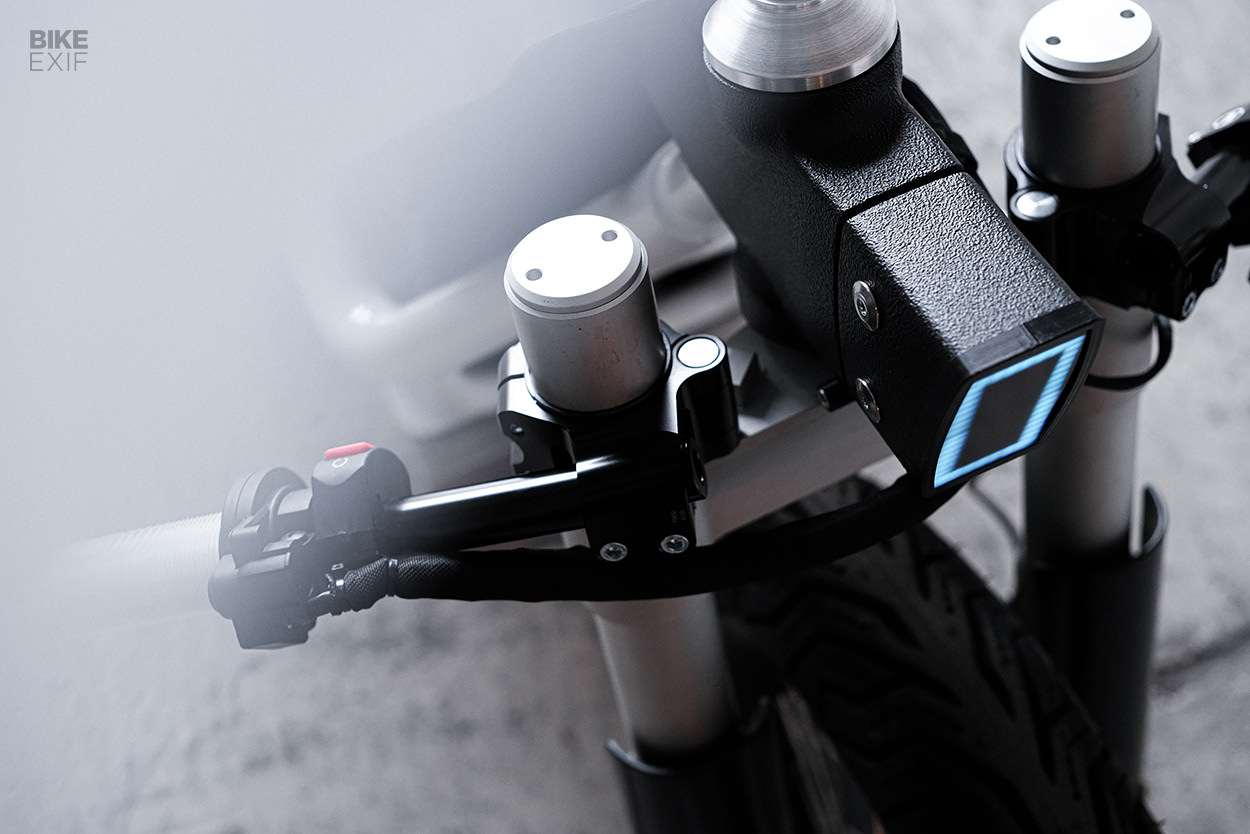
Hookie built their own head- and taillights too, each with a grid of small LEDs. Both lights are governed by a Arduino controller, allowing Hookie to customize the ‘display’ at each end.

And if you’re wondering what the antenna at the back is for, it’s a wireless receiver. Hookie are developing a system that offers remote access to the engine and battery software, but they’re still figuring out some range and reliability issues.
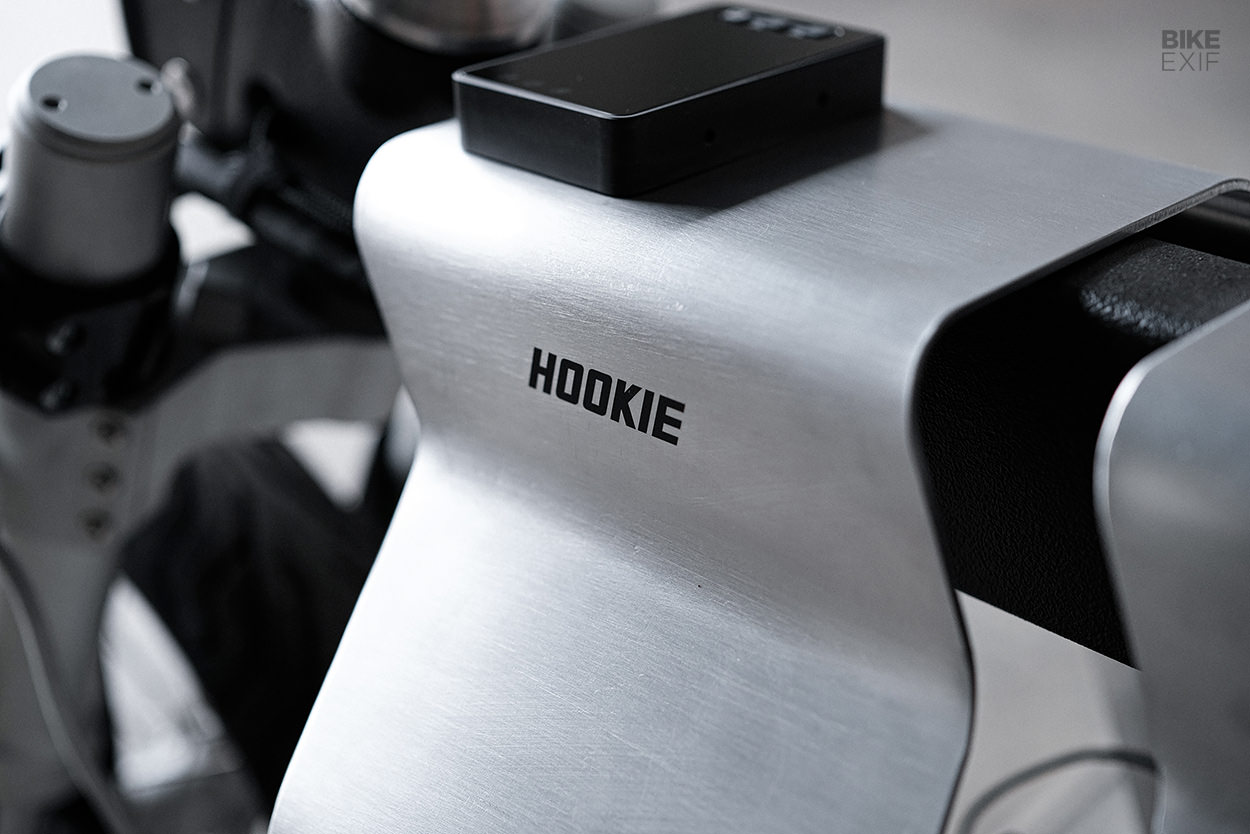
Cake Ösa+ electric drag racer by Hookie Co.
Visually, Hookie’s Silver Ant is a knockout. It’s compact and pixel perfect, with the sort of bold graphics that we’ve come to expect from this crew. But it also looks like it’d be wild to ride—especially when they manage to hit the numbers they’re aiming for.

We can’t wait to see what other electric oddities will line up at the Glemseck 101.

Hookie Co. | Facebook | Instagram
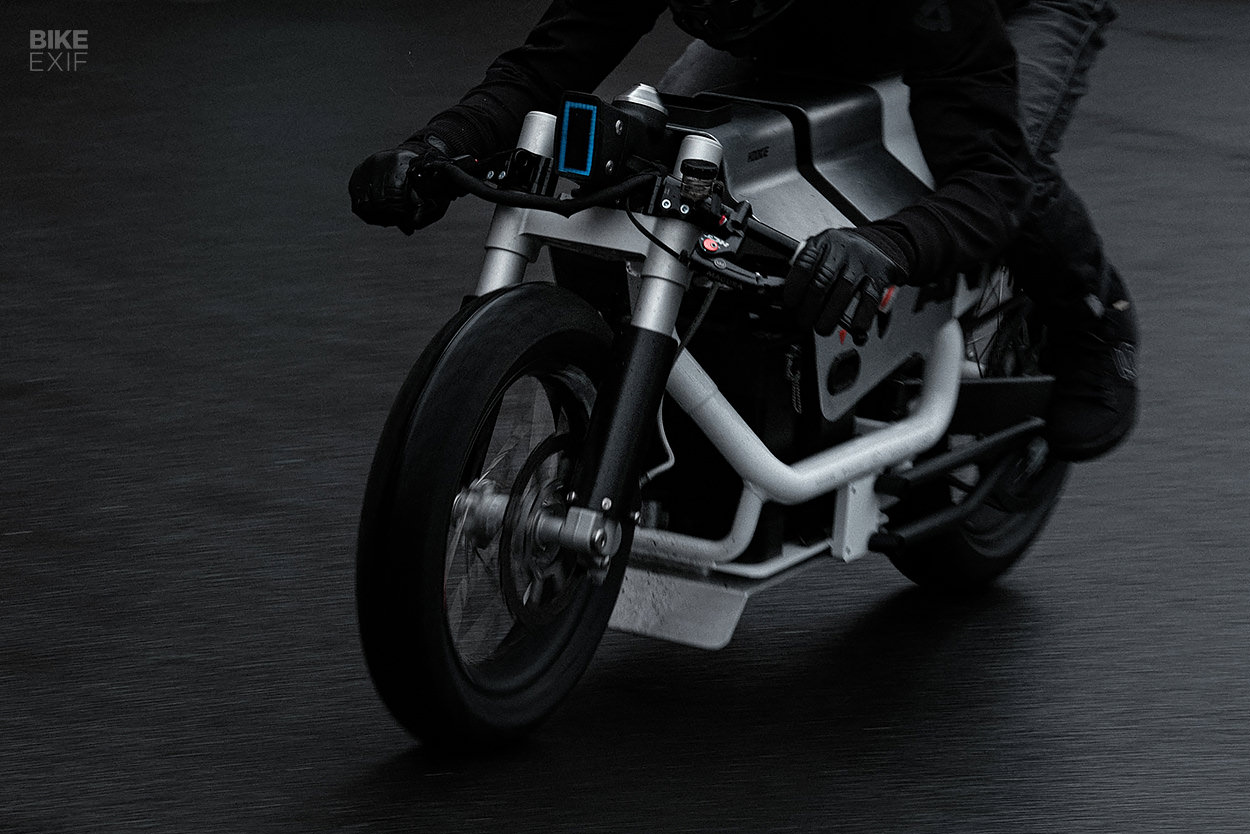
Cake Ösa+ electric drag racer by Hookie Co.

Cake Ösa+ electric drag racer by Hookie Co.


from Bike EXIF https://ift.tt/2L0xcZU

Monday, 11 April 2022

The ‘Go Fast’: A bored-out Honda CB550 by Federal Moto

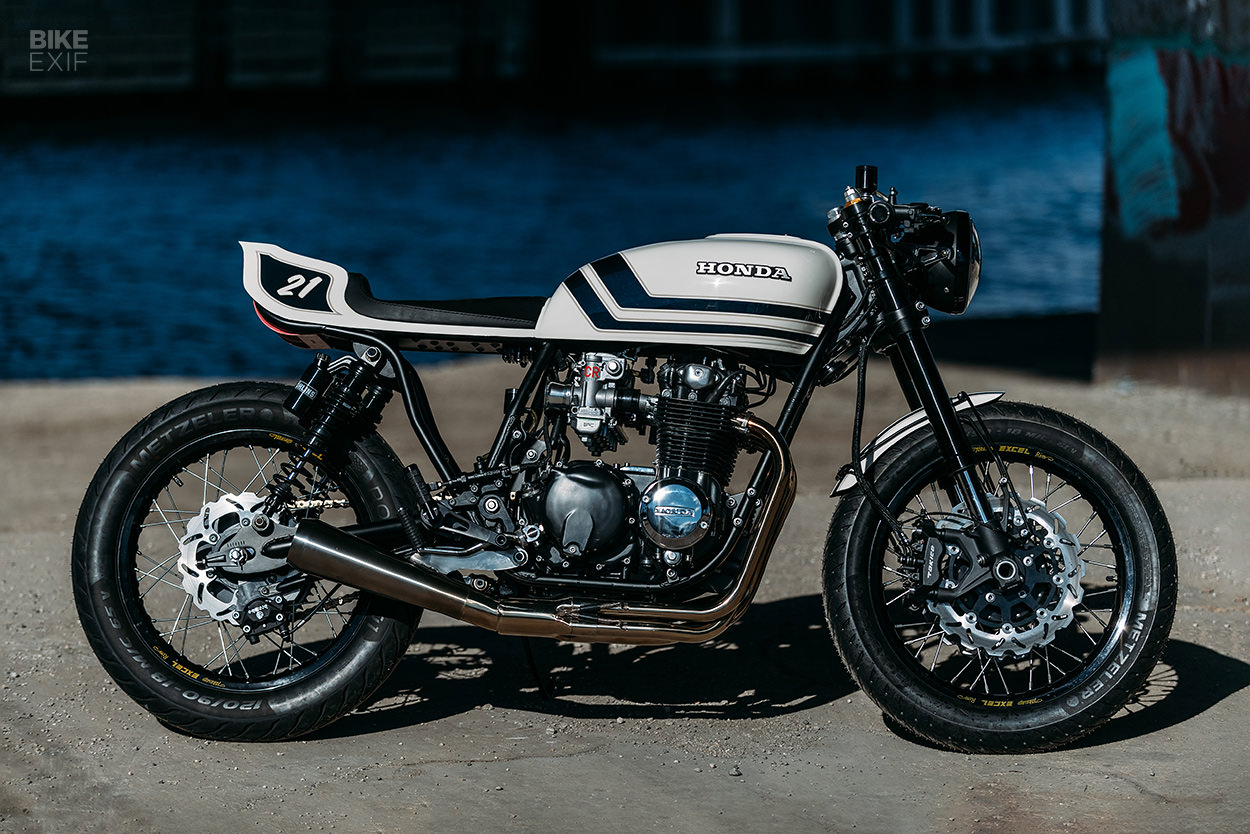
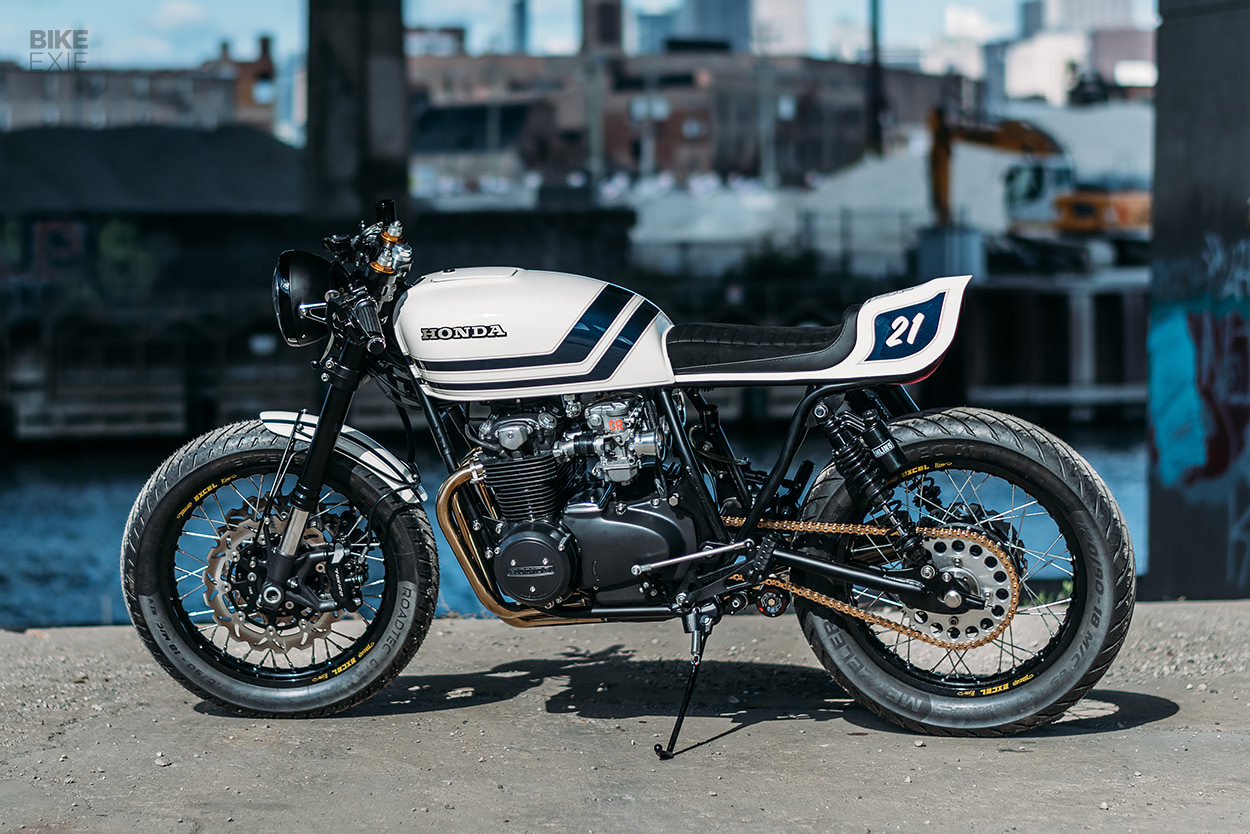
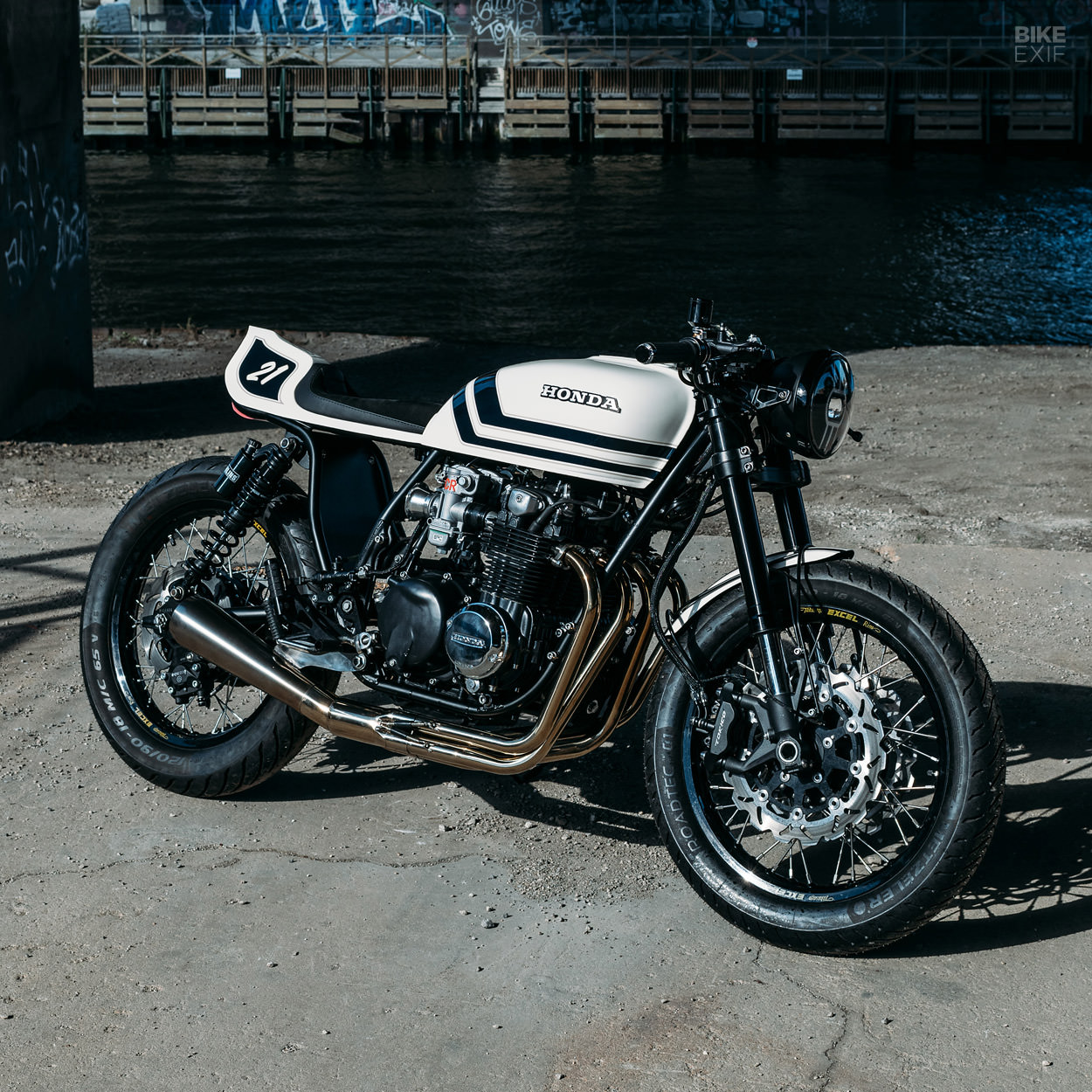
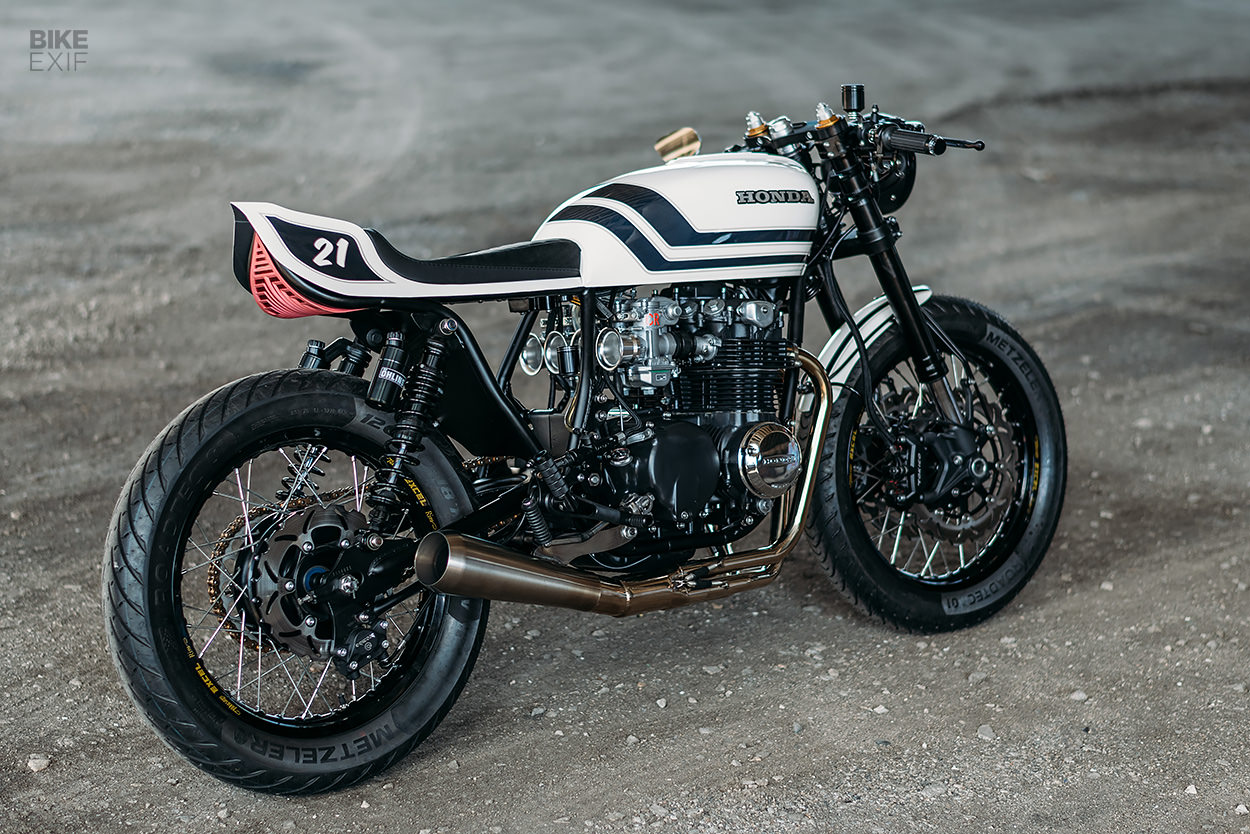
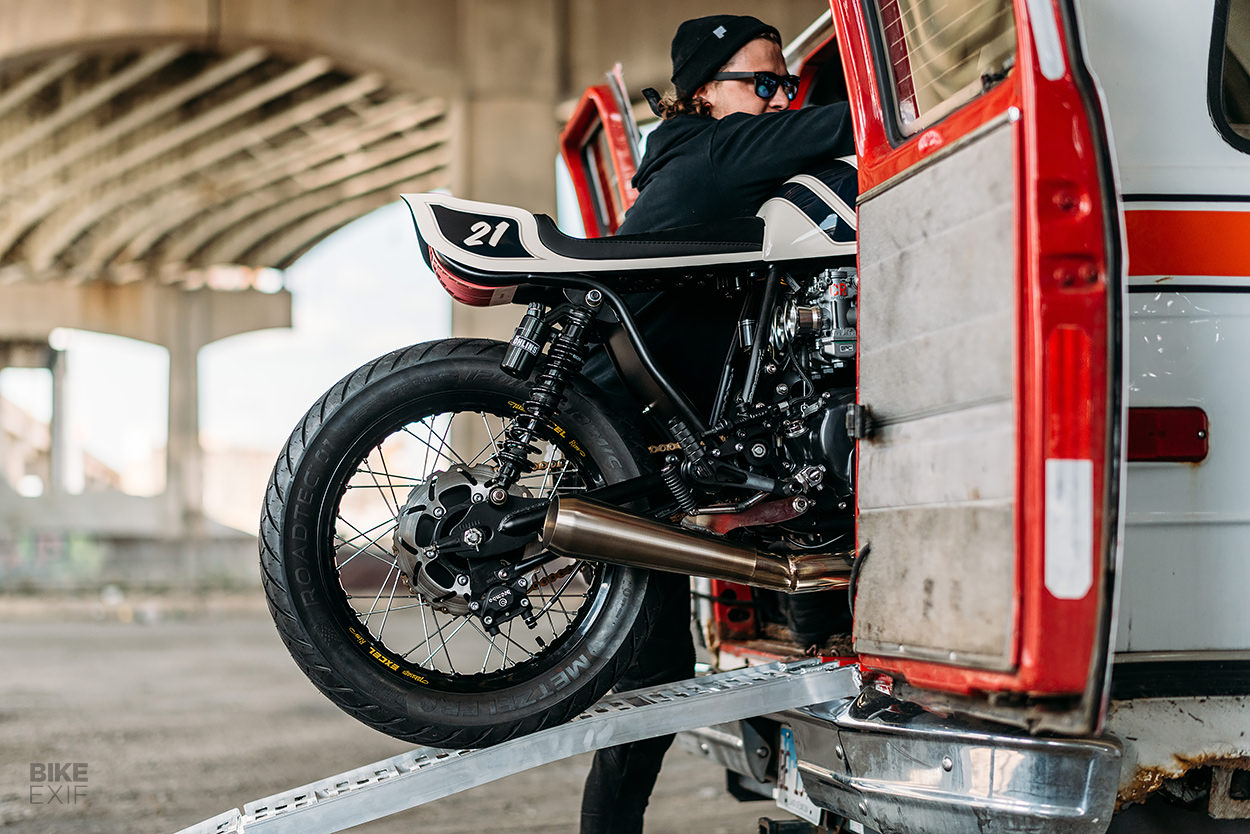
Custom Honda CB550F by Federal Moto
Building your own custom motorcycle is an incredibly rewarding experience… until it isn’t anymore. The owner of this 1976 Honda CB550F can relate. After taking a crack at rebuilding it himself, he threw in the towel and decided to hand it over to a pro shop, rather than let it become another abandoned shed build.

Since the owner’s based in Chicago, Federal Moto got the call. “When we picked up the bike it was a mess,” says shop boss, Mike Muller. “Rusty, tired and well ridden for decades. He wanted the full Federal treatment, wheel to wheel, giving us complete creative freedom with colors and design.”

Custom Honda CB550F by Federal Moto
“His only request was ‘make it fast as f-k.’ So here’s what we came up with: the ‘Go Fast’.”

Federal has spent the last while staffing up and moving to a bigger space. So they now offer a bunch of new engine-related services on top of their usual custom work. The CB was in good hands.

Custom Honda CB550F by Federal Moto
For starters, Federal’s head technician, Chris Goerg, went to town on the tired motor. It’s been fully rebuilt and blueprinted, with a 592cc piston kit from Dynoman Performance. APE Race Cranks lightened and balanced the crankshaft, while Webcam Racing supplied a new camshaft.

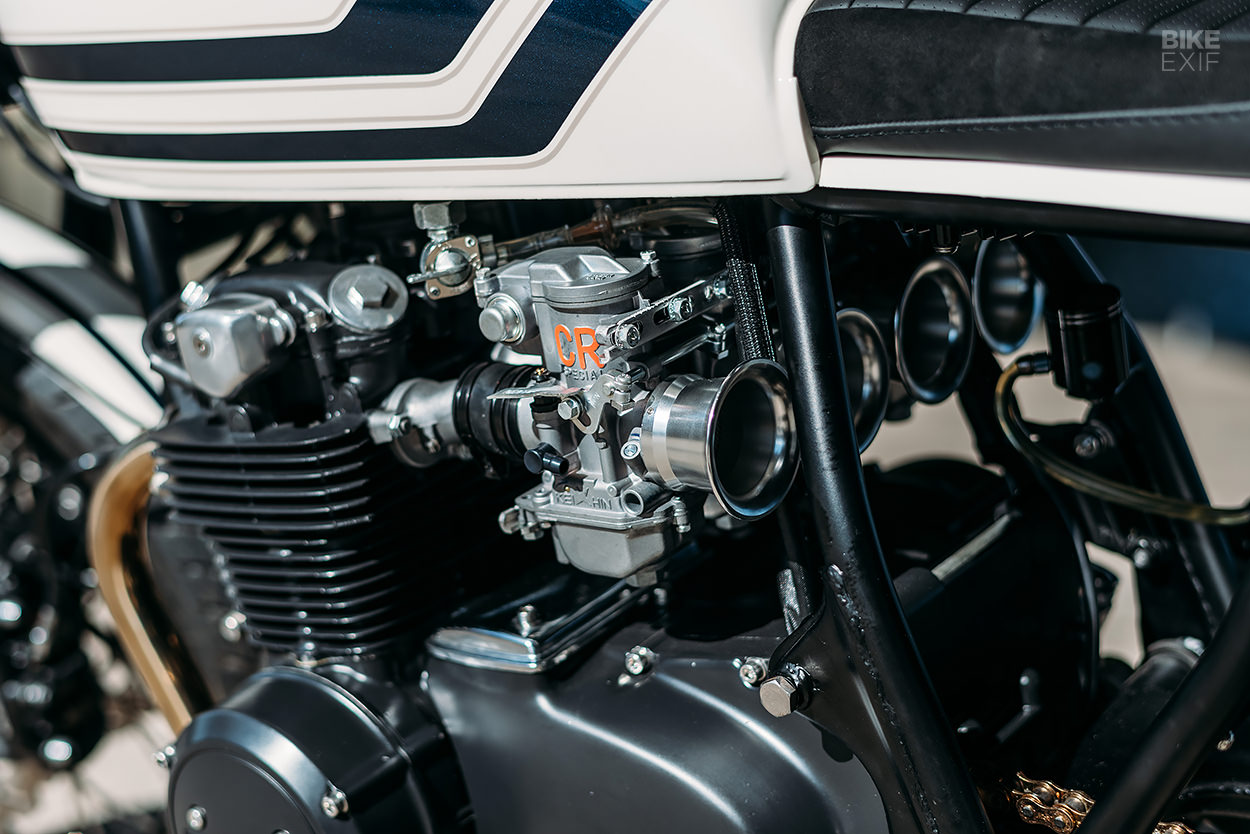
Chris also installed KPMI valves, springs and guides, then angled the valves. Other upgrades include a Dyna ignition, a Barnett clutch kit and Keihin CR carbs. The exhaust system is a thing of beauty; stainless steel headers mated to a throaty Cone Engineering muffler.

Custom Honda CB550F by Federal Moto
Speed is useless without control, so Federal upgraded the chassis too. The front end wears the forks and twin Tokico brakes from a Kawasaki Ninja ZX-6R, with a pair of Öhlins Blackline shocks mounted out back.

The Honda rolls on 18” Excel rims, laced to Cognito Moto hubs with stainless steel spokes. They’re wrapped in Metzeler’s Roadtec 01 sport touring tires. Federal also installed a Brembo brake at the back, custom sprockets from Sprocket Specialists, and a chain tensioner from Monster Craftsman that uses a skateboard wheel for a roller.

Custom Honda CB550F by Federal Moto
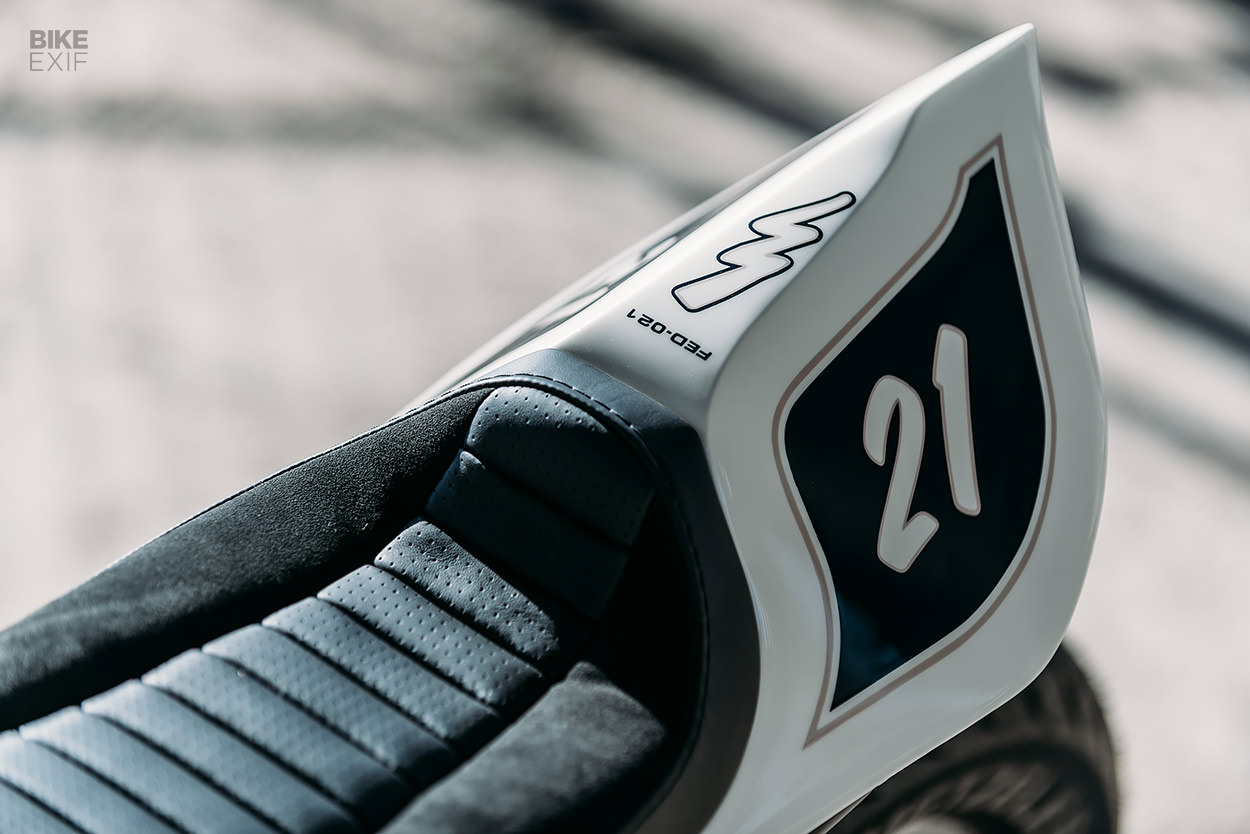
Mike has a knack for working unconventional design touches into his builds. Here, he kept the CB550F’s OEM tank to retain some of its original DNA, but fabricated a tail section that rides the line between organic and geometric. It might eschew typical café racer aesthetics—but it looks great here.

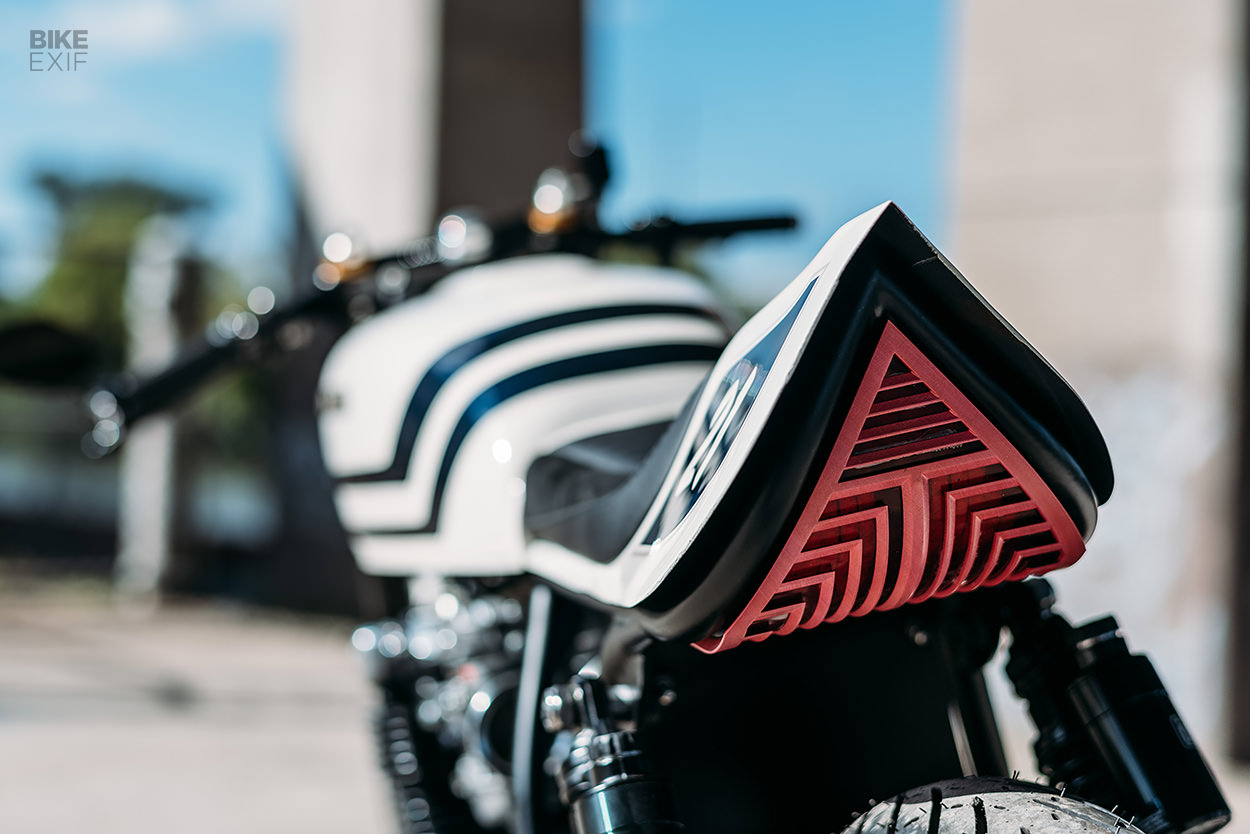
The flowy effect extends to the custom subframe, which features the subtlest of kinks to tie everything together. Peek between the down tubes, and you’ll spot a splash guard that keeps muck out of the velocity stacks.

Custom Honda CB550F by Federal Moto
The back end of the tail’s filled in by a 3D printed taillight and turn signals combo, deigned and built by in-house engineer Desmond Diogiovanni. Regular collaborator Dane Utech at Plz be Seated treated the seat to an equally interesting cover.

Other custom bits include the front fender and brackets, and the stainless steel exhaust hanger. Even the kick start lever is modified, tucking it in low and tight.

Custom Honda CB550F by Federal Moto
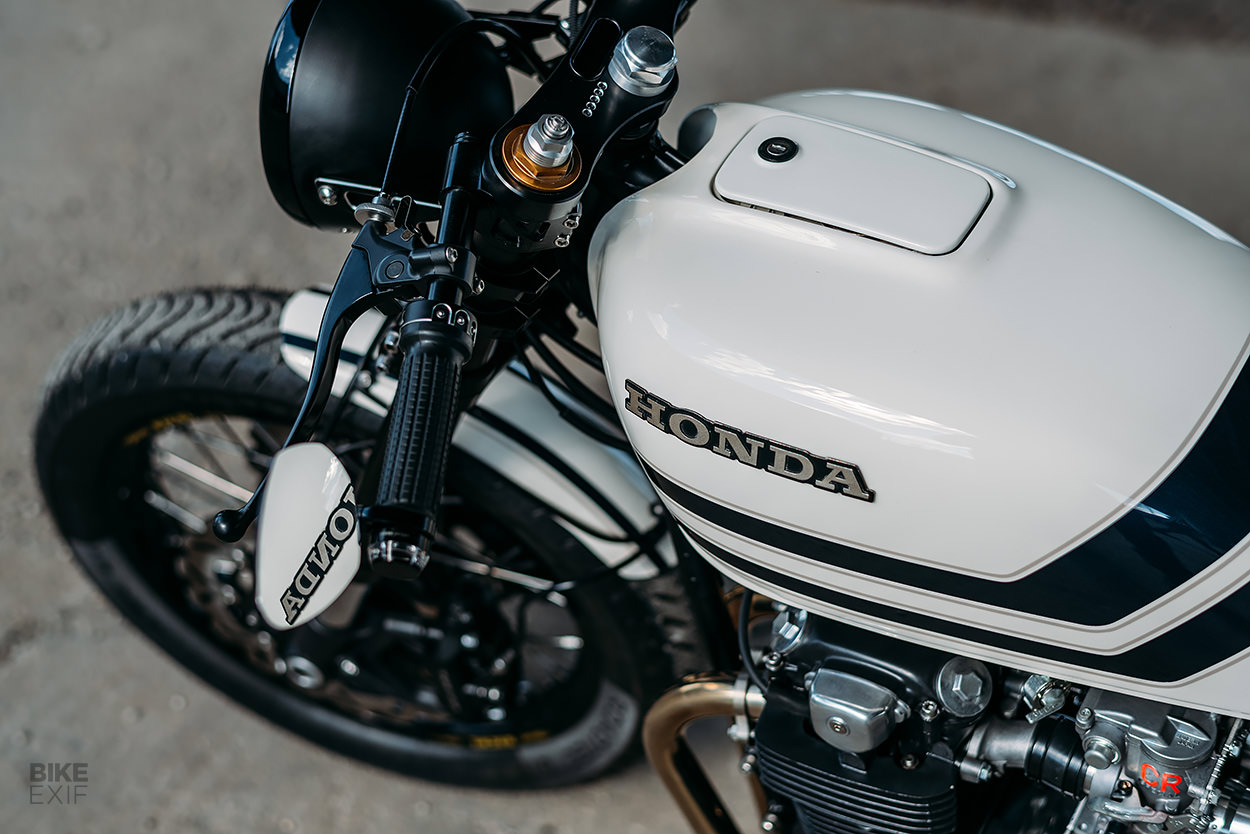
Up top is a CNC-machined yoke from Cognito Moto, with a Motogadget speedo and LED warning lights sunk into it. Federal installed clip-on bars, then kitted them out with Motogadget switches, grips, and bar-end mirrors and turn signals. An LED headlight lights the way.

Federal also re-wired the bike with a Motogadget control box and keyless ignition. The important electronic bits are stashed under the tail section, along with a Lithium-ion battery from AntiGravity. Cognito Moto rear sets finish off the parts list.

Custom Honda CB550F by Federal Moto
Parked, the CB550F looks poised to strike, with a compact and sharp silhouette. But it’s also wearing one of the freshest liveries we’ve seen in a while; top marks to Jason van der Woude at NSD Paintwerks.

A black Cerakote finish on the engine, and period-correct Honda logos on the tank, add the perfect finishing touches.

Custom Honda CB550F by Federal Moto
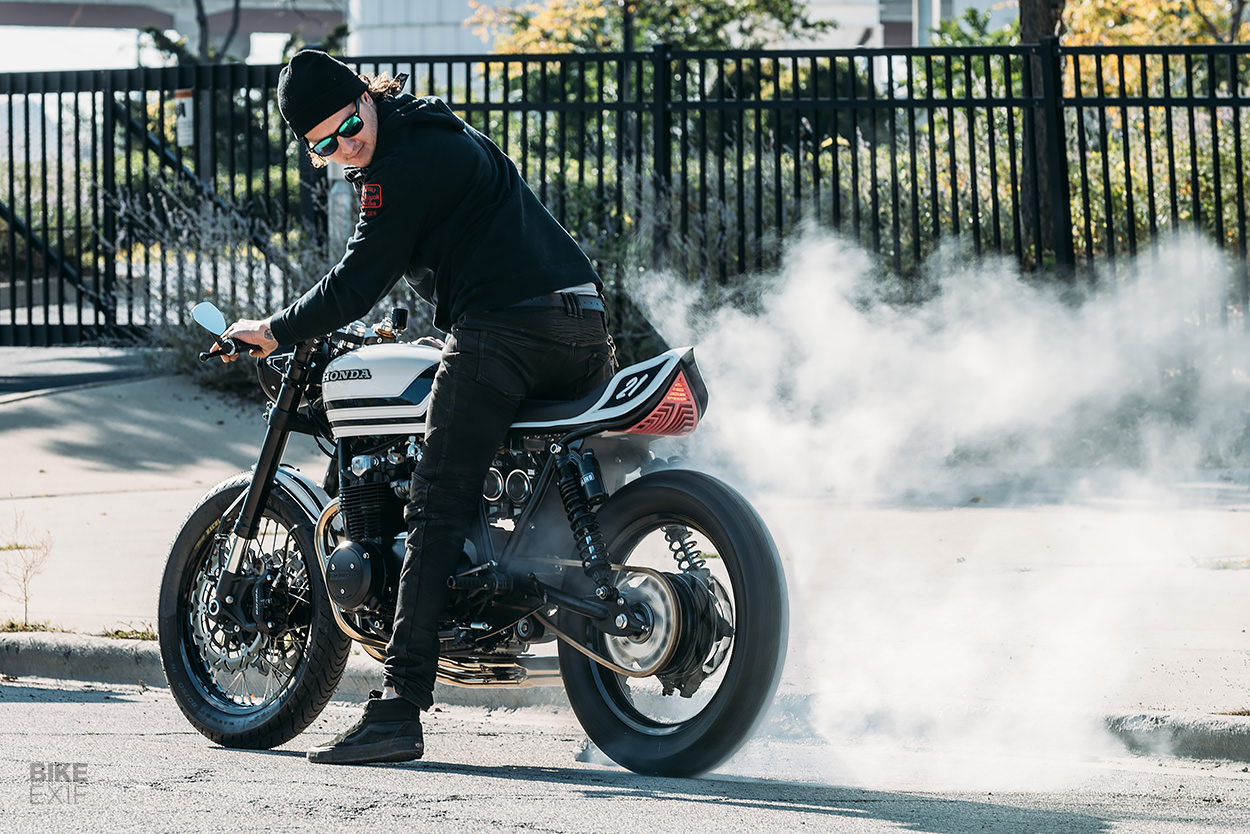
The real question is: did Federal nail the brief? Does this CB550F go as fast as it looks? Mike says “yes.”

“Let me tell you, its pretty awesome to feel a vintage Honda break loose in second gear!”

Federal Moto | Facebook | Instagram | Images by Grant Schwingle

Custom Honda CB550F by Federal Moto


from Bike EXIF https://ift.tt/RL649pa

How to Install a Turbocharger System

The automotive aftermarket industry reached a value of $560 billion in 2021. Some cars come with a turbocharger system as standard, and some don’t.

If your car doesn’t already have a turbo, you may want to add one. But how do turbochargers work? And how do you install one?

Keep reading to find out.

What Is a Turbocharger?

are devices that can be added to the engine of a vehicle to improve both performance and efficiency. They consist of two separate halves with a shaft joining them together.

One side of a turbo kit is the inlet where hot gasses spin the turbine. This causes the other side to spin which sucks in ambient air, compressing it into the engine. This brings more air into the combustion chamber which in turn makes the engine more efficient and powerful.

Installing a turbocharger takes some mechanical skill, but you may be able to do it yourself by following this guide.

1. Drain the Oil

Raise the front end of the car using a jack and rest it on jack stands. Drain the motor oil using a pan so that you can dispose of the oil properly.

2. Install the Intercooler and Remove the Exhaust Header

After all of the oil has drained out, place the oil drain plug back and remove the front bumper. Here is where you install the intercooler or charge air cooler. Remove the exhaust header as this will be replaced by the turbocharger manifold.

3. Attach the Turbocharger

Connect the turbo header to the turbocharger, then connect the header to the exhaust system. After this, you need to create a tap in the oil filter line. Attach the turbocharger’s oil feed line to this tap, then attach the oil return line to the engine oil pan.

Some cars don’t have an oil tap in the engine oil pan. If this is the case, then you may have to get one made.

4. Connect the Pipes and Hoses

Use the metal pipes and hoses to connect the intercooler to the compressed air outlet of the turbocharger. Any tubes and filters that are attached to the air intake of the engine need to be removed. If your car has a carburetor then you’ll also need a turbo hat.

5. Connect the Compressed Air Outlet

From the other side of the intercooler, the hoses and pipes will need to go to the engine’s air intake system. The intake system then needs to be connected to the compressed air outlet of the turbocharger.

Make sure all the oil taps and bolts are secure, add some new oil, and lower the car – now you’re good to go.

Installing a Turbocharger System Yourself

Doing your own turbocharger installation is usually not too difficult if you have some mechanical skill. If you’re not too confident, you should get a professional to help install your turbocharger system.

If you’re interested in more automotive articles, check out some of our other blog posts.

The post How to Install a Turbocharger System appeared first on Automotorblog: Daily news on cars and motorcycles.


from Automotorblog: Daily news on cars and motorcycles https://ift.tt/jsOXQJS

Wednesday, 6 April 2022

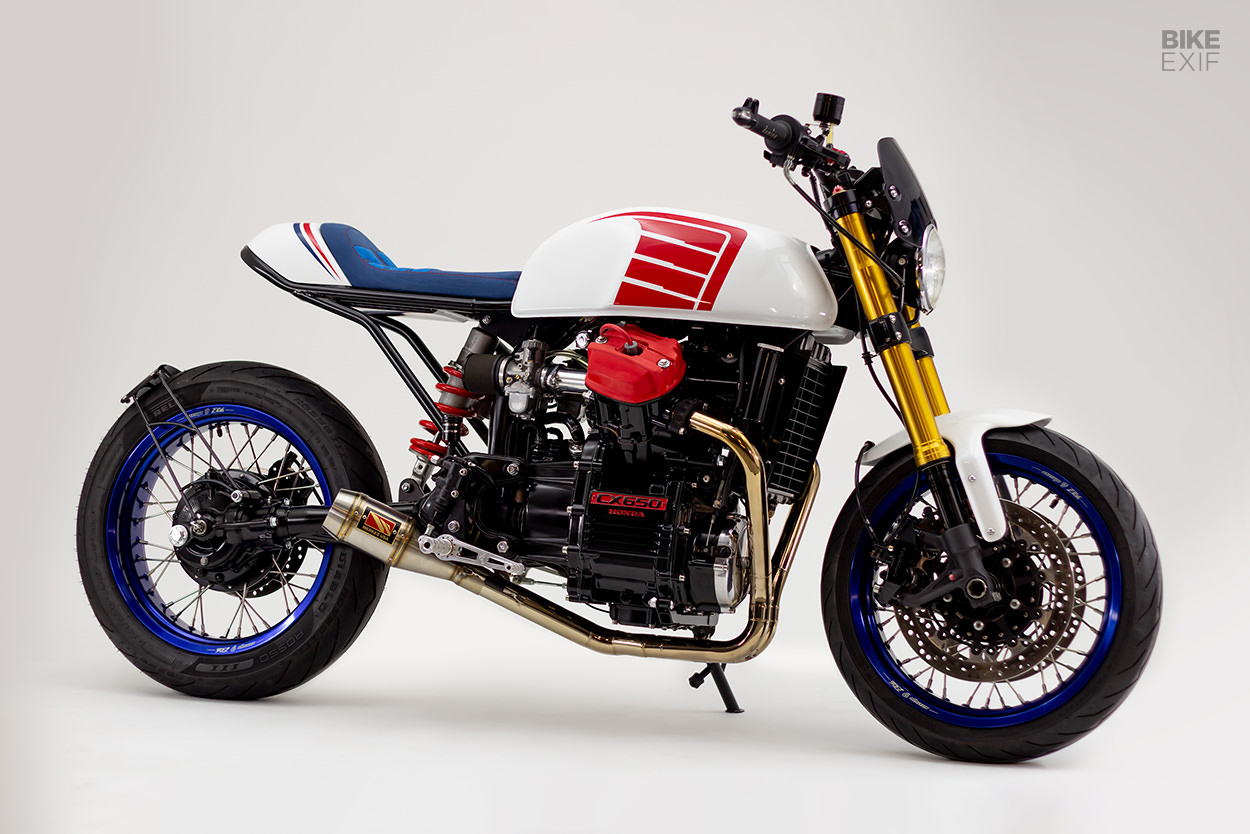
Rags to Riches: A custom Honda CX500 street tracker

Custom Honda CX500 street tracker by Brick House Builds
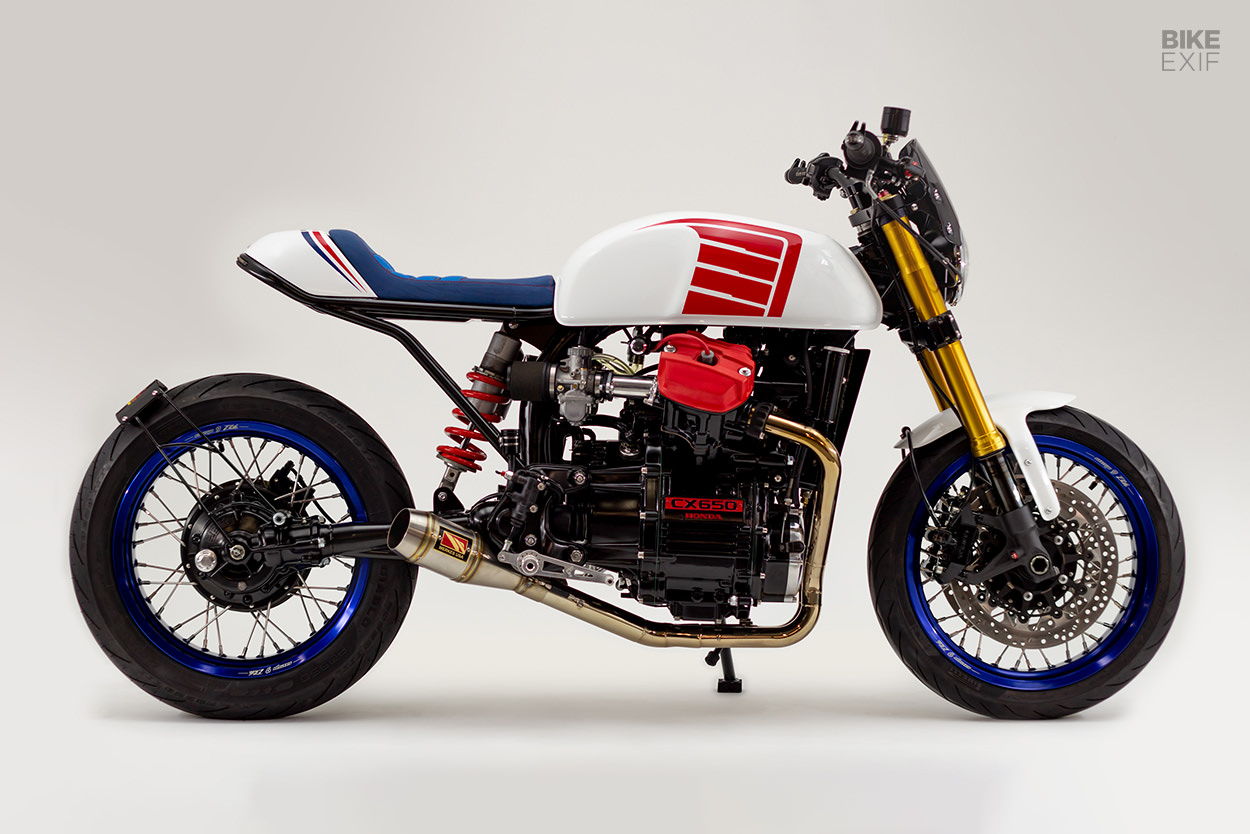
There’s nothing pretty about the Honda CX500, but it does have its charms. Case in point: the owner of this CX500 picked the bike for its engine’s industrial looks and rev-happy nature. For the rest, he turned to BJ English at Brick House Builds in Missouri.

BJ’s no stranger to the humble Honda V-twin, and has a few CX- and GL-based builds under his belt. “It’s a very versatile bike to build,” he says. “Think of them as Sportsters, in that they aren’t excellent at anything, but decent at everything!”

Custom Honda CX500 street tracker by Brick House Builds
His casual attitude belies just how much work went into turning the 1981-model CX500 into the spicy street tracker it is now. The project started with a less-than-ideal donor bike, and a brief loaded with expectations. “The customer wanted a very trick high-end custom that was also comfortable and fun to ride,” says BJ.

“When it arrived, the bike was in very sorry shape. It had already been modified but was incomplete, and unfortunately had very poor work done to it. As I went to push the bike into the shop the entire seat and tail literally broke off in my hand… it was that bad.”

Custom Honda CX500 street tracker by Brick House Builds
One of the biggest upgrades here is the motor, which BJ swapped out for a 1983-model Honda GL650 Silver Wing mill. Since the engine had been pulled from a wrecked bike found at a junkyard, he had no idea what condition it was really in—so it underwent a full rebuild.

The job included some light porting work, along with custom intake manifolds. Some of the internal parts were upgraded “for peace of mind,” and the clutch was rebuilt with new plates and stiffer springs. BJ kept the original CX500 radiator, but added a large Suzuki fan to it.

Custom Honda CX500 street tracker by Brick House Builds
The carbs are new, and inhale through a pair of pod filters. BJ fabricated the stainless steel two-into-one exhaust headers himself, adding a Competition Werks muffler on the end.

“Getting it dialed in on the dyno resulted in 61 hp at the tire,” he confirms, “which we were very happy with. Riding the bike you notice the torque the most, as it just feel grunty, even from low RPMs where you use the bike the most.”

Custom Honda CX500 street tracker by Brick House Builds
The CX500’s chassis has had a significant overhaul too. BJ upgraded the front end with the upside-down forks and twin Tokico disc brakes from a Suzuki GSX-R1000. The swap was made using a Cognito Moto kit, which included a new CNC-machined top yoke and wheel hubs.

Gone are the CX500’s unmistakable (read: ugly) Comstar hoops. The new wheels feature 17” Warp 9 rims, and road-focussed Pirelli Diablo Rosso tires.

Custom Honda CX500 street tracker by Brick House Builds
The CX500’s tail section isn’t falling apart any more either. BJ fabricated a new subframe with a tidy loop at the back, leveling out the stock bike’s wonky silhouette in the process. A subtle kink in the down tubes helps tighten the whole design up.

Lower down, BJ braced the swingarm and welded in reinforced shock mounts to convert the CX500 from a dual- to mono-shock setup. The shock itself is a Ducati 900SS unit.

Custom Honda CX500 street tracker by Brick House Builds
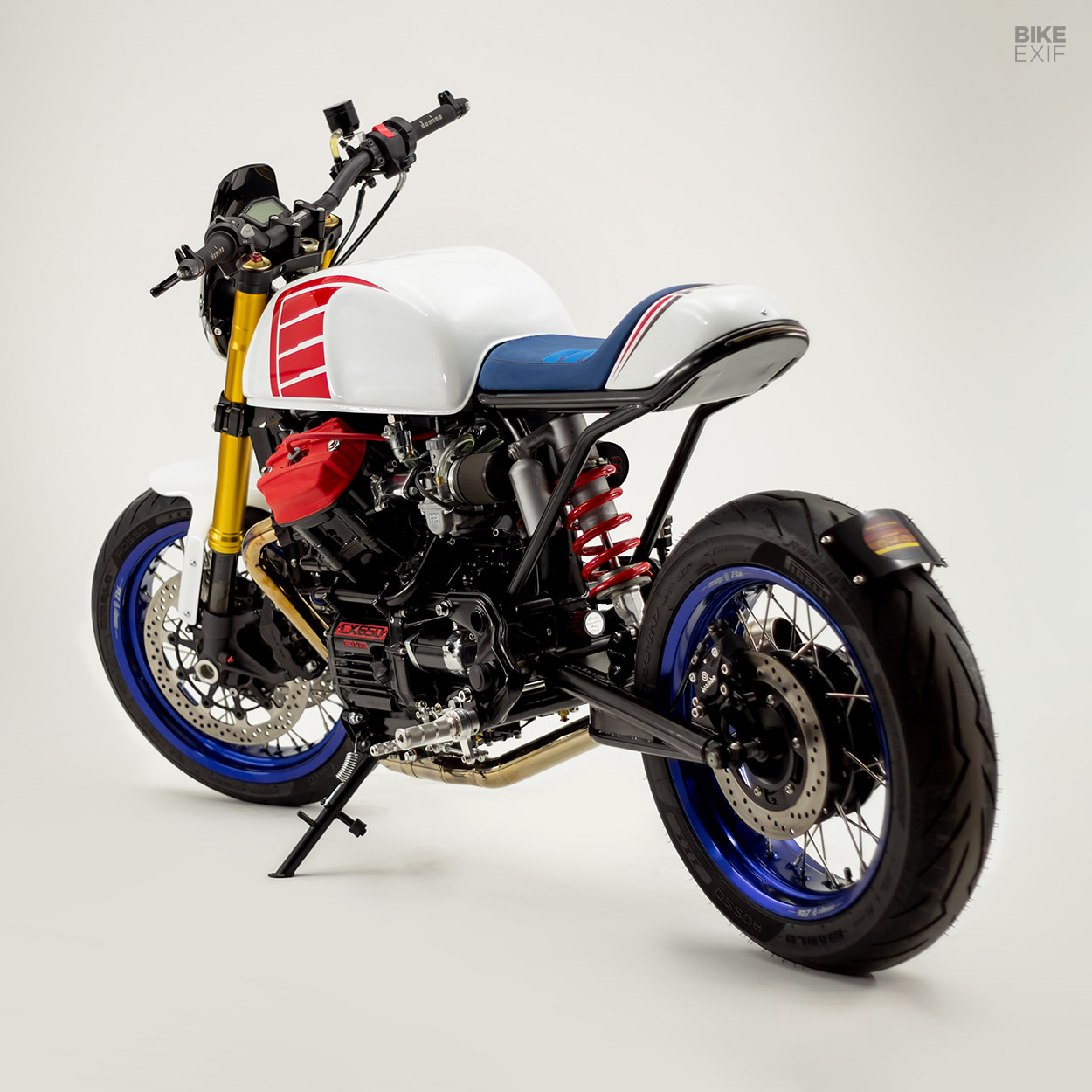
The bodywork on this street tracker is dead simple, but perfectly proportioned. Up front is the fuel tank from a ‘Deluxe’ model CX500, fitted with a flush-mounted filler cap. BJ tweaked its mounts to level it out too; it now harmonizes nicely with the new subframe, and the hand-made tail cowl.

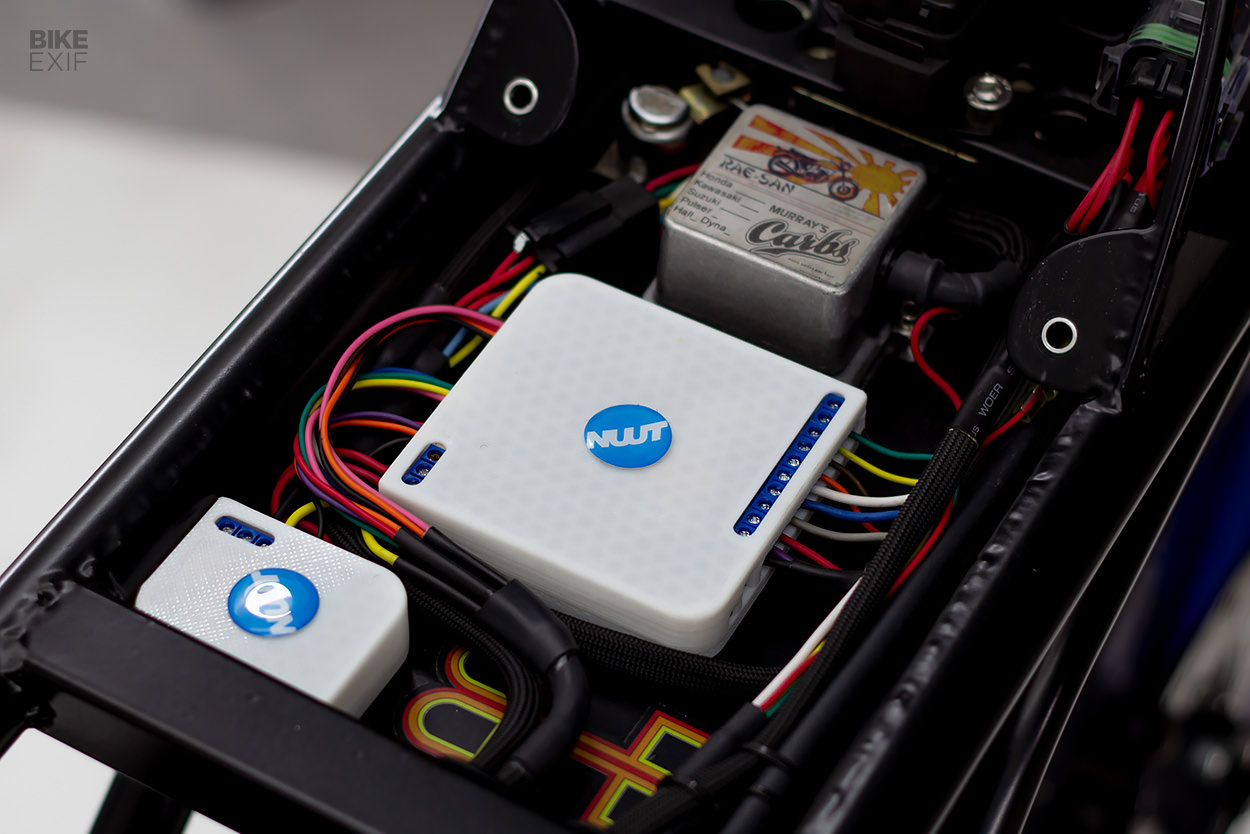
Lift the seat, and you’ll find a neatly arranged electronics tray, featuring a NWT Cycletronic ‘Morty’ system around which the bike was rewired.

Custom Honda CX500 street tracker by Brick House Builds
BJ’s client was set on an upright riding position, so this Honda is sporting Renthal 1 1/8” handlebars with a substantial amount of rise. They’re fitted with Domino controls, new levers and switches, and bar-end turn signals. (There’s a set of bar-end mirrors too, but they were removed for these photos.)

A digital dash from Koso sits behind a small cowl, with a vintage-style headlight mounted on hand-made brackets. The bike is littered with subtle one-off parts—including a hidden crankcase breather, an aluminum radiator overflow bottle and a custom shift linkage. Even the bike’s side stand is custom.

Custom Honda CX500 street tracker by Brick House Builds
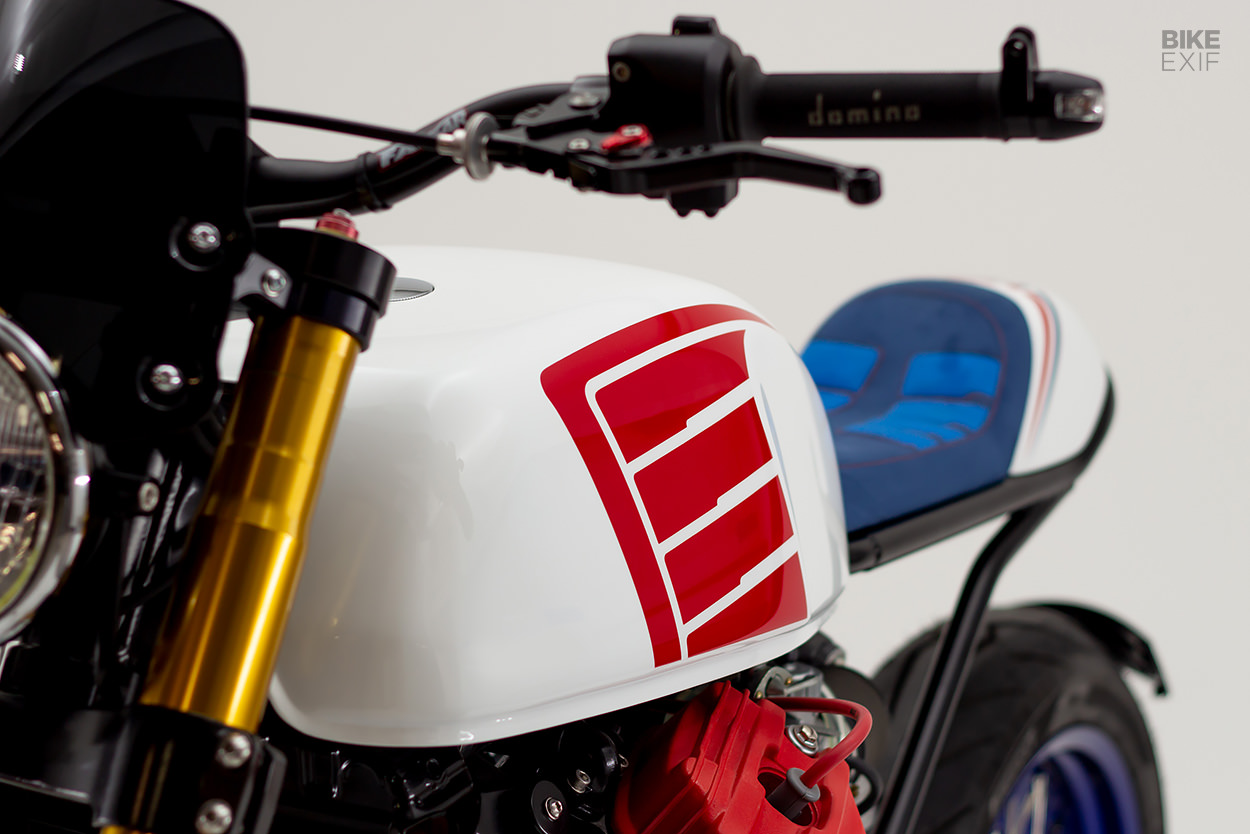
We have to award top marks to BJ for the incredibly well-judged livery too. “The customer and I collab very well on colors,” he says. “We knew we wanted a very timeless Honda scheme for this bike, but a bit more subtle in the way of logos and lettering.”

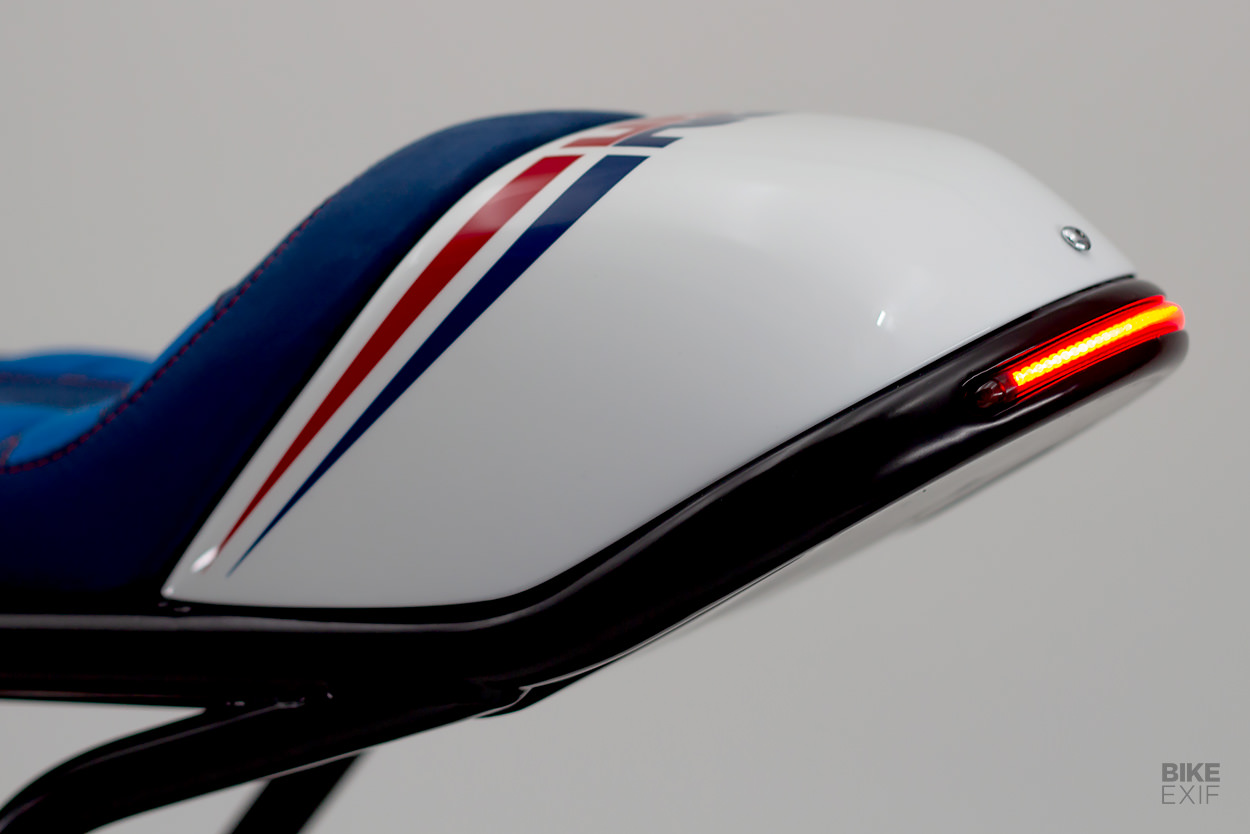
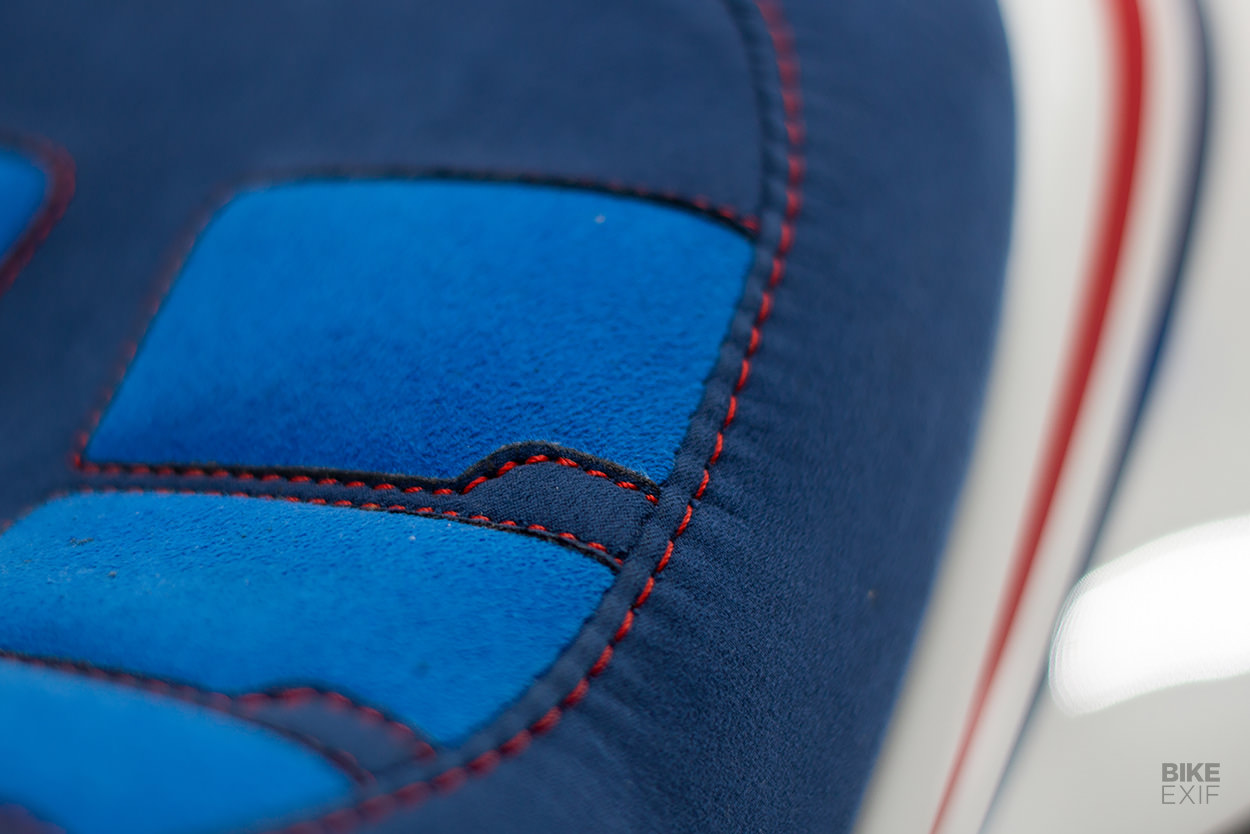
“I drew up a rendition of the Honda wing that ties in the angle of the valve covers, and helps them transition into the tank, both in shape and color. In the back, some simple HRC lettering helps fill the fiberglass cowl.” Slipstream Creations handled the paint work, while Rich Phillips Leather tackled the blue ultrasuede seat cover.

Custom Honda CX500 street tracker by Brick House Builds
It’s hard enough to make a bone stock Honda CX500 look good. But pulling that off with a bike that’s literally falling apart? That takes serious chops.

10/10.

Brick House Builds | Facebook | Instagram | Images by James Fawcett at Slipstream Creations

Custom Honda CX500 street tracker by Brick House Builds


from Bike EXIF https://ift.tt/DKpzPBL

Monday, 4 April 2022

Hit Machine: A Honda XR650R from Mule Motorcycles

Honda XR650R built for Matt Helder of the Arctic Monkeys
Repeat custom is the lifeblood of most businesses, including bike builders. Ten years ago, Matt Helders bought a very sharp Triumph T100 from Richard ‘Mule’ Pollock—and he’s just gone back for more.

This time, Matt has taken delivery of an absolute weapon: a crisp, vintage-style Honda with a most unusual exhaust system. And despite the knobby rubber (for road use and the photo shoot), it’s street legal.

Honda XR650R built for Matt Helder of the Arctic Monkeys
If you know the name Matt Helders, that’s because he’s the drummer of the hit British rock band Arctic Monkeys. The band has sold well over 20 million records worldwide, so Helders could probably have chosen any custom builder he wanted.

Mule, however, is a singular talent. And there’s nothing else on the road (or off) quite like this Honda.

Honda XR650R built for Matt Helder of the Arctic Monkeys
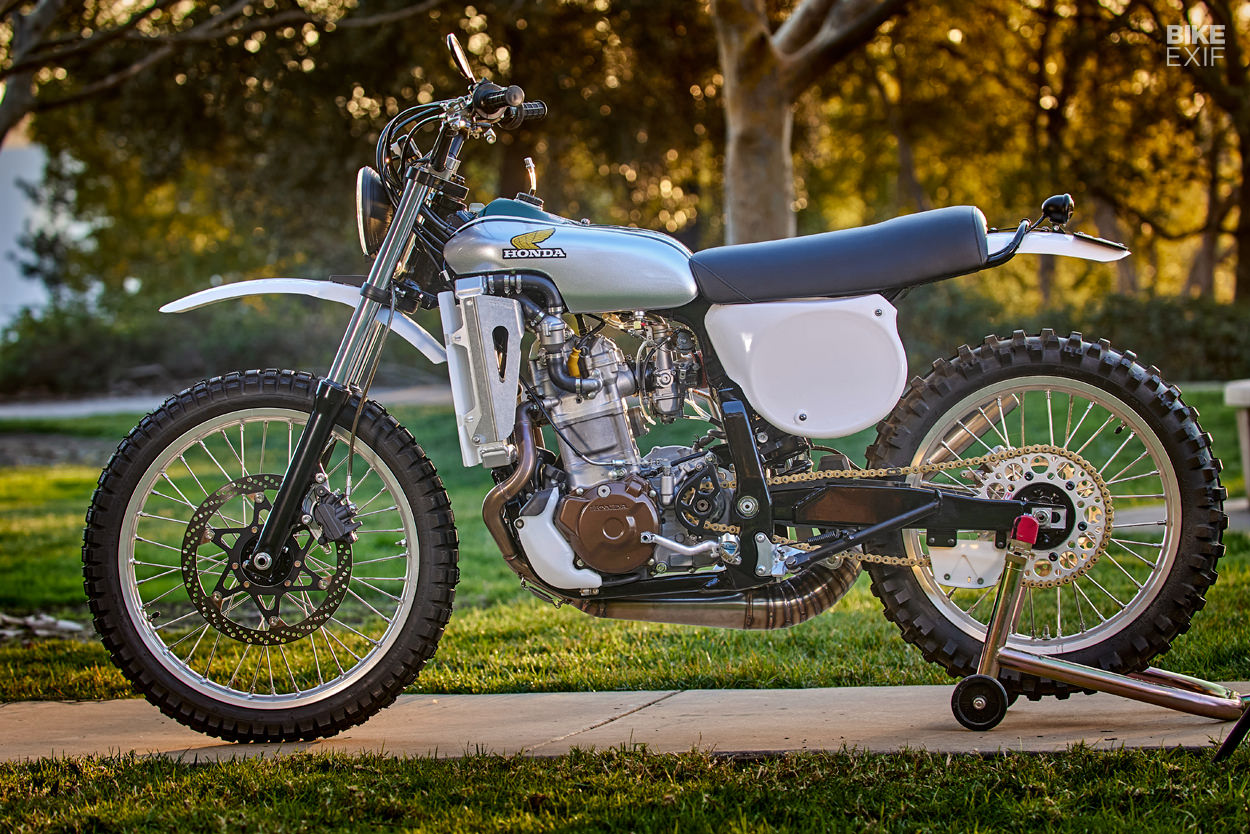
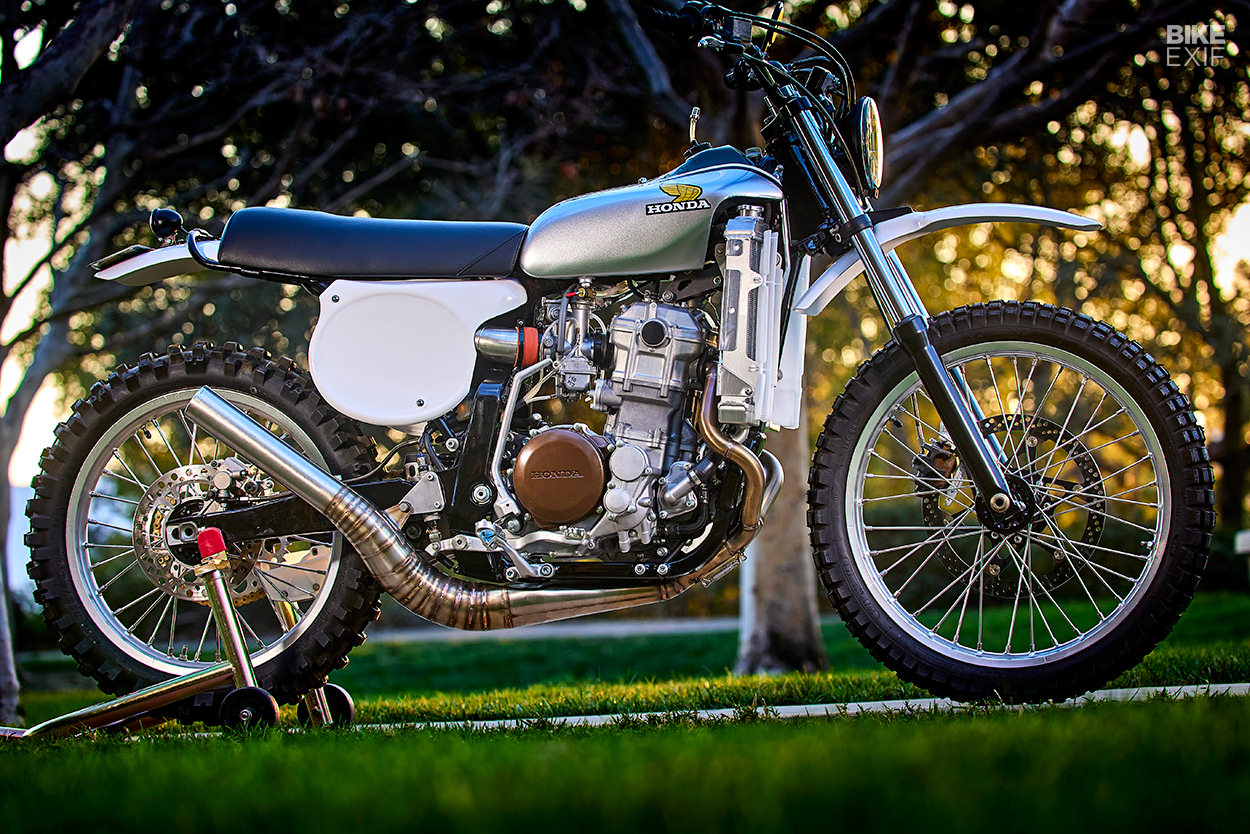
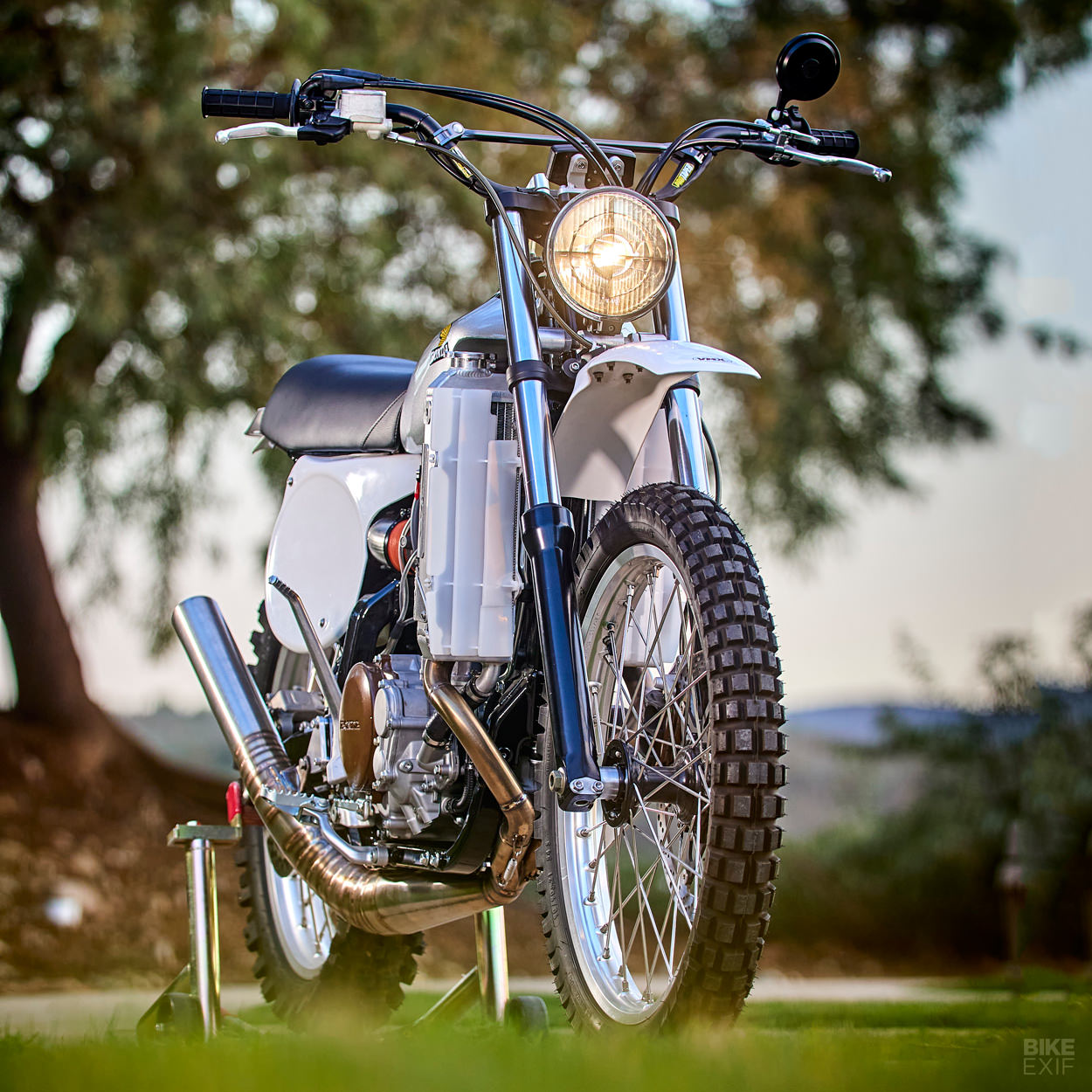
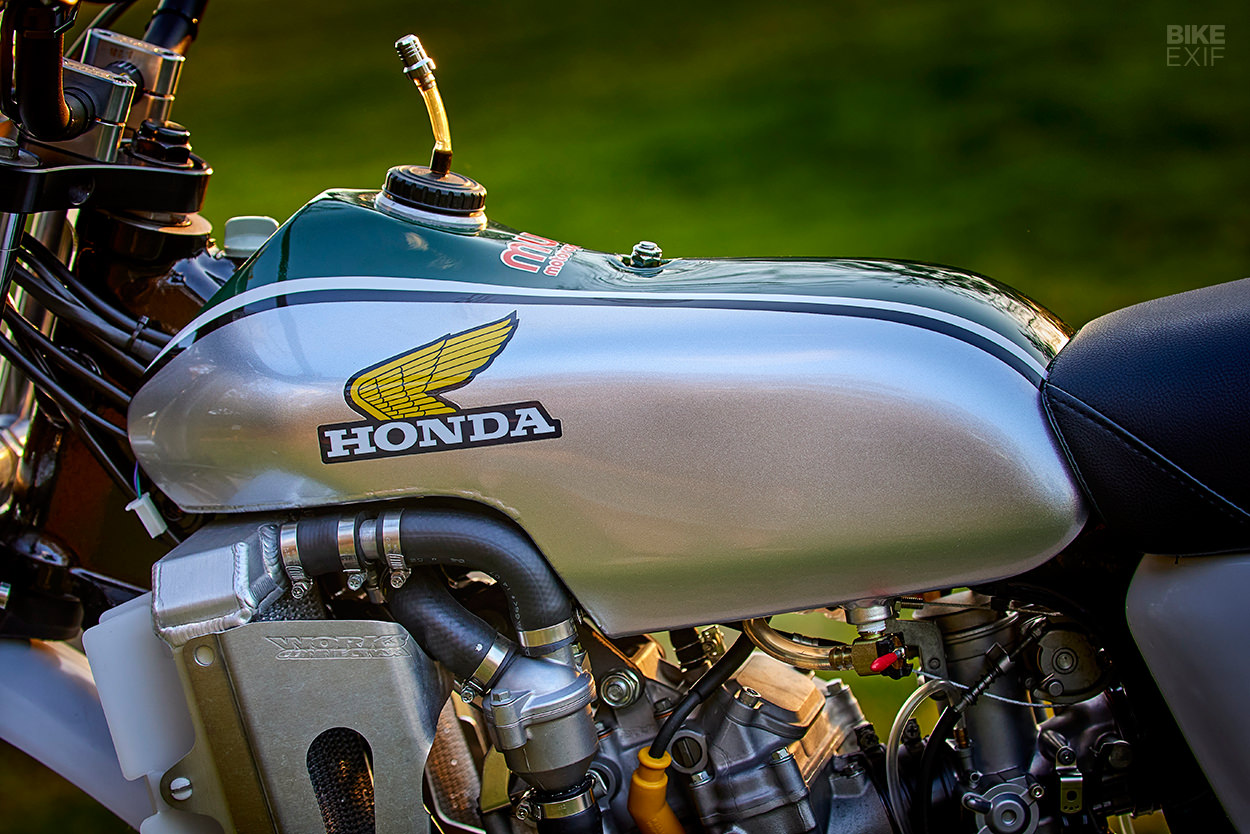
“This build started life as a 2000-spec XR650R,” Richard reports. “Matthew asked for a modern-ish dirtbike that looked like a 70s motocrosser. So I decided the look would resemble a 1973 CR250 Honda Elsinore—with the same paint scheme!”

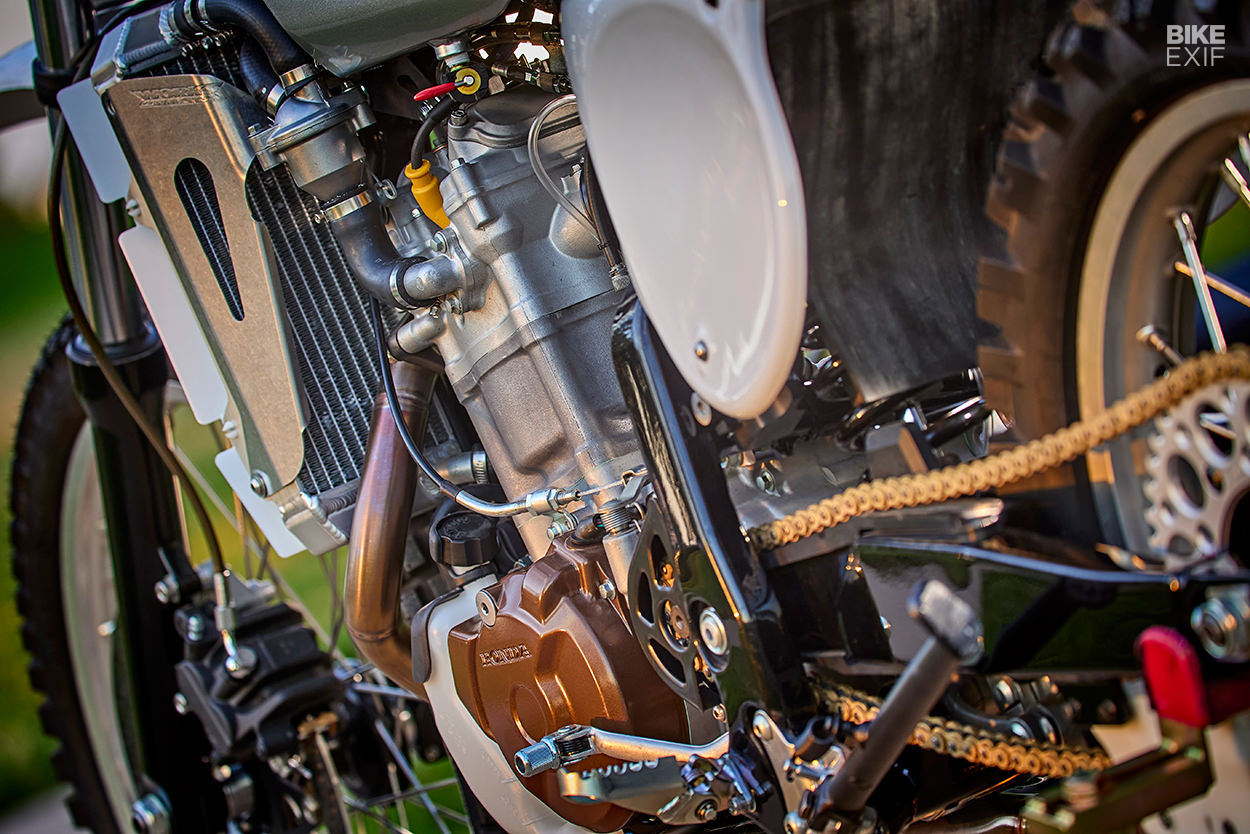
The XR650R is more of a desert racer than motocrosser, with a tough liquid-cooled single pumping out just over 60 hp. Dry weight is just under 300 pounds, helped by the aluminum frame and lightweight engine, so performance is spritely even by modern standards.

Honda XR650R built for Matt Helder of the Arctic Monkeys
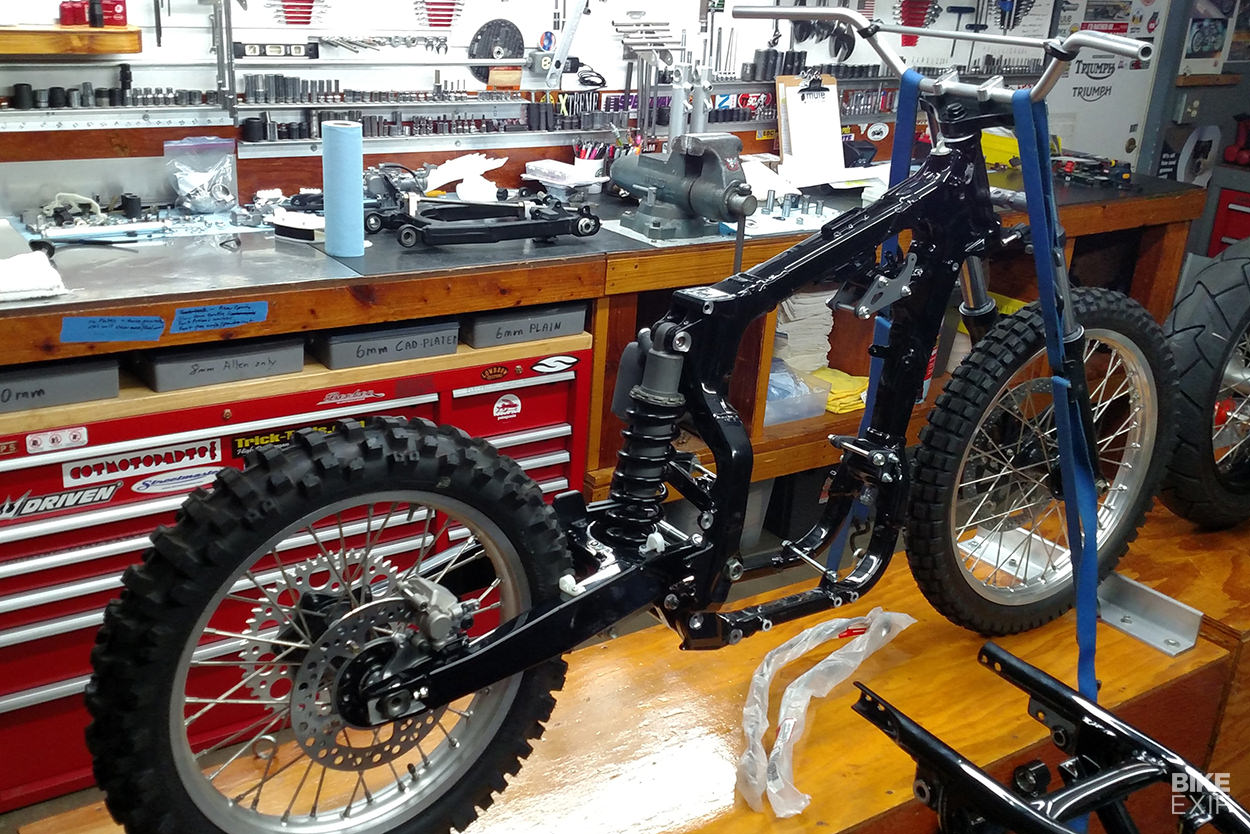
Mule started by stripping the XR650R down to the frame, and started optimizing the suspension setup.

“I shortened the shock to lower the stance slightly, and installed a Triumph Bonneville lower triple clamp,” he says. That had the most offset, for light-to-the touch steering.

Honda XR650R built for Matt Helder of the Arctic Monkeys
The original Honda fork stem is now matched to a billet top triple clamp, from Cognito Moto. And the forks, although older than the rest of the bike, are an upgrade for road use.

Mule liberated them from a 1993 Honda Hawk 650GT: “They’re 41mm longer than most conventional forks, and super light.” The wheels are light too, for spoked rims, and taken from a CRF450R.

Honda XR650R built for Matt Helder of the Arctic Monkeys
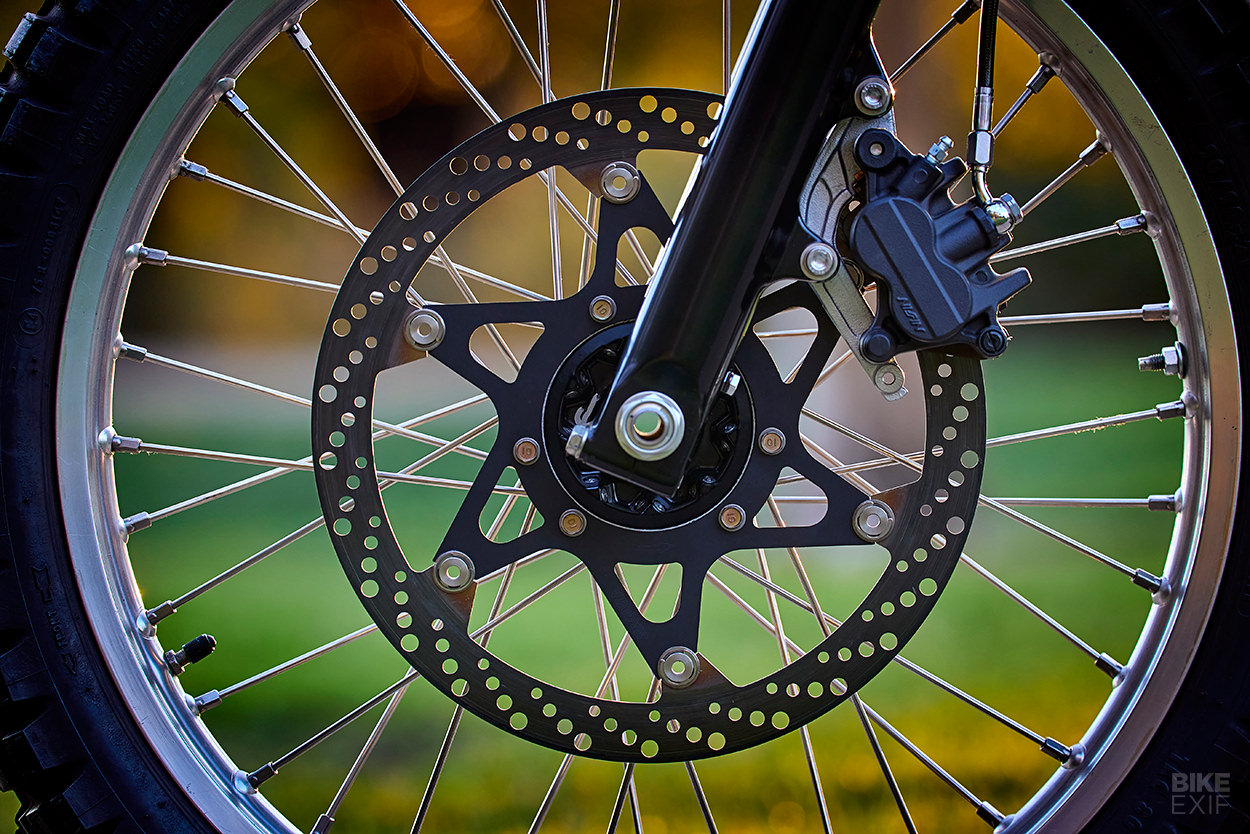
The front brake rotor is a Magura Supermoto unit, but the caliper is from a Triumph Bonneville. “As this will see occasional road use, I went with the bigger brake,” Mule reveals. “The tires are for the dirt and the pictures!”

If you’ve successfully identified the tank, give yourself a pat on the back. It’s from a mid 70s Yamaha MX400, highly modified and trimmed to fit. It’s as far from a bright red plastic cover as you can get, thanks to aluminum construction and a lovely, low-key paintjob inspired by the CR250 Elsinore.

Honda XR650R built for Matt Helder of the Arctic Monkeys
The cutaways in the tank—for the radiator and plumbing—must have been difficult to get right, but Mule singles out the elegant, vestigal subframe as the ‘major task.’

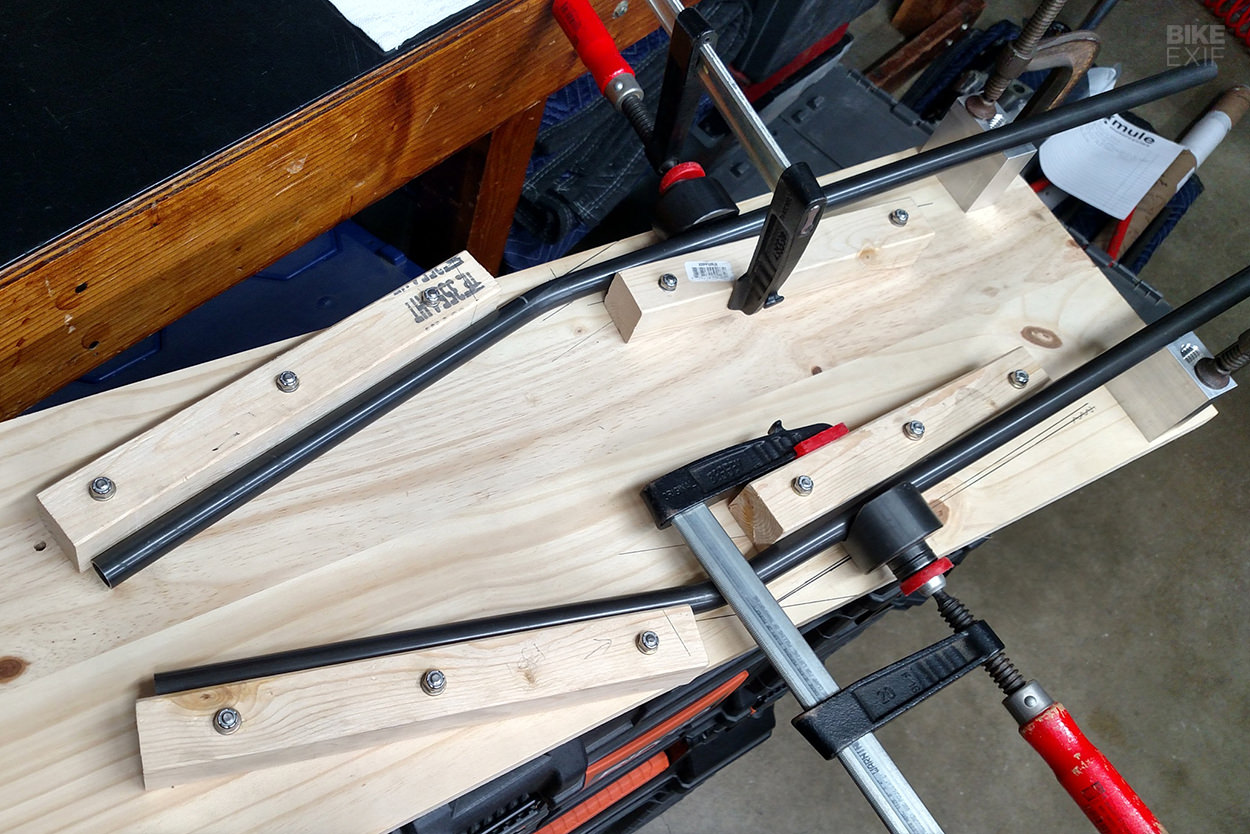
“I got a junk CR250 and cut the subframe off,” he says. “Then made a wooden ‘fixture’ and bent new cro-moly tubes. It uses the original rear fender mount section, and a side-to-side support for the seat.”

Honda XR650R built for Matt Helder of the Arctic Monkeys
“That was all done so that a stock CR250 seat could be fitted. Which it didn’t. I ended up getting a one-off seat made by Saddlemen!” The rest of the bodywork was a simpler operation: the side number panels and fenders are CR250 Elsinore reproductions from VMX Racing.

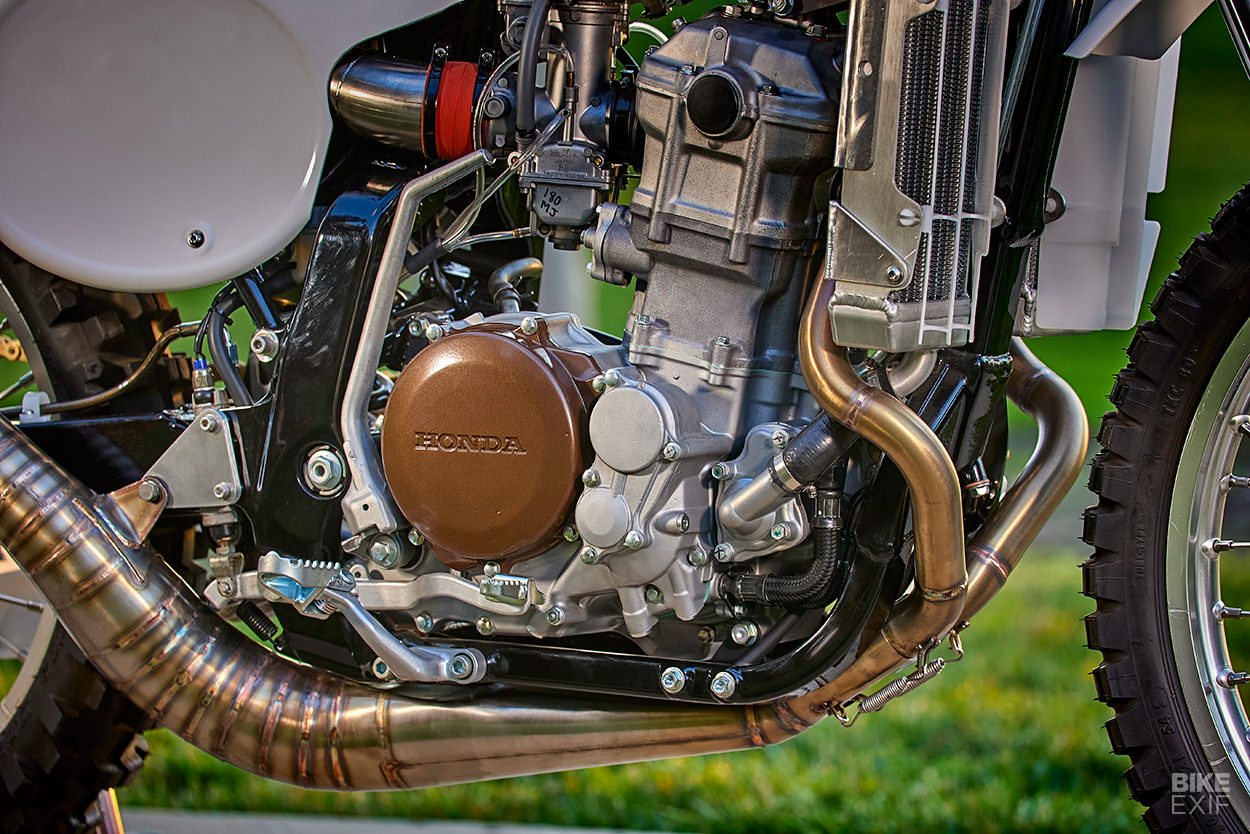
On the mechanical front, Mule went through the four-valve SOHC 649cc motor from top to bottom, replacing multiple parts to get it back to as-new spec. “Radiators, hoses, cables, chain and sprockets and every single nut and bolt are new,” he reports.

Honda XR650R built for Matt Helder of the Arctic Monkeys
But what about that exhaust? “The exhaust was made to look like a two-stroke chamber,” Mule says, “but it’s a four-stroke pipe internally.” The expert craftsmanship is by regular collaborator Randy Blevins, and will no doubt create lots of confused looks from bystanders.

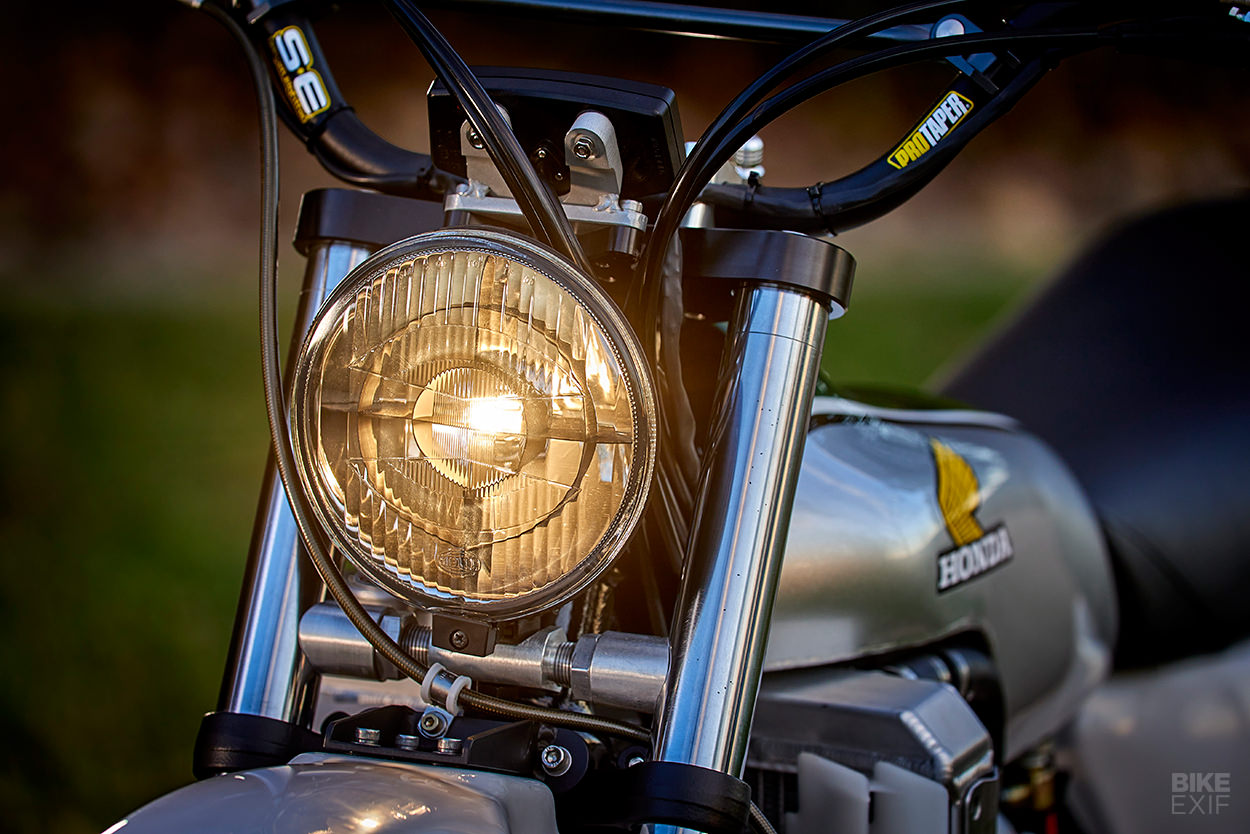
The legalities are covered off with a simple taillight, a classic Piaa headlight, a mirror clamped to the ProTaper bars—and a small Acewell gauge.

Honda XR650R built for Matt Helder of the Arctic Monkeys
Knowing Mule’s technical prowess, this machine will be a blast to ride.

Let’s hope Matt Helders gets enough free time to put his sticks down, and get some solid miles onto the XR.

Mule Motorcycles | Instagram | Outdoor images by Olivier de Vaulx

Honda XR650R built for Matt Helder of the Arctic Monkeys


from Bike EXIF https://ift.tt/WDK2AyY