In stock form, the Honda CL350 is a mild-mannered street scrambler with 33 horsepower and oodles of vintage charm. The kind of bike you meet the nicest people on.
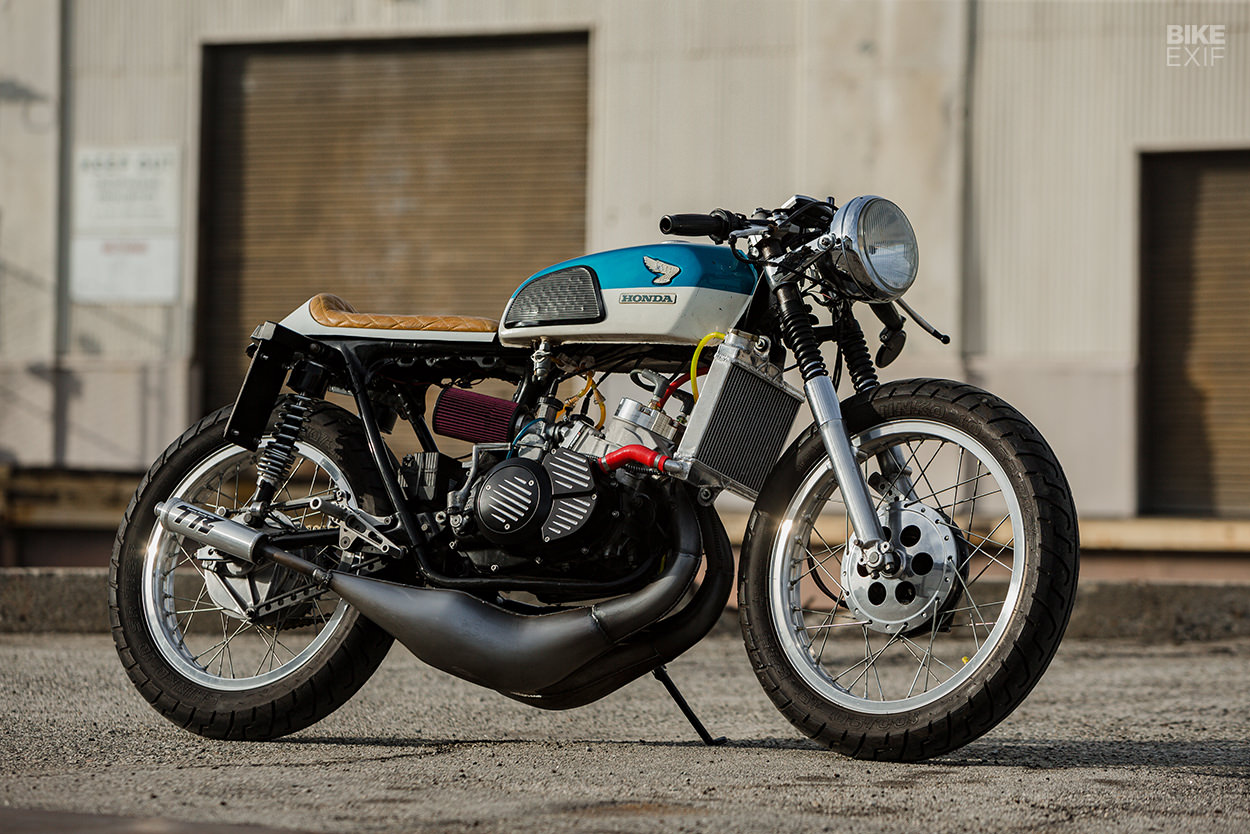
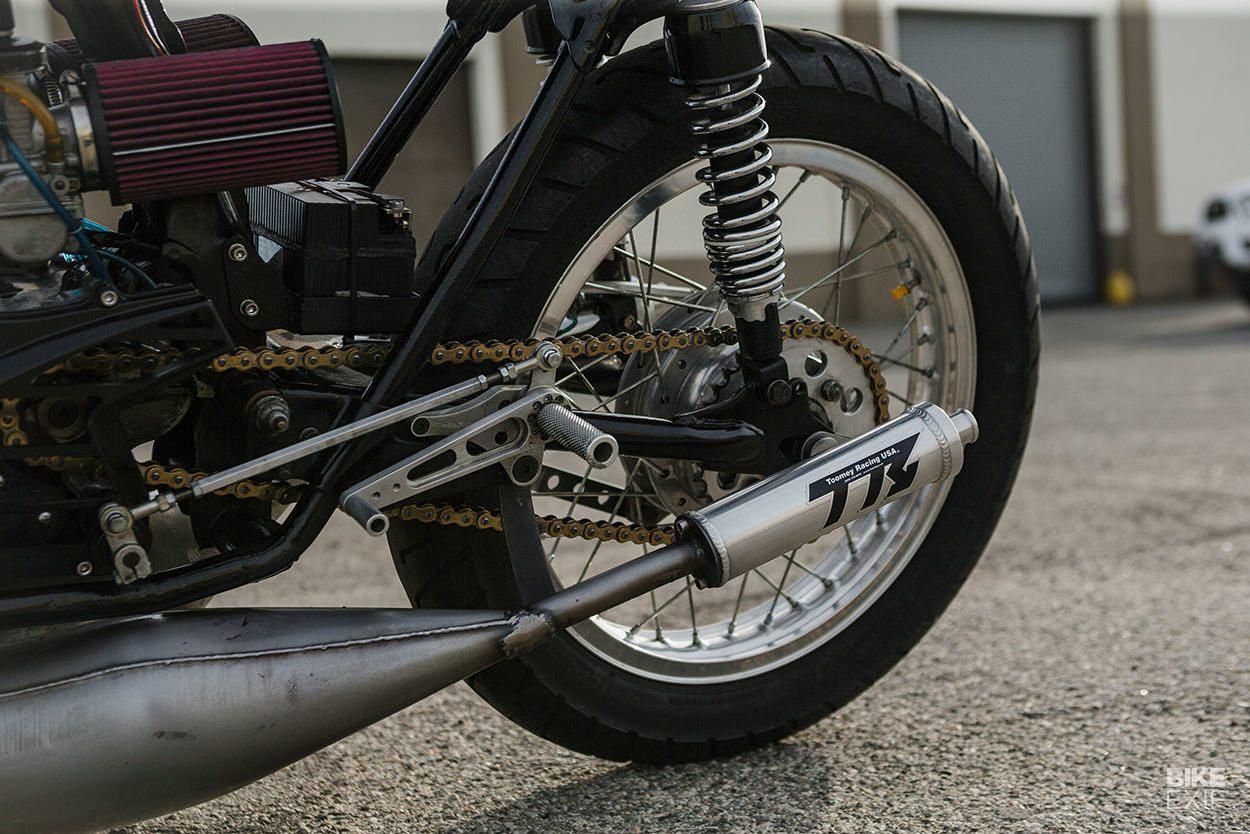
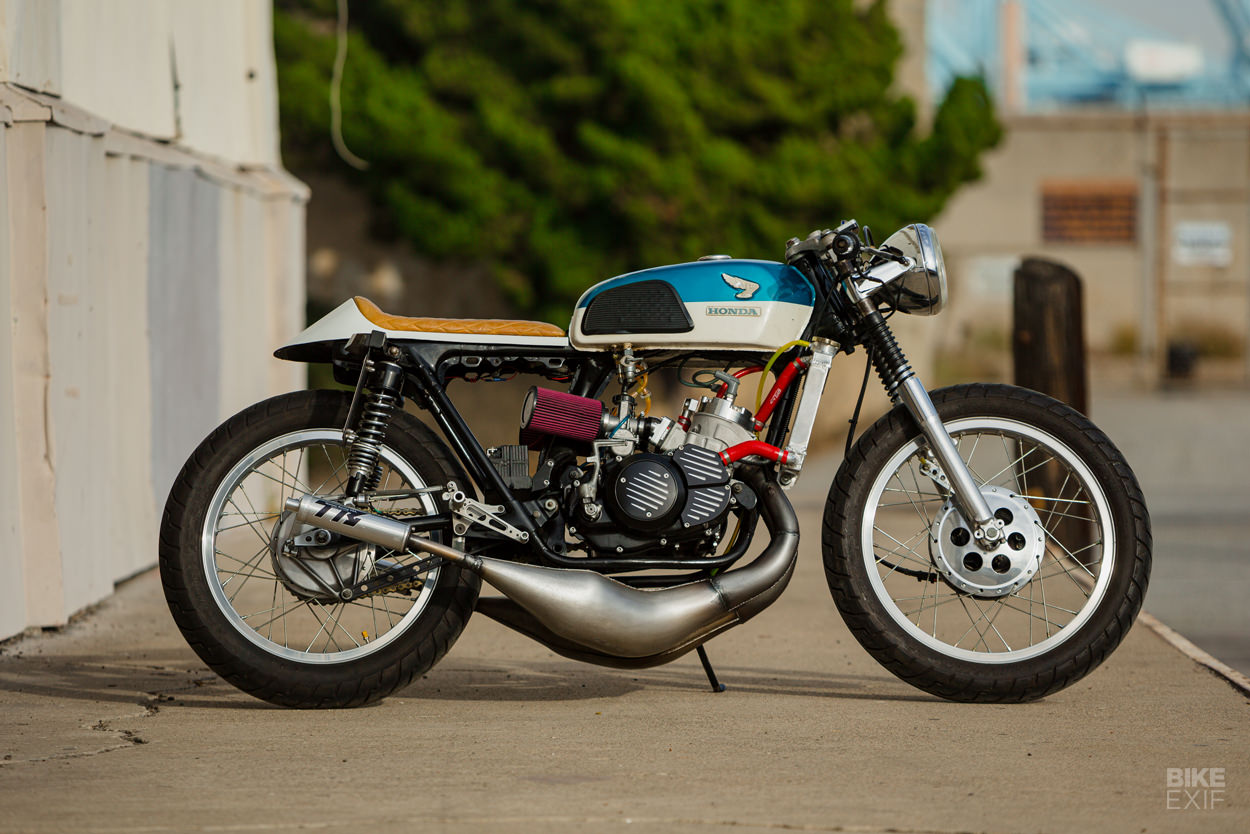
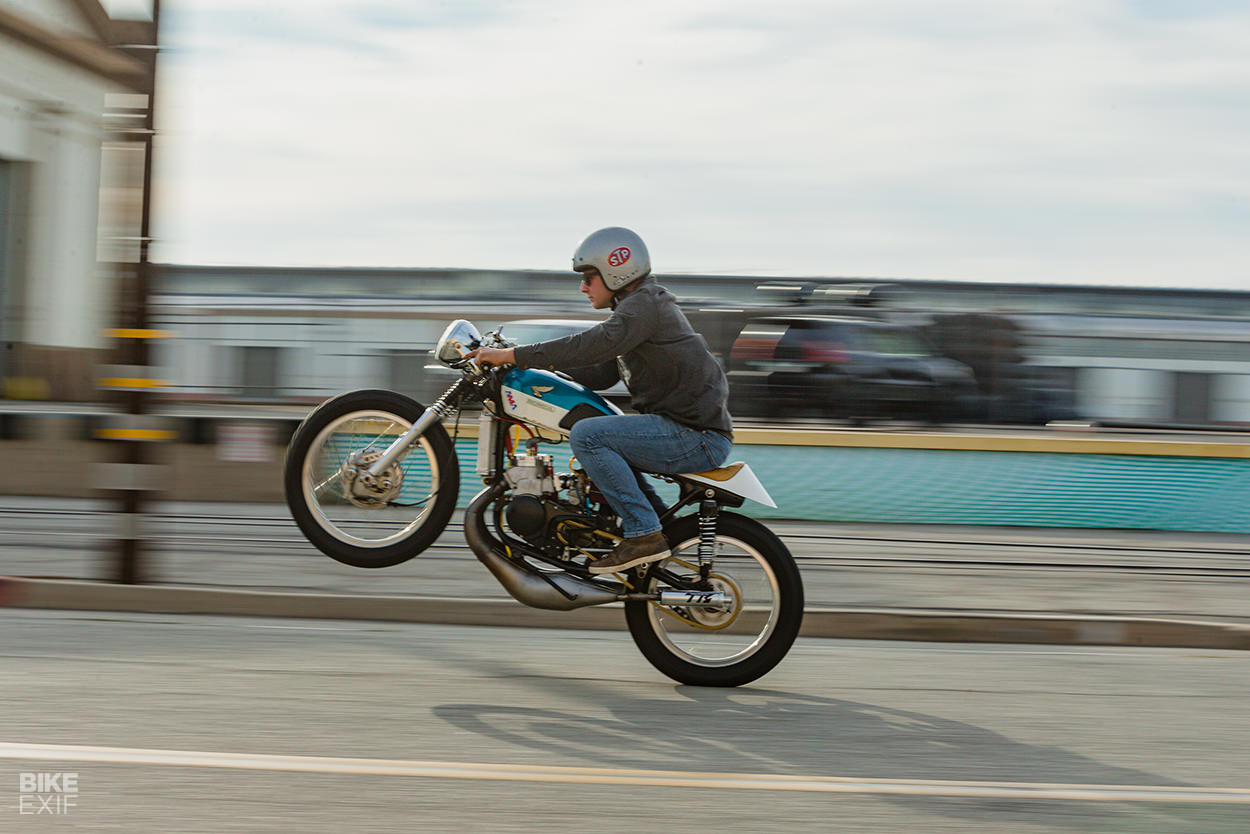
This CL350, however, is a very different beast. The clue is in the name—HonDeath—and the only figure you’re likely to meet while riding it is your maker. Because a two-stroke Yamaha Banshee ATV motor powers it, bumped up to 472cc and pumping out roughly a hundred horsepower.
This truly unhinged Honda cafe racer comes from Andrew Cecere, a Jaguar Land Rover technician based in Del Aire, California. He’s a multi-talented chap: “I build jet skis, dirt bikes, street bikes, shifter karts, and anything with an engine,” he tells us.
As the enormous expansion chambers suggest, Andrew is a dab hand at fabrication as well as engine building. Probably because he was an aircraft mechanic in his previous life: “I got burned out on night shifts and went to work for Land Rover, but I’m always busy in my free time.”
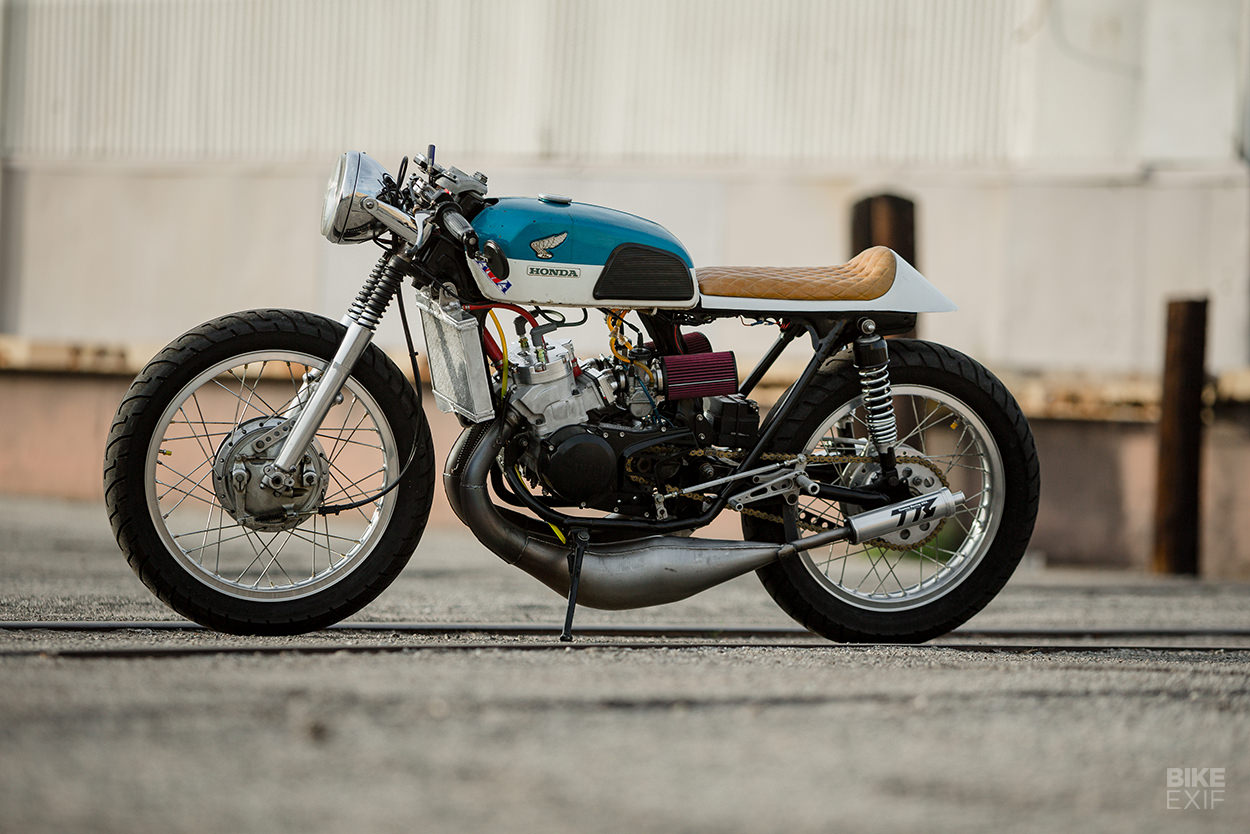
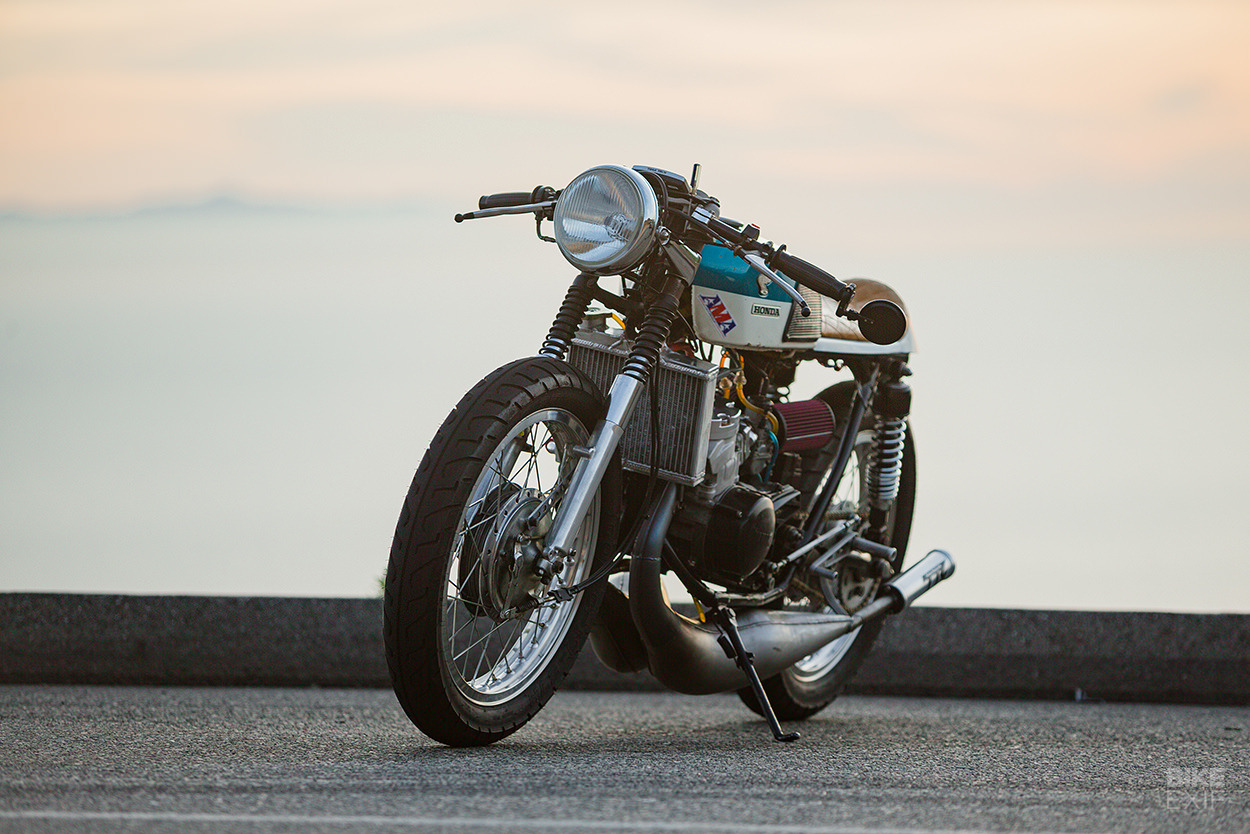
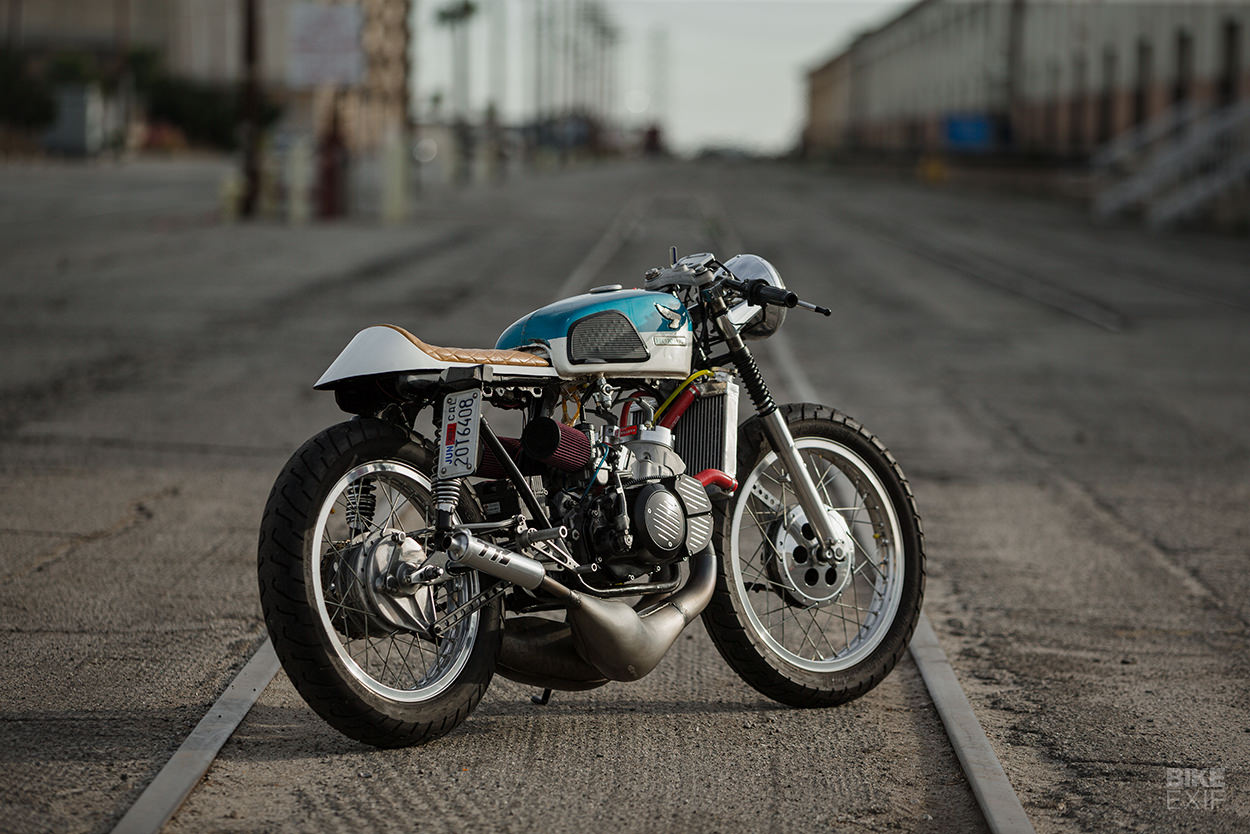
So what exactly is this mongrel of a motorcycle? It’s a 1971 CL350, although your bearings might be thrown off by the tank, which is from a 1968 CB350 Super Sport. Andrew has grafted on the front end from the same CB350 too, to give the bike more of a vintage look, and laced up matching Akront rims.
But let’s talk about that engine, since this machine has got to have the highest power-to-weight of any CL350 on the planet.
Andrew originally built the bike for a friend, keeping the 350 engine. “Then we started racing stand-up jet skis. Five years later my buddy wanted me to build him a jet ski, so he gave me the bike back in return.”
Honda’s 325cc 4-stroke motor had its charms, despite being crippled by a heavy, inefficient exhaust system that gained good looks at the expense of weight—and a three horsepower deficit over its CB350 sibling.
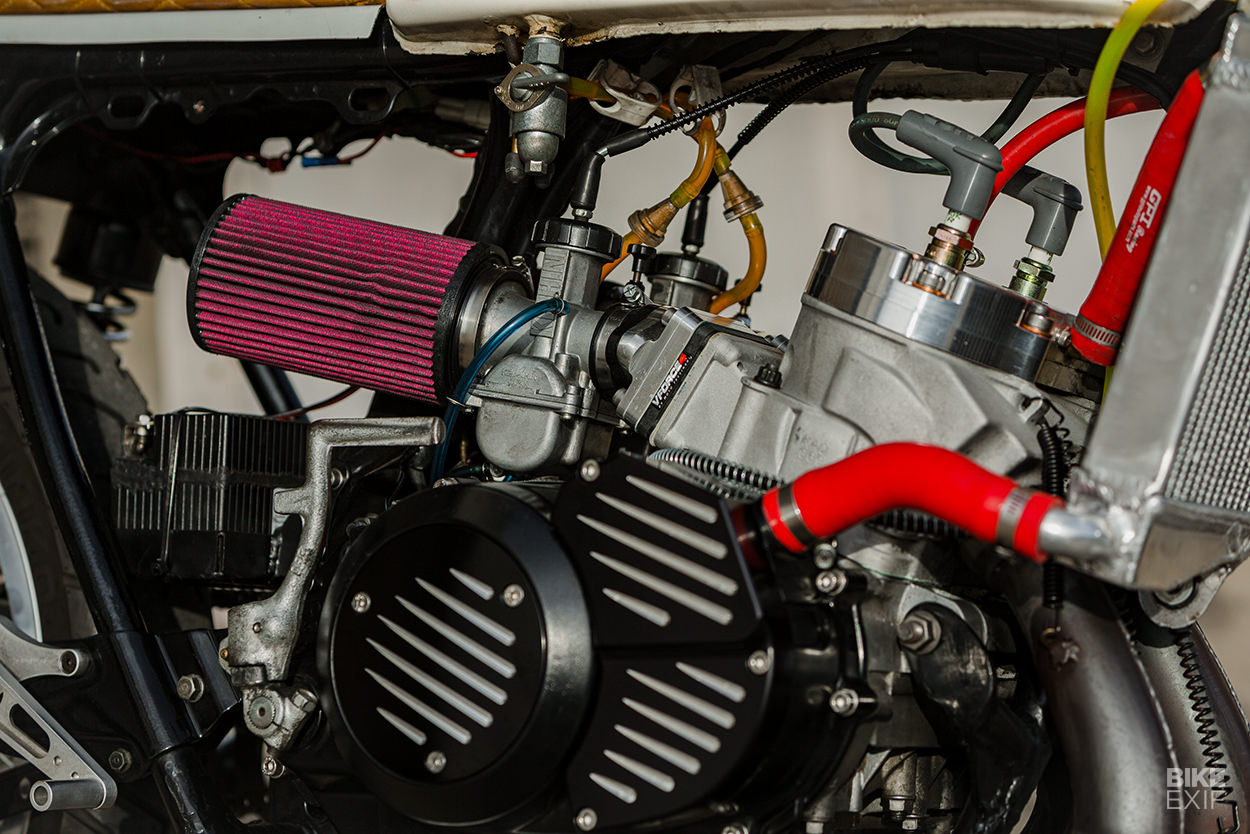
That didn’t wash with a power junkie like Andrew. “I decided to just replace it with something cool: a 472cc Super Cub engine.” This modified two-stroke mill is well-known in the Yamaha Banshee world: the stock engine was an evolution of the unit used in the RD350 motorcycle, and lends itself to massive power gains.
“I went to work on Craigslist and eBay and found miscellaneous Banshee parts, including a nice set of crank cases with a transmission,” says Andrew. “I ended up buying a new 4mm stroker crank and a 472 Super Cub cylinder, and then found some CPI Racing drag pipes.”
To get everything to fit, Andrew had to cut into the frame and modify the rails to contour around the engine. He also had to cut into the pipes to allow them to sweep under the frame, but given the size of them, that’s understandable.
Andrew has also installed a race-style MSD total loss ignition system (liberated from a jet ski), and a VForce reed valve system, but the 35mm carbs are decidedly street friendly and fuel-efficient. “They carburate very cleanly,” he says. “I also have a set of 40mm carbs for big power, but they eat way too much fuel.” A radiator taken off an RD250 keeps temperatures down.
The drum brakes are original though. “Many people might say they’re not enough for a 100 hp Banshee engine,” Andrew admits. “But the bike is so light—and the brakes are tuned to work very well … for drum brakes.” We’ll have to take his word for it, since everything else is so well sorted.
It all looks absolutely ridiculous, but you just know it will be a hoot to ride. “I love the concept of function and performance,” says Andrew. “The looks are just a by-product!”
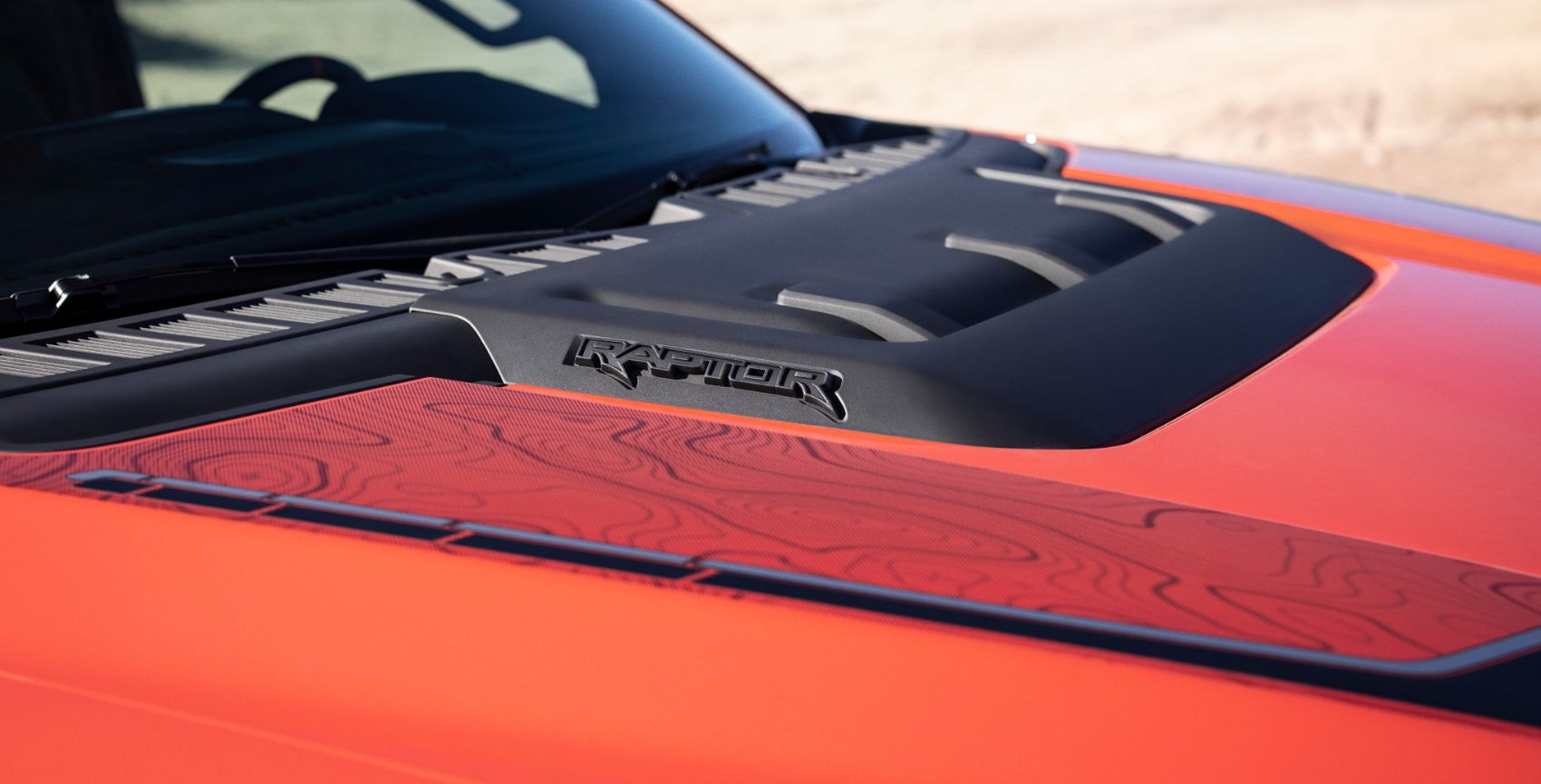
In the summer of 2010, Ford sent a factory rep to our dealership in Sioux Falls, South Dakota. At the time, I was a sales consultant for Sioux Falls Ford – and this particular sunny July afternoon was a training session for a wild new truck that would soon arrive on our showfloor: The 2010 Ford SVT Raptor. The demo Raptor the factory rep drove was a bright Molten Orange with the black “digital mud” graphics on the side. It was the coolest thing we had seen.
During the training session, the factory rep pointed to the fender flares and wide-open wheel wells of the SVT Raptor. “That’s to show the ‘candy’ that’s underneath,” he said. “We want everyone to admire and be impressed with those Fox Racing shocks.”
Impressed we were. And impressed we still are. Hence the 2021 Ford F-150 Raptor.
2021 Ford F-150 Raptor: On Another Level
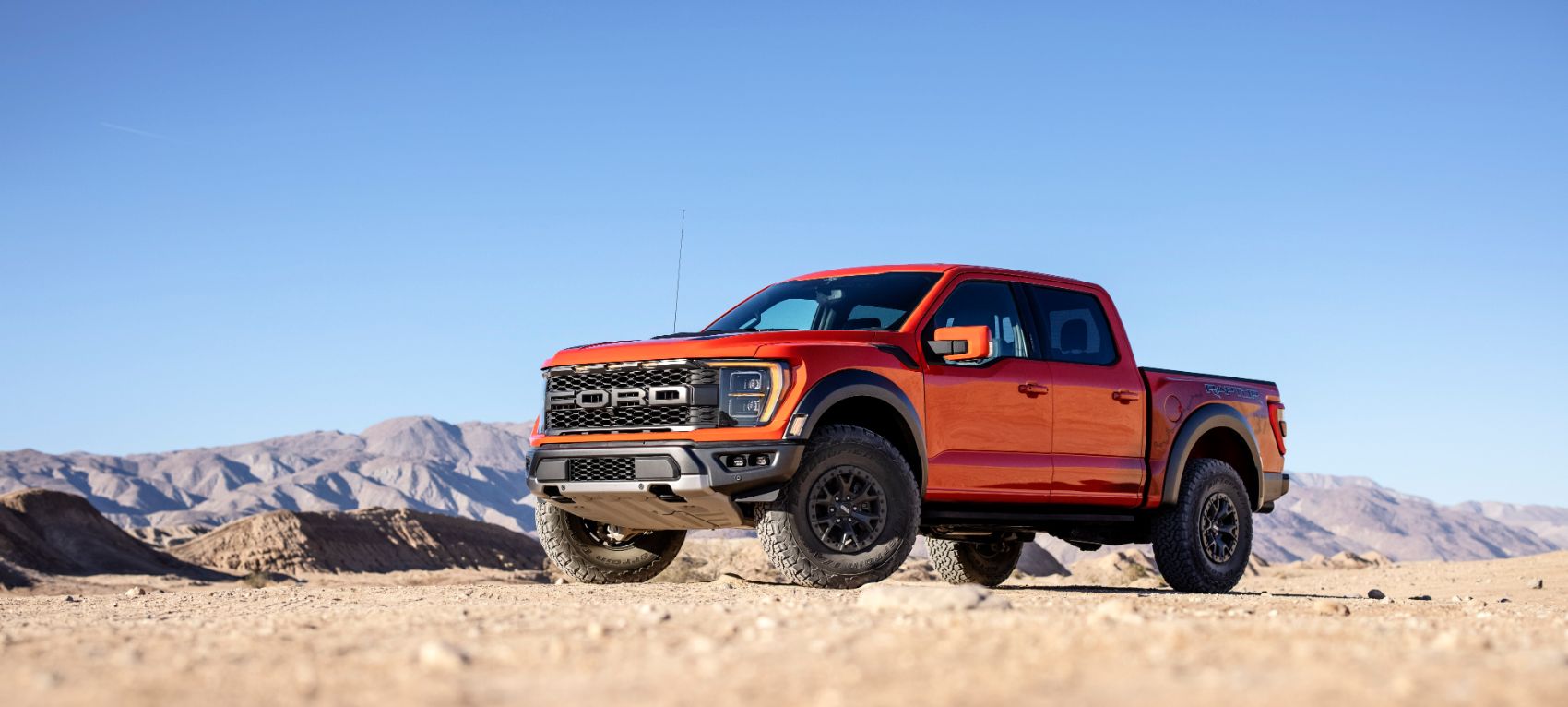
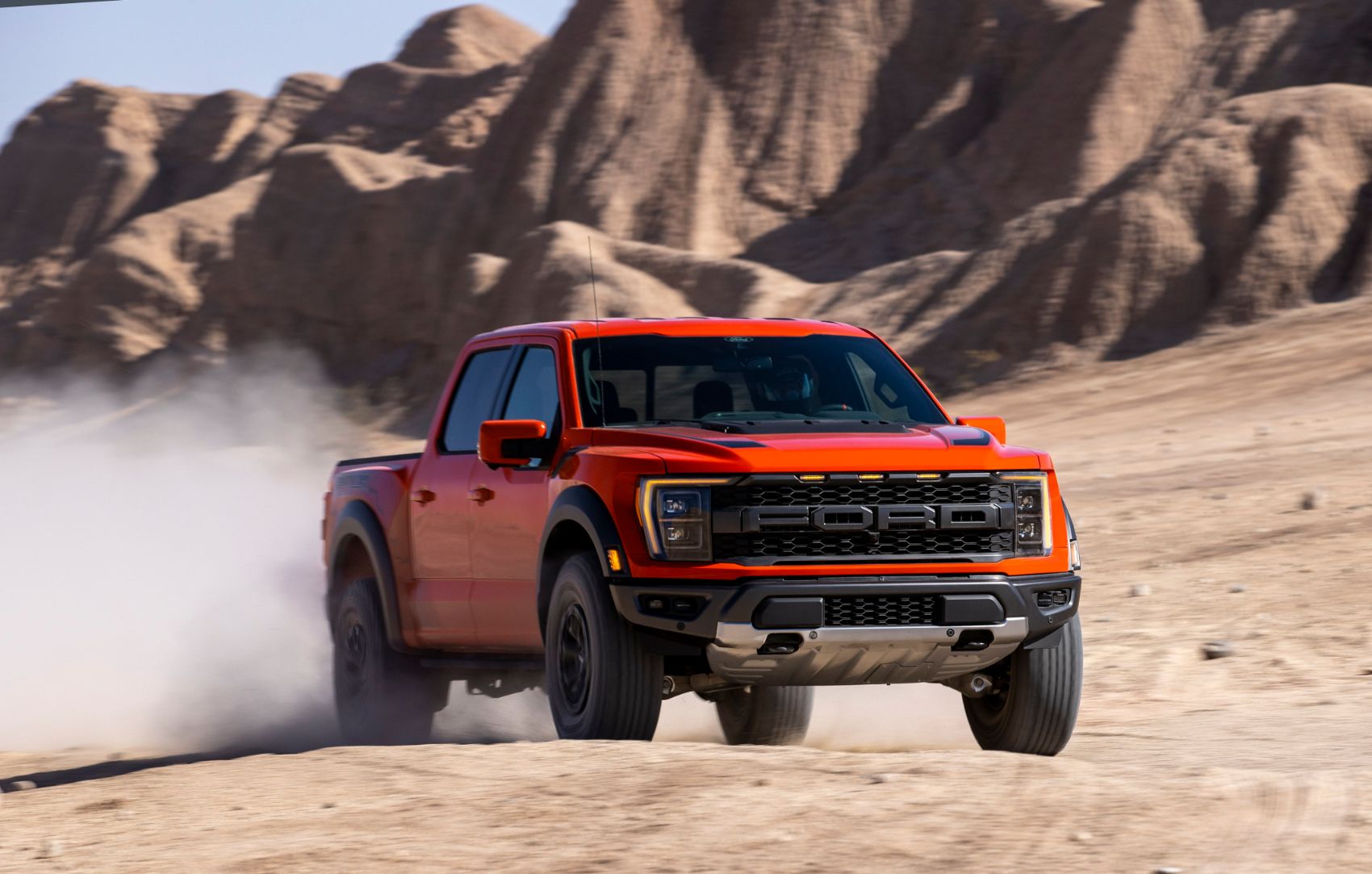
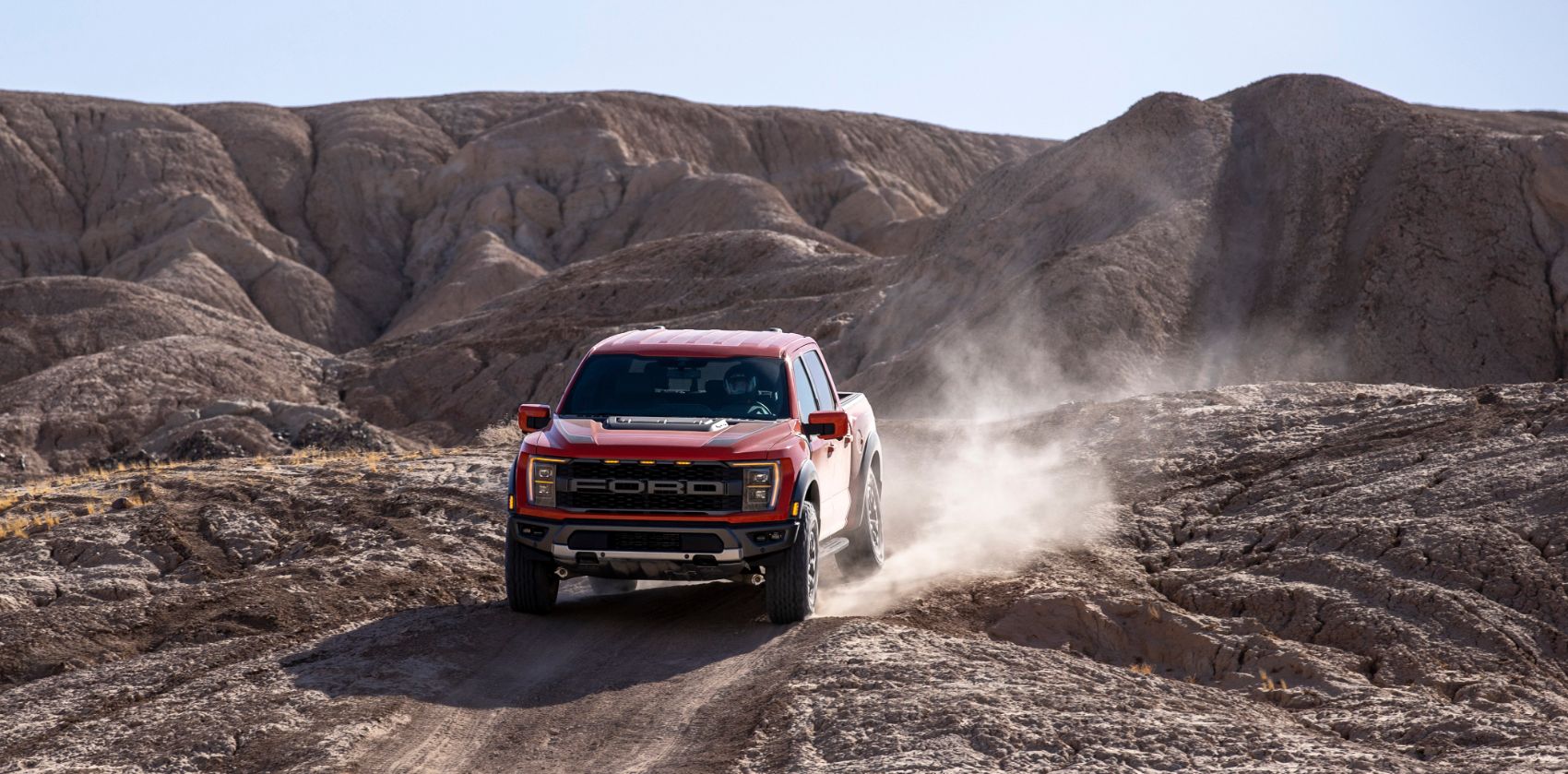
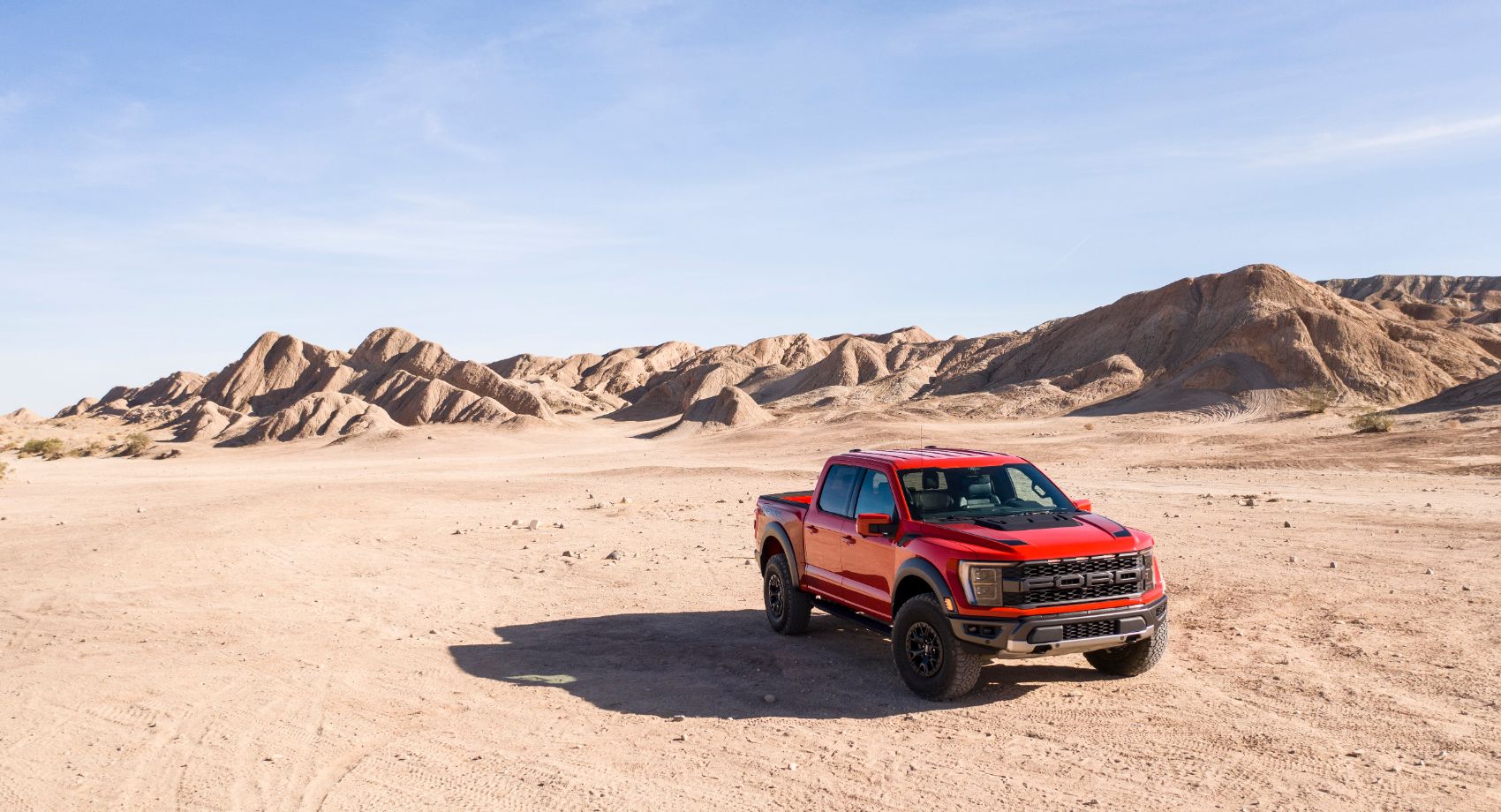
It’s hard to believe that’s been over a decade ago now, but here we are with a new Raptor. Perhaps not surprisingly, it’s the strongest, most powerful, and most connected Raptor to date, with a fully boxed high-strength steel frame, a twin-turbo powertrain, a ton of interior tech, and this super cool exhaust system. In a general sense, the Ford Raptor is the truck everybody dreams of driving, but this 2021 version even more so.
“Raptor is the original desert truck. We just took it to another level,” explained Ali Jammoul, Ford Performance vehicle program director. “The all-new Raptor splices high-speed off-road performance muscle with advanced technology and connectivity that comes together in a unique Built Ford Tough way.”
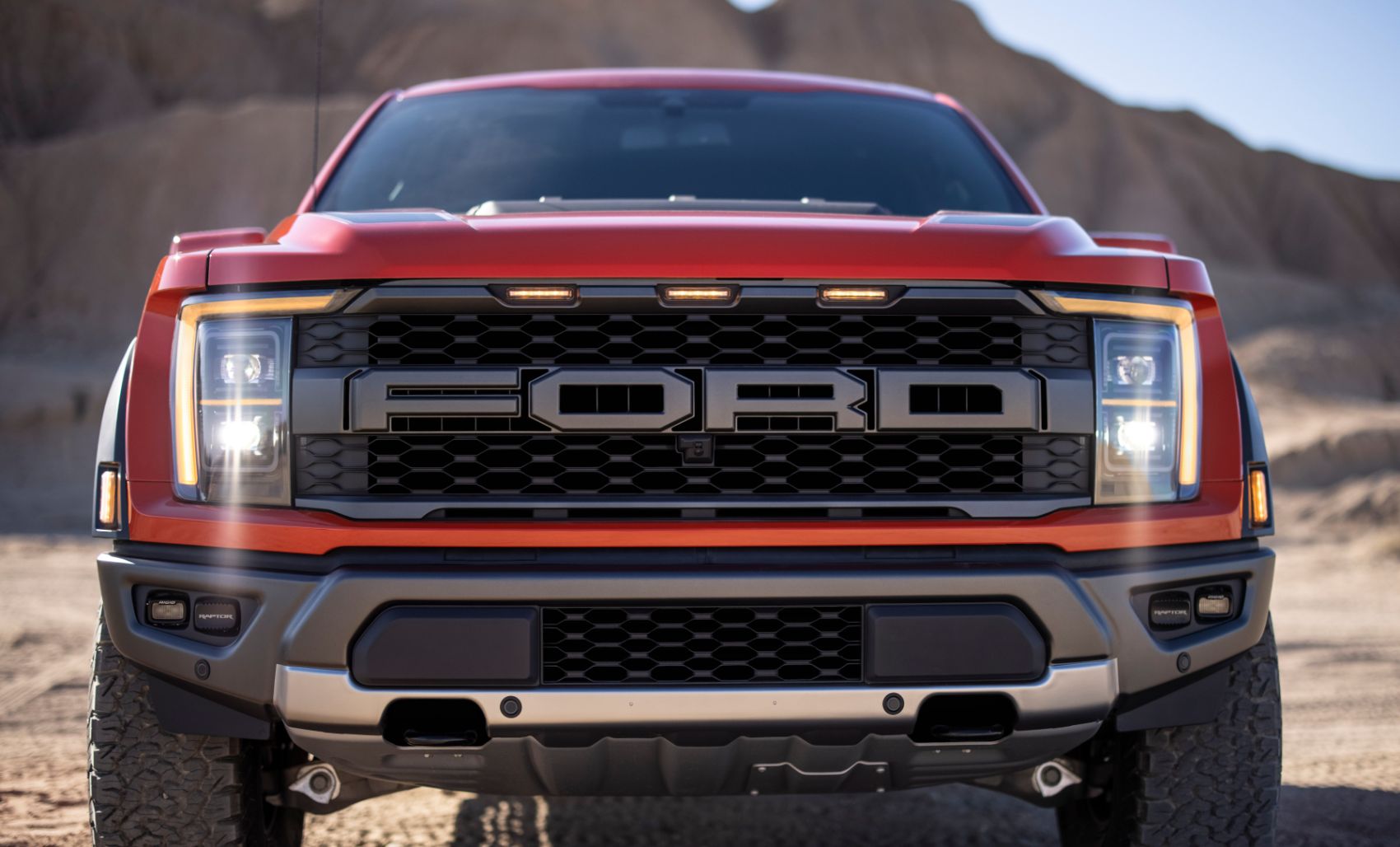
2021 Ford F-150 Raptor. Photo: Ford Motor Company.
Chassis & Suspension: The Trophy Truck
The foundation – that is to say, the architecture, chassis, and suspension – is what makes a truck, a truck. These are essential ingredients when you bake a truck in the automotive kitchen. And they are even more essential when your main entree is something like the 2021 Ford F-150 Raptor.
“Raptor is rooted in Baja 1000 racing, and its suspension advances our capability and performance – a five-link rear setup with more wheel travel than any Raptor before it,” said Carl Widmann, Ford Performance chief engineer. “And like a trophy truck, every aspect of Raptor has been engineered to deliver precision capability when your foot is flat on the floor, way out in the middle of nowhere roaring across the desert.”
The Raptor’s new five-link rear suspension consists of longer trailing arms, a Panhard rod, and 24-inch coil springs. Ford designed the suspension in tandem with the engine management software. On the one hand, this allows the new Raptor to maintain its footing on rough and demanding terrain. On the other hand, it also means the rear wheels will support more torque, which translates to quicker acceleration, better throttle response, and so on.
Photo: Ford Motor Company.
Electronic Controls & Low-Friction Fluid
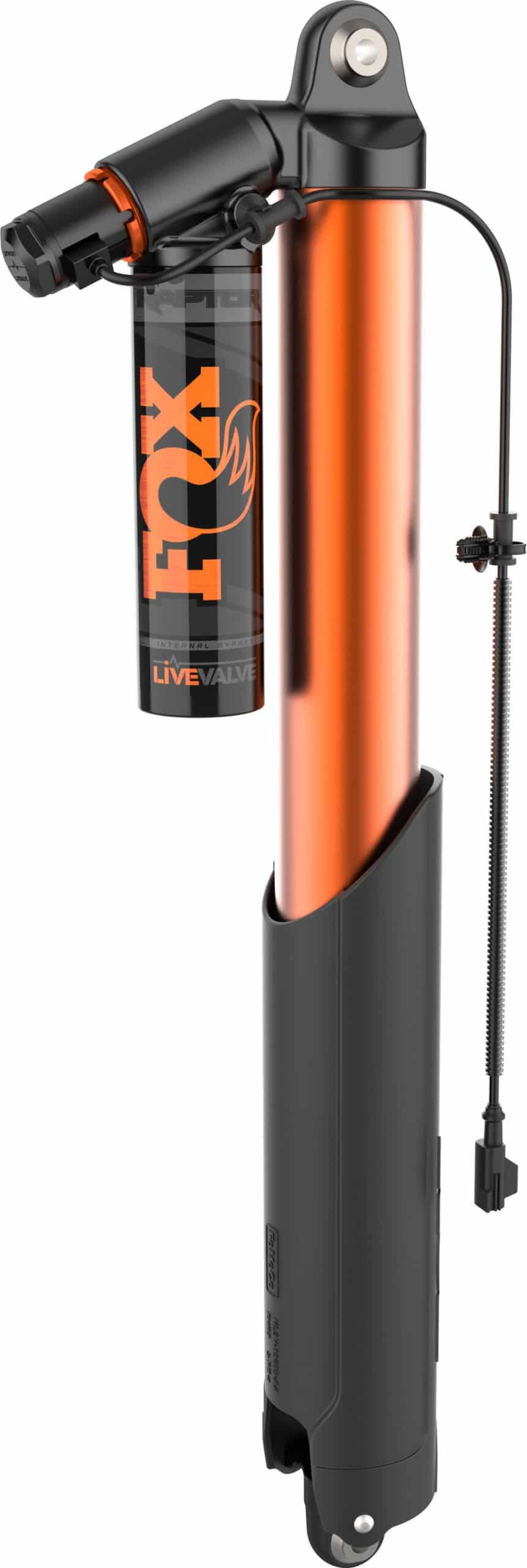
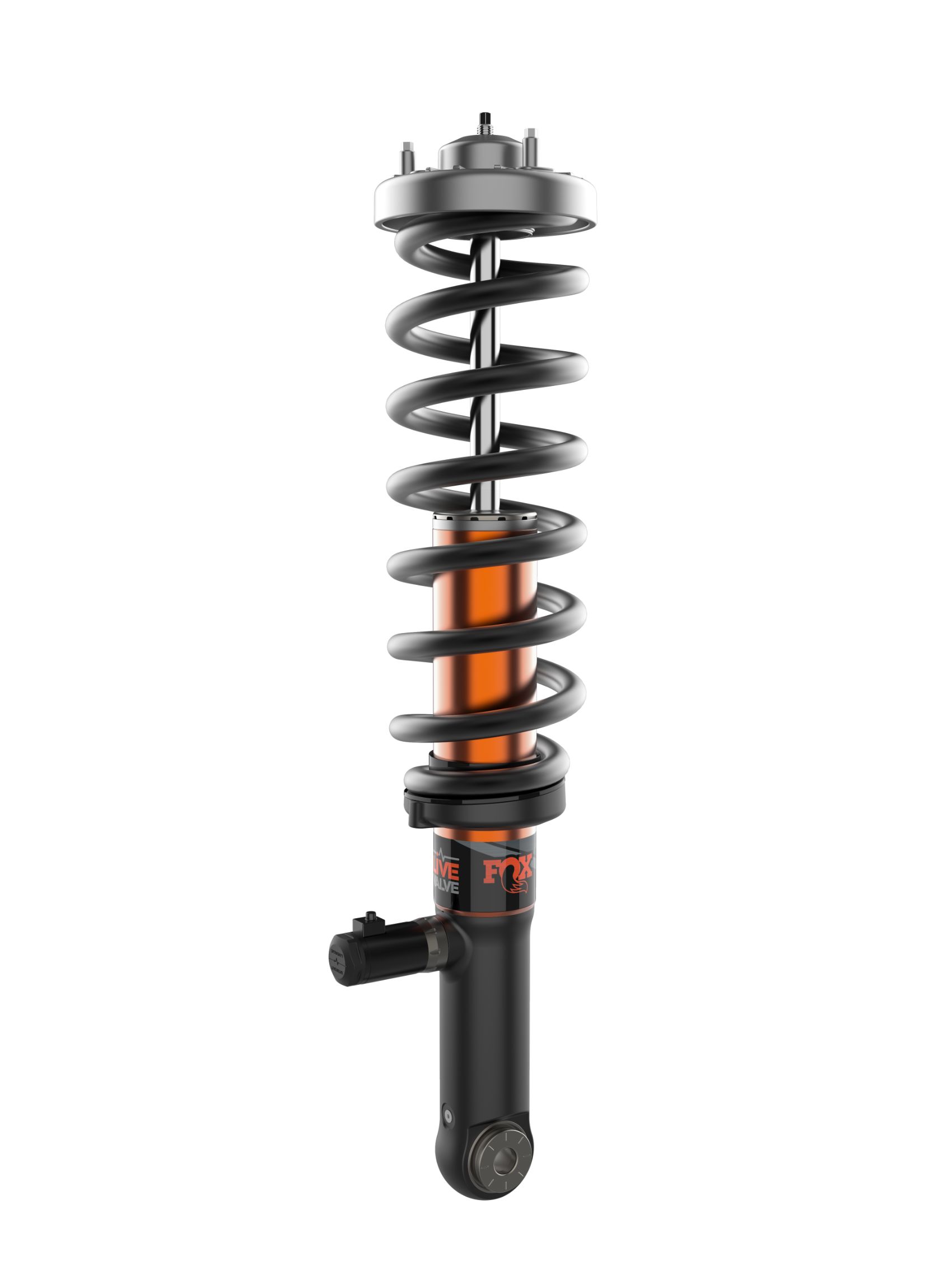
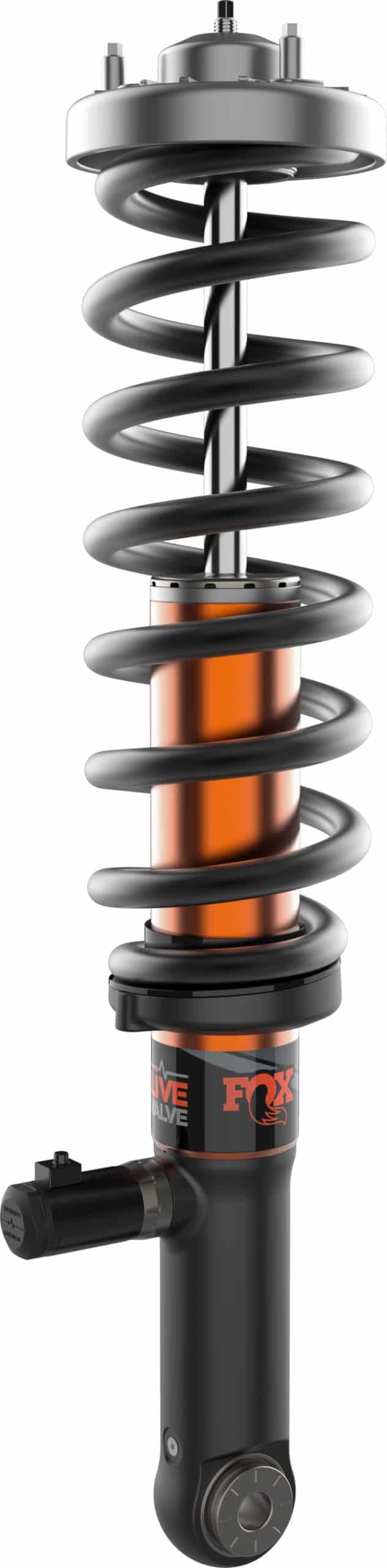
Next-generation FOX Live Valve internal bypass shocks (photos below), with state-of-the-art electronic controls, provide position-sensitive damping adjustability (say that five times fast!). Naturally, these are the Raptor’s largest and most functional shocks yet, engineered to resist more heat and react quicker to unexpected terrain changes versus prior generations.
In terms of the nitty-gritty, the 3.1-inch-diameter anodized aluminum shock bodies contain a new low-friction fluid to decrease frictional losses inside the damper (to improve off and on-road comfort). From there, the electronically controlled base valves withstand upwards of 1,000 lbs. of damping per corner at desert speeds.
At this point, we come to where the software and hardware meet. Suspension height sensors and other sensors around the Raptor can change damping rates independently at each corner 500 times per second. Essentially, the shocks respond at the same speed the human brain processes visual information. By the time the driver notices the terrain change, the 2021 Raptor has already adjusted accordingly (isn’t engineering fun!?).
When The Rubber Meets The Off-Road
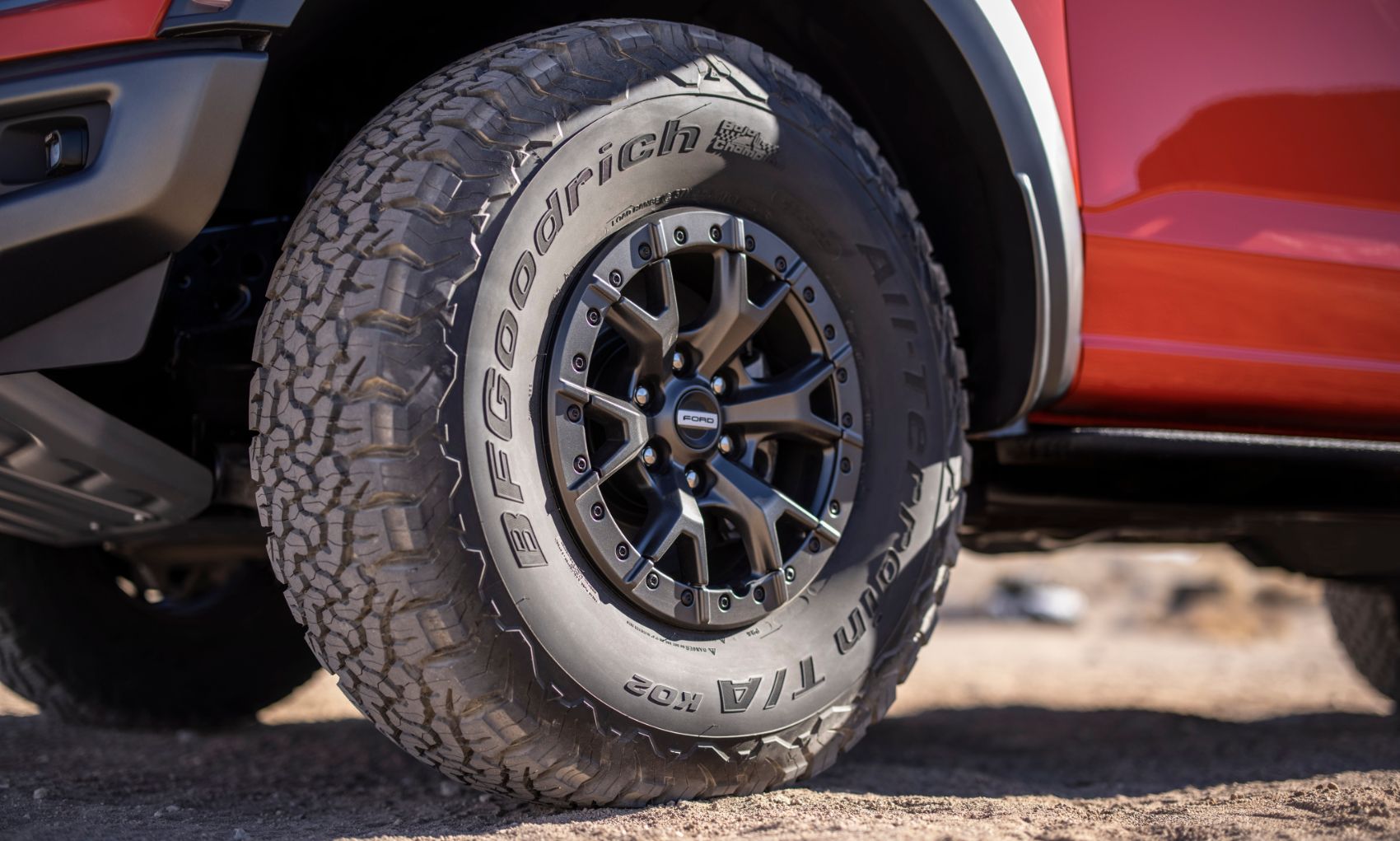
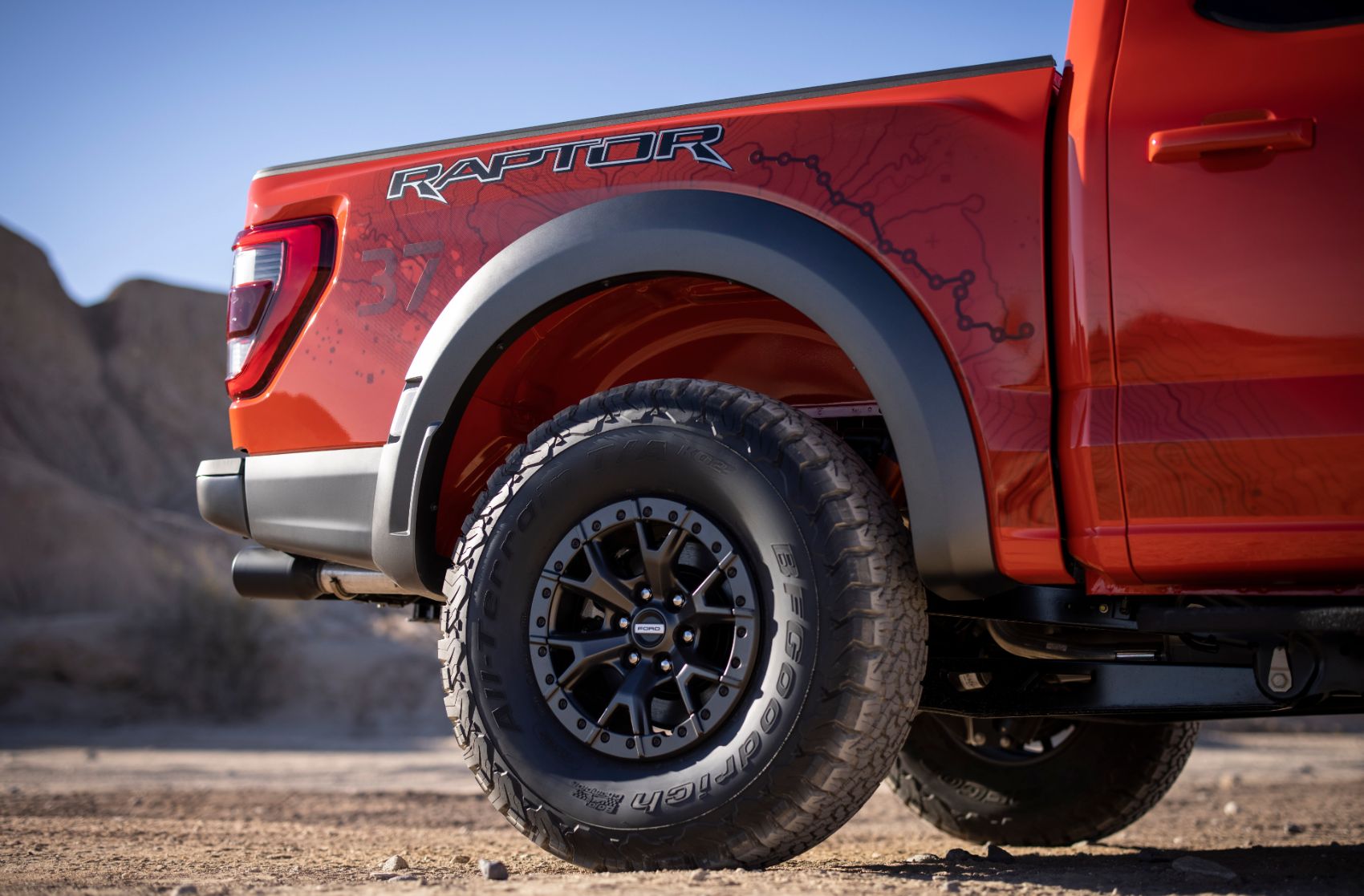
Drivers have the option for 35-inch or 37-inch BFGoodrich All-Terrain T/A KO2 tires. Wearing 35-inch tires, the new Raptor clears 12-inch obstacles with an approach angle of 31 degrees, a maximum departure angle of 23.9 degrees, and a break-over angle of 22.7 degrees.
With the 37-inch meats, the Raptor has an approach angle of 33.1 degrees, a maximum departure angle of 24.9 degrees, and a break-over angle of 24.4 degrees. The 37-inch tires also give the Raptor 13.1 inches of total ground clearance. Three different 17-inch wheels are available, two with beadlock capability.
2021 Ford F-150 Raptor: Engine & Powertrain
Under the hood is a high-output, twin-turbo 3.5-liter EcoBoost V6, complete with new cooling fans and a 10.5:1 compression ratio. The EcoBoost engine is married to a Ford-built 10-speed automatic and a torque-on-demand transfer case. An electronic locking rear differential is standard, while a TORSEN front limited-slip differential is available (4:10 final drive ratios).
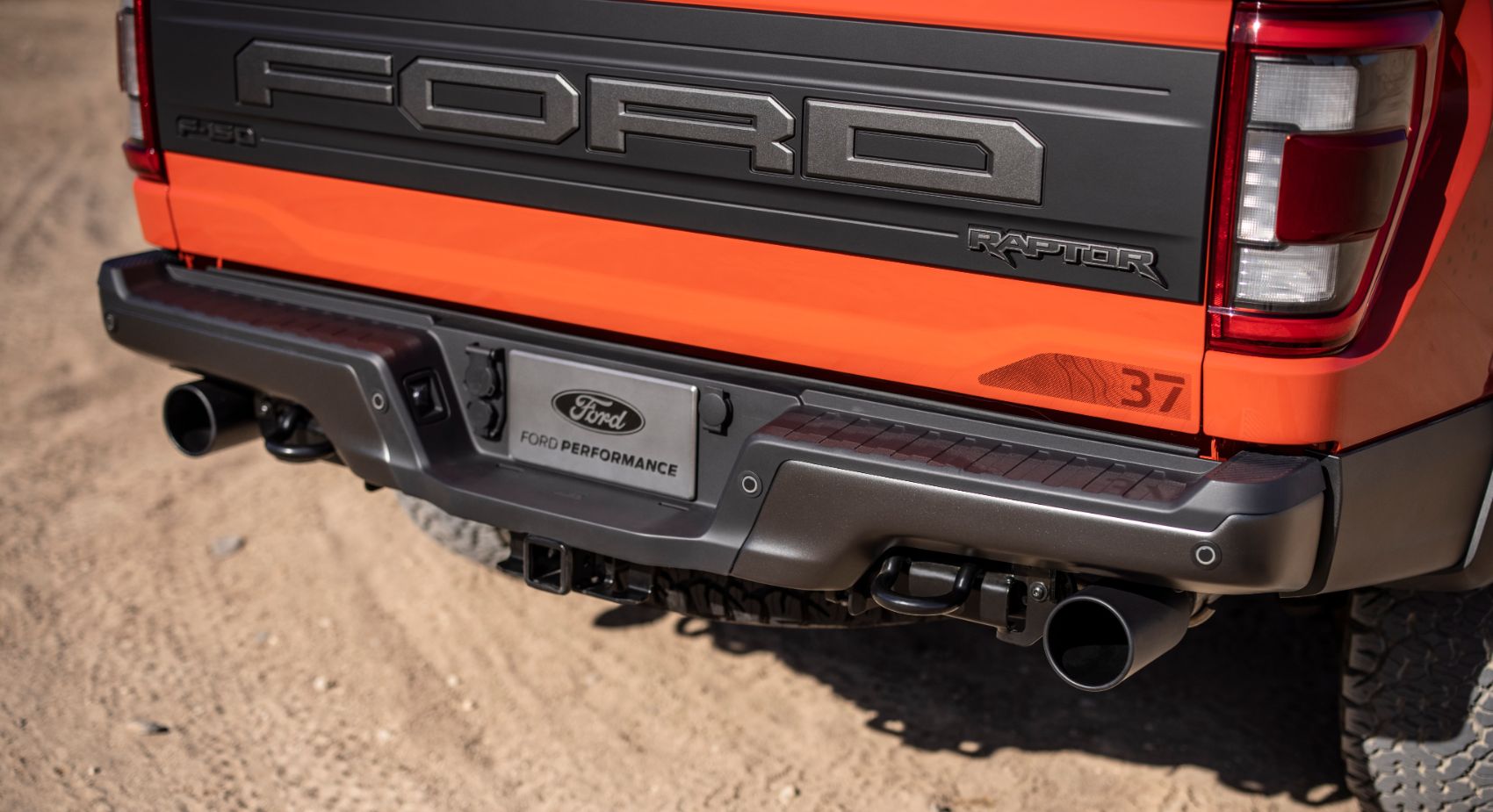
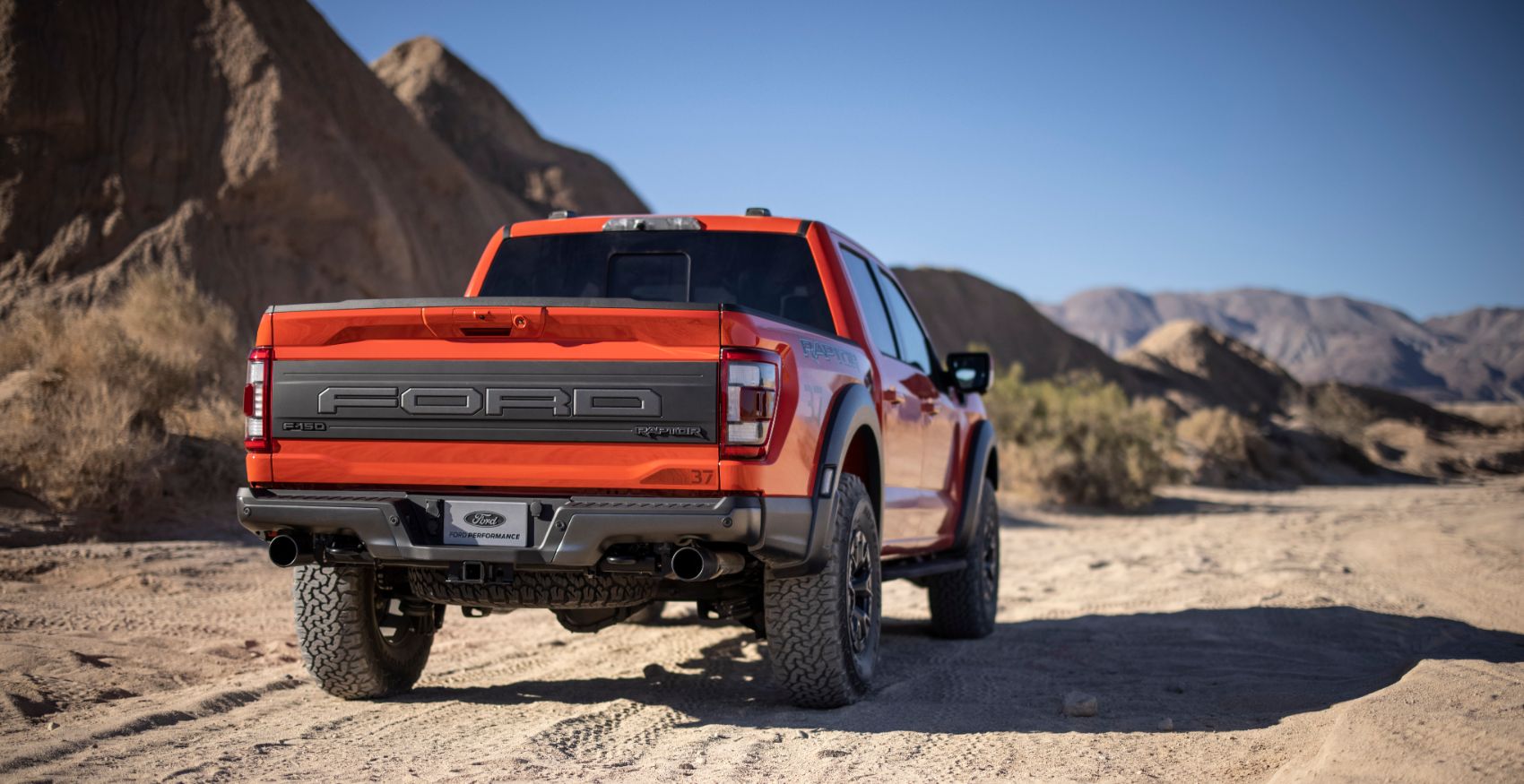
The new three-inch equal-length exhaust system is one feature that has everybody talking (some even thought the 2021 Ford Raptor might be packing a V8 because of the sound). The design consists of a “patent-pending built-in X-pipe” with a “unique trombone loop,” which allows for a proper pass-through muffler system. Inside the Raptor, drivers can play with four different sound settings: Quiet, Normal, Sport, and Baja.
Ford has not revealed horsepower and torque figures yet. However, we know that the Raptor’s maximum payload and towing capacities have increased by 200 lbs. to 1,400 and 8,200 lbs. respectively. According to Ford, the new Raptor does have a projected EPA-estimated range of more than 500 miles when its 36-gallon tank is full.
Photo: Ford Motor Company.
Off-Road Technology
The 2021 Ford F-150 Raptor has several tech tricks up its sleeve in the powertrain department when it comes to off-roading. The first is Ford’s Terrain Management System, with seven selectable drive modes: Slippery, Tow/Haul, Sport, Normal, Off-Road, Baja, and Rock Crawl. These different modes adjust the steering, throttle response, transmission shift points, transfer case stability control, and active damping system accordingly.
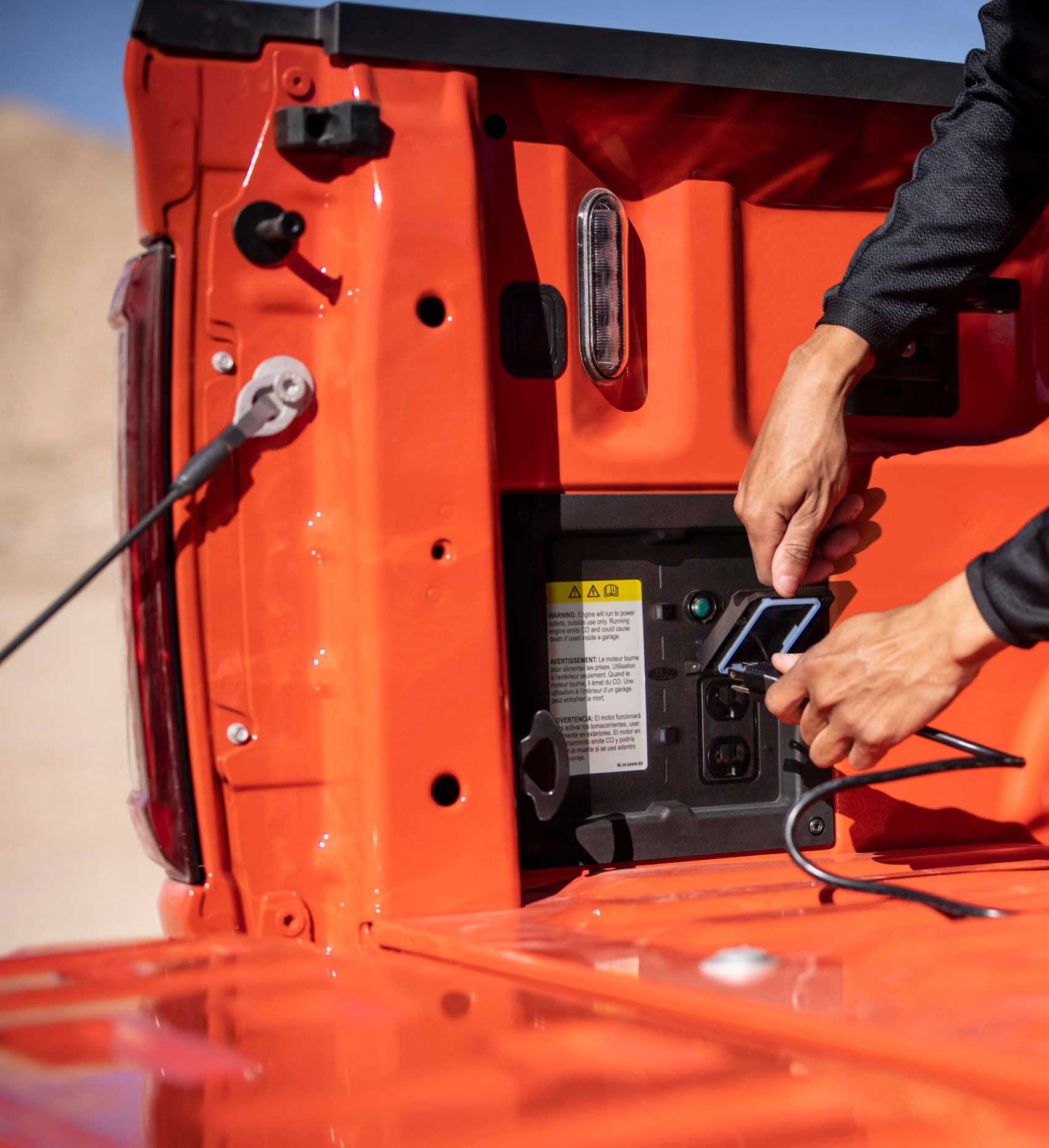
Next is a Trail 1-Pedal Drive system, which helps the driver modulate the brake and throttle while doing things like rock climbing. The third item is a standard Trail Control system, an off-road version of cruise control. Finally, the available Pro Power Onboard system turns the 2021 Ford F-150 Raptor into a rolling generator with up to two kilowatts of exportable output power. Rigid off-road lighting is available as well.
To add to the tech fun, drivers can control nearly every element of their 2021 Raptor with the FordPass feature. The mobile app can lock or unlock the Raptor from almost anywhere while showing things like the tire pressure and fuel level. Drivers can also control other nifty items through the app, like Zone Lighting, Trailer Theft Alert, Trailer Light Check, and the Pro Power Onboard feature.
The available Pro Power Onboard system turns the 2021 Ford F-150 Raptor into a rolling generator with up to two kilowatts of exportable output power. Photo: Ford Motor Company.
2021 Ford F-150 Raptor Interior Treatments
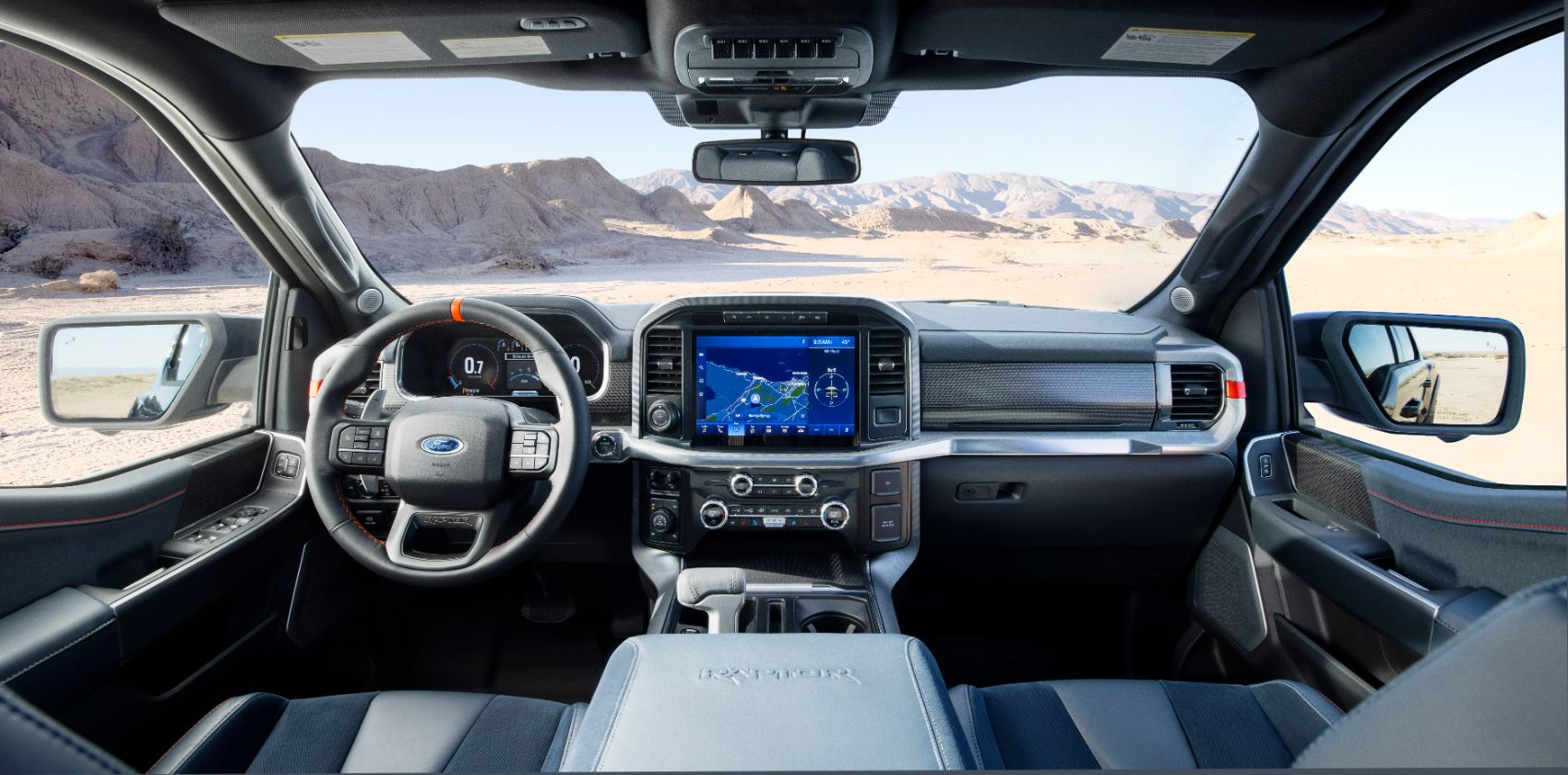
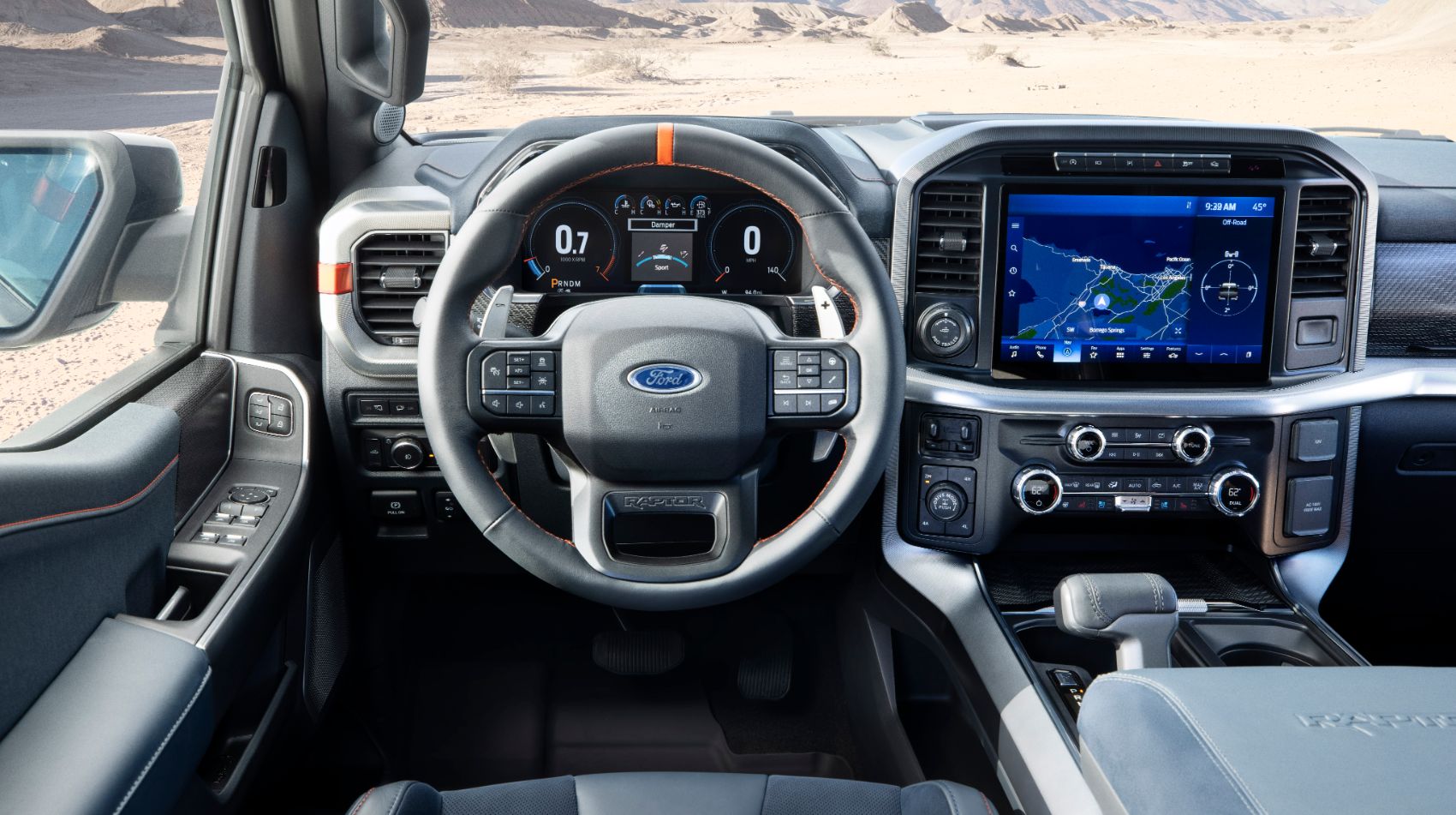
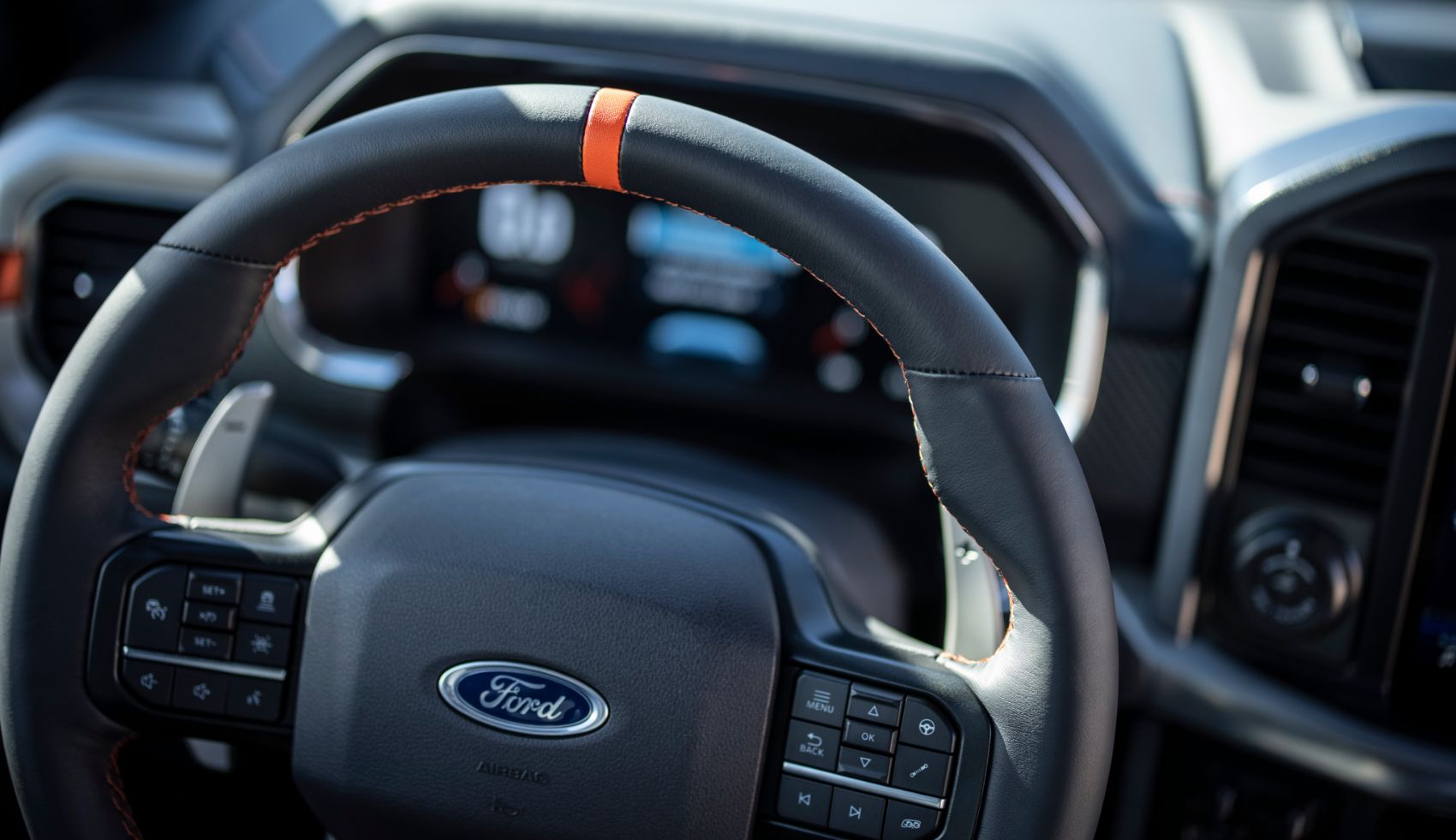
Like all Raptors before it, the 2021 variant has the steering wheel with the 12 o’clock marking. While the standard seats have plenty of bolstering, Recaro buckets are available (highly recommend). Interior trim packages consist of a standard aluminum finish layout or an optional carbon fiber array. Lockable, fold-flat rear storage is available, adding a vault under the rear seats for all kinds of different gear and equipment.
The standard SYNC 4 system supports wireless Apple CarPlay and Andriod Auto and apps like Ford+Alexa. A customizable 12-inch digital gauge cluster with off-road data, turn-by-turn navigation, and Raptor-specific graphics and animations is standard. Likewise, a 12-inch center screen, also customizable, allows the driver to split the display to access multiple functions at once. The available 360-degree camera provides a complete view around the Raptor; a dash-mounted button turns on the 360-degree view and rearview cameras.
2021 Ford F-150 Raptor interior layout. Photo: Ford Motor Company.
2021 Ford F-150 Raptor: Pricing & Availability
The 2021 Ford F-150 Raptor will be available in a SuperCrew configuration on a 145-inch wheelbase. Assembly will take place at the Dearborn Truck Plant in Dearborn, Michigan. Ford has not announced any pricing information but says we can expect to see the new Raptor at dealers this summer. According to Ford, a Raptor R with a V8 is on the way next year.
Carl Anthony is Managing Editor of Automoblog and a member of the Midwest Automotive Media Association and the Society of Automotive Historians. He serves on the board of directors for the Ally Jolie Baldwin Foundation, is a past president of Detroit Working Writers, and a loyal Detroit Lions fan.
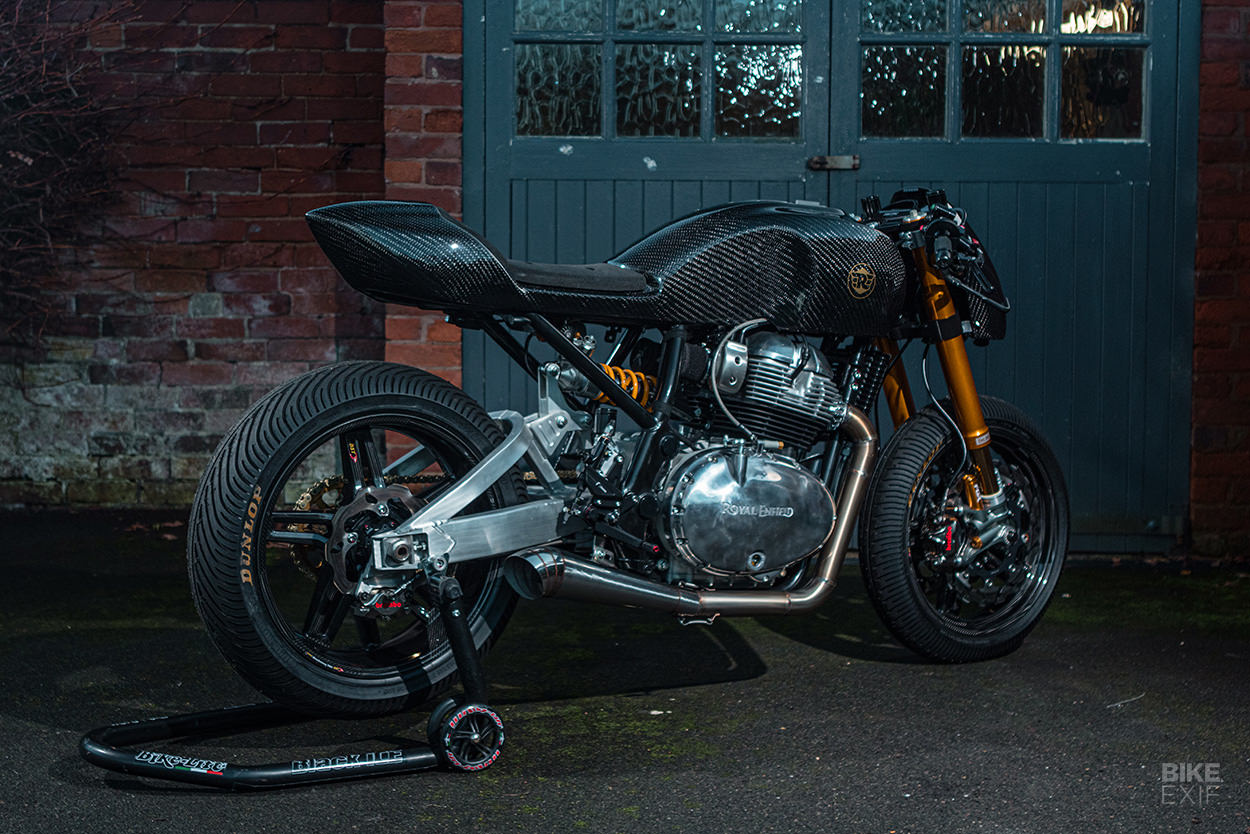
Modern motorcycles offer reliability and performance, but usually at the cost of simplicity—and that makes them harder to customize. Which is exactly why bikes like the Royal Enfield Continental GT 650 are making a splash in the custom scene.
“It’s simple, clean and not overly complicated with a mass of electronics,” says the man behind Partridge Design in the UK, Anthony Partridge. “Bikes like these are the best to work with, as I get to focus on my craft, without having to plan around rehoming complex sensors and wiring looms.”
Anthony’s wanted to tear into one of Royal Enfield’s new twins for a while, but the timing has never quite worked out. So when he needed a project for the second season of Goblin Works Garage, the Discovery Channel TV series he co-hosts, he put in a call to Royal Enfield. Their head of industrial design, Adrian Sellers, came onboard with a simple brief: “I want you to build a thoroughbred racer.”
“Those words were music to my ears,” says Anthony, “because at the heart of everything I build is performance. That’s where my passion lies. I love to race and ride hard whether on road or track, so naturally all my builds are performance-based.”
“In my opinion if you don’t make a bike lighter, faster and more fun to ride (than the manufacturer originally built it), then there is no sense! Sticking to my performance ethos, I wanted to go balls-to-the-wall and turn this lil’ GT 650 into a bona fide race bike.”
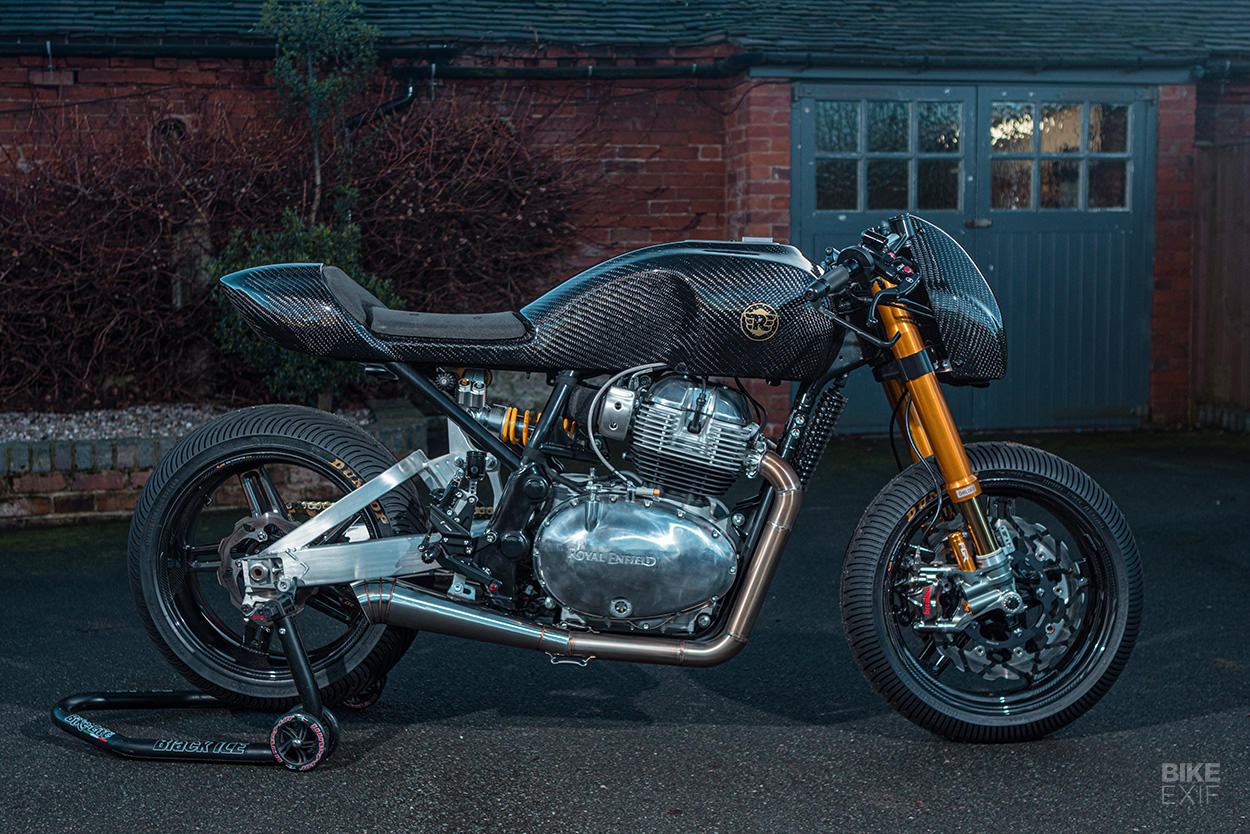
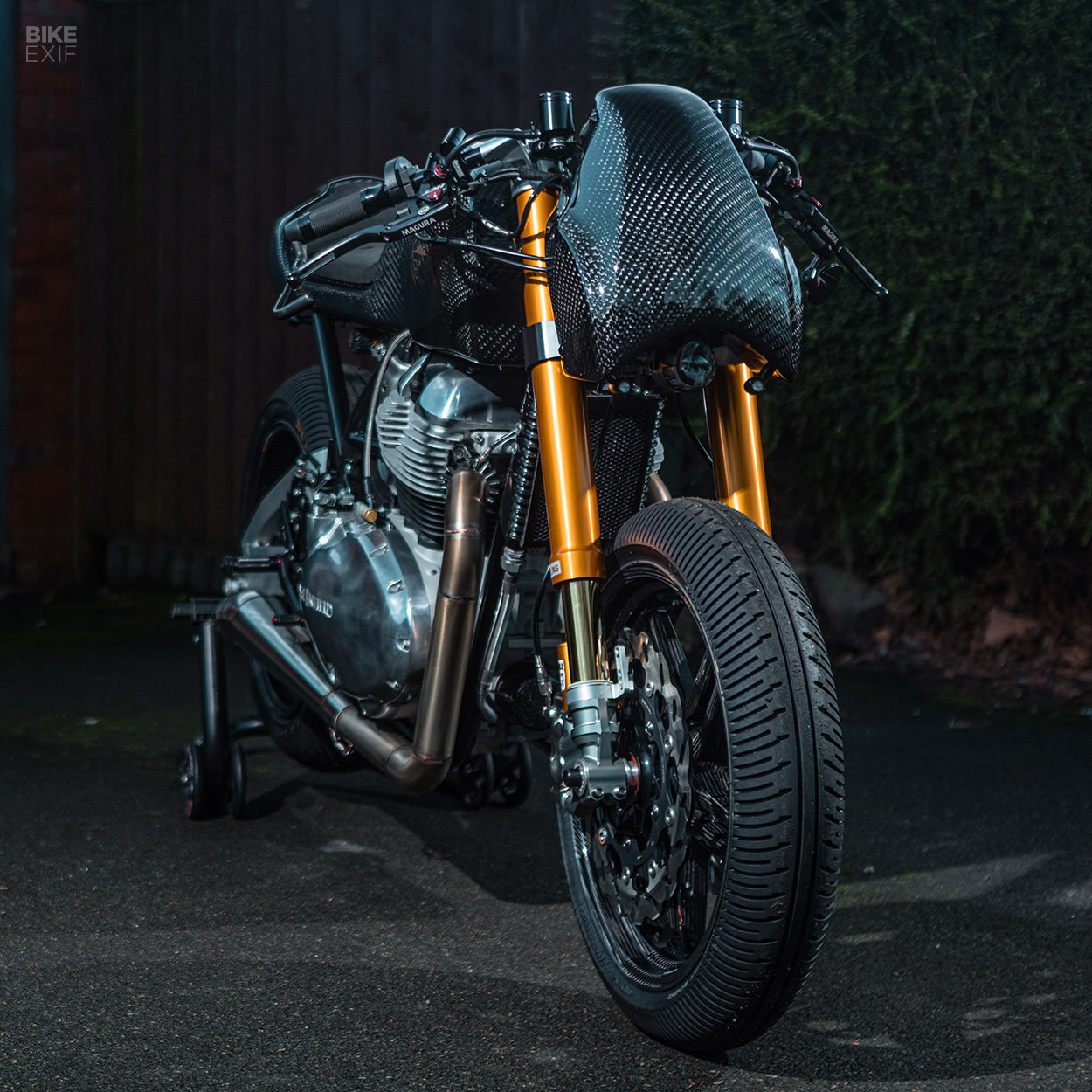
Anthony had a laundry list of go-fast parts planned for the Continental GT 650, but he wanted it to look flash too. So he stripped the bike down and asked his friend Paul of Ziggymoto fame to 3D scan it. From there, the pair designed a body kit that could fit any stock Continental GT.
“I wanted to show all the folks watching the TV show that they can customize their own bike with my body kit,” he explains, “and transform the look fairly quick and easy. I also wanted to make this a commercially viable project, hoping to claw back a little of my investment and also provide Royal Enfield with even more return on theirs.”
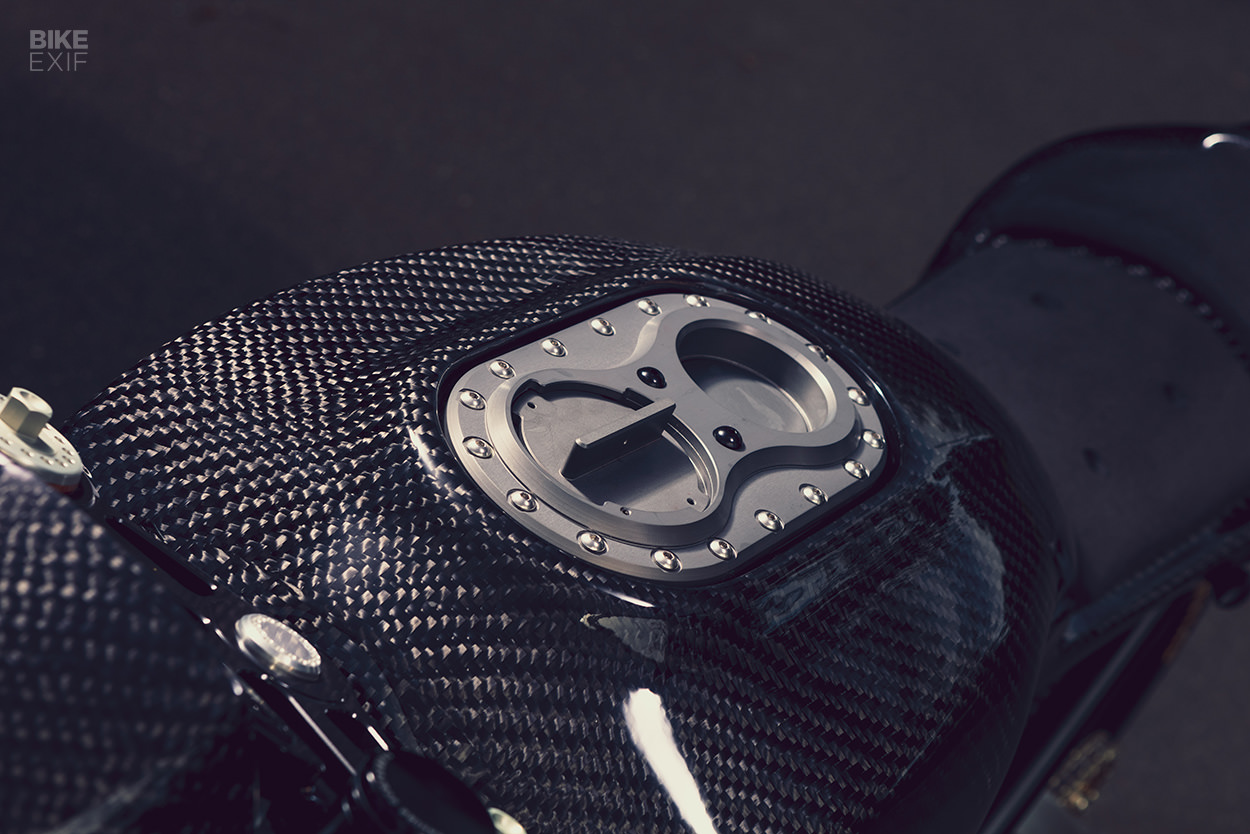
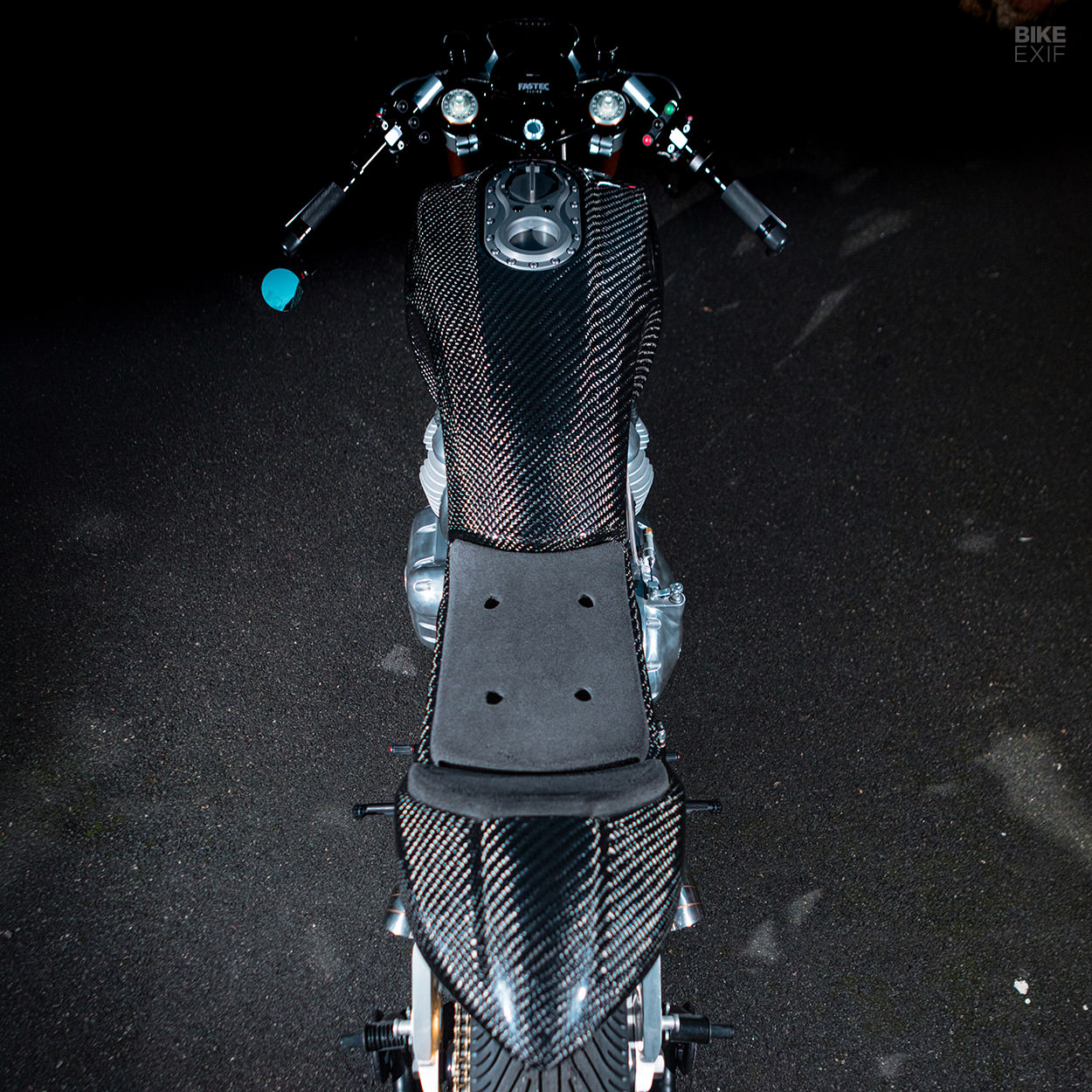
Mark Angus at 3Dcnc then machined a pair of bucks for molds, which Anthony modded slightly before sending off to his go-to mold maker. The final parts were shaped in carbon fiber, while GIA Engineering built a custom fuel cell, adorned with a Racefit cap.
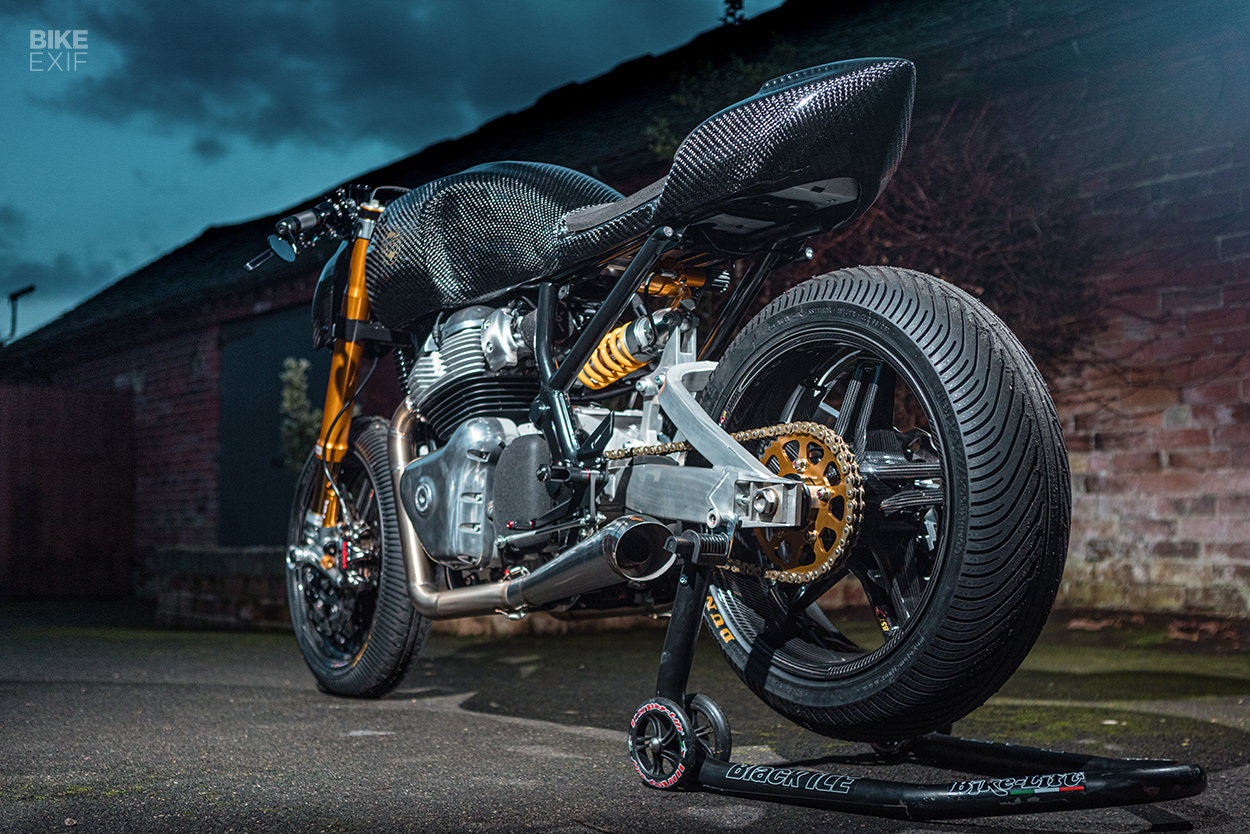
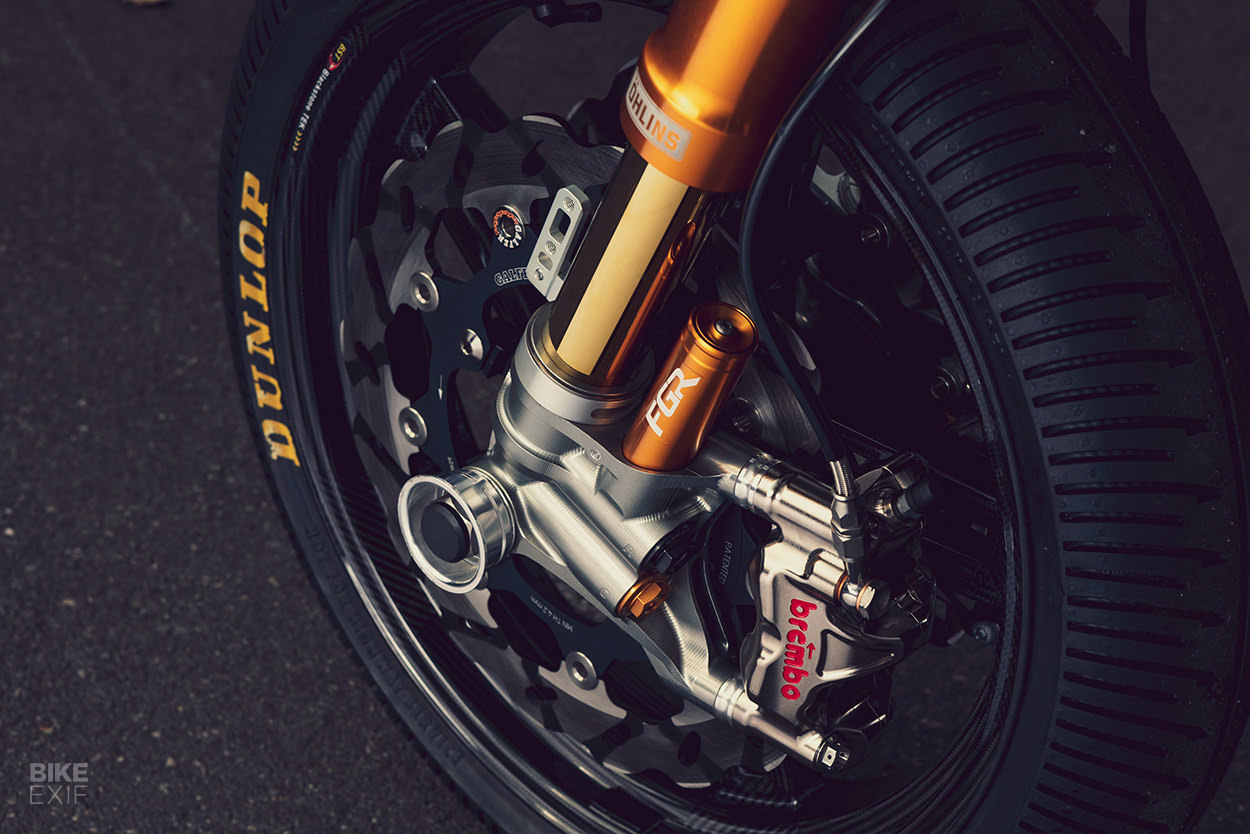
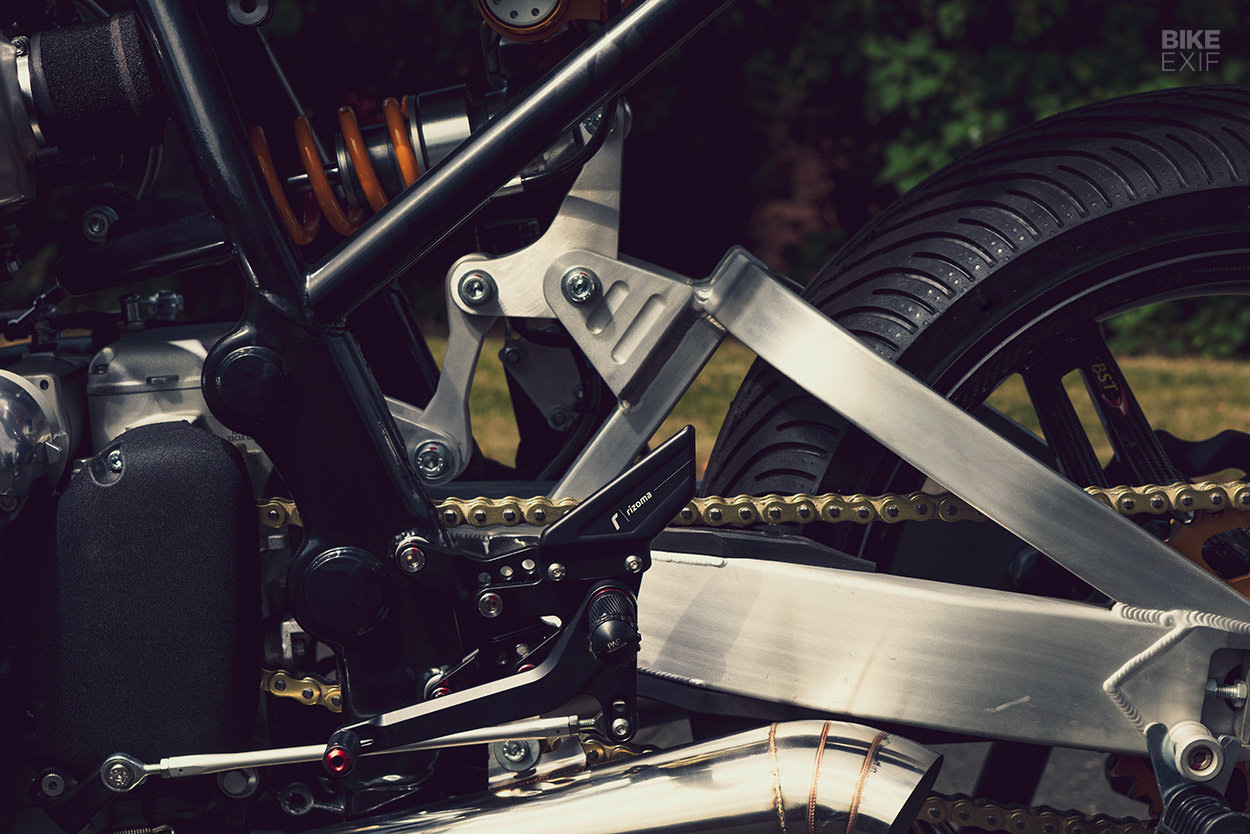
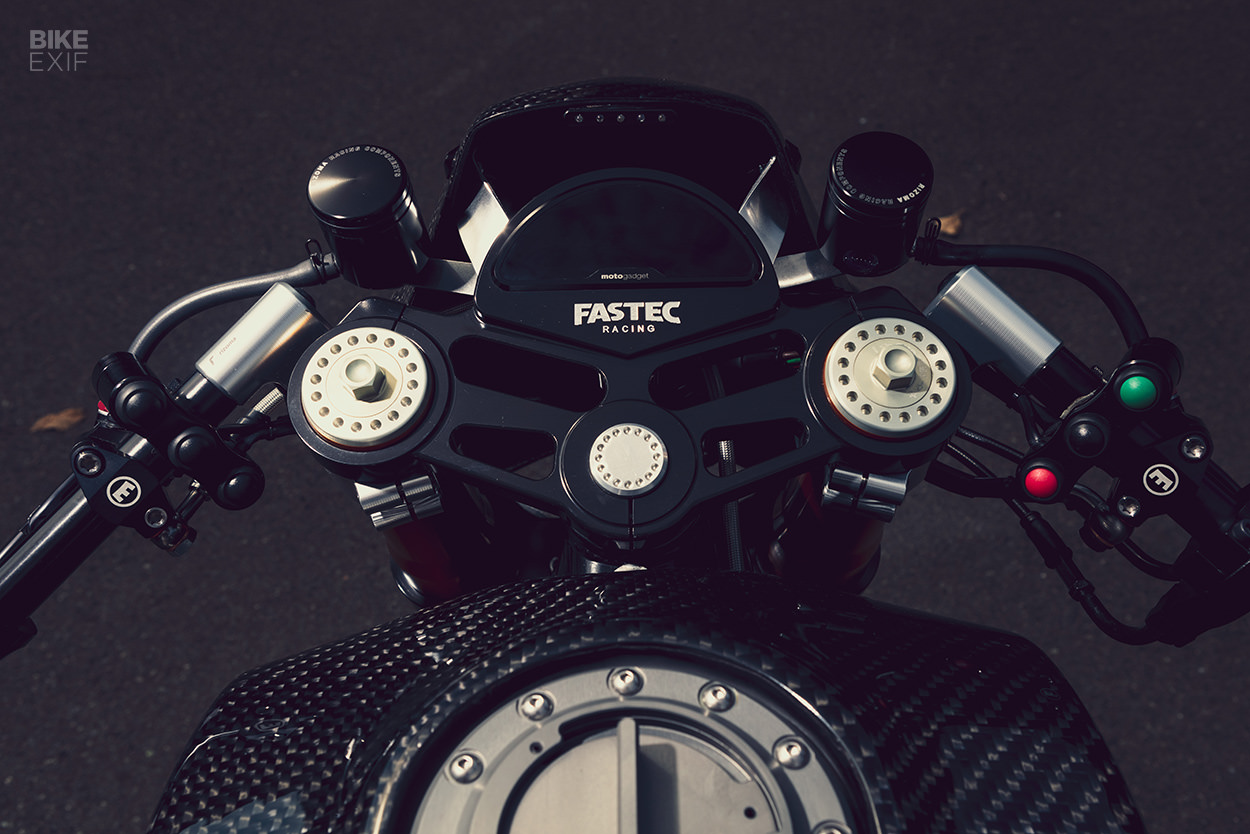
GIA also fabricated a burly monoshock swingarm for the bike, which is hooked up to an Öhlins TTX GP Pro shock. There’s a set of Öhlins FGR300 forks up front, held in place by custom triples from FastTec, who also supplied a set of GP-style quick-release axles. The wheels are carbon fiber units from BST, and the tires are Dunlop Sportmax GPAs.
For the brakes, Anthony has combined nickel-plated Brembo race calipers with Galfer discs, Venhill lines and a Magura front master cylinder. And he installed a Magura hydraulic clutch system too, just for kicks.
The work at the back included modifying and bracing the subframe. And since the rear wheel’s now wider than stock, the front sprocket needed an offset—which in turn meant that the frame had to be notched to make room.
The GT 650 was also treated to a 750 cc big bore kit from S&S Cycle, along with a handmade exhaust system, foam filters and a Power Commander.
Before Anthony could finish the project, he had to fly to Albania to shoot another episode of Goblin Works Garage. So he left the bike with Chris at Hard Knocks Speed Shop in Oxford to handle the remaining work.
Finishing touches include a handful of Motogadget electronic bits, Rizoma clip-ons, rearsets, mirrors and turn signals, and a Highsider LED headlight. There’s also an Antigravity Lithium-ion battery, and switch clusters from Reese Racing.
For its final shakedown, Anthony pitted his hopped-up Royal Enfield against a stock version on a sketchy, icy track—with the GT 650’s designer in attendance. “The difference was night and day,” he says. “The custom bike feels like a proper race bike: lighter, faster, way more agile than stock and heaps of fun to ride.”
“So it’s safe to say I managed to fulfill the brief… I stuck to my ethos and built a bike I really like!”