Wednesday, 4 September 2019

Win: A NEXX X.G100 Racer helmet—customized to your liking

Win a NEXX X.G100 Racer motorcycle helmet
We’ve joined forces with NEXX and four of the world’s leading helmet artists to give you the chance to win your own custom NEXX X.G100 Racer helmet.

Like all NEXX helmets, the X.G100 Racer is manufactured in Portugal. It echoes the style of 1970s racing helmets, and our four lucky winners will also be able to make their lids truly unique—by working with top artists to create a custom design.

Win a NEXX X.G100 Racer motorcycle helmet
The X.G100 Racer uses a retro-style round shell, and a smooth-lifting shield that snaps into place—whether you want the visor fully open, cracked, or closed tightly against wind or rain. The ‘X-Matrix’ shell construction has a strength-to-weight ratio previously unheard of in a retro helmet, with an X.Mart Dry liner and chin vent providing built-in climate control. It’s the most comfortable and best-performing helmet of its style.

For this giveaway, NEXX have hooked up with four of the best helmet artists of recent years. Each winner will be able to pick one of these four artists to work on a one-off design for their new helmet.
Custom motorcycle helmet designer Hello Cousteau
Hello Cousteau After spending his professional career designing everything from toothpicks to 180-meter mega-yacht interiors, the design force behind Hello Cousteau got bored. But what bored him the most was when he went to a bunch of motorcycle/helmet shops and couldn’t find a single good looking helmet that he’d fancy. “They all looked the same, with no individuality whatsoever.” So, that was it… Hello Cousteau was born. New concepts are dreamt up daily from a studio in Porto, Portugal.

Custom motorcycle helmet by designer Viktoria Grenier, founder of Vaim.me
Vaim.me Viktoria Greiner, founder of Vaim.me, started her career as a design engineer focusing on colors and patterns. In 2016, she took her skills to the skate world, painting skateboards and downhill helmets—but then she was introduced to the motorcycle community Loose Screw, and her focus shifted to all things two-wheeled. Requests for motorcycle helmets and tanks painted in her signature skate-style turned into a full-fledged business. Greiner now works out of a design studio in Munich, Germany.

Custom motorcycle helmet by designer Pamela Reis of Papeel
Pamela Reis is an artist, graphic designer and expert free-hand painter. Reis combines pyrography, brush work and digital illustration to showcase her unique creativity, and her hand-painted artwork won The Gnarly Magazine Tank Art Contest in 2019. Outside of her visual art she is also a musician, and the combination of these two personas are brought to life in The Papeel, where Pamela’s creativity is expressed with unabashed freedom.

Custom motorcycle helmet by designer Tag Gasparian of Tagger Designs
Tag Gasparian grew up in Laguna Beach, California, and began drawing at age 14, influenced and inspired by surf art and the ocean itself. In the 1980s he became a pro surfer and began painting his own boards, which kicked off a run of 20+ years in which he airbrushed surfboards and t-shirts for friends and team members. He eventually took his SoCal beach style and put it onto motorcycle helmets, and is now a renowned painter in the motocross world. He continues the work from his studio, Tagger Designs, in Lake Elsinore, CA.

HOW TO ENTER

Just head over to the giveaway page, answer three short questions, and fill in your details. You can also double your chances of winning by following the NEXX Instagram page. The giveaway is open to all persons aged 18 and over, and your entry must be received by 11:59 PM EST on September 29, 2019.

Good luck!

In association with NEXX North America | Giveaway terms and conditions

Win a NEXX X.G100 Racer motorcycle helmet


from Bike EXIF https://ift.tt/2ZKrhcv

Tuesday, 3 September 2019

Loving Vincent: A world championship build from Moscow

Custom Vincent Lightning by the Russian motorcycle builder Zillers Garage
Last year, Dmitry Golubchikov became the first Russian to become the AMD World Champion of bike building. The 31-year-old triumphed with an amazing hand-built Yamaha SR400 called ‘Insomnia.’

Dmitry is now back with another jaw-dropping creation, and we reckon this one could sweep the board too. It’s based around a Vincent Lightning engine, but virtually everything else is made by hand.

Custom Vincent Lightning by the Russian motorcycle builder Zillers Garage
Dmitry was born in the Republic of Karelia, near the Finnish border, and now lives in Moscow. His workshop is called Zillers Garage, but he usually works alone unless the job sheet gets too long.

A Zillers bike is a unique creation crafted around an existing engine. In this case, the engine is a 1200cc Vincent Lightning replica built by the English company JMC Classics, which is also licensed to produce new Egli-Vincent motorcycles.

Custom Vincent Lightning by the Russian motorcycle builder Zillers Garage
“I purchased the engine five years ago in England,” says Dmitry. “I’ve always been a fan of Vincent engines, and as soon as the opportunity arose to buy one, I decided to customize it.”

“The engine is ‘new’ and was already prepared for active riding. Dell’Orto carburetors came with it, but I decided to abandon them and use BMW carburetors. The intake manifolds are cast in aluminum, and the gearbox has four gears.”

Custom Vincent Lightning by the Russian motorcycle builder Zillers Garage
All the oil and fuel lines are custom-made using stainless steel, and it looks like Dmitry has used very early Bing carbs.

At the exhaust end, he’s built a sinuous system out of stainless steel. No pie-cut welds here: just a few perfectly socket welded pipes converging into a single length of muffler… that we suspect doesn’t muffle very much of the magnificent pushrod V-twin at all.

Custom Vincent Lightning by the Russian motorcycle builder Zillers Garage
Before working on motorcycles, Dmitry was a high-end motorsport mechanic. And that’s how he refined his amazing fabrication skills: the frame, front fork and control levers on this bike are made out of stainless steel, and the seat unit, bars and gas tank are made from aluminum.

Since this is a high-end show bike, the fabrication is anything but simple. The forks are a duolever design, similar to that used on BMW’s K series bikes. “The main advantage is that the steering is connected through a linkage, and vibrations from the road are isolated,” says Dmitry.

Custom Vincent Lightning by the Russian motorcycle builder Zillers Garage
It’s also a remarkably elegant-looking setup, which will help at show time. Dmitry has machined this arrangement himself, with cushioning provided by a spring at the bottom front of the hand-made frame.

The wheels are one-offs too, with chrome-plated steel rims shod with Avon Cobra rubber. The center section inside each rim is machined from aluminum, and hooked up to twenty spokes per wheel—each one individually CNC machined.

Custom Vincent Lightning by the Russian motorcycle builder Zillers Garage
Look closely and you’ll see that the brake discs and calipers are inside the spokes of each wheel. The discs are machined out of cast iron. “The brake lines with fluid pass through the center of the wheel,” Dmitry explains. “The hub itself is empty.”

Even the brake pads are custom-made, using repurposed clutch friction plate material.

Custom Vincent Lightning by the Russian motorcycle builder Zillers Garage
The Zillers Vincent is one of those machines that justify a very close look at the images.

The craftsmanship is off the scale, and the design is fascinating too: note the way the rear frame tubes snake under the seat unit, which is trimmed with crocodile skin, and reappear as one.

Custom Vincent Lightning by the Russian motorcycle builder Zillers Garage
That single tube then curves over the split tank, with a second tube right underneath the tank, carrying brackets that mount to the cylinder heads.

The bars alone are a work of art, curving like antelope horns, and graced with slender levers—in sharp contrast to the engineering complexity immediately beneath.

Custom Vincent Lightning by the Russian motorcycle builder Zillers Garage
If you’re keen to see this extraordinary machine in the metal, patience is called for. It won’t be revealed to the wider public until October 2020, at the next biennial AMD World Championship in Cologne, Germany.

That’s a long time to wait, but it’ll be worth it. We just hope the AMD judges feel the same way.

Zillers Facebook Group | VK.COM | Instagram | Images by Alexey Sulima

Custom Vincent Lightning by the Russian motorcycle builder Zillers Garage


from Bike EXIF https://ift.tt/2MS0Uj1

Monday, 2 September 2019

Audi Maintenance Cost: What You Might Pay

  • Audi produces some of the most popular high-end cars available, but the yearly price of maintenance might have you looking for ways to cut costs.
  • Learn how an extended warranty reduces repair costs and provides peace of mind.

Affiliate disclosure: Automoblog and its partners may be compensated if you purchase the products mentioned below.

It’s easy to like even entry-level Audi vehicles for their luxurious look and feel. However, it’s a lot harder to like the cost to maintain an Audi.

You should have routine maintenance done on your Audi every 10,000 miles, and it can get expensive. You can expect to pay between $200 and $300 for scheduled Audi maintenance. For larger mileage internals (like at 60,000 miles), maintenance costs jump between $700 and $875. Repairs for your Audi will cost even more than routine maintenance.

If you own an Audi or have your eye on one, you might be concerned about maintenance and repair costs. This guide will take you through common repair costs for popular Audi models and other luxury brands. There are options for keeping your Audi in good shape without clearing out your savings account – for example, an extended auto warranty from a reputable car warranty company like CARCHEX.

Get an extended warranty quote that’s customized to your Audi vehicle from CARCHEX by calling 866-254-0205 or answering a few questions online.

Regular Audi Maintenance Cost

The key to extending the life of an Audi is proper routine maintenance. Your owner’s manual details the recommended mileage for specific services, such as having a timing belt replaced. For general vehicle maintenance, Audi recommends you have your car serviced once a year or every 10,000 miles.

Some services may need to be performed more often. Below are five common regular maintenance needs for your Audi, using Audi A4 maintenance cost as an example, courtesy of RepairPal.

1. Brakes

You should check your brakes for wear at least once a year – or twice a year if you drive in a city or notice your brakes take longer to stop. Brake pads generally need to be replaced every 35,000 to 60,000 miles.

Cost: Front brake pad replacement for an Audi runs between $365 and $400.

2. Oil Change

Most modern Audi vehicles with synthetic oil can go up to 10,000 miles between oil changes. However, if you do a lot of city driving – stopping and starting at stop signs, lights, and in traffic – you may need your oil changed every 5,000 miles.

Cost: A regular oil change for an Audi car runs between $130 and $145.

3. Tires

Not only is your car going to perform less efficiently with worn-out tires, but it’s also dangerous. Worn tires with little to no tread or low air pressure are a potential safety concern, especially if the pavement is wet.

Cost: To replace all four tires with factory tires at an Audi dealership, you can expect to pay $180 to $330 per tire. When you factor in installation costs, new factory tires cost between $775 and $1,450.

4. Air Filter

Air filters are regularly replaced between 6,000 and 10,000 miles. A clean air filter helps keep debris from your engine.

Cost: Air filter replacements cost between $90 and $130.

5. Battery

Test your Audi’s battery every three months or 3,000 miles. When batteries wear out – about every three years – you will start to notice your car’s interior lights dim. If you rev your engine and the lights brighten, it may be time for a new battery.

Cost: Battery replacement for an Audi costs just over $300.

Common Audi Repairs & Costs

According to J.D. Power, Audi ranks in the top 10 brands for dependability. If you treat it with care, your Audi should be a reliable car with few issues. However, parts wear down and need to be replaced with age and mileage.

Check out the most common problems and repairs for Audi vehicles.

Electrical Component Failure

If your Audi has electrical problems, you may notice your dashboard lights or central display lights suddenly do not come on. Some Audi electrical problems cause taillights to go out.

  • Reason: Electrical wiring wears out or connections corrode.
  • Solution: Electrical system diagnosis and replacement of faulty parts.
  • Estimated cost: System diagnosis will cost between $130 and $200, plus the cost of the replacement part. Parts and labor may cost an additional $200 to $1,000.

Ignition Coil & Spark Plug Failure

A failing spark plug is the most common mechanical failure on Audi vehicles and can cause ignition failure. Ignition coils are also often culprits when you have spark plug problems.

  • Reason: The spark plugs and ignition coils have failed.
  • Solution: Replace spark plugs and ignition coils.
  • Estimated cost: $170 to $220 for spark plugs and $250 to $380 for ignition coils.

Exhaust Leaks

Audis are known for leaking exhaust pipes. If your exhaust is leaking, you will likely need to have your mechanic replace your catalytic converter.

  • Reason: The design of the Audi exhaust system makes the catalytic converter bend and opens the joint where it’s connected to the exhaust pipe. This allows exhaust to leak out.
  • Solution: Replace the catalytic converter.
  • Estimated cost: $1,590 to $1,650.

Oil Leaks

Even newer Audis are known to leak oil. If you notice the smell of burning oil, smoke under the hood, or other signs of an oil leak, find and fix the problem right away. Leaking oil can cause serious damage to your engine.

  • Reason: Leaking valve covers or gasket seals.
  • Solution: Replace covers or seals.
  • Estimated cost: $135 to $260 each time the seals need to be replaced.

What Are Audi Repair Costs for Different Models?

Different Audi vehicles have different repair costs. We’ve taken a look at the average Audi repair cost estimates for three top models: the 2017 A3, A4, and A6. These costs include repairing the electrical components, spark plug and ignition coils, catalytic converter, and valve covers.

  • Audi A3 Repair Costs: $2,800
  • Audi A4 Repair Costs: $3,000
  • Audi A6 Repair Costs: $3,500

Audi Maintenance Cost vs. Other Luxury Brands

If you’re choosing between an Audi or a similar car, you may be wondering how Audi maintenance costs compare to other brands. BMW, Lexus, and Mercedes-Benz cars offer similar levels of luxury and price points compared to Audi vehicles.

Over 10 years, you can expect to pay the most to maintain BMW and Mercedes-Benz vehicles, according to Clark.com. The average Audi maintenance cost over 10 years is $12,400.

  • BMW vs. Audi maintenance cost: These cars cost $17,800 to maintain, $5,400 more than Audi.
  • Mercedes-Benz vs. Audi maintenance cost: Mercedes-Benz vehicles cost $12,900 to maintain, $500 more than Audi.
  • Lexus vs. Audi maintenance cost: Lexus vehicles cost $7,000 to maintain, $5,400 less than Audi. Lexus is generally considered the least expensive luxury car to maintain.

How To Cover Audi Repair Costs

As an Audi owner, you might be worried about how to manage the cost of inevitable repairs. An extended warranty, which is really a vehicle service contract, can help you pay for repairs if components on your Audi wear out or fail.

There are many reasons why you might choose to protect your car with an extended auto warranty. Perhaps you just want the peace of mind you won’t be responsible for costly repairs if your Audi breaks down. Or, you may not want to deal with haggling at the repair shop. When your repair is covered by an extended warranty, you simply take your vehicle into the shop, and the mechanic will line up payment from your warranty provider.

Extended Warranty vs. Audi Manufacturer Warranty Coverage

Extended warranties are not the same as your Audi manufacturer warranty. Manufacturer warranties are only available for new cars and are included with your purchase. Manufacturer warranties, or factory warranties, are designed to only cover Audi repairs or replacements due to defective parts or installation.

An extended warranty, or vehicle protection plan, helps cover repair costs for breakdowns that happen due to the normal use of a vehicle. Manufacturer warranties won’t cover repairs for standard mechanical issues that happen as your vehicle ages.

  • Audi factory warranty: The Audi factory warranty lasts four years or 50,000 miles, whichever comes first. It includes perks like a free first scheduled maintenance service at 10,000 miles or 12 months and limited coverage on corrosion perforation. Another benefit of the Audi warranty is roadside assistance for the duration of the factory warranty.
  • Extended warranty: This service contract offers protection for your Audi vehicle after the factory warranty expires. Four years and 50,000 miles is a relatively short time when you consider it’s becoming commonplace to drive a car to 100,000 miles and beyond. Extended warranties cover Audi repair costs as the car ages and reaches higher mileage. Companies like CARCHEX offer a range of plans to protect your car from both minor and major repairs consistent with higher mileage.

Choosing An Extended Warranty From CARCHEX To Protect Your Audi

An extended auto warranty is an excellent way to protect your Audi if you plan to keep it for many years. There are two reputable options to getting your Audi repair costs covered under an extended warranty. You can choose to purchase an extended warranty from your dealership when you buy your Audi new, or you can choose to buy from a third-party warranty company like CARCHEX at any time.

Why Choose A CARCHEX Extended Warranty Over A Dealership Protection Plan?

CARCHEX logo

Both dealership extended warranties and CARCHEX third-party warranties cover repair costs for your Audi. However, there are some important differences.

  • Dealerships may place limitations on your repair facility choices and often charge interest on the cost of your protection plan by wrapping the premiums into your monthly financing payment.
  • You must buy an Audi protection plan when you purchase your car from the dealership. As your new Audi is already fairly well protected by the manufacturer’s warranty for the first four years of ownership, this may be an unnecessary expense.
  • Audi’s extended warranties also require covered repairs to be completed at your dealership. That means you may be tied to a certain location and mechanic instead of having the option to choose a more convenient, affordable, or trustworthy auto shop.

CARCHEX, on the other hand, provides a wide range of service contracts for Audis with almost any mileage. You’re not pressured to invest in a protection plan when your vehicle is brand new. CARCHEX allows you to wait until your manufacturer’s warranty expires and offers multiple contracts for vehicles with higher mileage. You’ll also be able to use one of the 30,000 certified repair shops most convenient for you instead of having to go to an Audi dealer.

Benefits of CARCHEX Protection Plans

As a BBB-accredited company with an A+ rating, CARCHEX is known for its superior customer service. The company also boasts endorsements from major auto industry leaders like Edmunds, CARFAX, and Kelley Blue Book. Other benefits of a CARCHEX protection plan include:

  • Transferable: If you sell your car, you can transfer the protection plan to the new owner, which can increase the resale value.
  • 30-Day Money Back Guarantee: If you decide you don’t like your protection plan, you can cancel within 30 days and get your money back.
  • No-Haggle, Low-Price Everyday Guarantee™: CARCHEX promises they will give the best deal up front, and there’s no need to haggle over the phone.
  • Affordable contracts: CARCHEX offers five levels of coverage for almost any Audi vehicle, as well as several payment plan options to make protection possible for any budget.
  • Direct payments for repairs: Unlike other warranty providers, CARCHEX pays the covered Audi repair cost directly to the repair shop, so you don’t have to foot an expensive bill and wait to be reimbursed.
  • Additional benefits: When your Audi factory warranty expires and you lose your roadside assistance, you’ll be glad to know a CARCHEX Extended Vehicle Protection Plan includes roadside assistance and extra perks like rental car reimbursement.

Choosing to protect your Audi with an Extended Vehicle Protection Plan from CARCHEX is a great way to keep yourself off the hook for costly repairs, and better manage the maintenance costs for your Audi. To get a free quote that’s customized to your vehicle, driving habits, budget, and needs, give CARCHEX a call at 866-254-0205 or fill out the form online.


from Automoblog.net https://ift.tt/2PAwKmq

Sunday, 1 September 2019

Automoblog Book Garage: Formula 1 – The Knowledge (2nd Edition)

  • Formula 1 – The Knowledge 2nd Edition will turn you into a modern-day Motorsport scholar. 
  • Your buddies will be impressed by all the interesting tidbits and information contained within. 
  • Our Book Garage series showcases what every gearhead and enthusiast should add to their library.  

Formula 1 – The Knowledge 2nd Edition: Records and Trivia Since 1950 is an interesting and somewhat unorthodox book. It’s not exactly a page-turner and has no real plot worth mentioning. At the same time, it’s a book that a big time F1 fan will end up going to again and again. How’d they do that anyway? Well, the first edition followed a similar format: the entire book was dedicated to F1 records, statistics, and trivia for fans and enthusiasts. The second edition is now updated again, with current stats and a number of amusing and memorable stories from the history of F1.

One Mighty Tome

Formula 1 – The Knowledge 2nd Edition: Records and Trivia Since 1950 was written by David Hayhoe and published by Veloce Publishing. Hard bound and clocking in at 544 pages it seems to weigh twice what it actually does. It’s a heavy tome, packed literally end-to-end with useful, but largely unreadable information; in the sense of a how you might read traditional book that is. Instead, Formula 1 The Knowledge is basically a book of all the Grand Prix records since the formal codification of the sport in 1950.

The FIA (the FĂ©dĂ©ration Internationale de l’Automobile, the people who make up literally all the rules governing Motorsports) have their own version of this book. It’s unofficially called “The White Book” due to the fact it’s bound in white vinyl. Even though this is not The Official record book, it does have the FIA’s White Book beat in a number of ways. First off, the print is bigger. Secondly, there are pictures. A fair number of them. There’s a big section of pictures plopped right in the middle. Some of these shots are familiar but a lot of them seem new. Sure, there’s an understandable bias towards current drivers, but it’s always nice to see a photo of, say, Jack Brabham you’ve never seen before

And yes, there are statistics. Page after page, literally hundreds of pages of statistics. But they are oddly arranged. Unlike The White Book, you won’t be able to flip to a given year and see who came in 12th at the Italian Grand Prix. No, what The Knowledge does is group things, sometimes into childishly-entertaining categories.

Keke Rosberg wins the 1984 Dallas Grand Prix. Photo: Williams F1 Team.

Truth In Numbers

For example, Chapter 1 is titled Coincidences. And that’s just what it is. Did you know Jackie Stewart had this weird thing with the number 11? He did. Stewart was born on the 11th, and that was 11 years before the F1 Championship started; he was the 11th driver to win the Championship and did so with his 11th win. And, while driving car number 11 he got his 11th pole position. See? Coincidences!

Then there’s the more nuts and bolts kind of number crunching in Formula 1 – The Knowledge. Car number 1 is the winningest number, for example. But that fits. Champions (who wear the number 1 badge) have a tendency to keep winning. So what’s the second-most-winning number? Number 5. Odd. That was both Jimmy Clark’s number and Nigel Mansell’s. Maybe that had something to do with it?

 Related: How a Formula 1 team moves their cars and equipment around the planet.

Jeopardy For Motorsports

And Formula 1 – The Knowledge 2nd Edition goes on like this. There are 1,200 some sections that cover the drivers, their cars and engines, along with the tires and the circuits. Longest races, shortest track, race retirements by driver’s nationality (that would be Italy, because Andrea de Cesaris was a baboon); fastest laps on home soil, percentage of laps lead without winning a championship, (yes, that would be Stirling Moss) and so on. There is an entire chapter that exhaustively breaks down winning drivers. That chapter alone has over 100 sections like Winner Age; First-Time Winner When A Circuit Was New; and Wins But Never A Fastest Lap.

Photo: ICN UK Bureau.

Data At Your Disposal

Like I said, this is not really a “I can’t put it down” type of book. However, if you’re the person organizing your car club’s trivia night, or if you want to impress your coworkers in the shop, then pal, have I got the book for you. Formula 1 – The Knowledge 2nd Edition should be at the top of your list.  

Tony Borroz has spent his entire life racing antique and sports cars. He is the author of Bricks & Bones: The Endearing Legacy and Nitty-Gritty Phenomenon of The Indy 500, available in paperback or Kindle format. Follow his work on Twitter: @TonyBorroz.   

Formula 1 – The Knowledge 2nd Edition by David Hayhoe 

  • Hardcover: 544 pages
  • Publisher: Veloce Publishing; 2nd edition (June 18, 2019)
  • Language: English
  • ISBN-10: 1787112373
  • ISBN-13: 978-1787112377
  • Product Dimensions: 8.6 x 1.2 x 11 inches
  • Shipping Weight: 4 lbs.

Price at the time of this writing: $55.20 (Hardcover) on Amazon.

About The Author

David Hayhoe was born in Beckenham, Kent in 1954 and attended Hawes Down Secondary School, West Wickham. His professional career as a Civil Servant began at the age of 17 in London, a career which lasted 33 years. He began in the Department of the Environment in 1971, in housing and road construction statistics, and moved to IT in 1986. He progressed to Aviation Security in 1990 and was an inspector of the airports and airlines throughout the UK from 1992, until he opted for voluntary early retirement in 2004. Alongside his professional career, Hayhoe developed a Formula 1 database and has contributed to numerous Formula 1 books, media guides, magazines, and newspapers since the 1980s.


from Automoblog.net https://ift.tt/2zEl0om

Custom Bikes Of The Week: 1 September, 2019

The best custom V-Twins, cafe racers and electric motorcycles from around the web
An Indian Scout from Austria, a Super Club from Italy, a production electric bike from Australia, and a BMW from Texas—with a 1,500 cc VW engine. We’ve been collecting the air miles this week.

Fonzarelli NKD electric motorcycle
Fonzarelli NKD A company with the best name in motorcycling has just produced the first Australian-made production electric motorcycle. It’s called the NKD, it’s tiny and it looks like bags of fun.

Fonzarelli already has three electric scooters in its catalog, but this is the first ‘motorcycle’ from the Adelaide-based outfit—albeit a mini-bike. The brushless motor kicks out 9.6 kW and 56 Nm of torque, with a 3.5 kWh battery that’ll take about five hours to charge. Range and top speed are listed as 60 km and 80 km/h for the regular model, and 120 km and 100 km/h for the Special Edition. (The base model is expected to retail for just AU$9,990 when it hits dealers later this year.)

Fonzarelli NKD electric motorcycle
The company has some interesting plans on how to roll out more accessible charging options, but right now we’re hung up on how cool this thing looks. It doesn’t come as a shock though—Fonzarelli’s design director is Bike EXIF alumni Wenley Andrews.

The look of the NKD invokes everything from the Honda Grom to the hooligan spirit of pit bikes. The one pictured here is kitted with some optional extras, like an Alcantara seat, twin LED headlights and Pirelli dual-sport rubber. All it needs now is a skateboard rack, and we’re sold. [More]

Indian Scout by Titan motorcycles
Indian Scout by Titan Motorcycles Headed up by Michael Siebenhofer and Thanh Ho Ngo, Austria-based Titan Motorcycles have some impressive builds under their belt. But when they were handed a brand new Indian Scout and a three-week deadline, they had their work cut out for them.

With no time to go deep, they turned the Scout into a low and lean dirt tracker with a handful of clever mods. They roped in metal shaper Bernhard Naumann (A.K.A. Blechmann), who whipped up a new headlight shroud and tail section. Then they installed flat track bars from Fehling, with Biltwell Inc. grips and Rizoma turn signals.

Indian Scout by Titan motorcycles
The exhaust headers are custom, and terminate in an AkrapoviÄŤ can (see top image). There’s a custom rear shock, a new footpeg set up, and a custom saddle. The wheels are wrapped in 16” Pirelli MT60 tires (Titan wanted to change the wheels to a 19F/18R setup, but the new wheels wouldn’t have arrived in time.)

The rear end’s finished off with an integrated tail light, and a custom license plate holder, kitted with a pair of Motogadget blinkers.

Indian Scout by Titan motorcycles
Everything’s wrapped in a slick blue paint job, with some faux rust thrown in for good measure, and ‘100’ graphics to mark the Scout’s one-hundredth birthday. A three-week timeframe is usually a recipe for cheap and nasty, but we dig how this Scout’s turned out—and we’d love to see it ridden in anger. [More]

Moto Guzzi T3 by Officine Rossopuro
Moto Guzzi T3 by Officine Rossopuro Filippo Barbacane has the golden touch when it comes to classic Moto Guzzis. Which is not surprising: he’s been working on them for a quarter century. He’s built some pretty out-there stuff too—but this build errs on the side of restraint, and is all the better for it.

It’s a 1979 Moto Guzzi T3 850, built for a Guzzista that wanted something classic and usable. Beyond those criteria, Filippo was free to do whatever he wanted. So he gave the donor’s engine, gearbox and frame a deep once-over, then ditched the shoddy bodywork in the trash and got cracking.

Moto Guzzi T3 by Officine Rossopuro
Filippo started with a new fuel tank—hand-shaped from sheet metal with classic lines and enough capacity for longer rides. Next, he hand-rolled a pair of aluminum fenders and fabricated neat triangular side covers. Capping the bodywork off is a well-padded diamond stitched saddle.

The Guzzi also wears new, shouldered Borrani rims, Bitubo rear shocks and custom-made mufflers from Mass Moto. Filippo overhauls the electrical systems and brakes on all his bikes, and here he also fitted his own adjustable rearsets, engine guard plates and brake mounts. The end result: a perfectly proportioned cafe racer that’s also a stellar daily runner. [More]

The Fikobike: A BMW with a Volkswagen engine
The BMW Volkswagen Fikobike Since motorcycles existed, riders have been trying to find ways to make them go faster. Some people are happy with a light carb tune and a new exhaust, but others go totally overboard. Back in 1967, Lee Fikes decided that the best way to squeeze more power out of his BMW R60 was to stick a VW motor in it.

Fikes had bought it to ride Mexico’s Yucatan Peninsula on his honeymoon. But then he decided that the 600 cc boxer motor would be too weak to cope with a long distance, two-up trip with luggage. So he stuck a 1,500 cc Volkswagen flat-4 in there instead. Then he upgraded it further, with a bunch of performance parts that also included a set of rare Thomas Tomahawk finned valve covers.

The Fikobike: A BMW with a Volkswagen engine
Other mods included a custom headlight housing with twin lights, and a custom dash up top. It houses a speedo, tacho, ammeter, and oil pressure temperature gauges, and there’s a cylinder head temperature gauge (from a Harley) mounted on the bars. But despite the extra power, this BMW still rolls on 1960s suspension and brakes.

Fikes eventually sold the Fikobike, and it’s still running and in an overall excellent condition today. Come late September, it’ll be going up on RM Sotheby’s auction block—so have your pocketbook ready. [More]

Custom Honda Super Cub by Greaser Garage
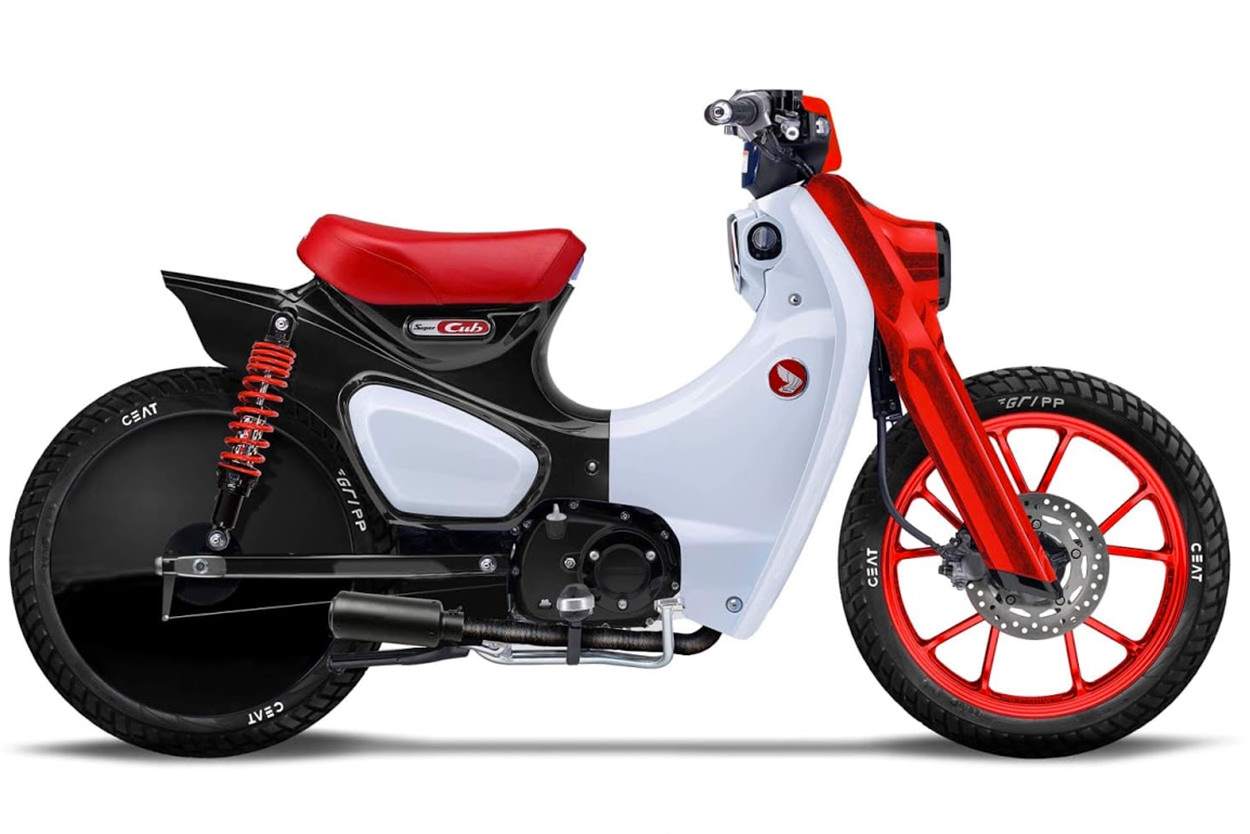
Honda Super Cub by Greaser Garage The Honda Super Cub may be small in size, but it’s massive in stature. It’s one of the best selling two-wheelers of all time, plus it’s also impossibly cute.

This custom job from Greaser Garage in Italy adds a dose of BMX style to the lovable Super Cub. Most of the work’s gone into the front end; the original leg fairings are still in play, but the middle section’s been replaced by hand-beaten aluminum. The pieces include new fork covers, and a headlight housing with an LED unit inside.

Custom Honda Super Cub by Greaser Garage
Higher up, the entire steering cluster’s been ditched for a completely custom setup. There’s a set of BMX-looking handlebars held by a bicycle bar clamp, motocross grips and a GPS-enabled speedo. (Look closely, and you’ll see that the turn signals have been integrated into the lower section of the bars.)

Out back, we can spot a bobbed rear fender with a built-in taillight, new shocks, and a race-style exhaust can. This Super Cub also wears dual sport rubber, and an aluminum rear wheel cover. What we wouldn’t give to park this little pocket-sized smile-machine in our garage! [More]

Custom Honda Super Cub by Greaser Garage


from Bike EXIF https://ift.tt/2zJ0F10