Saturday, 2 February 2019

2019 Mazda MX-5 Miata RF Grand Touring Review: Fabulous & Fun

97
Stellar
Overall Impression
Still hard to beat after all these years.
RF doesn't sacrifice the fun-to-drive character.
Pros
Price Point
Ride & Handling
Cons
Limited Cargo Space
Heavier Than The Soft Top

The Mazda Miata has been around for 30 years and the new MX-5 stays true to what made the drop-top so popular among enthusiasts. What’s better than dropping the top and going for a spin on the weekend? For around $35,000 you can have a dynamic sports car that’s second to none. We recently drove the 2019 Mazda MX-5 Miata RF Grand Touring with the Power Retractable Hard Top. And it didn’t disappoint. 

Our tester came with a sweet six-speed manual, proving the MX-5 is still a driver’s car. Let’s just say we enjoyed the manual gearbox to the fullest!

What’s New For 2019

The 2019 Mazda MX-5 Miata gets an updated engine with more power and a higher redline. The steering wheel now telescopes to better accommodate all drivers. Mazda also added new safety features, including Smart City Support and Traffic Sign Recognition.

Features & Options: Nice But Not Necessary

The 2019 Mazda MX-5 RF Grand Touring ($33,335) is equipped with adaptive headlights, heated leather seats, a cloth-lined top, an auto-dimming rearview mirror, automatic climate control, and automatic wipers. Mazda even threw in a navigation system. These features are certinately nice to have but strike us as contradictory to the Miata’s elemental nature. Then again, a power-folding top isn’t exactly simple either.

Our Grand Touring tester came with the optional GT-S package ($750) that added a front shock tower brace, limited-slip differential, Bilstein dampers, and a black-painted roof. The new i-Activsense package of safety features also came on our Miata.

Total MSRP including destination: $35,405. By contrast, the 2019 MX-5 Sport starts at $25,730 with a manual transmission; $27,080 with an automatic. The Sport is only available as a soft top. 
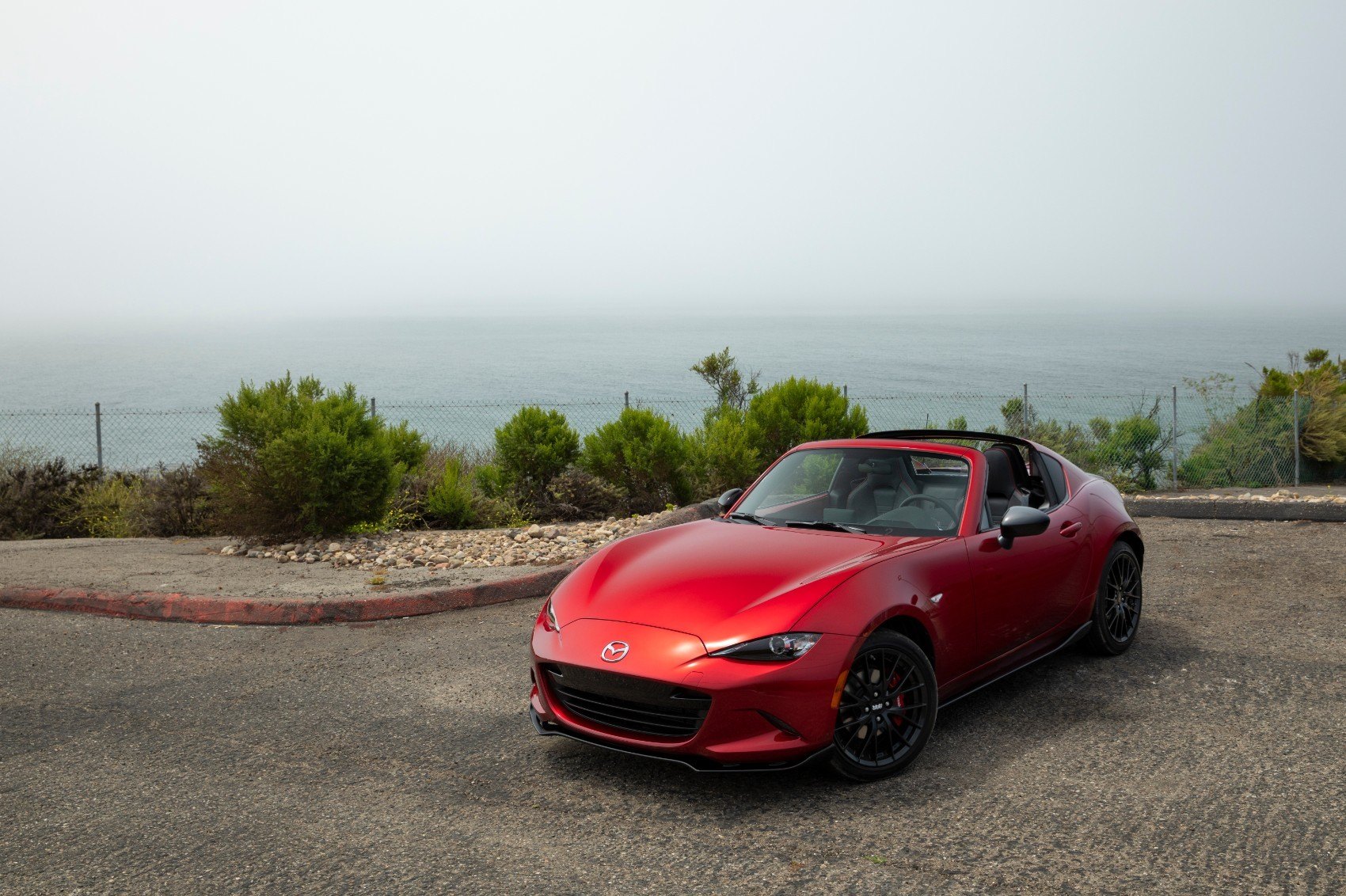
2019 Mazda MX-5 Miata RF.


Overall, the interior quality and appearance are far beyond what loyal followers will remember from previous generations.
Click To Tweet


Interior Highlights: Marked Improvements 

The cockpit’s fit-and-finish is tight and well-designed, with better material quality than past models. The Grand Touring’s leather seats are comfortable and the driver’s seat has a height-adjuster, making it perfect for those who want to sit up a bit higher. Overall, the interior quality and appearance are far beyond what loyal followers will remember from previous generations.

Once inside, the cockpit is roomier than it looks from the outside. The new Miata grew in all dimensions and we could tell there was more rearward seat travel. That makes it easier for taller drivers to adjust the seat far enough back. A six-footer still has a notch or two of travel left.

Interior Highlights: Wind In Your Hair! 

Our 2019 Mazda MX-5 RF tester came with the Power Retractable Hard Top (PRHT). The composite roof is convenient in that it lowers quickly via a button. Although, the biggest benefit of the hard top is the quieter ride: it reduces wind noise considerably versus a soft top. Even over the bumpy dirt road leading to my house, the hard top was relatively squeak-free with minimal outside noise.

And it only adds about 80 lbs. to an otherwise very light car.

It’s easy to operate. While in neutral, you just pop the inside handle at the top of the windshield; then touch a button on the dash, and in 13 seconds the top lowers itself into the trunk space. The roof does not reduce trunk space either.
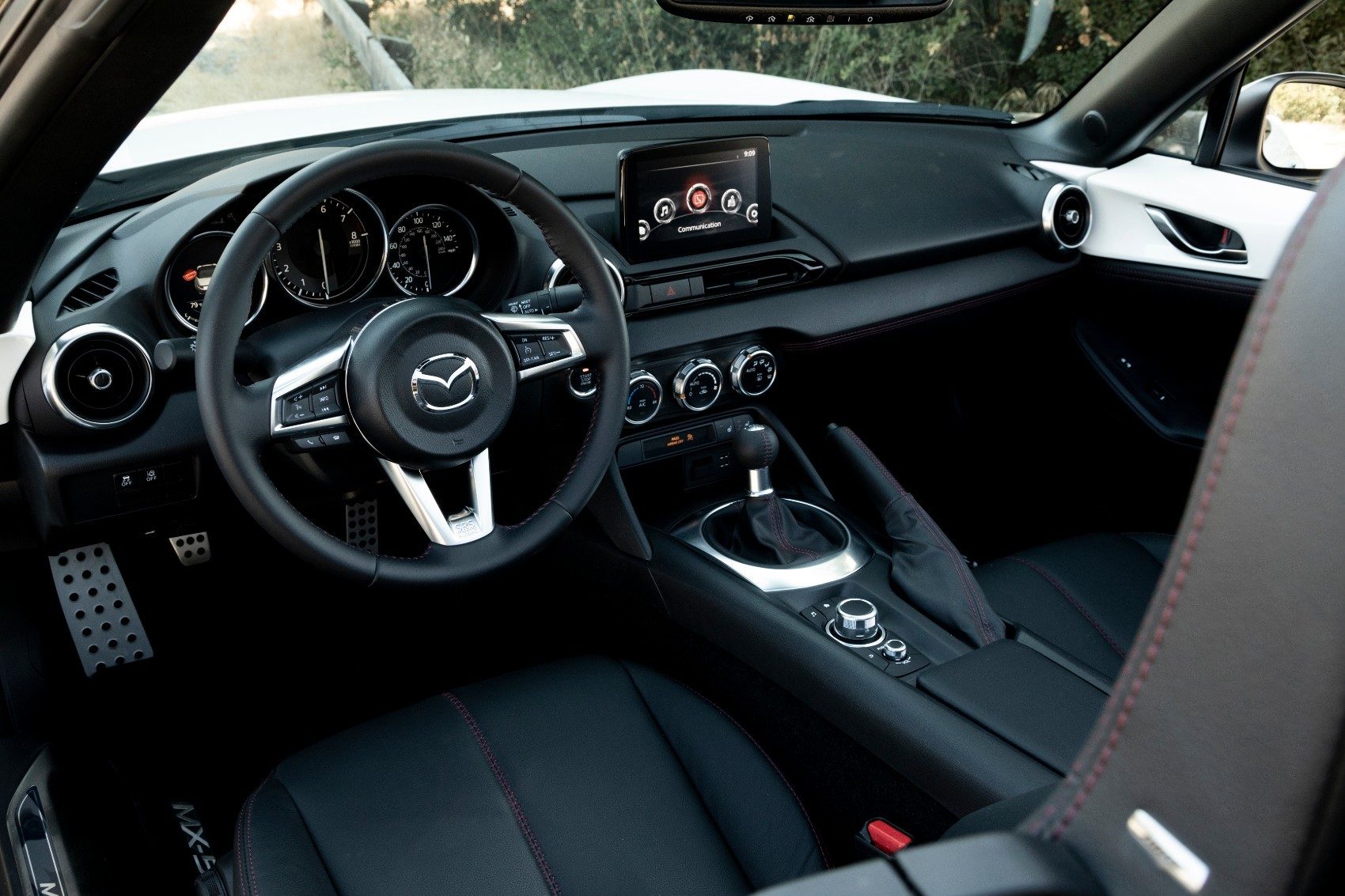

The new #MX5 #Miata stays true to what made the drop-top so popular among enthusiasts.
Click To Tweet


Engine & Fuel Mileage Specs

The SKYACTIV-G 2.0-liter engine now revs to 7,500 rpm, cranking out 181 horsepower and 151 lb-ft. of torque in the process. Miata fans may know that’s 26 more horsepower and three more lb-ft. of torque than last year. The new Miata sends the power to the rear wheels making it a true sports car. The revised final drive ratio from 3.454 to 3.583 makes for stronger acceleration.  

Of course, adding to that true sports car feel was the the six-speed manual gearbox. 

Fuel economy is an EPA-estimated 26/34 city/highway and 29 combined with the manual transmission. By comparison, the six-speed automatic returns 26/35 city/highway and 29 combined. For only a marginal gain on the highway, and considering the higher starting price of the automatic, we think the manual is the better choice. 

Total weight for the 2019 Mazda MX-5 Miata comes in at 2,453 lbs.
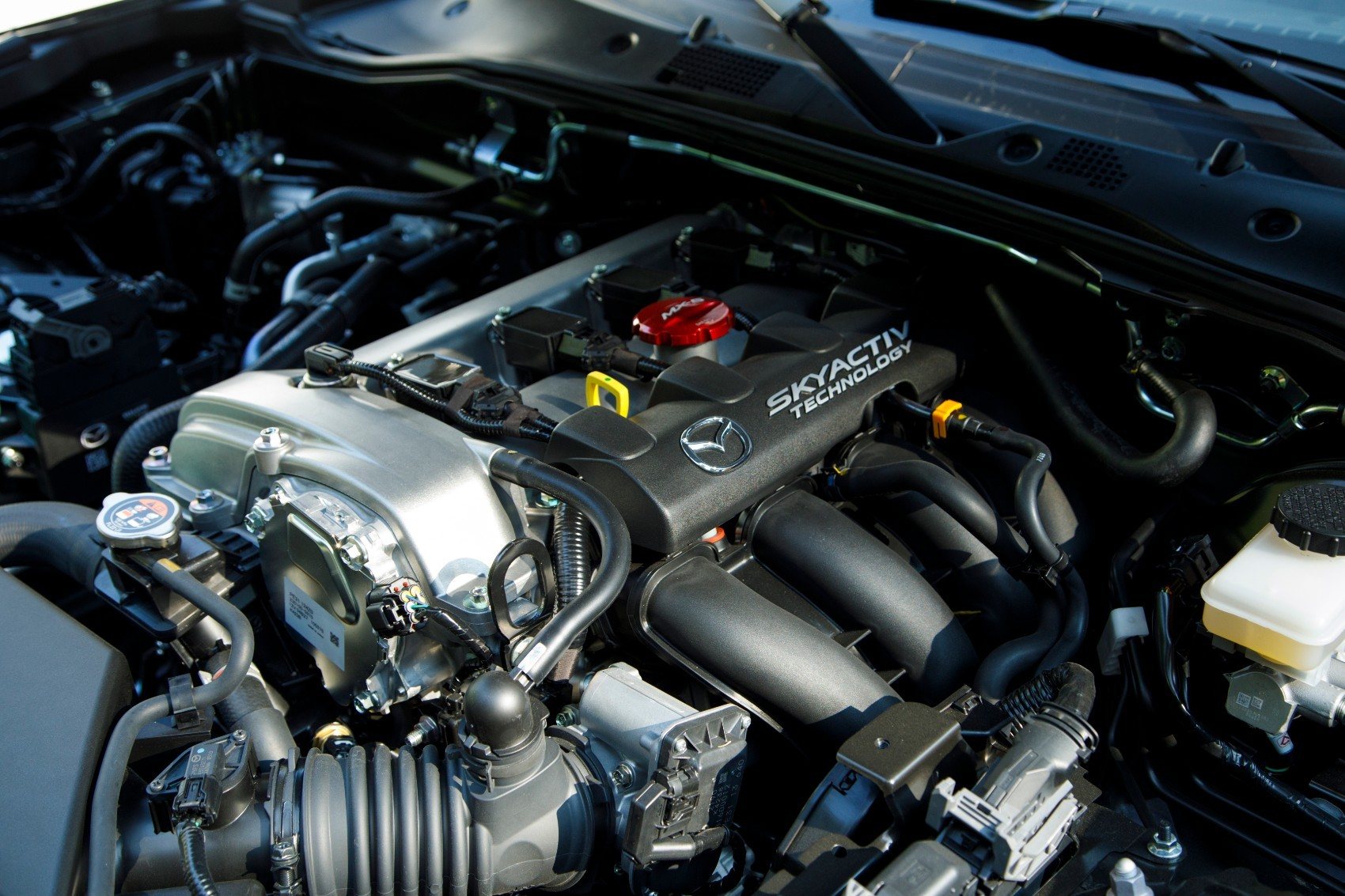

The #MX5 #Miata hugs the lines and handles like it's on rials!
Click To Tweet


Driving Dynamics: Tight Corners & Short Throws 

On the open road is where you can fully enjoy the MX-5’s reason for being. With the top down and the engine running on the twisty mountain highways, this roadster is hard to beat. The rear-drive Mazda MX-5 has an ideal weight distribution of 50:50. This alone preserves the excellent agility and balanced handling that has made this a favorite among enthusiasts for decades.

The Subaru BRZ or Scion FR-S rear-wheel drive coupes are the closest to the MX-5 in terms of driving fun, but they don’t offer a convertible.

The MX-5’s 2.0-liter four-cylinder revs freely and delivers good throttle response when you need it. The six-speed manual gearbox is the right choice if you like to drive. Mazda’s six-speed is one of the best manuals in the industry and worked flawlessly with the high-revving 2.0-liter powerplant. We thought it was easy to find the right gear with the short throws. 

Related: Could the Miata outpace one of history’s top muscle cars?
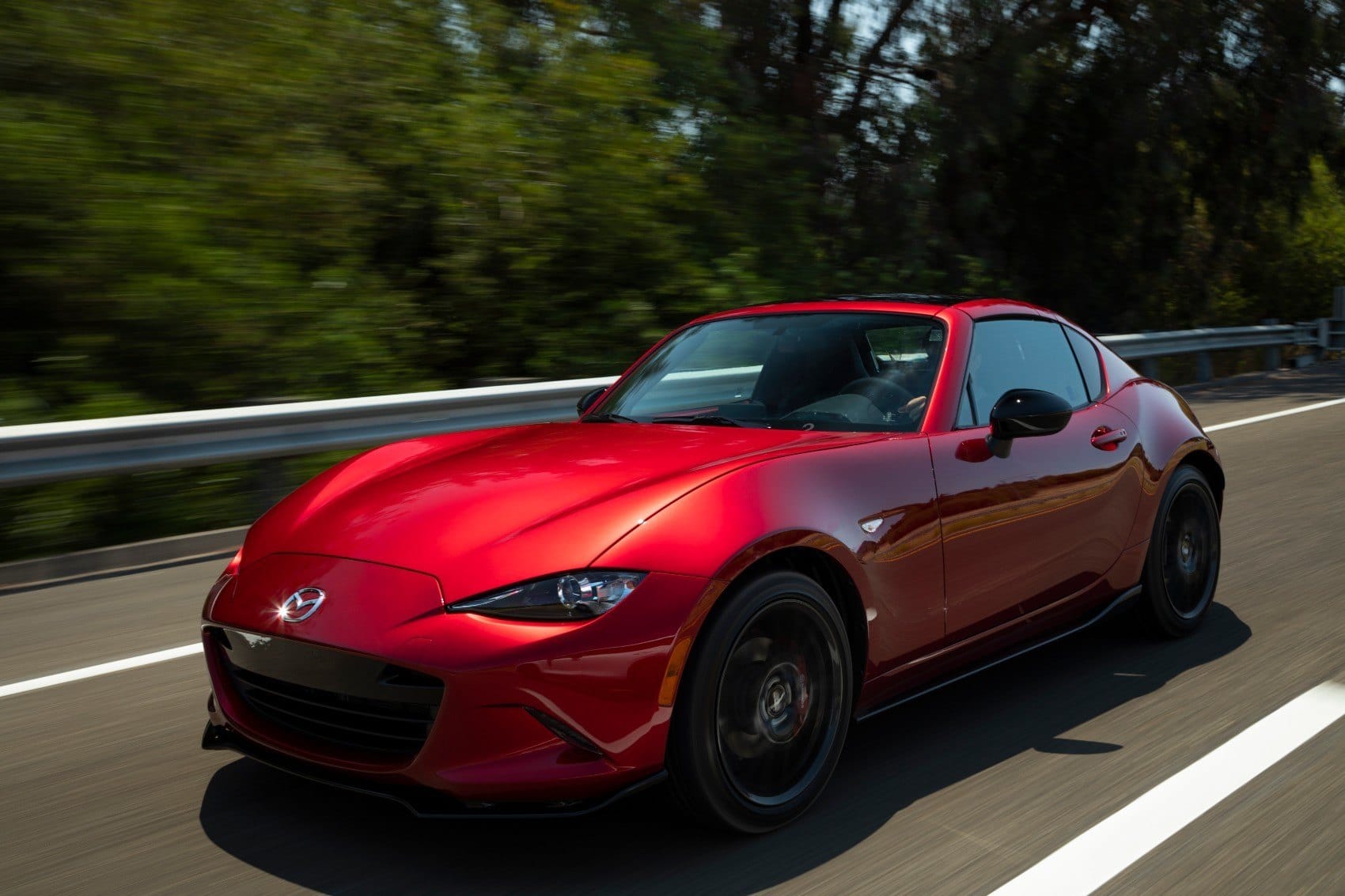
Driving Dynamics: On The Rails 

The 2019 Mazda MX-5 Miata has a wider track and lower center of gravity that enables it to corner flatter than you would think is possible. The Miata has always been a favorite car to take to the track. The next best thing for us, however, were the Colorado mountains. We took some tight corners at high speeds but the roadster held the curves without any body roll, staying flat and balanced the entire time. 

Our MX-5 tester came with the optional sport-tuned suspension with Bilstein shocks. With this upgrade, the MX-5 hugs the lines and handles like it’s on rials!

Unfortunately, we had the rear-drive sports car right before a winter snowstorm hit the Denver area. Luckily, this tester came with Bridgestone Blizzak winter tires which we would highly recommend for snow and ice. We were able to make it home safely before the snow piled up too deep.

And we were thankful we had a go at some dry roads before the snow fell! 
Conclusion: Affordable & Fun

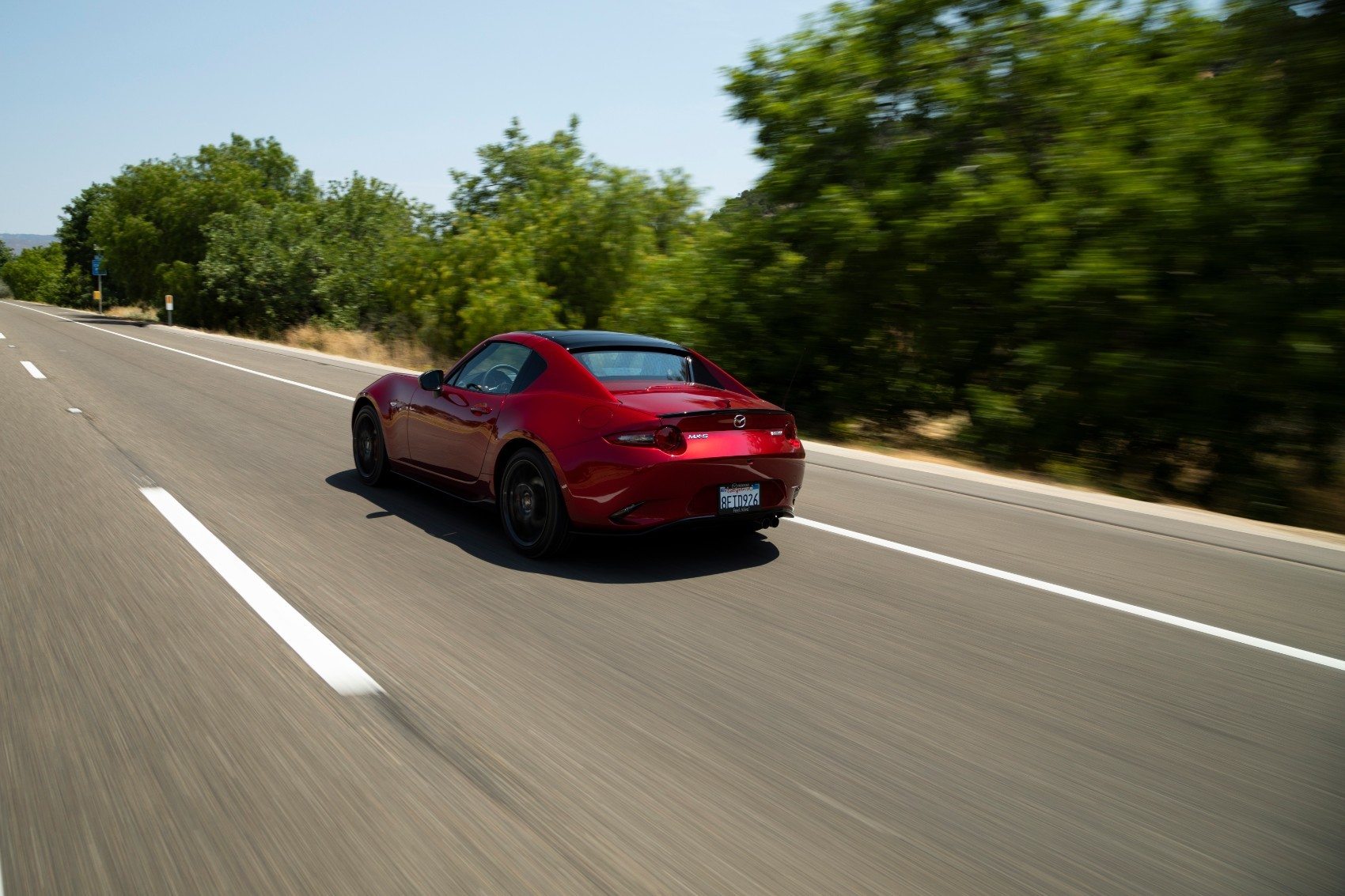
The two-seat, 2019 Mazda MX-5 Miata RF offers top-down driving enjoyment that much more expensive sports cars can’t exceed. Mazda has engineered an exceptional, affordable sports car that’s hard to beat. To this day, the Miata is still attractively priced and relatively easy to maintain; nor will it break your wallet at the gas pump.

We would recommend the RF with the Power Retractable Hard Top since it offers reduced wind noise and increased security.

For those wanting a sports car that offers excellent acceleration and braking; precise gearbox operation and suspension dynamics, the MX-5 Miata is an obvious choice. On the fun-to-drive meter, few can surpass it. 

Denis Flierl has invested over 25 years in the automotive industry in a variety of roles. Follow his work on Twitter: @CarReviewGuy

Mazda MX-5 Miata Fun Facts
Debut: 1989 Chicago Auto Show
RF: Stands for “Retractable Fastback”
5,000: Number of Miatas Raced Globally
April 2016: One Millionth Miata Produced
Weight Savings Per Component Versus 2018
Driveshaft: 3 lbs.
Suspension: 26 lbs.
Front Rotors: 14 lbs.
Transmission: 16 lbs.

2019 Mazda MX-5 Miata RF Gallery

Photos: Mazda North American Operations (additional models shown).


from Automoblog.net http://bit.ly/2sZKZmK

Friday, 1 February 2019

Got Lemons? Enter Yours In The Official Clunker Contest

  • Do you have a contest-worthy clunker of a car? 
  • Lemon Law Experts is holding a Clunker Contest with cash prizes.
  • If you suspect your car is a lemon, there is legal action you can take. 

There are many ways to describe them: jalopies, rust-buckets, hoopties – the list is endless. But call them what you will, there’s nothing quite like a clunker! No matter how much money you pour into them; no matter how many times you plead before starting them; a clunker is likely to let you down in the worst of ways.

But clunkers can have their redeeming qualities. Even though you won’t see a clunker with the pristine vehicles that encompass the typical auto show, that doesn’t mean we can’t celebrate them.

A Contest For Your Clunker

That’s what Lemon Law Experts is doing with their official Clunker Contest. If you think you have the worst vehicle on the road – a real rust-bucket and real money-pit of a ride – then you need to submit your car. You could walk away with a little spending money for doing so.

With their Clunker Contest, the Lemon Law Experts want to pay homage to the cars that have gotten us from point A to point B for years. These particular cars may not be beautiful, but they stay running with a little elbow grease and TLC (and a few miracles!).

When Life Gives You Lemons

The attorneys at Lemon Law Experts focus on lemon law, representing consumers who have paid for a car only to be burdened with problem after problem. Consumers may not realize they have legal rights if they buy a lemon from a manufacturer. Unfortunately, even though protections are available, as U.S. & World Report points out, automakers and dealers don’t necessarily make it easy to avail yourself of them.

The entire experience often leaves more questions than answers for unsuspecting consumers.

“I started the Lemon Law Experts a decade ago,” said Jessica Anvar, Founder & Managing Attorney. “What makes us unique from other law firms is that we have a number of star attorneys here who have had success in lemon law, and who are well-respected in the community.”

Have you done a “Frankenstein” and swapped parts from another car to keep your clunker running? The Lemon Law Experts want to know!

How To Enter

Submit a quick history of your vehicle’s mechanical quirks along with the pain each has caused you on the official entry page. Make sure to include a photo or two, and the funnier the better! In order to offset the all the money you have shelled out on your beloved clunker, the Lemon Law Experts are offering the following prizes:

First Place Winner: $250 American Express Gift Card.
Second Place Winner: $100 American Express Gift Card.
Third Place Winner: $50 American Express Gift Card.

All entries must be submitted prior to Wednesday, February 6th 2019. Winners will be announced that day. In the meantime, keep up with the Lemon Law Experts and the Clunker Contest on Twitter:@lemonexperts.

Have fun and remember: When life gives you lemons, enter them in the Clunker Contest! Good luck and may the worst car win!


from Automoblog.net http://bit.ly/2Tqxk3F

What if … Kawasaki had built a scrambler?

Kawasaki W650 scrambler by Mark Huang
Think of a classic scrambler, and a Triumph desert sled probably comes to mind. BSA and Matchless also made pretty good scramblers, and Honda had its CL series. But the other Japanese marques were noticeably absent.

This stunning W650 hints at the missed opportunity. What if Kawasaki had got down and dirty with its W series in the 60s and 70s? Machines that, after all, were copies of a BSA.

Kawasaki W650 scrambler by Mark Huang
This thoroughly hoon-able W650 scrambler is the work of Mark Huang, who runs a moto parts business in Taipei, Taiwan. He does small custom jobs month-to-month and a couple of full builds every year.

This scrambler is based on a 2004-model W650, and is packing a lot more custom work than you’d think. For starters, the frame has a new polished stainless steel backbone and subframe, joined to the original chassis via custom-made steel lugs.

Kawasaki W650 scrambler by Mark Huang
The effect is classy and neatly executed. The original chunky backbone was ground off just behind the steering head, but it’s been cleaned up beautifully.

Mark’s also tweaked the stance for a scrambler vibe: It sits a little higher now, with a 21” front wheel in place of the original 19” unit, and a new set of Koni shocks out back.

Kawasaki W650 scrambler by Mark Huang
The rear wheel still measures 18”, but both wheels are actually new. The guys built them up using vintage Triumph T120 drum brake hubs, stainless steel spokes, and rims from the Mark Motorcycles store stock.

That front brake is a stunner, but all the trick engineering is happening out back. The T120 originally used a left foot brake—so the crew built a linkage to operate the left side brake with the W650’s right-side pedal.

Kawasaki W650 scrambler by Mark Huang
Up top, you’ll find a classic BSA fuel tank, complete with its traditional center-mount system (hence the new frame backbone that accommodates it). It’s also been adorned with stainless steel sections at the front and back, for a little extra flair.

The seat’s custom too, and consists of a fiber-reinforced plastic base and leather upholstery. Together with the lengthy rear fender, it nails the retro desert sled vibe.

Kawasaki W650 scrambler by Mark Huang
Smaller upgrades and touches are littered throughout this W650. The carbs have been upgraded to Keihin CR35s, and the air box has been ditched for a pair of K&N filters. The exhaust is custom too; an elegant, high riding twin stainless steel system.

Mark also rewired the W650, repacking everything into a discreet battery box under the seat. The ignition’s been relocated, and there’s no speedo, leaving the cockpit very sparse. New parts include 1” bars, modded levers and basic switches—all from the Mark Motorcycles store.

Kawasaki W650 scrambler by Mark Huang
The headlight’s a small 4.5” unit, mounted on a custom bracket with a petite cowl finishing it off. A side mounted tail light and a full complement of turn signals round out the lighting package.

Other touches include a beefy engine protection plate, and our favorite bit: a military fuel can repurposed as a pannier.

Kawasaki W650 scrambler by Mark Huang
It’s a charming bike, made even more so by the top shelf paint job. Mark always works with Jeffrey at Air Runner Custom Paint—the same guy that paints Winston Yeh’s bikes.

The single tone blue seems basic, but just take a look at the shading on those graphics. And between the surfing octopus on the tank, and the penguin (from the movie Madagascar) on the pannier, there’s a healthy dose of playfulness here too.

Kawasaki W650 scrambler by Mark Huang
Mark tells us the bike’s owner is an outdoorsy guy—so we’re guessing he’s over the moon with his new ride. Wouldn’t you be?

Mark Motorcycles Facebook | Instagram

Kawasaki W650 scrambler by Mark Huang


from Bike EXIF http://bit.ly/2SfQLPx

Viaduct Elegy: Chapter 1: Walking With Blaine

Viaduct Elegy is a four-part series from Automoblog feature columnist Tony Borroz, who broke the law in preparation for writing it. He is a Seattle native and author of The 2018 Indy 500 Notebook and Bricks & Bones: The Endearing Legacy and Nitty-Gritty Phenomenon of The Indy 500, available in paperback or Kindle format. Tony grew up in a sportscar-oriented family, but sadly, they were British cars. 

Finally, finally, finally they are tearing down the Alaskan Way Viaduct, a colossal, monumentally-ugly, seismically-catastrophic piece of transportation “infrastructure” that has been a scar on the face of Seattle for the better part of a friggin’ century.

And yesterday I walked on it at sunset with an old friend, apparently breaking the law.

Viaduct Elegy: Chapter 1: Walking With Blaine

Most of my friends are artists. Painters, sculptors, photographers, raconteurs, theater types, dancers, gallery impresarios, experience technicians, graphic-novel slingers, art professors, filmmakers, experimental composers; a clan of asymmetric polymath misfits that fit in nowhere else but The Art World.

Chief among these is my friend Blaine. I’ve known him since college, when we were in a punk band together. He taught me to skate. He’s a good guitarist and an even better graphic designer, having a savant-like affinity for fonts and what “looks” and “works” and what would not do either justice. Spending time with Blaine, especially when we’re going from gallery to gallery, is a non-stop conversation about art. What it is and how it works. How it doesn’t work. How this painting fits in with what trends are going on, locally, globally, and historically. Blaine’s commentary is to the point and efficient. It’s the kind of conversation that two mechanics would have; we’re both speaking the same language and we use a lot of shortcuts.

“Well, no, not Picasso so much – Look, I’m not saying the guy shouldn’t go all Guernica, but . . . ”

Northwestern Charm & The End Times

Blaine has an arid sense of humor I always figured he picked up from his dad, a former fighter pilot and commander of a wing of intercontinental ballistic missiles. That drawled-out, dry punch line is never emphasized, only hinted at. His entire family are wise-cracking wisenheimers, and that trait landed on Blaine pretty hard. This is also a trait shared by most Northwesterners. It’s a great way to counteract the abysmal weather and to start bar fights with crab fishermen.

So, here we are, walking through downtown Seattle on a fine, sunny Saturday afternoon. Everything is eerily quiet and rather sparsely populated. Most times, there would be people out in droves, but on this weekend, the city, civic leaders, roadway engineers, priests, rabbis, and ministers all cried out “Stay away from downtown Seattle! Traffic will be terrible. The end is nigh! The Viaduct is closing!”

Smart people seemed to listen. Blaine and I did not.

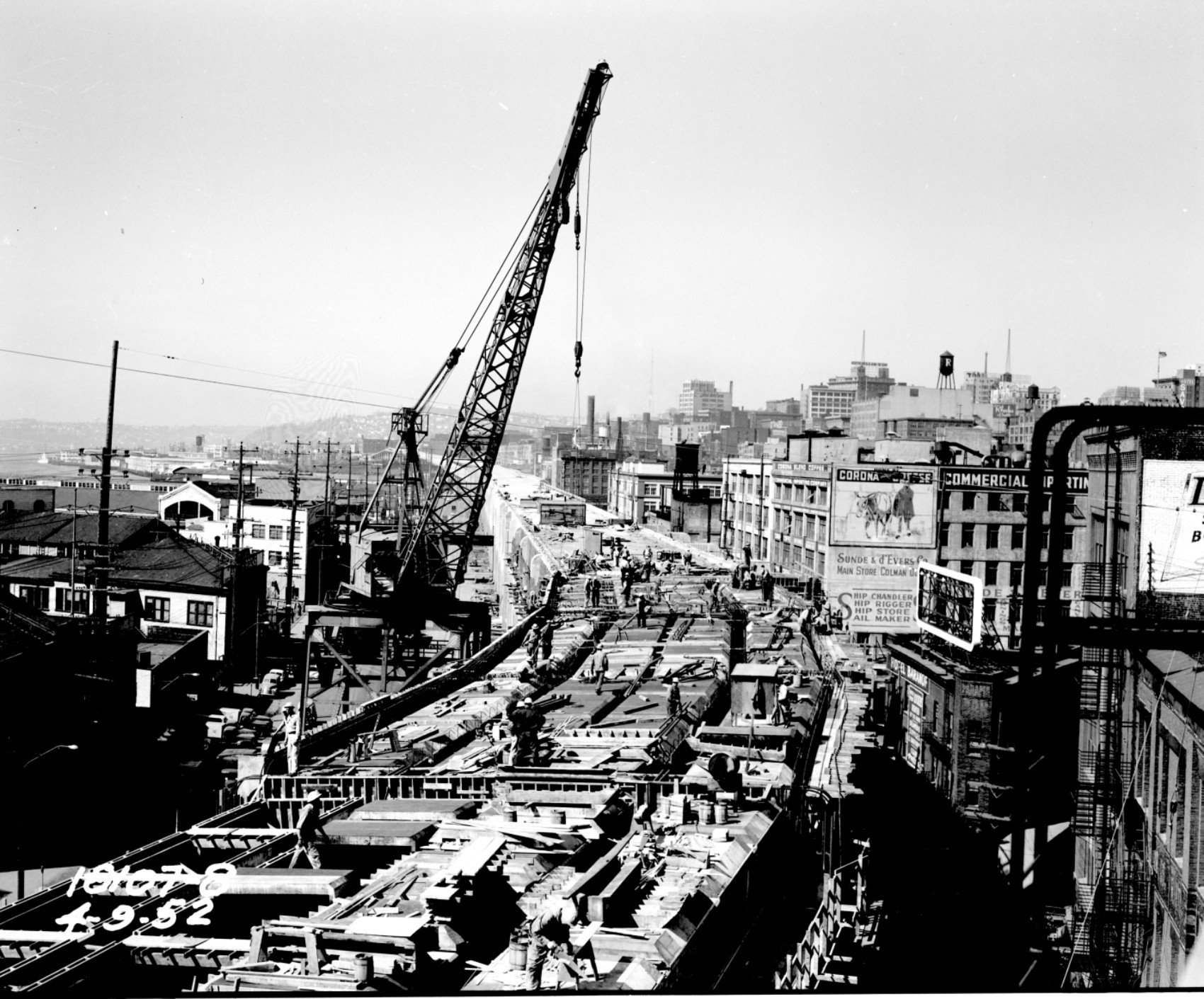
The Alaskan Way Viaduct was an elevated freeway in Seattle that supported State Route 99. The double-deck freeway ran north and south, along the city’s waterfront for 2.2 miles, east of Alaskan Way and Elliott Bay, and between the West Seattle Freeway in SoDo and the Battery Street Tunnel in Belltown. Construction consisted of three phases from 1949 through 1959, with the first section opening on April 4th, 1953. Photo: Seattle Municipal Archives.

Weasel’s Paradise

The lack of traffic did make getting around much easier. We could jaywalk with much more impunity. We were doing just that, ambling up Western Avenue, just out of the hulking shadow of The Viaduct, past the 619 building – a previously wonderful, old industrial building chocked full of artist’s studios. That only lasted until a few years back when the city declared the entire place unsafe, ran out scores of long-time artists in residence like so many bums . . . then turned right around, sold it to developers who renovated the place, jacked up the rents, and made money as quick as their Seattle ancestors sold gold panning equipment for 1,000 percent over retail 120 years ago.

Screwing people over, even if they are literally your neighbors, is a fine, fine Seattle tradition. It dates back to the founders of the place, the Mercers and the Dennys et al. when they twisted the Native Americans out of literally everything they had. And don’t get me started on how they treated Tacoma. Or that time they nearly started a war with Canada because the Mayor stole some totem poles from Vancouver.

“So where’d everybody go to?” I asked about the former inhabitants of the 619 Building.

“Georgetown, ” Blaine said. “Or Tacoma. Or Ballard.”

I was thinking about this eternal struggle of artists, of how you are always looking for cheap studio space, when Blaine suddenly stopped and turned to his left, “Hey, there’re people walking on The Viaduct.”

It was a party atmosphere amongst the people. Lots of groups of three and four and five people wandering here and there, taking selfies, posting to Instagram, on FaceTime with friends around the world. “Dude! Check this out! I’m walking on The Viaduct. No man, right now! Photo: Tony Borroz.


The lack of traffic did make getting around much easier. We could jaywalk with much more impunity.
Click To Tweet


Jesus Is Just Alright

There were a bunch of people, wandering on what used to be, and I mean less than 24 hours ago, a sort of junior freeway, three lanes northbound, and three lanes southbound on the lower deck. Now, it was completely closed off. Soon, within days, the jackhammers and big claws and such would start tearing into it like sharks into a whale carcass. Some months in the future, it will be completely gone.

Blaine and I glanced at one another, but we didn’t even have to say it. We just started walking and working our way up to the Seneca Street off-ramp, about three-and-a-half blocks away. Here’s a funny thing about Seattle: The big streets downtown are named, South to North, Jefferson, James, Cherry, Columbia, Marion, Madison, Spring, Seneca, University, Union, Pike, and Pine, their first letters matching in pairs: J, C, M, S, U and P. Or “Jesus Christ Made Seattle Under Protest.”

Yes, they did it on purpose. Yes, it was the idea of “city leaders.”

See, we’ve always been like this.

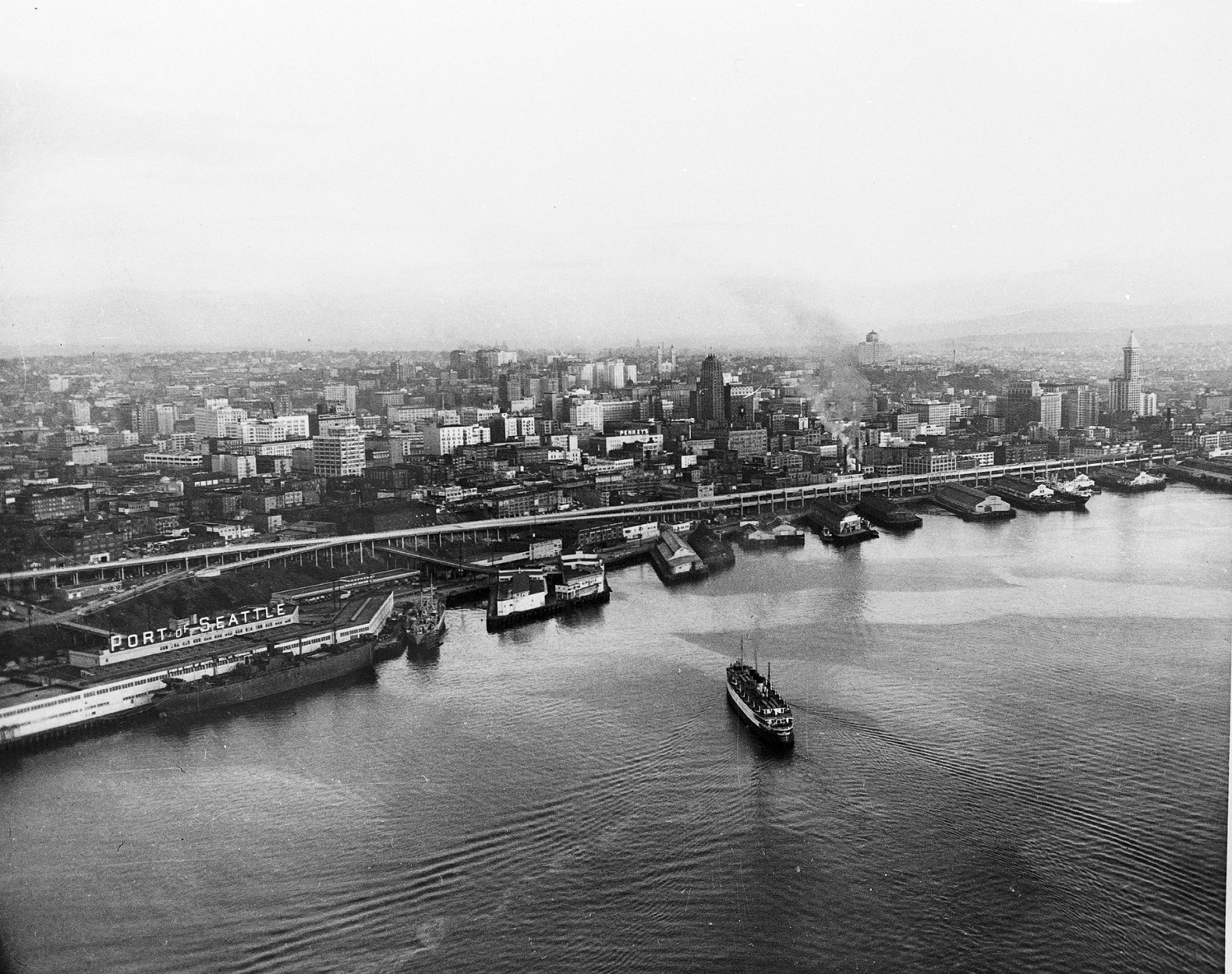
Seattle waterfront and skyline, circa 1952. Photo: Engineering Department Photographic Negatives, Seattle Municipal Archives.


Soon, within days, the jackhammers and big claws and such would start tearing into it like sharks into a whale carcass.
Click To Tweet


Middle Earth, Grunge Bands & Tech Billionaires

As we approached the Seneca off-ramp – one of only two ways off The Viaduct once you’re driving on it – we could see more people milling around on the upper deck. 100 . . . 150 . . . 200 . . . a lot more than I expected. At the bottom of the ramp where it meets First Avenue were sections of cyclone fence, and some not-very-threatening yellow tape admonishing us with “\\\DANGER///CONSTRUCTION///” There were a dozen or so PG&E workers severing power lines, a couple of bored cops, and a gap just big enough to walk through.

It wasn’t even a question. Over the years, Blaine and I have broken into so many parking garages, derelict buildings, movie shooting locations, punk venues (later escaping from those same punk venues), that blatantly disrespecting the authority of a length of yellow tape was easy. Besides nobody batted an eye.

We walked up the slight slope and onto the road deck itself. This is always a surreal experience. I should mention, this is not the first time I’ve done something like this, just the first time in this location. From a walking perspective, the place seemed wide open and flat.

You’re about 100 feet up in the air, facing directly West, right into the sunset over Alki Point in West Seattle. Sure, the weather is terrible and the city is screwed up, but it is very pretty around here.

Picture Middle Earth only with grunge bands and tech billionaires, and you’ll get the picture.

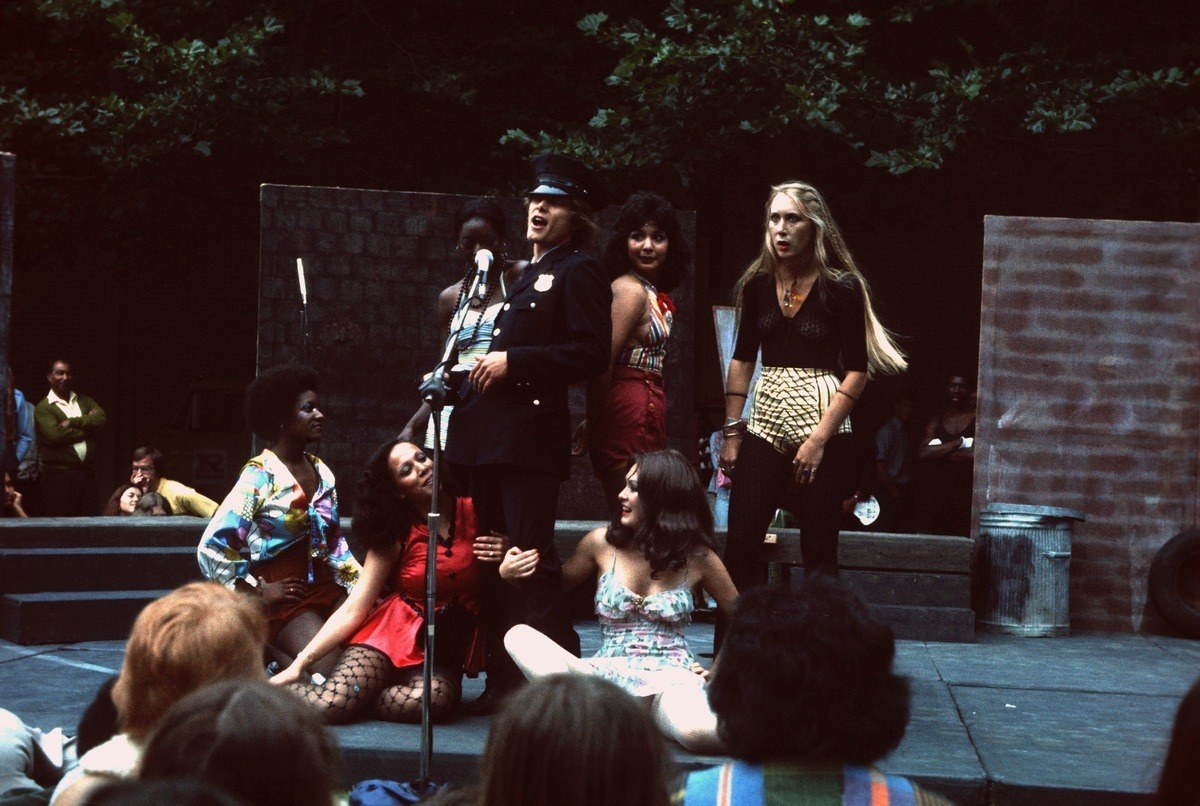
Performers at the 1974 Bumbershoot music festival. Photo: Item 77477, Bumbershoot Festival Records (Record Series 5807-05), Seattle Municipal Archives.


Picture Middle Earth only with grunge bands and tech billionaires, and you'll get the picture.
Click To Tweet


The Abyss of Seattle

Blaine stops and looks down at an expansion joint – I’m sorry, I mean he stopped and looked down through an expansion joint. Yes, it was cold, but not that cold. You could clearly see through the upper deck, then through the lower deck, and then to the surface of Alaskan Way below. The gap was huge, easily the width of my hand. Big pieces of the angle iron that faced the expansion joints were missing. Divots on either side of the gap were as big as loafs of bread. The road deck was rutted and grooved. There was a pothole deep enough to swallow my entire right foot.

And it wasn’t just this section, it was the entire length of The Viaduct – on both decks – that was chewed up like this.

Now on top of this, add a constant drizzle of rain on a 41 degree “day” and 10,000 angry, late, muddled, timid, unfocused, distracted (“the view”!), confused drivers, and you can imagine the Mad Max like texture a daily commute would bring. And with all those divots, potholes, expansion joints, poor expansion joints, lethal expansion joints, and sometimes good expansion joints, the grooves, ruts, spray from semi trucks and buses, and a road surface made out of greasy concrete and stone aggregate – well, you can guess what grip and traction were like.

And yet, overall, day-to-day usability is not what led to the demise of The Alaskan Way Viaduct.

Viaduct Elegy: Chapter Two: The New Colossus will be published here on Automoblog on Friday, February 9th, 2019. In the meantime, follow Tony Borroz on Twitter: @TonyBorroz. For more historic photos of the Alaskan Way Viaduct and the city of Seattle, visit the Seattle Municipal Archive’s Flickr page


from Automoblog.net http://bit.ly/2D0BdVX