Friday, 4 January 2019

2019 Chevy Traverse LT Review: Spacious But Lacking Elsewhere

88
GOOD
Overall Impression
Stable on the open road.
Transmission shifts smoothly.
Fuel economy lags behind competition.
Pros
Cargo Capacity
Passenger Room
Cons
All-Wheel Drive System
Lacks Important Driver-Assist Systems

The 2019 Chevy Traverse is ideal for growing families who need to carry extra cargo during the day. It received a complete redesign last year and gets more legroom in the second and third rows. In this regard, it’s set up well against its three-row Japanese competitors like the Toyota Highlander, Honda Pilot, Mazda CX-9, and the Subaru Ascent.

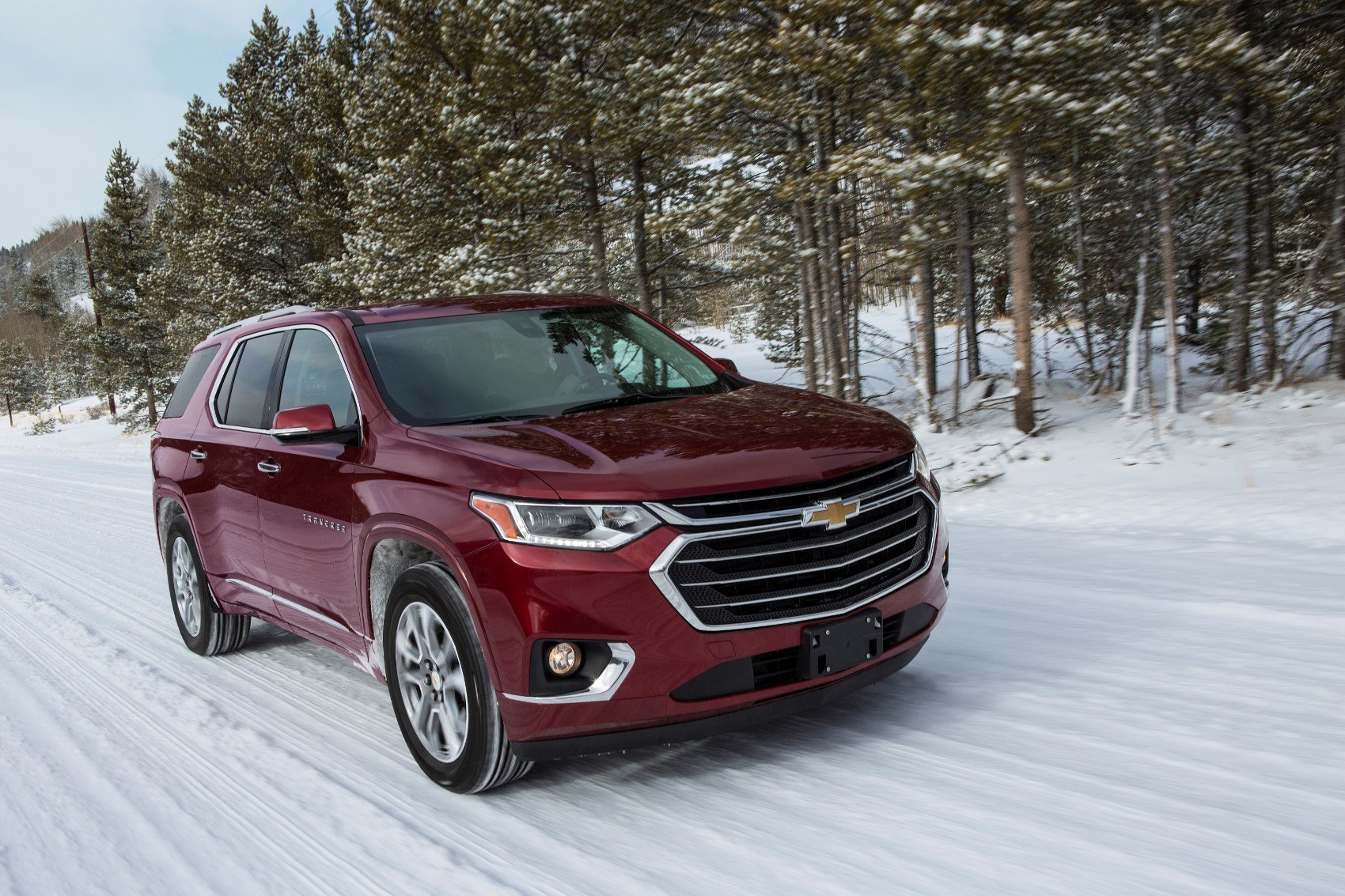
The Traverse is one of the roomiest three-row crossovers available. And that suited us well this week as we drove the 2019 Chevrolet Traverse AWD LT (Leather).

What’s New For 2019

The Chevy Traverse carries over unchanged for the 2019 model year but gets a newly available eight-inch touchscreen.

Features & Options: LT Packages Add Goodies 

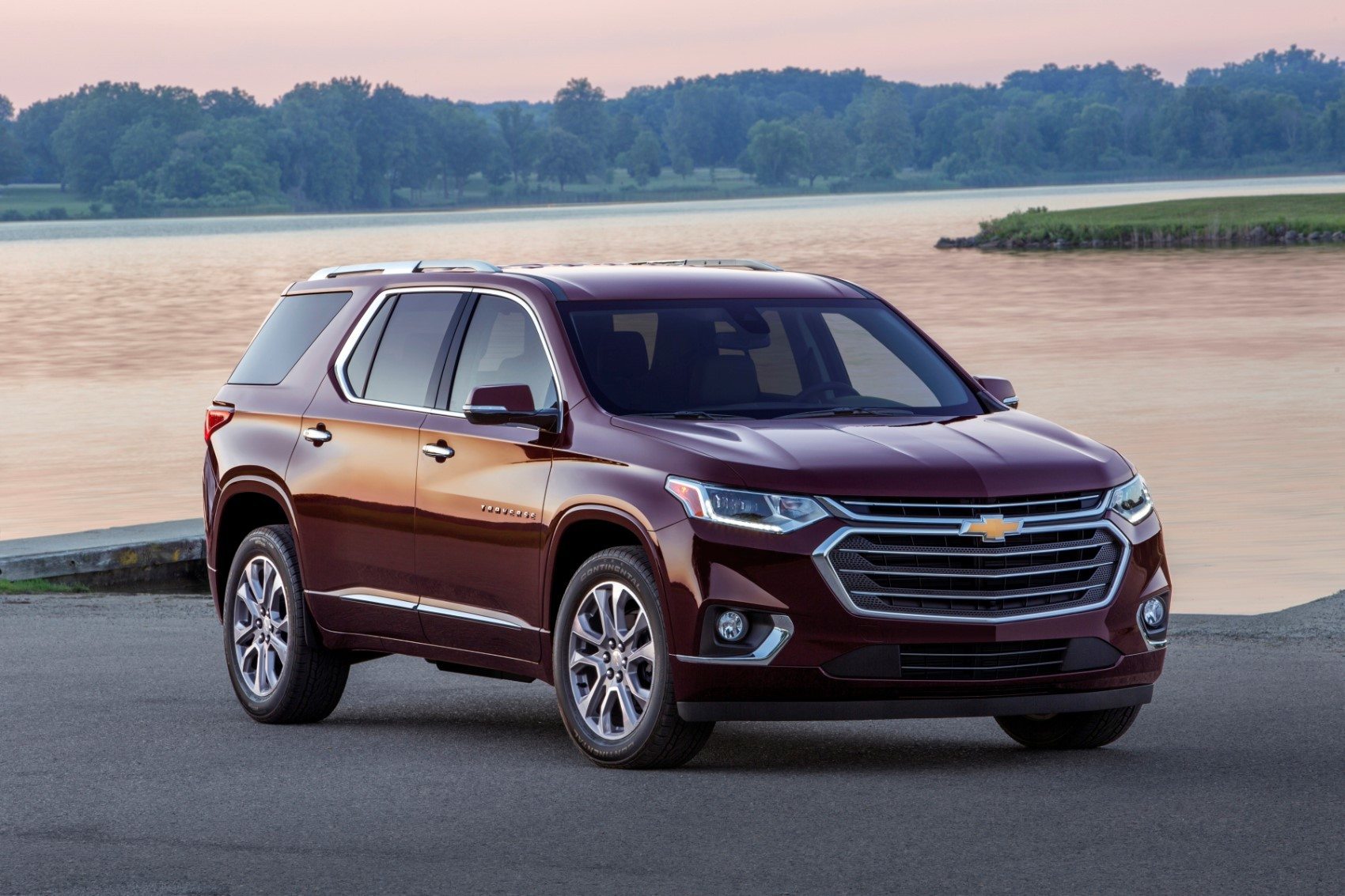
The 2019 Chevrolet Traverse AWD LT Leather ($41,000) comes standard with second-row captain’s chairs in place of a bench. This reduces seating capacity to seven but improves accessibility and comfort. The LT also gets roof rails, mirror-integrated turn signals, and a power-adjustable driver’s seat.

The LT also comes standard with leather upholstery, heated front seats, a power-adjustable passenger seat, color driver information display, power liftgate, and a remote start. Safety features include rear parking sensors, blind-spot monitoring, and rear cross-traffic alert. It does lack automatic braking like some of the competition, however. With the 2019 Chevy Traverse, some safety features are only available on the top trims.

The LT Premium package ($3,095) added 20-inch wheels, navigation, a 10-speaker Bose sound system, 120-volt power outlet, auto-dimming rearview mirror with a built-in rearview camera display, and a top-down parking camera.

Total MSRP including destination: $45,090. By comparison, the 2019 Chevy Traverse starts at $29,930. 

2019 Chevy Traverse.

Interior Highlights: Impressive Storage

Stepping inside the newly-remodeled Traverse reveals a big, comfortable cabin for active families. The Traverse is one of the largest vehicles in the class and it pays dividends for families on the inside. There’s abundant space for adults in all three rows, and getting in and out is easy. You’ll have plenty of room for car seats, sporting equipment, water bottles, the kids’ electronics, and anything else you need for the week ahead.  

It’s easy for someone of any size to find the perfect driving position with the eight-way power adjustable seat, although visibility out back is limited due to larger rear pillars. However, the rear cross-traffic alert and blind spot monitoring came in handy to help with the limited visibility.

Up front there’s lots of storage and the wide console is impressive.

In the second-row, the captain’s chairs are particularly appealing because it makes for easier to access the third row. Second-row passengers have more than 38 inches of leg clearance, with rear-seat riders getting 33 inches. Behind the third row, there’s a generous 23 cubic feet of cargo-carrying ability. With the third row folded flat, cargo space passes 58 cubic feet, reaching 98.2 cubic feet with only the front seatbacks upright.

Engine & Fuel Mileage Specs

The Traverse carries on with the same 3.6-liter V6 from before the remodel, but it gets an additional 29 horsepower. Totals now come in at 310 horsepower and 266 lb-ft. of torque. The engine couples nicely with a nine-speed automatic, a pairing that helps achieve up to 17/25 city/highway and 20 combined mpg with all-wheel drive. Front-wheel drive models improve to 18/27 city/highway and 21 combined. 

When compared to the competition, the 2019 Chevy Traverse ranks dead last in terms of fuel economy. Although not as large, the smaller Equinox does much better in terms of fuel economy.

Related: The new Chevy Equinox is perfect for city dwellers. Here is our full review.

Driving Dynamics: Stable But One Glaring Drawback 

The Traverse has sufficient power for any family and their driving needs. It’s not going to win any races, but who buys an SUV to be a performance car? The bigger Traverse feels stable on the open road, and we felt reasonably confident in the mountains west of Denver.  

Traverse comes with a smooth-shifting nine-speed automatic that never had to hunt to find the right gear. That’s not easy driving from Denver (5,280 feet) all the way up to 8,000 feet elevation. The 2019 Chevy Traverse handles and steers like most other large three-row SUVS. It leans a little in the corners but overall, it feels steady at highway speeds.

One drawback is the optional all-wheel drive system, which functions too much like a setup from the past. The Traverse has a truck-like dial on the console that can be switched from 2WD to 4WD. We like the full-time all-wheel drive systems you don’t have to think about. An all-wheel drive system that simply does the right thing when you need it, without driver input, is much better for families on the go. 

Overall we felt confident during our drive, but the all-wheel drive system on the 2019 Chevy Traverse feels a bit outdated.

Conclusion: Solid B+ 

Chevy took direct aim at growing families when they redesigned the Traverse. The LT comes nicely equipped and has plenty of passenger and cargo room. Overall, the Traverse is worth a look if you need a spacious family hauler.

Denis Flierl has invested over 25 years in the automotive industry in a variety of roles. Follow his work on Twitter: @CarReviewGuy

2019 Chevy Traverse Gallery

Photos: Chevrolet.


from Automoblog.net http://bit.ly/2Aw4Uho

Thursday, 3 January 2019

Winter Driving 101: The Complete Guide To Staying Safe & Ready

This winter driving guide includes: 

  • How to respond during an emergency.
  • Driving tips that will help keep you and your family safe.
  • A comprehensive checklist for getting your vehicle “winterized.”
  • Seven simple DIY maintenance items to watch during the winter.
  • What to place in your emergency kit, including something we all overlook.
  • How states are implementing new technology to help keep you safe when you travel.

Winter Driving 101: The Complete Guide To Staying Safe & Ready

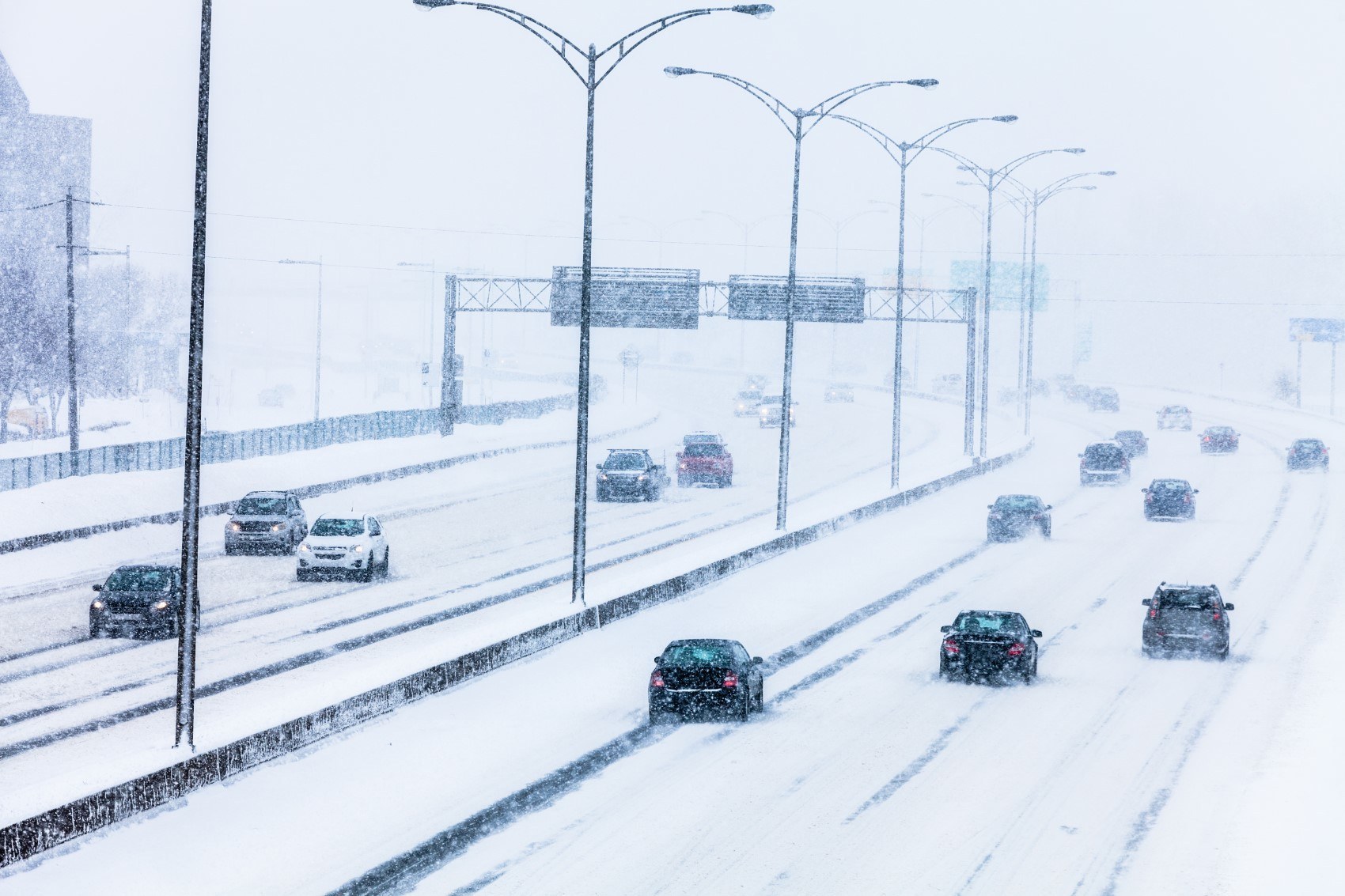
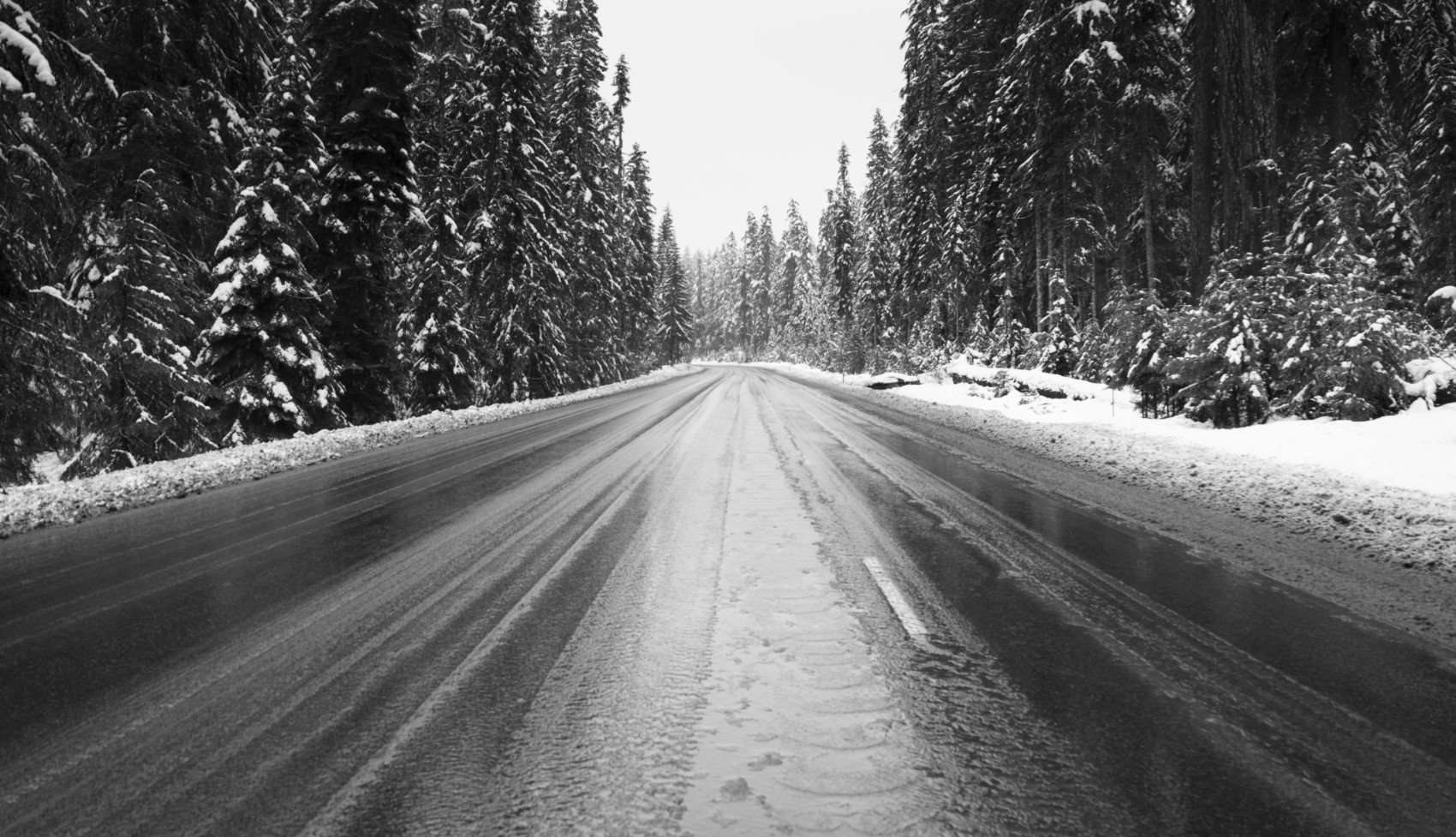
Driving during the winter is a challenge. How your car behaves on dry pavement is different than snowy or icy roads. And just like us, our cars can get grumpy when it’s freezing outside. But instead of being a winter worrier, let us help you become a winter warrior with our winter driving guide.

With this guide, you can better prepare your vehicle (and yourself) to tackle snow and ice more confidently. One thing that may come as a surprise is the actual number of accidents during the snowy season. Contrary to popular belief, there are not more crashes during the winter months.

“But those we see tend to be more serious,” explained Maureen Vogel, Spokeswoman for the National Safety Council. “Often, drivers do not realize how much they need to slow down when the weather is bad. Many tend to drive too fast for the conditions, which can lead to unnecessary crashes.”

However, driving at a slower speed is not the only factor to consider when it’s snowing. This winter driving guide will give you an in-depth look on how to properly prepare for snowy weather.

Vehicle Safety Checklist: 4 Essential Points

Let’s start this winter driving guide by examining the condition of your vehicle. It’s best to do this before the snow falls, or before taking any long journey this winter.

#1. When Was Your Last Service

Breaking down is bad enough but getting stranded in the winter cold is another thing. Start by visiting your local mechanic or dealership for an inspection and any routine maintenance items you may have overlooked. This includes changing the oil and other fluids, repairing leaks, drive belts, or replacing worn out parts.

When it comes to replacing parts, always prioritize safety items first. Brakes, tires, wheel bearings, and other suspension components can have a direct impact on safety if left unchecked. When in doubt, ask your mechanic to explain how the part that needs to be replaced functions, and if it impacts your safety.

#2. Check For Existing Safety Recalls

With safety in mind, the next thing you want to do is check your vehicle for outstanding safety recalls. If it’s something serious, the problem might be more dangerous during freezing weather. In order to check if your vehicle is affected, go to the NHTSA Safety Issues & Recalls page.

Using the site is relatively easy. Enter the VIN number or the make and model of your car and go from there.

#3. Buy Your Vehicle Some New Shoes

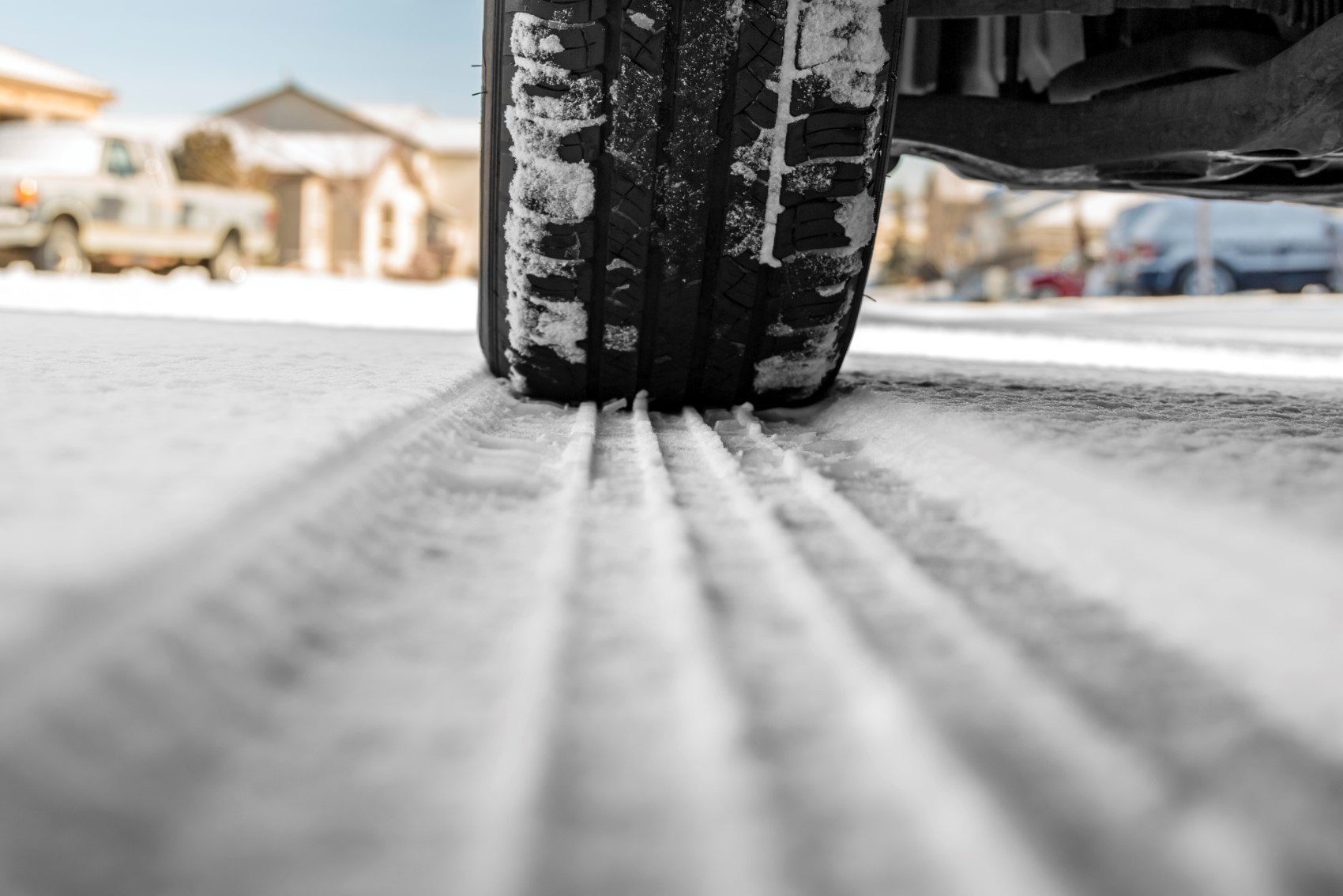
Your tires are the only things keeping you in contact with the road, and they’re even more important during slippery conditions. It’s crucial to make sure they’re up to the task. Tread depths and designs are primarily engineered to generate traction on wet or snow-covered pavement. The more “depth” your tires have, the better the traction. As a general rule of thumb, make sure to replace your tires when the tread depth drops to 4/32”.

But what about snow tires? Are all-season tires good enough to handle winter driving? Not necessarily.

“If temperatures are generally above 15°F and there is only light to moderate snowfall, all-season tires may be adequate,” said Michael Calkins, Manager of Technical Services at the American Automobile Association or AAA. “However, if you live where temperatures are frequently below 15°F and there are regular storms that deliver several inches of snow, then snow tires will provide definite traction, handling, and safety benefits.”

Snow tires are manufactured using softer compounds that provide adequate grip in freezing temperatures. Snow tires also have aggressive tread designs with various biting edges or sipes to offer better traction. In some cases, snow tires will come with metal studs for increased traction over and through deep snow.

“If your car slips and slides on snowy or icy pavement, it is hard to accelerate and brake without spinning or locking the wheels,” Calkins said. “Or if the car doesn’t want to track smoothly through corners without losing traction at the front or rear, snow tires will be of huge benefit in this regard.”

#4. Got Air? Check Tire Pressures

Did you know tire pressures drop an average of two PSI for every 10-degree drop in ambient temperature? This means the amount of air inside the tires is just as important as the tires themselves.

However, dropping the tire pressure is not necessarily a bad thing when tackling icy roads. Having the tires a bit underinflated in low-traction conditions will actually help generate more traction. But how low can you go? Check the owner’s manual for the recommended range of tire inflation pressures. Vehicles today also have the recommended tire pressures printed in a chart-like box inside the driver’s side door jamb.

We highly advise you to check the tire pressure before traveling and during every fuel stop if you deem it necessary. With that in mind, always keep a tire pressure gauge handy. Most cars today are also equipped with a Tire Pressure Monitoring System, or TPMS for short. If a tire drops too low, you will receive a warning light on your dashboard.
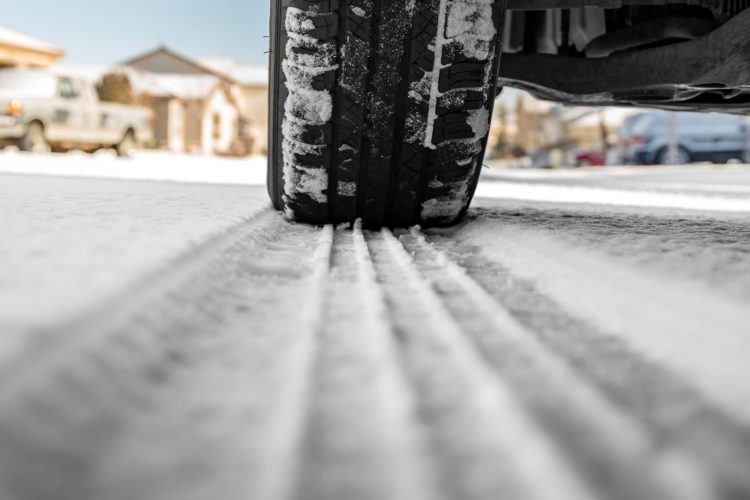
A new set of tires is one of the best defenses against winter weather.

7 Simple DIY Maintenance Items For Winter Driving

Even if your car and the tires are in relatively good shape, there are still a couple of DIY maintenance items to check. We’ve included these in our winter driving guide because they are easily overlooked.

#1. Check The Battery

Batteries lose their charge faster when they’re cold, making it harder to crank the motor during the winter season. If you see cracks or damage on the battery casing, replace it immediately. You can also use a multi-meter to check the voltage of the battery. If the reading falls below 12.40 volts to 12.75 volts, it may be time for a new battery.

And while you’re at it, make sure the battery cables are tight to ensure a perfect start the first time around.

#2. Check The Coolant Reservoir

The name “coolant” is a bit misleading. In truth, coolant primarily lubricates all the metal and aluminum parts in the cooling system. This includes the radiator, water pump, and other critical internal parts. Coolant or antifreeze will also prevent the liquid from hardening or freezing inside the cooling system. If the temperature is forecasted to fall below freezing, consider flushing the cooling system and refilling the radiator with a 100 percent concentration of antifreeze.

As for how often you should do this, it’s best to consult either your local mechanic and/or the owner’s manual. The schools of thought on this vary greatly but it’s an important maintenance item nonetheless.

#3. Wiper Blades Are Important

As a general maintenance rule, you don’t need to wait for the windshield to get streaky before replacing the wiper blades. This is a low-cost solution that will help you see easier in adverse weather.

#4. So Is The Washer Fluid

You will end up using a lot of windshield wiper fluid during the winter. Make sure to fill up the reservoir with winter-formulated fluid before setting off. It is a good idea to check the reservoir every time you stop for gas. Keep a reserve jug of fluid (or two) in your trunk.

#5. Check All Exterior Lights

This includes the headlights, taillights, signal markers, and hazard lights. If one or more of the bulbs are defective, replace them before driving off.

#6. Fill Up Often

We generally recommend keeping your gas tank at least a third full when driving in the winter. If the weather is really bad, the tank should be at least half full. If you find yourself stranded, a full tank means the engine can run and you can stay warm. Of course, this is also insurance against running out of gas on an icy and frozen road.

#7. Change The Floor Mats

Rubberized floor mats are ideal for winter driving. They can trap dirt, snow, and slush without staining or wetting the carpets underneath. Rubber floor mats are also much easier to clean. However, only buy the correct shape and size mats for your vehicle, and make sure to install them correctly. Improper installation will interfere with the gas and brake pedal as you drive.
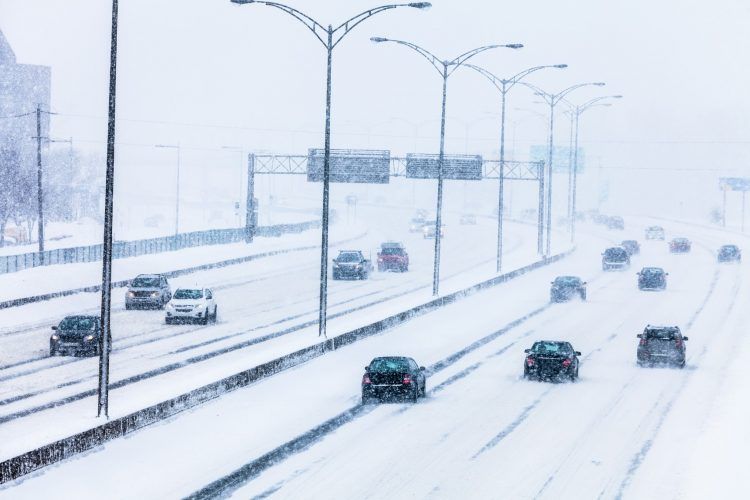
Prepare An Emergency Kit & Get An Atlas

In a recent study conducted by Siegfried & Jensen, 62 percent said they feel prepared in the event of a breakdown. However, that same study found people carry just four of the eight emergency items recommended by DMV.org.

“This research goes to show how gravely underprepared drivers are for accidents on the road,” said Ned Siegfried, President of Siegfried & Jensen. “This misplaced confidence suggests there isn’t enough being done to educate drivers about how to get their vehicles ready.”

Siegfried & Jensen also found that less than a quarter of Americans keep paper maps in the glovebox, and only 11 percent have a sat nav, suggesting drivers rely overwhelmingly on smartphones for directions. But as signals can disappear in remote areas and batteries can die after several hours in the cold, having a traditional road atlas handy like our grandparents always did is good advice for the winter months.

“Although getting lost without access to a map or being stuck on the side of the road for a couple of hours can be a minor annoyance, it’s crucial to prepare for more serious accidents for the safety of all road users,” Siegfried said.

As for your emergency kit, it should include: a flashlight, jumper cables, salt or kitty litter, a small shovel, scraper, flares or glow sticks, matches or pocket lighter, candles, food and water, medication, an extra set of clothing, spare blankets, and an extra cell phone. Include anything else you think will best serve you in the event you are stranded.
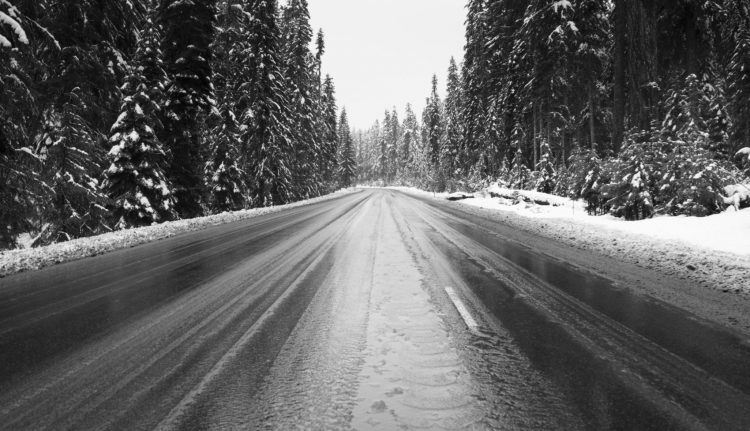
Less than a quarter of Americans keep paper maps in the glovebox. In remote areas, this could be problematic as smartphones can lose signal.

Driving In Snow & Ice: 5 Critical Things To Consider

Now that your vehicle is in tip-top shape and your emergency kit and atlas are packed, here are five tips to help you safely arrive at your destination.

#1. Obey The Speed Limit

We cannot stress this enough. Driving at high speeds, especially on slippery roads is dangerous.

“The majority of traffic crashes in the winter can be attributed to driving too fast for the conditions of the roadway,” said Jim Flegel, Special First Lieutenant, Michigan State Police. “Drivers must obey the basic speed laws and must operate their vehicle at a careful and prudent speed taking into account the road and weather conditions at all times.”

And always keep a safe distance from the other vehicle in front of you.

“By adhering to the basic speed law, the driver will be able to properly maintain control of their vehicle and will be able to stop within the assured clear distance ahead,” Flegel added. “The only compensation that will work when driving on slippery roads, is to slow down and increase your following distance.”

#2. Avoid Distracted Driving

Driving over slippery or icy surfaces is bad enough, and doing it while distracted will severely increase your chances of an accident. Make no mistake about it. Distracted driving kills and it’s a worldwide problem. Never text, call, or operate a smartphone or mobile device as you drive. Even just a half-second of distraction can mean the difference between life and death.

#3. Always Drive Sober

Alcohol and other drugs will significantly impair your motor skills, reaction time, and judgement. Your brain needs these things in order to get you home safe during the cold winter months. Know your limit and always designate a sober driver before heading out.

#4. Electronic Traction Control

Keep the stability and traction control (ESC and ETC) on at all times. These safety features will assist you if you find yourself skidding, sliding, or spinning.

#5. Plan Ahead

Even if the weather conditions are generally calm from where you are, it might not be the same upon reaching your destination. In Michigan, travelers can see the location of plow trucks in real-time across the state. The trucks even have on-board cameras so you can see what the plow operator sees.

Pennsylvania’s Where’s My Plow? and North Dakota’s Track-A-Plow are similar programs. North Dakota Department of Transportation Director Tom Sorel believes we should use the advancements in technology to our advantage.

“This is one more piece of information that travelers can use to see what is happening on the highways and make more informed decisions when making travel plans,” he said.

Check your home state’s department of transportation website to see if a similar program exists in your area.
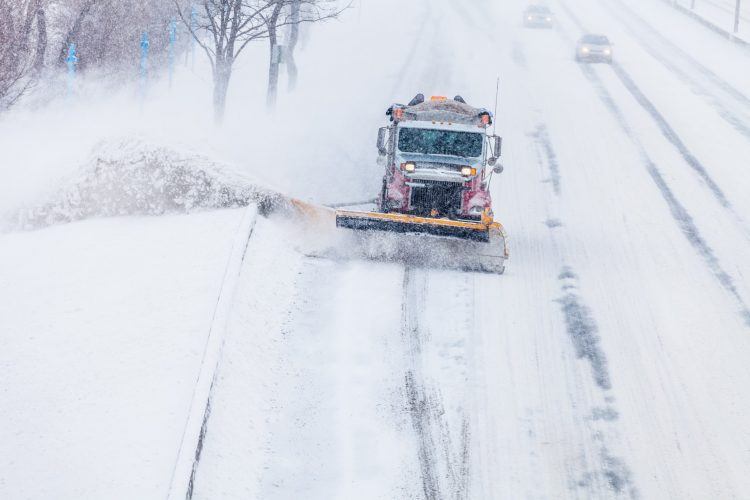
States like Michigan, North Dakota, Pennsylvania, and Virginia offer residents a free plow tracking service through their respective transportation departments. The programs can help residents better prepare for winter driving.

What To Do During An Emergency

If something bad happens, do NOT panic. Check if you or your passengers are injured, then follow the Steer It, Clear It rule.

“If you are not injured and the vehicle is drivable, immediately move the vehicle from the traveled portion of the roadway to the shoulder or other safe location,” Flegel said.

The next thing is to call 911 or roadside assistance.

“Take good note of your location, including the mile marker if you’re on the highway, to ensure they can easily find you,” Vogel advised.

Here are other important things to remember if you end up in the middle of the road after an accident:

  • Stay inside the vehicle with your seat belt securely fastened.
  • Activate your four-way emergency flashers to warn other drivers.
  • If you must leave your vehicle, be extremely aware of passing traffic.
  • Walk directly to a safe location away from the traveled portion of the roadway.
  • Call 911 and report the crash, giving the dispatcher specific details about the location.
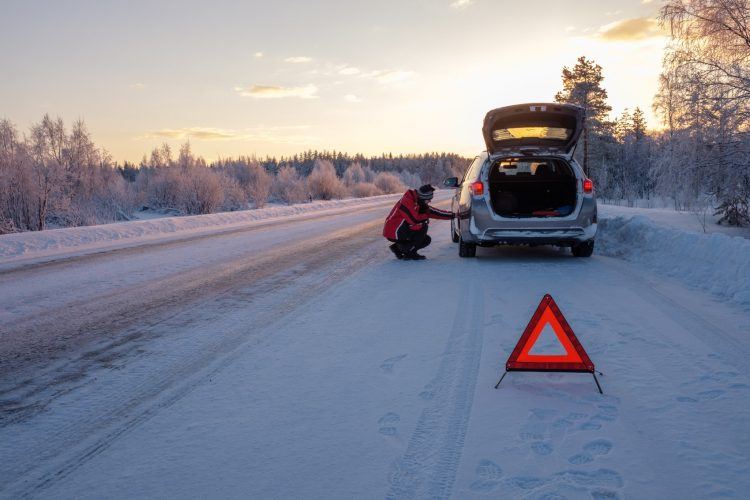
In the event of an emergency, do not panic. Try to remain calm.

Putting It All Together

Colder months can be safer and easier if you follow the advice in this winter driving guide. You may never predict what another driver will do at any given moment; you may not be able to predict the weather, but it helps to remain alert so you can anticipate any curve balls along the way.

“Be a good defensive driver so you can continuously scan for other motorists losing control and crossing the centerline,” Flegel concluded. “Check the weather report, leave early if necessary, and let others know your route and anticipated arrival time.”

“Winter presents all kinds of challenges. As a general rule, stay inside if it’s bad outside,” Vogel added. “Our roads are risky even when conditions are clear – add inclement weather to the mix and you increase your risk of a crash.”

Additional Resources

NHTSA: Tips for Traveling Safely.

AAA Exchange: Winter Driving Tips.

OHSA: Prepare, Protect, Prevent: Safe Winter Driving.

Michigan.gov/FEMA: How To Prepare For a Winter Storm (PDF Packet).


from Automoblog.net http://bit.ly/2QjMx4o
Dakar style: A Yamaha Super Ténéré restomod from Italy

A Yamaha Super Ténéré restomod from North East Custom
This Sunday, the Dakar Rally kicks off again. If you suffer from rally fever but don’t have the stones to actually race through Peruvian deserts, let this Yamaha Super Ténéré be your medicine.
First produced in 1989, the twin cylinder XTZ 750 Super Ténéré was the big brother of the XTZ 660 Ténéré. Both bikes were named after a notoriously difficult, sandstorm-prone section of the Sahara desert, which featured on the Paris-Dakar route in the 1980s.

A Yamaha Super Ténéré restomod from North East Custom
This 1992-model XTZ has been reworked by North East Custom, a shop in Padua run by brothers Diego and Riccardo Coppiello. They’re not twins, but it’s impossible to tell the two bearded Italians apart—and they both like anything with knobbly tires.

So although they don’t exclusively focus on off-roaders, they have a real affinity for the genre. (Their stunning Yamaha XT500 restomod was a showstopper at our Wildays stand last year.)

A Yamaha Super Ténéré restomod from North East Custom
Here, they took everything good about their customer’s Super Ténéré, and amplified it. “The idea was to bring to life the ‘desert spirit’,” explains Diego, “while adding a fresh touch, to make it more modern and slender.”

The most obvious change is up front. North East have binned the Yamaha’s original fairing in favor of something more svelte, and more akin to modern rally bike designs. The new unit was hand-built using fiberglass, and designed to incorporate the original instruments and headlights, with a new acrylic glass cover to protect the beams.

A Yamaha Super Ténéré restomod from North East Custom
Even though it doesn’t look like it, the Super Ténéré’s practical 26-liter fuel tank is still in play. And Diego and Riccardo designed their new fairing to attach via OEM mounting points, so that they could attach it to any XTZ 750 without any hacking.

All the bodywork further back is custom. North East built new side covers, and a sharp new rear fender. Then they matched it up to a custom saddle—shaped like a modern enduro bike seat and covered in vinyl.

A Yamaha Super Ténéré restomod from North East Custom
It’s a super-neat arrangement, capped off at the end by a slim LED taillight, and a license plate bracket that also carries a pair of LED turn signals.

Take a look at the space between the side panels and rear fender, and you’ll spot a pair of red plates. Remove those, and you’ll find an array of mounting points that the brothers have welded to the frame, designed to carry a variety of luggage accessories. Clever stuff.

A Yamaha Super Ténéré restomod from North East Custom
As for the rest of the Super Ténéré, North East have upgraded all the right bits—and left alone the bits that work.

There’s a new Bitubo shock out back, with Bitubo springs giving the front end a boost. The wheels are stock, but wrapped in new Continental TKC80 rubber. And the brakes have been treated to new discs, and a Brembo master cylinder up front.

A Yamaha Super Ténéré restomod from North East Custom
The motor is stock, but North East put it through some routine maintenance. They also upgraded the air filter to one from K&N, and re-jetted the carbs with a Dynojet kit. The exhaust is a mash-up of Arrow headers and a modified Virex silencer.

North East have taken care of the smaller details too. A pair of spotlights is mounted low down for maximum nighttime visibility, and there’s a single mirror that can fold away when you venture off-road. And since the bike’s not meant for professional rally racing, there’s a Givi phone case and mount where you’d normally find a road book.

A Yamaha Super Ténéré restomod from North East Custom
As for the livery, Diego and Riccardo shunned the Super Ténéré’s original 90s vibe for a contemporary mix of gloss white and matte black. Custom ‘Super Ténéré’ decals and sponsor logos add a hint of red—and a little extra race flair.

We’re not sure we’d survive even one grueling day of the Dakar. But for regular dual-sport riding with a little retro rally flavor, this Super Ténéré is just the ticket.

North East Custom | Facebook | Instagram | Images by Filippo Molena

A Yamaha Super Ténéré restomod from North East Custom


from Bike EXIF http://bit.ly/2F4iXP3

Wednesday, 2 January 2019

Turning the CB250 RS into a vintage-style Honda trail bike

Turning the CB250 RS into a vintage-style Honda trail bike
We love seeing ugly ducklings turned into graceful swans. After all, anyone can make a Ducati SportClassic look good—but a cheap 1980s commuter bike is a completely different ball game.

This ice-cool little scrambler started life as a Honda CB250 RS, a plasticky but well-made runabout that was popular in the UK and Europe. You can still find them on the secondhand market, and they’re a bargain at about US$1,500.

Turning the CB250 RS into a vintage-style Honda trail bike

That makes the air-cooled single perfect for a low-cost, big-value custom job—and Mokka Cycles have taken the bait.

Mokka is the nom de plume of Árpi Bozi, a young programmer from Hungary. For the past five years, he’s sought refuge from the digital world by building beautifully finished customs.

Turning the CB250 RS into a vintage-style Honda trail bike
“It’s a cheap but quite ugly bike,” says Árpi. “So the idea was to turn it into a vintage-looking trail bike.”

A CB250RS only weighs around 148 kg wet (326 pounds), and the suspension and brakes are excellent. So it’s nimble enough for trails and green lanes.

Turning the CB250 RS into a vintage-style Honda trail bike
The cosmetic surgery has been drastic, though. Árpi started by binning all the plastics, and then positioning a 1970s-era Suzuki TS185 gas tank on the frame. It’s been tunneled to make it fit neatly.

Then Árpi replaced the entire rear frame with new tubing, and topped it off with a plush black leather seat with plenty enough room to move around on.

Turning the CB250 RS into a vintage-style Honda trail bike
The engine is a ripe 37 years old, so Árpi has rebuilt it back to factory specs using genuine Honda parts. (It’s essentially the same engine as found in the XL250.) The twin exhaust outlets are now hooked up to a new stainless steel exhaust system with beautifully curved headers that remind us of Auto Fabrica’s work.

The pipes are terminated with a simple reverse cone muffler and at the intake end, there’s a K&N filter to free up the breathing even more.

Turning the CB250 RS into a vintage-style Honda trail bike
The suspension and brakes have been rebuilt too, with new seals, caliper pistons, pads, and braided brake hose. The brake master cylinder is from a Honda CB600 Hornet, and the shocks are brand new British-made Hagons.

Árpi has made the fenders from scratch using aluminum cut and shaped to size, and fitted using custom stainless steel brackets. (“Every project is partly about losing weight,” he says, “so there are lots of aluminum parts.”) There’s also a custom chain guard to keep things even cleaner.

Turning the CB250 RS into a vintage-style Honda trail bike
The cockpit is equally meticulous, with neatly routed cables and simple custom switchgear designed in-house, attached to LSL flat track style bars.

The grips and throttle pull are from Accossato, and the clutch lever is a Domino part. “It’s used on many Moto Guzzis,” says Árpi. “I’ve used it for some time on my builds because it has a built-in choke lever that’s really comfortable to use.”

Turning the CB250 RS into a vintage-style Honda trail bike
The speedo is a simple Daytona Velona unit, and the headlight is a classic Bates reproduction. Árpi’s even added a custom-made stoplight, with a cast and polished aluminum shell housing an LED bulb.

A lithium battery provides the juice and the little Honda has been completely rewired for reliability.

Turning the CB250 RS into a vintage-style Honda trail bike
With a fresh set of Heidenau K60 tires installed, the CB250 RS was ready for delivery to its new owner in Denmark, some 1,300 kilometers north of Mokka’s Budapest workshop.

What a perfect Christmas present.

Mokka Cycles | Facebook | Instagram | Images by Peter Mosoni Photography

Turning the CB250 RS into a vintage-style Honda trail bike


from Bike EXIF http://bit.ly/2LLzkR9

Tuesday, 1 January 2019

Work, Relationships & Family: Do Trucks Make Them Better?

  • A survey conducted by Chevrolet and Harris Poll sheds light on why we love trucks.
  • The data shows a link between truck ownership and serving the local community.
  • Trucks owners even name their pickups and consider them part of the family.  
  • Although the poll was conduced by Chevrolet, it is not brand specific. 

Sometimes, it’s the young working class who reflect why trucks are the greatest aspirational vehicles in the United States. Many don’t have their dream truck yet, but when they tell you about it, their eyes light up and their voice and tone changes. It doesn’t matter what type of truck, or what badge it carries, either.

What matters is how they believe that day of beloved ownership is getting closer. And when it arrives, a portion of their lives will be complete.

Prodigal Son

On the 2016 Luke Bryan Farm Tour, one man in his mid-thirties explained why the day he buys a new truck will be the day he’s “made it.” This now humble farmer recalls his prior days, caught up in a whirlwind of vice and vixens; in a life devoid of a future. He returned later to his family’s cattle operation broken and exhausted; a significant humbling when the ground finally dropped out from under his empty pursuits.

“Yeah, but you couldn’t tell me nothing then anyway; swore I’d never come back, swore it,” he said. “I did what I wanted, what I pleased, and low and behold, didn’t get nothing.”

His vision today involves seeing the family business he long rejected to a successful future. A new truck, in his mind, represents that future come true.

“I know it’s only a truck, but it’s something; like I might be the kinda man people respect in something like that,” he reasoned. “These days, you can fit your tools and your kids in a pickup- there’s enough room – so maybe, I don’t know.”

Trucks handle some of the most important jobs, including our interpersonal relationships.

What Is It About Trucks?

Sure, there are those typical dream cars, all of which are fast and lavish, but trucks capture our hearts like no other vehicle can. In the auto industry, there is an expression that goes to the effect of “everyone (secretly) wants a truck.” And it’s true. They are alluring in so many ways, far beyond the towing and payload specs. Trucks are alluring because they are the mechanical extension of who we are and what we value.

“Here in Montana where I’m from, trucks are mandatory because a lot of people need them for their ranch or their job,” explained Jeremy Pulse, Founder of Throttle Down Kustoms. “If you hunt, fish, or camp, a truck is the best way to get to where you’re going and haul your gear.”

“Roofers, painters, electricians, farmers, carpet and flooring folks, landscapers – they all have them,” added Matt Mylan, Director at GMPartsCenter.net. “Can’t really do those jobs without a truck or, at least, a truck makes it easier.”

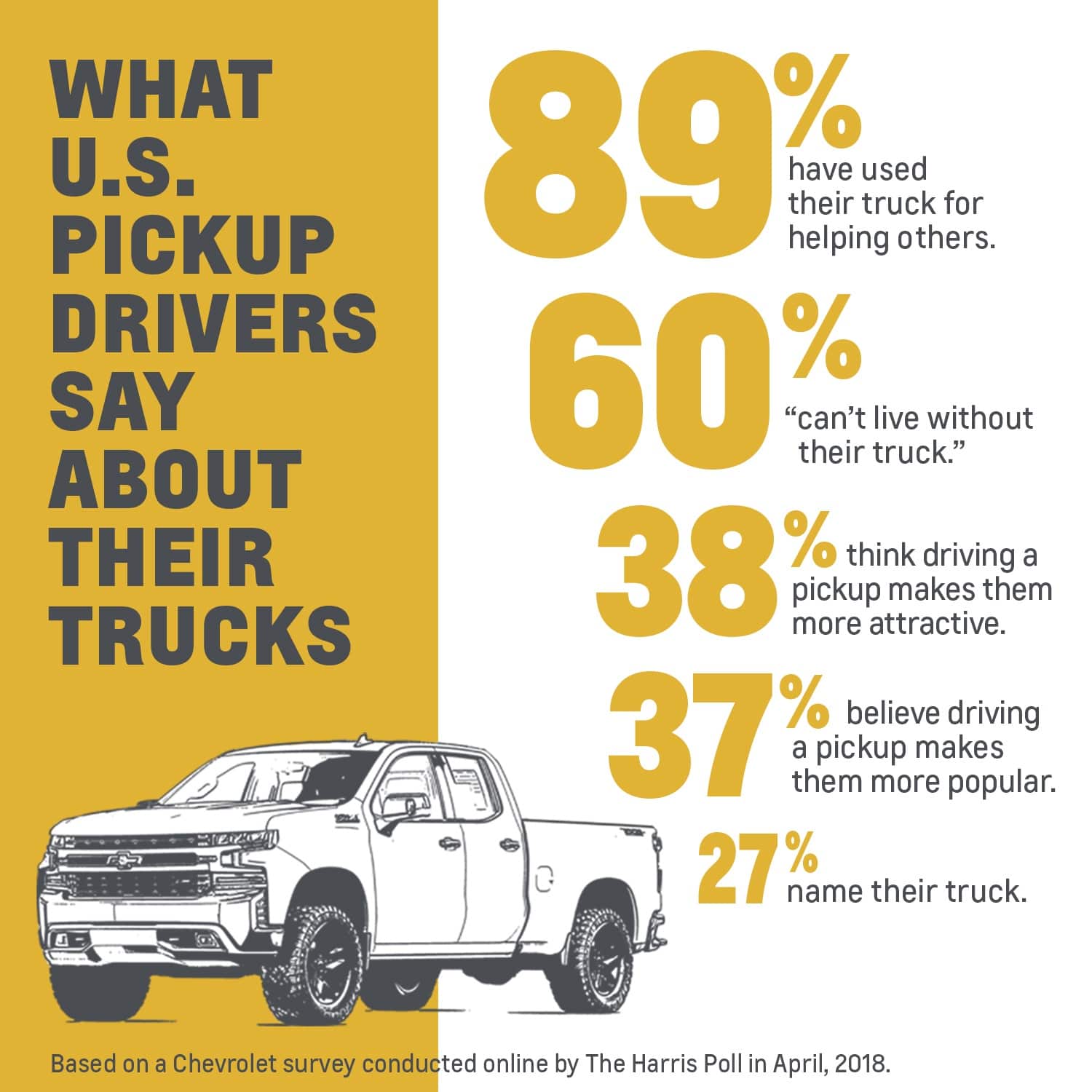
How Americans view truck ownership, according to a Chevrolet survey conducted by Harris Poll.


#Trucks are alluring because they are the mechanical extension of who we are and what we value.
Click To Tweet


The Good Life

Chevrolet recently worked with Harris Poll to gather more insight into why trucks hold a special place in our hearts. Although Chevy conducted the poll, it is not brand specific. Ford, Ram, Toyota, and Nissan owners can just as easily relate, as can those who own both bigger and smaller trucks. Over a thousand pickup owners across the United States weighed in, and the responses offer a wealth of explanation.

One of the biggest insights is how people name their truck, with “Betsy” and “Big Red” among the most popular. And Betsy and Big Red are instrumental in making us better friends and citizens, according to the data. Turns out, trucks are great for performing good deeds.

For example, over thirty percent say they often use their truck to help a friend or family member with a task. Another thirty percent say they regularly use their pickup to support a local school or a charitable cause. Overall, Chevy’s survey finds 89 percent use their truck to help others, be it moving a stalled car or hauling a new couch. Truck owners know this more commonly as “hey, I’m moving next weekend, can I borrow your pickup?” 

According to a Chevrolet survey conducted by Harris Poll, truck owners often help friends and family with tasks that require a pickup.

Family Matters

Now 18 years ago, my Father went home to The Lord. That summer of 2000, I often drove his old Silverado down the rural highways of Northwest Iowa. Such emotions are best described by Lee Brice in his 2012 song, I Drive Your Truck. In a similar way, 45 percent say they plan on passing their pickup down to a child or loved one. Further, nearly 60 percent say they consider their pickup a part of the family, while another 60 percent say they “cannot live” without theirs.

“People keep trucks a long time. Most of the owners I know have owned one for 10 plus years,” Mylan explained. “When you keep something around that long, it’s easy to think about all the ‘stuff’ that’s happened with your truck and your family.”

“A lot of people use them for vacation and travel; maybe they tow a trailer, or use it for getting the kids around in the winter,” Pulse added. “So trucks are definitely important to the family.”

Red Dirt Rich & Flint River Paid

Fans of Cheers may recall how Diane Chambers explains why she took the job (one certainly beneath her) at the bar. In her mind, she wanted to experience that slice of Americana. The slice of Americana that sees Norm in contest with his job, Cliff with his encyclopedia brain, and Coach being . . . well Coach being Coach. Between repressed feelings for Mayday Malone and feuds with Carla, she experiences Americana alright.

If Diane attended a Midwestern State Fair, or NASCAR race; visited any number of hunting and fishing expos or Sunday morning tailgates; if she visited the NFR in Las Vegas in December, she would see the slice of Americana that is trucks. What Chevy’s survey really reflects is how these vehicles are inexplicably woven into the fabric of our lives, and how they remain universal insignias for our best memories.

“All the trips you’ve taken, that time your son-in-law borrowed the truck and ran out of gas, the time you got it stuck on a trail . . . stuff like that,” Mylan continued.

According to the survey, 26 percent learned how to drive in a truck. Another 10 percent say they have brought their newborn children home from the hospital in a pickup. This likely explains why 38 percent said say they love their pickup more than any other object they own.

According to a Chevrolet survey conducted by Harris Poll, nearly 10 percent say they had their first kiss in a pickup.

More Right Swipes?

Single folks should consider adding a truck photo to their online dating profile. According to the survey, nearly 40 percent believe driving one makes them more attractive and popular. Is this true ladies? Does it really make us guys more attractive?

“That’s kind of funny to me because it sounds like a country song or something,” Mylan said. “I’ll bet most Toyota owners don’t think it makes them more attractive because Toyota trucks are kind of ugly.”

Fair enough.

“The polling people should look into that,” Mylan added.

What do you love about your truck? Share with us on Twitter

Carl Anthony is Managing Editor of Automoblog and resides in Detroit, Michigan. He studies mechanical engineering at Wayne State University, serves on the Board of Directors for the Ally Jolie Baldwin Foundation, and is a loyal Detroit Lions fan.


from Automoblog.net http://bit.ly/2F18HX0